
Quick Summary
- HVAC maintenance agreement leads come from four places: people searching for a plan or a tune-up, repair customers, new system owners, and new homeowners. A website chatbot covers the first group well and the others in part, by answering plan questions at any hour and qualifying the visitor before it asks for contact details.
- Consumer guides price maintenance plans at roughly $150 to $500 a year, and Angi puts typical maintenance contracts at $150 to $300. The fee is the smaller part of the value, because members come back for repairs and eventually for replacements.
- Conversion is the lever. Figures attributed to ServiceTitan research say the average shop turns 15% to 25% of new customers into members, while top performers reach 40% to 60%.
- Warranty is a strong reason to sign. Trane states on its own site that maintenance is a requirement for its limited warranties, and other manufacturers may ask for service records when a claim comes in.
- A chatbot should not take payments, promise appointment dates in peak season, or imply a plan covers repairs unless yours does. Billing and renewals belong in your field service software.
- Zappiq AI trains on your website, qualifies visitors before asking for contact details, and starts with a 14-day trial including 100 conversations. Starter begins at $9/month equivalent billed annually for 350 conversations.
Why a Maintenance Agreement Lead Is Worth More Than the Plan Price
A single tune-up is a one-hour visit and a checklist. A maintenance agreement is a relationship with two dates on the calendar every year. Most consumer price guides land between $150 and $500 a year for a plan, and Angi's figure for a typical maintenance contract sits at $150 to $300. Nobody builds a company on $250. HVAC owners build on what happens after the signature.
Three things tend to follow a signed agreement:
- The member calls you first when something breaks. Contractor guides often estimate that members generate one to three dollars of repair and replacement work for every dollar of plan revenue. That number is a rule of thumb repeated across marketing blogs, not an audited statistic, so treat it as directional.
- Renewals do the heavy lifting. Vendor and consultant benchmarks put annual renewal at roughly 75% to 85% on annual billing, with higher numbers reported for monthly billing. Again, directional. Your own renewal report is the only number that matters.
- Warranty gives the homeowner a reason. Trane's site says maintenance is a requirement for its Base Limited and Registered Limited warranties and recommends service twice a year through a local dealer. Other manufacturers may ask for service records when a claim comes in. A homeowner with a new system and a warranty to protect is about the easiest plan sale in the trade.
Where most shops leak: Figures attributed to ServiceTitan research from late 2025, repeated across contractor guides, put the average at 15% to 25% of new customers becoming members and top performers at 40% to 60%. The exact numbers are secondhand, but the gap between average and best is wide enough to be worth chasing.
Most of that conversion work happens on the truck or on the phone. This guide is about the other place: your website, where people who have never called you are reading about plans right now.
Where Maintenance Agreement Leads Come From
"Maintenance agreement leads" is not one type of visitor. Five groups show up, and they want different things.
| Source | What they search or say | What they need to hear | Chatbot fit |
|---|---|---|---|
| Plan shoppers | HVAC maintenance plan near me, AC tune-up near me, HVAC service agreement | What is included, what it costs, whether it is worth it | Strong. They ask questions a bot can answer from your plan page |
| Repair visitors | AC not cooling, furnace not heating | A fast fix first, a plan second | Partial. Capture the repair lead first, mention the plan after |
| New system owners | HVAC warranty registration, how often to service a new AC | Maintenance protects the warranty | Strong, if your site has a warranty page |
| New homeowners | HVAC inspection new home, how old is my AC | Nobody knows the system's age or history | Good. A first tune-up doubles as a checkup |
| Expiring or lapsed members | Renew HVAC plan | Renewal date and price | Weak. Billing and reminders belong in your field service software |
The first and third rows are where a website chatbot earns its keep. The last row is where it does not, and pretending otherwise would send you shopping for the wrong tool.
What Homeowners Ask Before They Sign Up
Plan shoppers search in questions. "HVAC maintenance plan cost." "Are HVAC maintenance plans worth it." "What does an HVAC tune-up include." "How often should you service your HVAC system." "Furnace tune-up cost." "Heat pump maintenance." Every one of those is answerable from a single well-written page, and a chatbot trained on that page can answer them at 10 pm, which is when many people are reading.
The questions that decide whether someone signs are usually these:
- Is it worth it? Consumer guides tend to say yes for systems older than about five years and for hot or cold climates, with repair discounts of 10% to 20% and waived diagnostic fees doing most of the work. On a brand-new system the repair discount matters less and the warranty matters more.
- Is it insurance? No, and most plans say so. They are service agreements: visits, priority scheduling, and discounts. A few premium tiers add limited repair coverage. Say plainly what yours covers.
- How many visits? The common setup is a spring AC check and a fall furnace check. Heat pump owners need both, since one system does the heating and the cooling.
- What are the terms? Does it auto-renew, can they cancel, is it monthly or annual. People hate hunting for this, so put it on the page.
- What about a second system? Homes with two units want to know whether a second one costs a full second plan.
For context, one-off tune-ups are usually quoted between $75 and $200 a visit in consumer price guides, and two of them can cost about as much as a basic plan. That is why a plan page has to lead with what else the homeowner gets, not just the visits.
Be blunt about exclusions: The fastest way to earn an angry review is a homeowner who assumed a $250 plan would pay for a compressor. Whatever your plan does not cover, say it on the page and let the chatbot repeat it.
Why the Calendar Matters More Than the Ad Budget
Plan leads are seasonal. Spring brings "AC tune-up" and "AC maintenance before summer." Fall brings "furnace tune-up" and "heating maintenance." One agency guide claims that shops advertising AC tune-ups in March fill their spring schedules before competitors launch, which is a marketing claim, but the logic holds: the homeowner who books in March is not yet panicking.
Maintenance keywords are also among the cheaper ones in HVAC. Benchmarks put clicks on tune-up and maintenance terms at roughly $5 to $15, against $15 to $25 for emergency repair keywords. Cost per lead is quoted anywhere from about $25 to $120 depending on the market and who is measuring, so use the figure from your own account, not a blog's.
The trouble comes in the surge weeks. The first heat wave jams the phones. A homeowner who was mildly curious about a plan on Tuesday is desperate on Thursday night because the AC died, and the plan's best feature, priority service, is the thing you are least able to deliver while the phones ring. Those visitors become repair leads, and speed decides them. Harvard Business Review research on 1.25 million online leads found that companies reaching a lead within an hour were nearly seven times as likely to qualify it as those that waited even one more hour. One benchmark roundup puts the share of home service businesses taking longer than five minutes to reply at 88%. A chatbot replies in seconds, and it can mention the plan once the repair lead is safely in your inbox.
What a New Member Costs You
Take a plan lead that costs $100 to earn, which sits inside the range above. What it costs to turn that lead into a member depends almost entirely on how many of them convert.
Cost Per New Member at $100 Per Lead (Illustrative Math)
Set that beside a plan that sells for $150 to $500 a year and something becomes clear. On the plan fee alone, year one often only covers what you paid to win the member. The return arrives through renewals, repair work, and the replacement that follows in a few years. That is why chasing a cheaper click matters less than converting more of the visitors you already have. Swap in your own lead cost and close rate, because these are round numbers for illustration.
What a Maintenance Agreement Chatbot Should Ask (and Never Say)
The job is to sort the visitor who is ready for a first visit from the one who is just browsing, and to hand you something useful for the call. A sensible order:
- What system do you have? Central AC, furnace, heat pump, ductless, and how many of them.
- About how old is it? "No idea" is a fine answer, and an honest one for new homeowners.
- Do you own the home, and is it inside your service area?
- What brought you here today? A new system and its warranty, a friend's recommendation, a unit acting up, or a house just purchased.
- When do you want it done, before the cooling season or before the heating season?
- Only then: name, phone number, and email.
Zappiq's qualification step works along those lines. It screens for intent and asks about the project, timeline, and situation before it asks for a name and number. Read the AI lead qualification chatbot guide for the question order and handoff logic. It answers from your own pages, so the more precisely your plan page describes tiers, visits, and exclusions, the better it handles the plan-specific questions.
What the bot should never say
- That the plan covers repairs, unless yours genuinely does. Repeat the exclusions from your page.
- A specific appointment date in peak season. Your schedule changes by the hour in July. Offer a callback, not a promise.
- What is wrong with a system. A chat cannot diagnose a unit that is short cycling or freezing up.
- A ruling on someone's warranty. Do not tell a homeowner that theirs is void or valid. Point them to the manufacturer's paperwork and offer to have your team review it with them.
Safety comes first: If a visitor mentions a gas smell or a carbon monoxide alarm, the right response is to leave the home and contact emergency services or the gas utility, and your team should treat the lead as urgent. A plan pitch has no place in that conversation.
How to Set Up a Maintenance Agreement Chatbot on Your Website
You do not need a developer, but you do need good pages for the bot to read. In order:
- Publish a plan page with real details. Tiers, prices, number of visits, priority rules, repair discount percentages, exclusions, contract length, and how to cancel. Vague pages produce vague answers.
- Add seasonal tune-up pages. An AC tune-up page for spring and a furnace tune-up page for fall, each explaining what the visit covers.
- Write a warranty page. Explain that many manufacturers expect regular maintenance and tell homeowners to check their own paperwork.
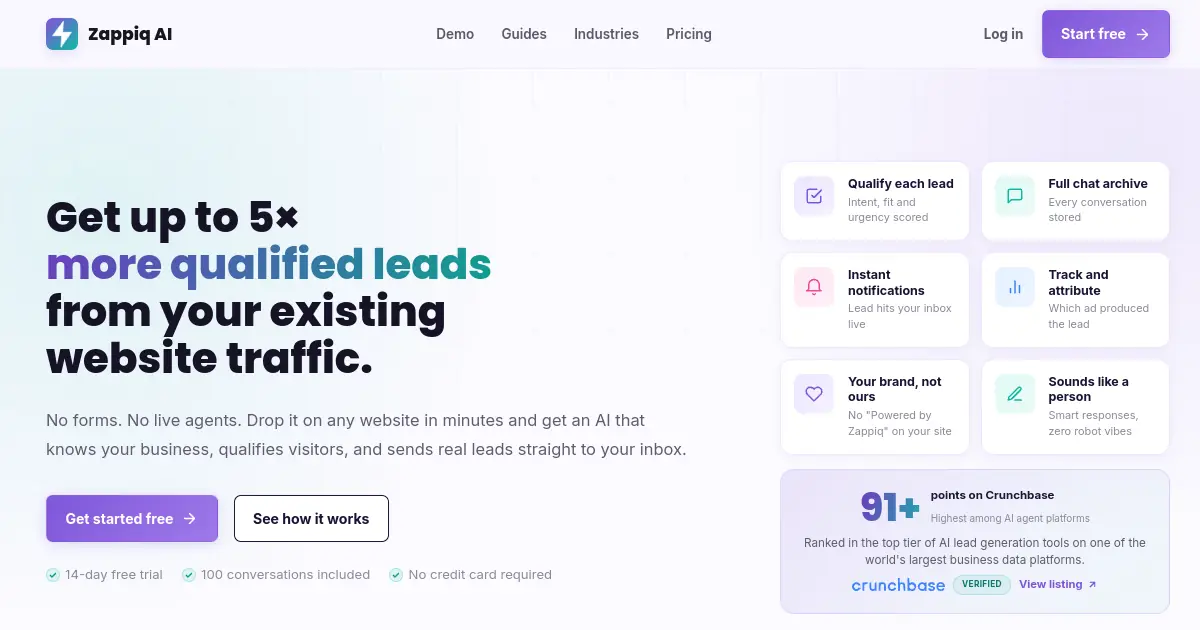
- Install the one script. Zappiq AI for HVAC companies reads your site on signup and trains automatically, so there is no flow builder to configure.
- Send leads where you will see them. Every qualified lead arrives by email with the full transcript, and webhooks through Zapier, Make, or n8n can push it into a CRM, a Google Sheet, or a Slack channel. Add lead-source tracking so you can compare tune-up campaigns with emergency repair campaigns.
- Track the source. Ad attribution per lead lets you compare tune-up keywords against emergency ones, which behave very differently.
- Follow up with a specific next step. Offer the first visit and, if it is true, mention locking in priority service before the season starts.
- Read the transcripts. Every question the bot could not answer is a sentence missing from your plan page.
What the chatbot handles
- Answers plan and tune-up questions from your site at any hour
- Asks about system type, ownership, and timing before contact details
- Emails the lead with the full conversation immediately
- Tracks which campaign or keyword produced each lead
- Runs on flat monthly pricing with no AI credit meter
What stays in your other tools
- Taking payment and monthly billing for members
- Scheduling visits and dispatching technicians
- Renewal reminders and lapsed member outreach
- Phone calls and text messages, since it is website chat only
Want plan questions answered while your techs are on the roof?
Zappiq AI trains on your website, qualifies each visitor, and emails you the lead with the full conversation while it is still fresh.
Start Free Trial →No credit card | No developer needed | No branding on any plan
What a Chatbot Costs Next to Buying the Lead Again
You pay for the click once. If the visitor leaves without a conversation, you pay again to replace them. That is the frame that makes the price easy to judge.
Growth costs $324 across a year when billed annually at its $27/month equivalent, which two new members at $250 each would cover. A chatbot does not replace ads, local SEO, or the renewal reminders in your field service software, because it does not bring traffic or manage billing. It improves what happens to the traffic you already paid for.
How to Tell If It Is Working
- Plan leads per week in season. Watch how it moves as spring and fall campaigns start.
- Lead to member rate. This is the conversion number from the math above, and the one to push up.
- Cost per new member. Ad spend divided by members signed, split by source.
- Attach rate and renewal rate. These come from your field service software, not from the chatbot, but they tell you whether the members you win are worth winning.
Frequently Asked Questions
An HVAC maintenance agreement, also called a service agreement, maintenance plan, or membership, is a yearly arrangement in which an HVAC company performs scheduled tune-ups, usually one for cooling and one for heating, and adds perks like priority scheduling and repair discounts. It is a service contract, not insurance, and most plans do not pay for repairs.
Combine seasonal pages and ads that match searches like AC tune-up and HVAC maintenance plan, a clear plan page with prices and exclusions, a warranty angle for new system owners, and a fast first response on every inquiry. An AI chatbot handles the last part around the clock by answering plan questions and qualifying visitors before sending you the lead.
Consumer guides put HVAC maintenance plans at roughly $150 to $500 a year, with Angi placing typical maintenance contracts at $150 to $300. Basic plans usually include one visit, while standard and premium tiers add a second visit, priority service, waived diagnostic fees, and repair discounts. One-off tune-ups are commonly quoted at $75 to $200 per visit.
For many homeowners, yes, especially with a system older than about five years, a harsh climate, or a warranty to protect. The value usually comes from priority scheduling, repair discounts of 10% to 20%, and waived diagnostic fees rather than the tune-ups alone. On a new system in a mild climate the case is weaker, so a good company says so honestly.
A chatbot can answer plan questions, qualify the visitor, and send you a ready-to-call lead, but it does not take payments, schedule visits, or manage renewals. Keep billing and scheduling in your field service software and use the chatbot to feed it better leads and to cover the hours when nobody is at the office.
It should ask what system the home has and how many, roughly how old it is, whether the person owns the home in your service area, what prompted the inquiry, and when they want service. Contact details come last. It should never claim the plan covers repairs unless it does, promise a date in peak season, or rule on a warranty.
Zappiq AI offers a 14-day trial with 100 conversations. Starter is $9/month equivalent billed annually for 350 conversations; Growth is $39 monthly or $27/month equivalent billed annually for 1,500; Pro is $99 monthly or $69/month equivalent billed annually for 5,000. There is no AI credit meter or per-lead fee, and no plan adds Zappiq branding.
The Bottom Line
Maintenance agreements are the steadiest revenue an HVAC company can build, and they are won or lost in small moments. A homeowner reads a plan page at night, has one question, and either gets an answer or moves on to the next company in the search results.
Start with the page. Spell out tiers, prices, visits, exclusions, and terms, and add a warranty page and seasonal tune-up pages. Then put something on those pages that answers when nobody is in the office, asks a few sensible questions, and sends you the result while the homeowner is still thinking about it. Keep billing, scheduling, and renewals where they already live.
That is the job Zappiq AI does for HVAC companies. You can try it free at zappiqai.com, no card needed. If the first twenty transcripts show your plan page has been leaving obvious questions unanswered, that is worth knowing either way.
See what your plan page visitors are really asking
Start with a 14-day trial that includes 100 conversations. Zappiq AI reads your site, qualifies each visitor, and emails you the leads with the full transcript.
Start Free Trial →No credit card | No developer needed | No branding on any plan
References
- Angi. "How Much Does HVAC Maintenance Cost?" angi.com.
- Angi. "Are HVAC Maintenance Plans and Service Contracts Worth the Money?" angi.com.
- Trane. "Contact Us" FAQ on warranty and maintenance requirements. trane.com.
- PipelineOn. "How to Sell HVAC Maintenance Plans." pipelineon.com.
- PipelineOn. "Maximize Your HVAC Maintenance Agreement Value." pipelineon.com.
- RYN Digital. "How Much Do Google Ads Cost for HVAC Contractors?" ryndigital.com.
- Webtonic. "HVAC Google Ads Statistics: CPC and CPL Data." webtonic.io.
- Watson and Co. "HVAC Google Ads Strategy: Book More Calls." watsonco.marketing.
- Oldroyd, McElheran, and Elkington. "The Short Life of Online Sales Leads." Harvard Business Review, March 2011. hbr.org.
- Apten. "Speed-to-Lead Benchmarks 2026." apten.ai.
- Texas TempMasters. "HVAC Maintenance Cost 2026: Annual Tune-Up and Service Plan Prices." texastempmasters.com.
- HVAC Pricing Guide. "HVAC Maintenance Cost: $75 to $200 Per Visit." hvacpricingguide.com.

Ansar Ali
Ansar Ali founded Zappiq AI after noticing that most small businesses were paying for chat platforms designed around support desk workflows when what they actually needed was a smarter way to identify serious visitors in their traffic. He works on qualification logic, attribution, and keeping Zappiq fast and unobtrusive on any site it is installed on. Mentions of Zappiq in this guide come from the company that makes it, so weigh them accordingly.