
Quick Summary
- Zappiq AI is the best CustomGPT alternative for businesses that want a website chatbot focused on capturing and qualifying leads, not just answering questions from a document library. It uses conversation-volume tiers with no separate per-query or AI-credit meter.
- SiteGPT is the closest direct swap, training on the same kind of website and document content at roughly 60 percent less than CustomGPT's entry price.
- Chatbase covers similar ground with a wider integration list and its own published pricing tiers.
- DocsBot AI is worth a look for teams whose main use case is a documentation-heavy help center rather than general website content.
- My AskAI fits small support teams that want a knowledge-base bot connected directly to an existing helpdesk.
- Voiceflow suits teams that want more control over the conversation flow around the AI answers, not just a Q&A box.
- eesel AI is the pick if you'd rather add an AI layer on top of your current helpdesk than run a separate chatbot platform.
Why Businesses Look Past CustomGPT.ai
CustomGPT.ai does one thing reasonably well: it lets a non-technical team point the platform at a website, a set of PDFs, or a Google Drive folder and get back a chatbot that answers questions using that content, with source citations attached to each response. For a business that specifically needs an accurate, citation-backed Q&A bot trained on its own documents, that's a real and useful capability, and it's a big part of why the platform has built a genuine customer base since launching.
Where people start looking elsewhere is the pricing curve once real usage shows up. The current Standard plan is $99 a month, or $89 billed annually, with 1,000 queries per month, while Premium is $499 a month, or $449 billed annually, with 5,000 queries. CustomGPT says query limits are counted at the account level, and Premium adds more agents, more team members, automatic website syncing, and branding removal.
The Jump Most CustomGPT Users Eventually Hit
The free trial has its own catch worth knowing before you start one. CustomGPT offers a 7-day trial on both Standard and Premium, but a credit card is required upfront, and the account converts to a paid subscription automatically once the trial window closes unless it's cancelled first. That's a meaningfully different experience from a platform that lets you poke around free before deciding anything.
Support responsiveness comes up repeatedly in third-party reviews too. One Capterra reviewer described a genuinely frustrating account-access situation: after an employee left the company, getting access transferred required routing through the departed employee's old login, and the team was later blocked from their own data over what turned out to be an inactive-subscription issue they had to pay to resolve. That's not universal, but it's a pattern worth being aware of if your business might ever need to change account ownership.
None of this means CustomGPT is a bad platform for what it's built to do. A knowledge-intensive business with a genuine need for citation-backed answers from a large, structured document library, and stable enough query volume to plan a tier around, can get real value here. The businesses shopping for alternatives tend to be the ones who hit the Standard plan's query ceiling faster than expected, the ones who wanted a lead-capture chatbot and ended up with a document Q&A tool instead, or the ones who just want to try something before handing over a card.
Quick Comparison: 7 CustomGPT.ai Alternatives
| Tool | Starting Price | Pricing Model | Free Trial | Best For |
|---|---|---|---|---|
| Zappiq AI | 14-day trial with 100 conversations; Starter $9/mo annual equivalent (350), Growth $39/mo monthly or $27/mo annual equivalent (1,500), Pro $99/mo monthly or $69/mo annual equivalent (5,000) | Flat by volume | 14-day trial with 100 conversations | Lead generation, SMB websites |
| SiteGPT | $59/mo monthly | 4,000 / 10,000 / 40,000 answer messages | Yes, 14 days | Website support Q&A, budget-friendly |
| Chatbase | Free / $40/mo monthly | Flat by message credits | Yes, limited free tier | General-purpose document chatbot |
| DocsBot AI | $49/mo | Flat by source pages/messages | Trial, card required | Documentation-heavy help centers |
| My AskAI | $0.10/ticket | Flat + per-ticket | Yes | Small teams on an existing helpdesk |
| Voiceflow | Free trial / usage-based or custom | Seat + credit based | Yes, free Starter tier | Custom conversation flow around AI answers |
| eesel AI | $0.40/ticket | Pay-per-ticket, no seats | Yes, 7 days | AI layer on an existing helpdesk |
1. Zappiq AI: Best for Lead Generation on Business Websites
Zappiq AI
zappiqai.com | AI lead generation chatbot built for small and medium business websites
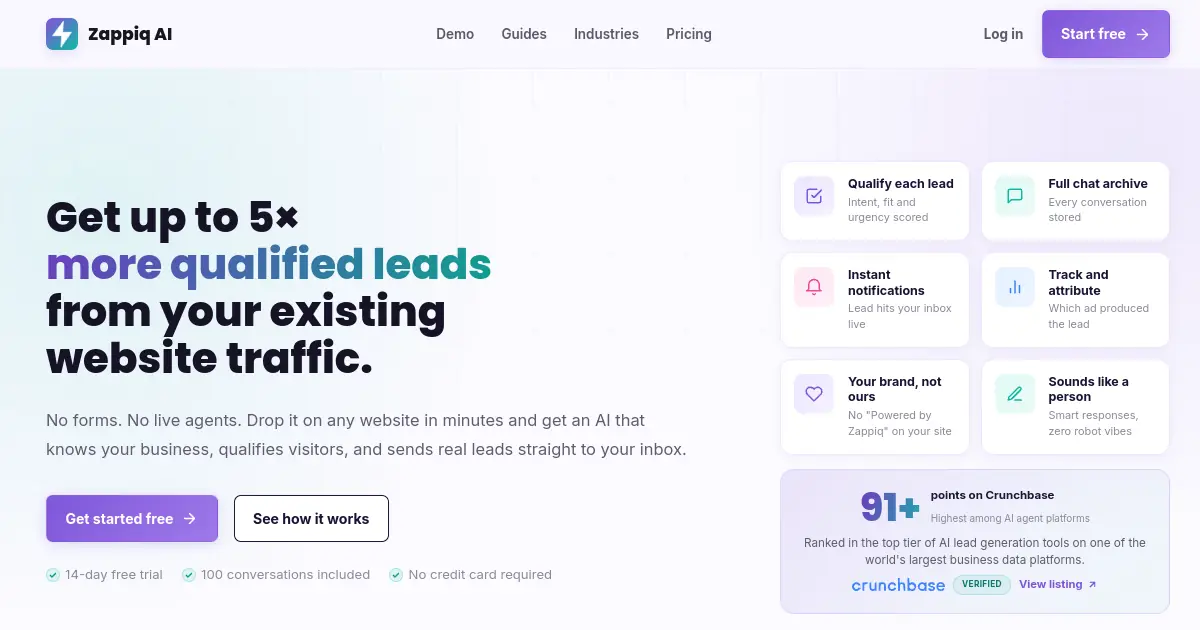
CustomGPT and Zappiq AI are answering different questions, and it's worth being upfront about that before comparing them line by line. CustomGPT is built to be an accurate Q&A engine over a document library, the kind of tool a knowledge base or internal wiki genuinely needs. Zappiq is built to turn a website visitor into a qualified lead. A lot of small businesses who go looking at CustomGPT actually wanted the second thing and found themselves pricing out the first.
That difference shows up immediately in setup. There's no document library to curate, no source pages to manage against a query budget. Zappiq reads your website when you sign up, trains itself on your services and pages automatically, and starts qualifying visitors right away. There's also no query counter to watch climb toward a plan ceiling; billing is flat by conversation volume, so a good traffic month doesn't force an unplanned five times jump to the next tier the way CustomGPT's Standard-to-Premium gap does.
Lead qualification happens inside the conversation itself rather than as a separate workflow to configure. The bot asks about intent, timeline, and fit as visitors talk to it, and the moment someone qualifies, an email lands in your inbox with their details and the full transcript. Every lead also carries the campaign or keyword that brought that visitor to your site, something a document Q&A tool like CustomGPT was never built to track, since it's answering questions rather than watching for buying signals.
For agencies: Zappiq ships white-label on client sites with no added branding fee, and there's no per-query meter to monitor across a roster of client accounts the way CustomGPT's shared query pool can create surprises.
Pros
- Conversation-volume pricing with no separate per-query or AI-credit meter
- Auto-trains on your website, no document library to manage
- Lead qualification built into the conversation itself
- Instant email alerts with full conversation context
- Ad source and keyword tracking on every lead
- Free trial with no credit card required to start
- No branding fee on any plan
- White-label ready for agencies
Cons
- Not built for large, citation-heavy document Q&A libraries
- No PDF or Google Drive ingestion the way CustomGPT offers
- Smaller community than an established platform like CustomGPT
- No native WhatsApp channel
Why lead-focused teams choose Zappiq AI
Ad tracking: Connect each qualified enquiry to the campaign, keyword, or channel that brought the visitor in, so marketing spend can be tied to real conversations.
Email lead delivery: Receive contact details, intent, source information, and the full conversation in your inbox as soon as the visitor qualifies.
No branding: Keep the widget native to your website without a third-party badge competing with your brand or call to action.
Automatic website training: Let Zappiq learn from your live services, pricing, and FAQ pages instead of curating a separate document library.
Natural qualification: Ask useful follow-up questions and collect contact details when a visitor shows genuine buying intent, not simply when they ask a question.
Simple installation: Add one script to WordPress, Shopify, Webflow, Wix, Squarespace, or a custom website without configuring a separate document-chatbot deployment.
Pricing
Pricing: The 14-day trial includes 100 conversations. Starter is $9/month equivalent when billed annually for 350 conversations; Growth is $39/month or $27/month equivalent annually for 1,500; and Pro is $99/month or $69/month equivalent annually for 5,000, with no per-lead fees or Zappiq branding.
Best for: Small and medium business websites that want a chatbot built specifically to capture and qualify leads, rather than a document Q&A tool repurposed for a website widget. Especially strong for service businesses and agencies running paid traffic who need every lead tied back to the campaign that produced it.
sitegpt">2. SiteGPT: Closest Direct Swap at a Lower Entry Price
SiteGPT
sitegpt.ai | AI chatbot trained on your website and documents, positioned directly against CustomGPT on price
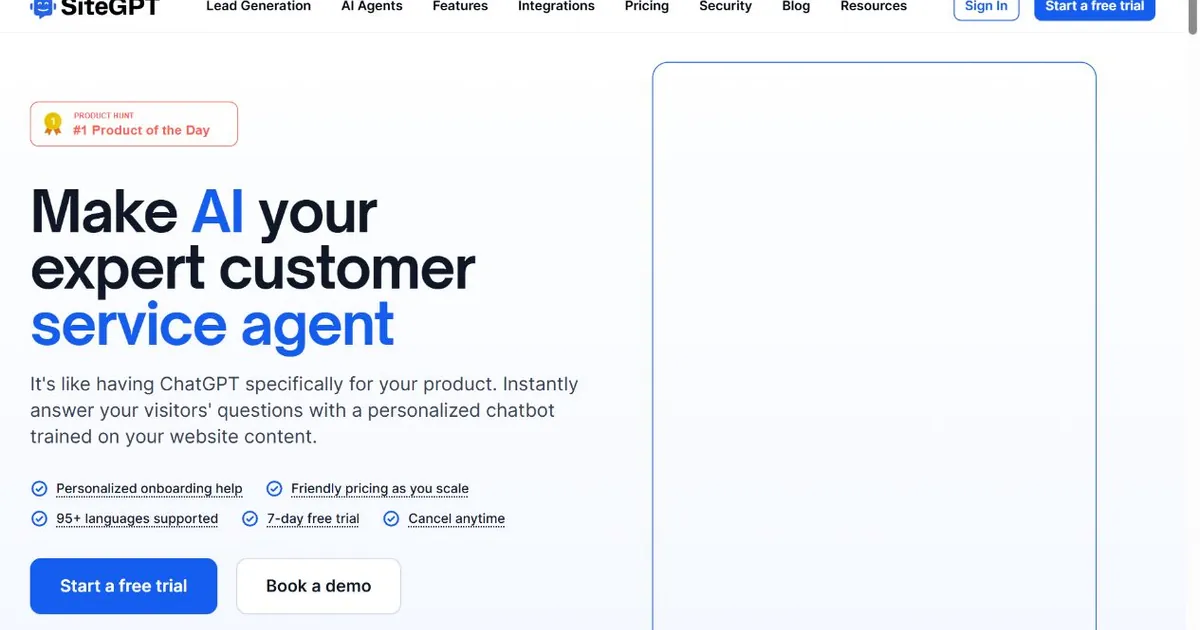
SiteGPT does functionally the same job as CustomGPT: train a chatbot on your website and document content, then answer visitor questions from it. Its Starter plan is currently $59/mo on monthly billing for 4,000 chatbot-answer messages, with Growth at $129/mo for 10,000 and Scale at $429/mo for 40,000. Branding removal is a separate $59/mo monthly add-on.
The core workflow is close to identical: point it at your site or upload documents, and it generates a trained assistant you can embed. Where SiteGPT differs is mostly around who's on the other end of support. Reviews describe the founders themselves being reachable for support questions, a different experience than a larger platform's ticket queue, and one that matters if you've had a slow support experience elsewhere.
SiteGPT currently offers a 14-day free trial. Its billing documentation describes usage as chatbot answers tracked across the account, while CustomGPT uses account-level query limits. SiteGPT's annual billing and add-on prices can differ from the monthly checkout, so verify the selected billing interval before comparing totals.
The tradeoff for the lower price is company size and depth of enterprise features. CustomGPT has more years in market, a broader native integration list including Salesforce and SharePoint, and dedicated enterprise packaging. SiteGPT is a leaner operation aimed squarely at the small and mid-sized business segment CustomGPT tends to overprice.
Pros
- Lower monthly entry price than CustomGPT's Standard plan
- Same core workflow, train on your site and documents
- 14-day trial available before paid billing
- Direct, founder-level support reported in reviews
- Faster typical setup than a larger enterprise platform
Cons
- Smaller integration catalog than CustomGPT's enterprise list
- Less established brand and shorter track record
- Not built for enterprise compliance needs like SOC 2 or HIPAA
- Fewer languages supported than CustomGPT's broader list
Pricing
Best for: Businesses that specifically liked CustomGPT's document-training workflow but want the same core capability at a fraction of the entry price, without the five times jump to the next tier.
chatbase">3. Chatbase: Broadest Integration List in This Category
Chatbase
chatbase.co | AI chatbot trained on your content, with a wide integration and automation catalog
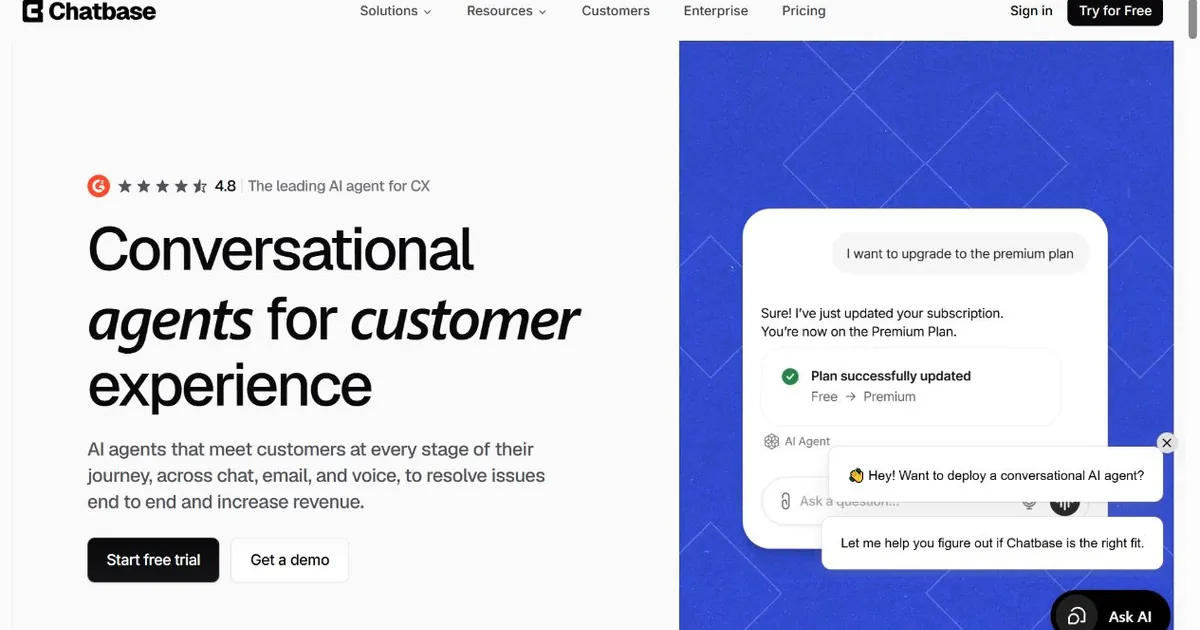
Chatbase and CustomGPT compete for a lot of the same buyer: a business that wants an AI chatbot trained on its own content, with a no-code setup and a published pricing page. The difference that tends to matter most in practice is breadth. Chatbase's integration list, connecting to tools like Zapier, Slack, WhatsApp, and a wide range of CRMs, runs deeper than CustomGPT's, and its pricing tiers are structured around message credits rather than a fixed query count shared across every chatbot on the account.
Chatbase currently lists 50 free message credits/month, Hobby at $40/mo with 700 credits, Standard at $150/mo with 4,000 credits, and Pro at $500/mo with 15,000 credits. Its message-credit model scales more gradually than CustomGPT's query jump, while the free tier provides a way to test the product before paying.
Where the two platforms land closest together is core capability: both ingest documents, websites, and various file types, both cite sources in responses, and both are aimed at businesses rather than individual hobbyists. The decision between them usually comes down to which integration ecosystem matches your existing stack and which pricing curve you'd rather live with as usage grows.
We've written a full breakdown of Chatbase specifically, covering its pricing tiers, message credit system, and its own set of alternatives, if Chatbase itself is also on your shortlist.
Pros
- Genuinely usable free tier, no card required to start
- Broader integration catalog than CustomGPT
- Message-credit pricing scales more gradually than CustomGPT's tier jump
- Source citation and document ingestion comparable to CustomGPT
- Large, well-documented user base
Cons
- Message credit system takes some getting used to when forecasting cost
- Advanced features gated behind higher tiers, same as CustomGPT
- Not built for lead qualification specifically
- Branding removal only on paid tiers
Pricing
Best for: Businesses that want a document-trained chatbot with a deeper integration list than CustomGPT and a gentler pricing curve as message volume grows.
Tired of watching a query counter?
Zappiq AI bills flat by conversation volume, not by how many questions your bot happens to answer. Your chatbot trains itself on your website and emails you every qualified lead the moment it's captured.
Start Free Trial >14-day trial · 100 conversations | No separate query meter | No branding on any plan
4. DocsBot AI: Best for Documentation-Heavy Help Centers
DocsBot AI
docsbot.ai | AI chatbot built specifically around structured documentation and help center content
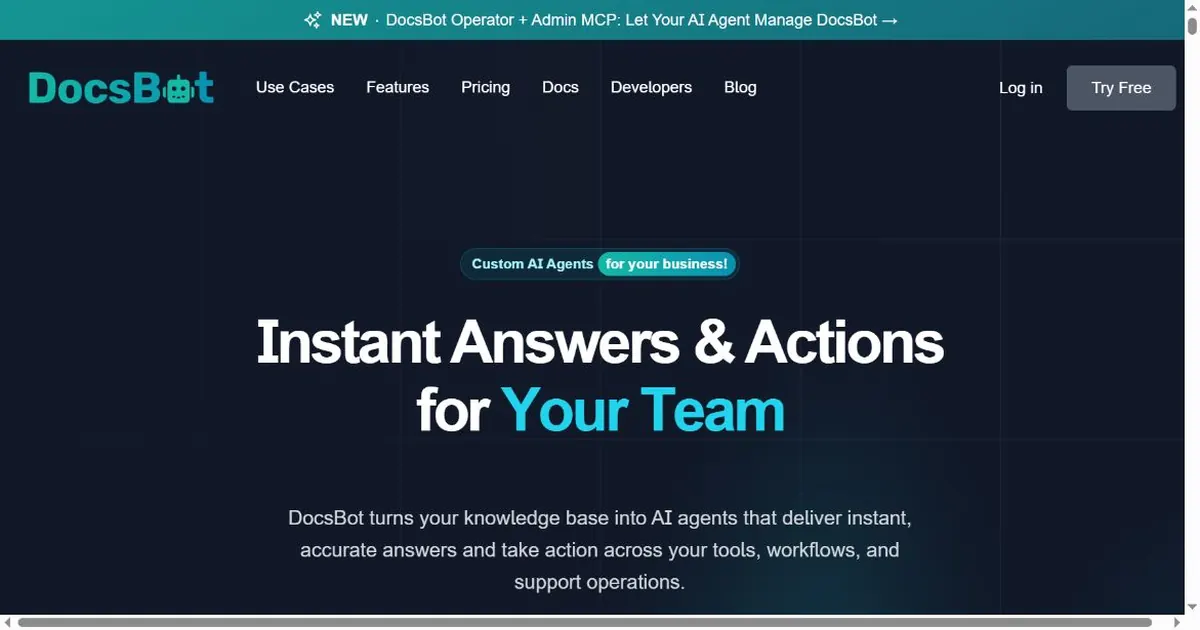
If what drew you to CustomGPT was specifically the ability to point a bot at a large body of structured documentation, help articles, API references, product manuals, DocsBot AI is built around that exact use case rather than treating documents as one input option among several.
Pricing runs on a tier structure similar in shape to CustomGPT's, and went through a 2026 update that raised entry pricing while adding features. The current Personal plan runs $49 a month for 3 DocsBots, 5,000 source pages, and 5,000 messages a month. Standard, the tier most existing Pro-plan customers were migrated into as of March 2026, runs $149 a month with 10 DocsBots and higher page and message allowances. Business tops out at $499 a month for 100 DocsBots and 100,000 source pages and questions, matching CustomGPT's Premium price point almost exactly at the top end.
The message and source-page allowances scale more gradually across DocsBot's four tiers than CustomGPT's two-tier structure does, which softens the kind of abrupt five times jump CustomGPT users hit between Standard and Premium. DocsBot also lets you bring your own OpenAI API key to manage advanced-model costs directly, an option CustomGPT doesn't offer in the same way.
The tradeoff is scope. DocsBot is optimized for documentation-style content specifically; a business whose knowledge lives mostly in scattered web pages, PDFs, and support tickets rather than a structured help center may find CustomGPT's broader source-type list, or Chatbase's, a better fit.
Pros
- Four pricing tiers instead of CustomGPT's steep two-tier jump
- Purpose-built for structured documentation and help centers
- Bring-your-own-API-key option for advanced model costs
- SOC 2 Type II certification on current plans
- Overage keeps the bot running with a warning rather than a hard stop
Cons
- 2026 pricing update raised entry costs on legacy plan holders
- Free plan is essentially a time-limited trial, not a sustainable tier
- Narrower source-type support than CustomGPT or Chatbase
- Trial requires a credit card, same friction as CustomGPT
Pricing
Best for: Teams whose core use case is a documentation-heavy help center rather than general website or mixed-content Q&A, and who want a gentler pricing curve than CustomGPT's two-tier jump.
5. My AskAI: Best for Small Teams on an Existing Helpdesk
My AskAI
myaskai.com | Knowledge-base AI agent that connects to Zendesk, Intercom, Freshdesk, Gorgias, and HubSpot
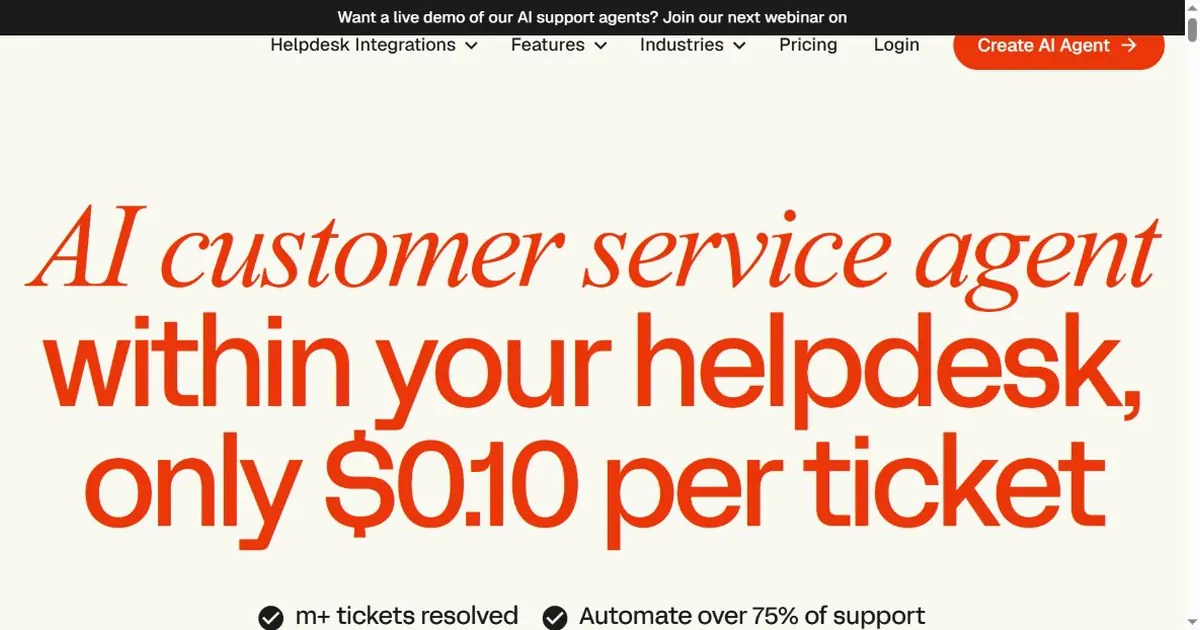
CustomGPT works as a standalone widget you embed on a site. My AskAI takes a different approach for teams that already run a helpdesk: instead of replacing your support stack, it plugs an AI agent directly into Zendesk, Intercom, Freshdesk, Gorgias, or HubSpot and answers from the knowledge you already have there.
My AskAI currently promotes a 30-day unlimited free trial and $0.10 per support ticket, with no developer required for its helpdesk integrations. That is a different pricing model from CustomGPT's query tiers: you pay for resolved support tickets rather than maintaining a standalone document-chatbot allowance.
Setup is also considerably faster for a team that already has a helpdesk populated with past tickets and articles, since My AskAI trains on that existing content rather than requiring a fresh document library to be built and uploaded the way a standalone tool like CustomGPT does.
The tradeoff is that My AskAI isn't a general-purpose website widget the way CustomGPT is; it's specifically designed to sit inside an existing support workflow. A business without a helpdesk already in place, or one that wants a chatbot purely for lead capture rather than support, is better served by Zappiq or SiteGPT.
Pros
- $0.10 per support ticket, with a 30-day unlimited trial
- Trains on your existing helpdesk content, no fresh upload needed
- Works inside an existing helpdesk instead of requiring a separate widget
- Fast setup, typically days for teams with an existing helpdesk
- Connects to major helpdesks rather than requiring migration
Cons
- Requires an existing helpdesk to connect to
- Higher entry price than CustomGPT's Standard tier
- Not a general-purpose standalone website widget
- Smaller company and shorter track record than CustomGPT
Pricing
Best for: Small support teams that already run a helpdesk and want an AI agent trained on that existing content, rather than building a separate document library from scratch the way CustomGPT requires.
voiceflow">6. Voiceflow: Best for Custom Conversation Flow Around AI Answers
Voiceflow
voiceflow.com | Visual agent builder combining scripted flow control with AI-generated answers
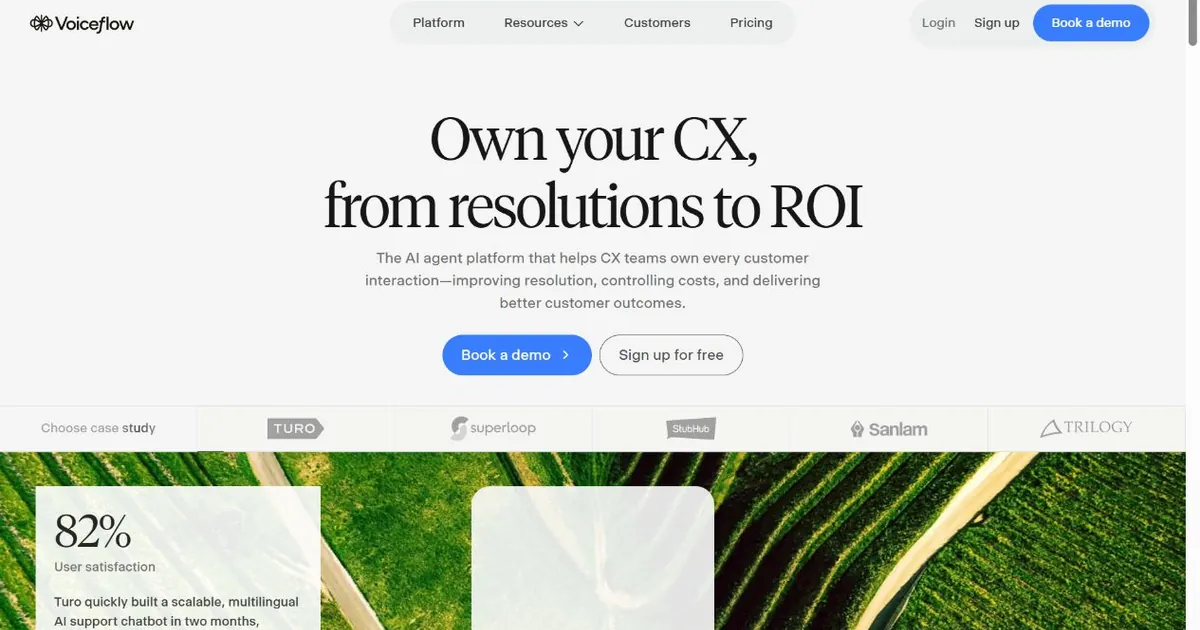
CustomGPT is essentially a Q&A box: ask a question, get an answer pulled from documents. Voiceflow is closer to a full agent builder, letting you design what happens before and after the AI answers, collecting information, branching based on intent, and handing off to a human, rather than treating every interaction as a single question-and-response pair.
Voiceflow now presents transparent usage-based billing for its agency offering, while business plans are quote-based and include implementation support, observability, and multi-channel deployment. The final cost depends on deployment scope, usage, integrations, and support rather than one universal editor-seat price.
Where Voiceflow pulls ahead of CustomGPT is control. You can design a structured intake flow around the AI's document-based answers, qualify a visitor before or after the bot answers their question, and connect directly to GPT or Claude models rather than being limited to whatever CustomGPT bundles in. For a business that wants more than a passive Q&A widget, that flexibility matters.
The tradeoff is complexity. Voiceflow has a real learning curve compared to CustomGPT's more turnkey upload-and-go setup, and the credit system requires more active monitoring than a simple query count.
Pros
- Full conversation flow control, not just a Q&A box
- Connects to GPT and Claude models directly
- Genuinely useful free tier for prototyping
- Can qualify visitors around the AI's document-based answers
- Unlimited agents on the Business tier
Cons
- Steeper learning curve than CustomGPT's upload-and-go setup
- Deployment scope and support requirements affect the final quote
- Usage and implementation scope require careful budgeting
- More setup effort required for a basic document Q&A bot
Pricing
Best for: Teams that want to build a structured conversation flow around AI-generated answers rather than a passive document Q&A widget, and are comfortable with a steeper setup curve than CustomGPT.
7. eesel AI: Best Lightweight Layer on Top of an Existing Helpdesk
eesel AI
eesel.ai | AI layer that connects to Zendesk, Intercom, Freshdesk, Gorgias, and other helpdesks
CustomGPT stands alone as its own widget and document library. eesel AI takes the opposite approach: it connects to the helpdesk you already run and learns from your actual historical tickets, wikis, and docs, rather than asking you to build a fresh knowledge base from scratch the way CustomGPT requires before it can answer anything useful.
Pricing is usage-based: light tasks are free, regular support tickets and chat sessions cost $0.40 each, and heavy tasks such as blog generations cost $4.00 each. eesel also offers $50 in free usage plus two free blog generations, with no credit card required and no platform or per-seat fee.
A feature CustomGPT doesn't really offer at any price point: eesel's simulation mode lets you test the AI against thousands of your own historical tickets before it ever talks to a real customer, giving you an actual performance estimate rather than trusting that the document library you uploaded will produce good answers.
The tradeoff is scope. eesel isn't a general-purpose website chatbot the way CustomGPT is; it's specifically built to layer onto an existing support desk. A business without a helpdesk in place, or one that wants a public-facing Q&A widget rather than an internal support layer, is better served by CustomGPT, SiteGPT, or Chatbase directly.
Pros
- $0.40 per ticket, no seats, no interaction cap
- Connects to your existing helpdesk instead of a fresh document build
- Simulation mode tests against real historical tickets first
- Trains on tickets, wikis, and docs, broader than a curated library
- Predictable, linear cost as ticket volume grows
Cons
- Requires an existing helpdesk, not a standalone website widget
- Per-ticket cost can add up at very high volume
- Smaller integration list than an established platform like CustomGPT
- Newer pricing model, still settling as of 2026
Pricing
Best for: Teams that already have a helpdesk full of historical tickets and want to add AI resolution as a thin, predictable-cost layer, rather than building a fresh document library the way CustomGPT requires.
How to Pick the Right CustomGPT Alternative
The seven tools here split roughly into two groups, and figuring out which group you actually need decides which alternative makes sense.
If what you actually wanted from CustomGPT was a chatbot that captures and qualifies leads from your website, not a document Q&A tool, Zappiq AI is built for exactly that and skips the query-counter problem entirely.
If you specifically want the same document-training workflow CustomGPT offers, just cheaper or with a gentler pricing curve, SiteGPT undercuts it directly on price, Chatbase offers a broader integration list and a real free tier, and DocsBot AI is the strongest fit if your content is genuinely documentation-heavy rather than general website copy.
If you already run a helpdesk and want AI answers pulled from tickets you've already handled rather than a document library you have to build, My AskAI and eesel AI both connect directly to Zendesk, Intercom, Freshdesk, or similar platforms instead of asking you to start from scratch. And if you want more control over the conversation itself, qualifying a visitor before or after the AI answers rather than treating every exchange as a single Q&A pair, Voiceflow gives you that flexibility at the cost of a steeper setup.
Before you migrate: Export your CustomGPT source documents and any custom prompts before cancelling, since most alternatives on this list can re-ingest a document library directly even if they can't import CustomGPT's configuration wholesale. Test the new bot against your ten most common visitor questions before pointing live traffic at it, so any gap in answer quality shows up before a customer finds it.
Frequently Asked Questions
Zappiq AI is the best CustomGPT alternative for businesses that want a chatbot to capture and qualify website leads rather than just answer questions from a document library. It trains itself on your site automatically, bills flat instead of by query volume, and emails you the moment a visitor qualifies as a lead, along with the campaign that brought them in.
The most common reason is the jump between plans. CustomGPT's Standard plan is $99 a month monthly or $89 billed annually with 1,000 queries; Premium is $499 monthly or $449 billed annually with 5,000 queries. Queries are counted at the account level, so capacity depends on usage across the agents you run. The 7-day free trial requires a credit card upfront, and third-party reviews also mention account-access support concerns when ownership or billing issues come up.
No. CustomGPT.ai offers a 7-day free trial on its Standard and Premium plans, but a credit card is required to start it, and the account converts to a paid subscription automatically once the trial ends unless it's cancelled first.
SiteGPT and DocsBot AI are the closest matches, both letting you train a chatbot on your website, documents, and help center content the same way CustomGPT does, at a lower entry price. Chatbase covers similar ground with a broader integration list and its own published pricing tiers.
The Bottom Line
CustomGPT.ai built a genuinely useful tool for turning a document library into a citation-backed Q&A chatbot, and businesses with real documentation depth and stable query volume can plan around its tiers reasonably well. The reason so many people go looking for alternatives comes down to two things: a Standard plan that runs out of queries faster than expected for any business getting real traffic, and a Premium tier that costs five times as much the moment you cross that line. A trial that requires a credit card upfront, on top of that, makes it harder to find out whether the fit is right before committing.
The right alternative depends on what you actually need CustomGPT to do. If it's document-trained Q&A specifically, SiteGPT and Chatbase both undercut CustomGPT's price with a gentler cost curve, and DocsBot AI is the stronger fit if your content is genuinely documentation-first. If you already run a helpdesk, My AskAI and eesel AI skip the fresh-document-library step entirely and train on tickets you've already answered. If you want more control over the conversation around the AI's answers, Voiceflow gives you that at the cost of a steeper setup.
For businesses whose real goal was never document Q&A but a chatbot that turns website visitors into qualified leads, Zappiq AI is the most direct fit in this list. It trains on your site automatically, qualifies visitors without a document library to build, alerts you the instant a lead comes in, and ties every lead back to the campaign that produced it, all on a flat bill that doesn't jump five times when your traffic grows.
Zappiq offers a 14-day trial with 100 conversations. Starter is $9/month equivalent billed annually for 350 conversations; Growth is $39/month or $27/month equivalent billed annually for 1,500; Pro is $99/month or $69/month equivalent billed annually for 5,000. No plan adds Zappiq branding.
Try the CustomGPT alternative built for lead generation
Zappiq AI is live in under 5 minutes. It trains itself on your website, qualifies visitors automatically, and emails you every lead. Pricing is based on conversation-volume tiers, with no separate query meter or branding fee.
Start Free Trial >14-day trial · 100 conversations | No branding on any plan
References
- Capterra. "CustomGPT.ai Software Pricing, Alternatives & More 2026." capterra.com.
- SiteGPT. "CustomGPT AI Review 2026: Pricing & Alternatives." sitegpt.ai.
- CustomGPT.ai. "How Much Does An AI Chatbot Cost In 2026?" customgpt.ai.
- DocsBot AI. "2026 Plan and Pricing Update FAQ." docsbot.ai.
- GoodFirms. "DocsBot Reviews & Pricing 2026." goodfirms.co.
- xpay. "CustomGPT Pricing 2026: Real Costs, Plans & Alternatives." xpay.sh.

Ansar Ali
Ansar Ali is the founder of Zappiq AI, a lead-capture platform built for small businesses that cannot afford to lose high-intent website visitors. He writes from hands-on experience building chatbot flows, attribution systems, and qualification workflows for service businesses, with a focus on the practical details that turn website conversations into qualified enquiries.