
Quick Summary
- Zappiq AI is the best SiteGPT alternative for small business websites where the goal is capturing and qualifying leads, not just answering FAQ questions. Conversation-based monthly plans, no branding fee, qualifies visitors by intent before collecting contact details, and emails every lead with the full conversation attached.
- Chatbase is the closest functional replacement for teams that liked SiteGPT's content-trained chatbot approach, with similar training source flexibility and a more widely reviewed product at comparable pricing.
- Tidio is the best pick for ecommerce and Shopify stores that want a chatbot with live chat fallback and native store data access, without paying for a pure support-deflection tool.
- Botpress is the right choice for developers and technical teams that need a fully customizable open-source chatbot framework without a message quota or per-seat ceiling.
- Crisp is worth evaluating for teams that want a content-trained chatbot bundled with a shared inbox, live chat, and omnichannel messaging under a single workspace price.
- tawk.to covers the zero-budget case: free live chat with no agent cap, no conversation limit, and no branding fee on the core product.
- HubSpot Chatflows is the sensible move for any team already using HubSpot for CRM, marketing, or sales, where keeping chat conversations on the same contact record matters more than chatbot sophistication.
What SiteGPT Does Well and Where It Creates Friction
SiteGPT earns its reputation for fast setup. You drop in a URL, it crawls your site, and a working chatbot is live in minutes. That is genuinely useful for a business that wants to stop fielding repetitive FAQ emails without hiring someone to build a bot from scratch. The training source list is also broader than most tools at its price point: websites, sitemaps, uploaded files including PDFs and spreadsheets, YouTube videos, and cloud drives including Google Drive, Notion, Dropbox, OneDrive, and GitHub. If your knowledge is scattered across different systems, SiteGPT can pull from more of them out of the box than its closest competitors.
The friction shows up when you look past the marketing page and into how the pricing actually works. SiteGPT currently lists 4,000, 10,000, and 40,000 chatbot-answer messages per month on Starter, Growth, and Scale. The current billing documentation describes these as chatbot answers tracked across the account, rather than separately charging for the visitor question and the bot reply. Starter therefore gives you 4,000 measured answers per month; the practical limit depends on how detailed your bot responses are and how much traffic you receive.
The quota detail buyers should check: SiteGPT's Starter plan lists 4,000 chatbot-answer messages per month. SiteGPT's billing documentation says messages are chatbot answers tracked across the account, so do not present the allowance as 4,000 full conversations. Your actual conversation volume depends on how many answers each visitor needs.
Branding removal is a second cost to include. SiteGPT currently lists the add-on at $59/mo on monthly billing, separate from the Starter subscription. That makes a white-labeled Starter deployment $118/mo before any extra message packs. The annual billing documentation lists the branding add-on at $468/year ($39/mo equivalent), so the checkout interval materially changes the total cost.
SiteGPT also does not train on historical ticket data. The AI learns from your content sources but not from past support conversations, which limits how well it handles the kinds of nuanced follow-up questions that experienced human agents handle well. For content-heavy sites like documentation portals, that limitation matters less. For teams with years of resolved support tickets that contain real answers to real customer questions, it is a meaningful gap.
What SiteGPT Actually Costs Once You Factor In the Extras
None of this makes SiteGPT a poor product. For the specific use case it was built for, a content-heavy website that needs a chatbot to answer documented questions and hand off to a human when needed, it is fast, compliant (SOC 2 Type II, GDPR, HIPAA path on Enterprise), and founder-supported. The alternatives below are relevant when the message allowance, branding cost, the lack of a permanent free plan, or the website-only channel focus is what is actually driving the evaluation.
Quick Comparison: 7 SiteGPT Alternatives
| Tool | Starting Price | Message Quota | Free Plan | Branding Removal | Best For |
|---|---|---|---|---|---|
| Zappiq AI | 14-day trial: 100 conversations; Starter $9/mo annual equivalent (350); Growth $39 monthly / $27 annual equivalent (1,500); Pro $99 monthly / $69 annual equivalent (5,000) | 350, 1,500, or 5,000 conversations by plan | 14-day trial with 100 conversations | Included on all plans | SMB lead generation |
| Chatbase | $40/mo (Hobby) | 50 free; 700 credits on Hobby | Yes, 50 credits/mo | $99/mo add-on | Content-trained support bot |
| Tidio | $24.17/mo annual | 100 billable + 50 Lyro starter | 7-day trial; no permanent free plan | Included on paid plans | Ecommerce and Shopify |
| Botpress | $0 + AI usage | No per-message quota | PAYG cloud tier | Included, self-hosted | Developers and technical teams |
| Crisp | $45/mo (Mini) | AI credits by tier, ~450/mo on Essentials | Yes, 2 seats | Included on paid plans | Flat-rate omnichannel inbox |
| tawk.to | Free | No AI, no quota | Yes, unlimited agents | $29/mo add-on | Zero-budget live chat |
| HubSpot Chatflows | Free CRM tier | Breeze AI credits, bundled | Yes, unlimited seats | Included on paid plans | Teams already on HubSpot |
Know which job you are replacing: SiteGPT is primarily a website FAQ deflection tool that also collects leads. If your team's priority is lead generation with qualification, you want a different type of tool than if the goal is reducing repetitive support tickets. The right alternative depends on which of those jobs matters more.
1. Zappiq AI: Best for Lead Generation on SMB Websites
Zappiq AI
zappiqai.com | AI lead generation chatbot for small and medium business websites, trains on your content automatically with clear monthly conversation tiers
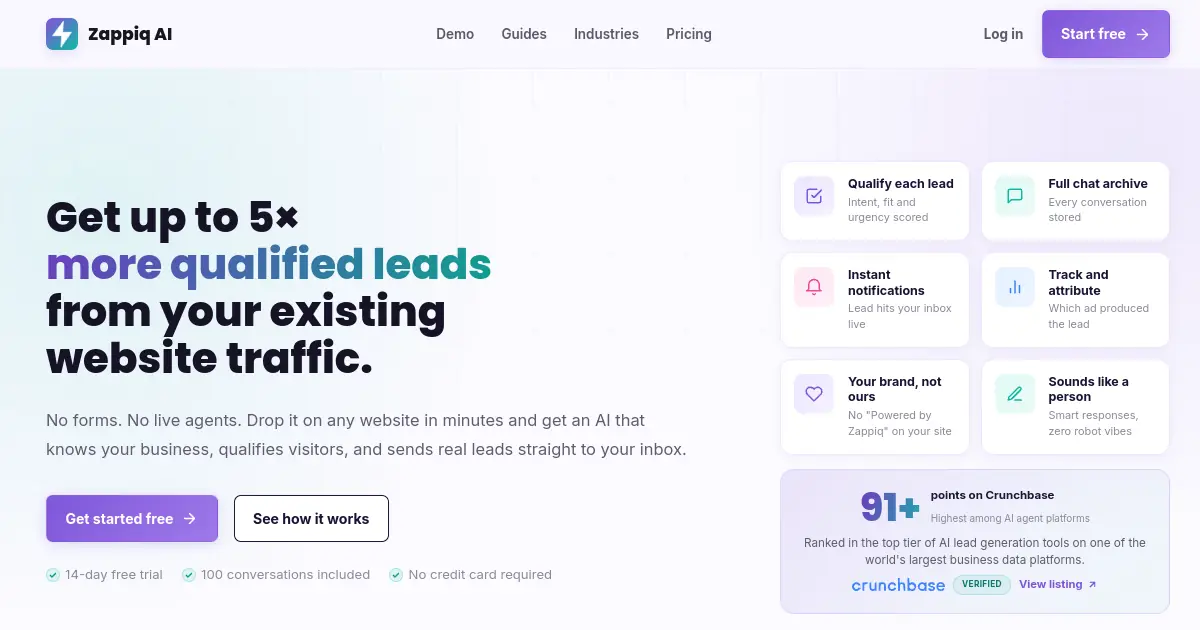
SiteGPT and Zappiq both train on your website and answer visitor questions automatically. The difference is in what happens after the conversation starts. SiteGPT treats every conversation as something to deflect: answer the question, minimize the ticket. Zappiq treats every conversation as a potential lead to identify: answer the question, figure out if this person is worth your time, and get their contact details if they are.
That distinction shapes everything about how the two products behave. SiteGPT will answer a question from a visitor who has no intention of buying as willingly as it answers one from a serious prospect. Zappiq reads intent during the conversation. Visitors who ask exploratory or informational questions get answers. Visitors whose questions suggest real buying intent get asked about their situation, their timeline, and their project before the chatbot requests contact information. The leads that reach you have cleared that filter rather than being every person who started a conversation.
Setup works the same way SiteGPT describes its own: you give it your URL and it reads your website. The difference is that Zappiq is operational from that point without additional configuration. SiteGPT's setup is also fast, but the lead capture and qualification logic requires manual configuration to work the way most businesses need it to. Zappiq's qualification is built into the core behaviour rather than being a feature you switch on.
The pricing difference is still concrete. SiteGPT starts at $59/mo monthly for 4,000 chatbot-answer messages, with branding removal at another $59/mo. Zappiq offers a 14-day trial with 100 conversations, then uses conversation-volume plans: Starter is $9/month equivalent billed annually for 350; Growth is $39 monthly or $27/month equivalent billed annually for 1,500; Pro is $99 monthly or $69/month equivalent billed annually for 5,000. There is no separate branding fee, and the plan is easier to budget when traffic changes.
When a visitor qualifies, Zappiq sends an immediate email with the contact details and a complete transcript of the conversation. That alert typically arrives while the visitor is still on the site, which changes how quickly a follow-up can happen. SiteGPT collects leads and can notify you, but the intent scoring and immediate alert structure that makes lead follow-up timely are specific to a tool built around that use case.
Ad attribution: Every lead Zappiq sends includes the campaign, source, and keyword that brought the visitor to your site, so you know exactly what a lead cost before you pick up the phone. SiteGPT does not include attribution data in its lead capture.
Pros
- Conversation-volume plans instead of per-answer metering
- Trains on your website automatically, ready from day one
- Qualifies visitors by intent before collecting contact details
- Instant lead email with full conversation transcript
- Ad campaign and keyword attribution per lead
- No branding on the widget at any plan, including the trial
- Zapier, Make, and n8n routing for CRM and notification workflows
- Free trial, no credit card required
Cons
- Not a full support platform or ticketing system
- Does not train on uploaded documents or cloud drives like SiteGPT
- No shared team inbox or multi-agent conversation queue
- Younger product, smaller third-party review base than SiteGPT
Why teams choose Zappiq AI for lead generation
Ad tracking: Each lead carries campaign, source, and keyword data, so SiteGPT visitors can be measured as enquiries rather than only as answered questions.
Email lead delivery: When a visitor qualifies, Zappiq sends the contact details and full conversation transcript immediately, giving the team useful context while the lead is still warm.
No branding: The widget stays under your brand on every plan without a separate white-label add-on, unlike the separate SiteGPT branding charge.
Automatic website training: Zappiq reads the pages already published on the site, so launch does not depend on building a manual content tree first.
Natural qualification: Questions about intent, timing, and fit guide the next step before contact capture, separating genuine prospects from casual FAQ traffic.
Simple installation: Add one script to WordPress, Shopify, Webflow, Wix, Squarespace, or a custom website without creating a separate document-chatbot workflow.
Pricing
Pricing: Start with a 14-day trial that includes 100 conversations. Starter is $9/month equivalent billed annually for 350 conversations; Growth is $39 monthly or $27/month equivalent billed annually for 1,500; Pro is $99 monthly or $69/month equivalent billed annually for 5,000, with no per-lead fees.
Best for: Small and medium business websites where the chatbot's job is generating and qualifying leads from existing traffic, not deflecting support tickets. Service businesses, agencies, clinics, legal, real estate, home improvement, and any business running paid traffic where attribution per lead has real value.
chatbase">2. Chatbase: Closest Like-for-Like Replacement
Chatbase
chatbase.co | Custom AI chatbot builder that trains on uploaded files, websites, and text, with a credit-based conversation model
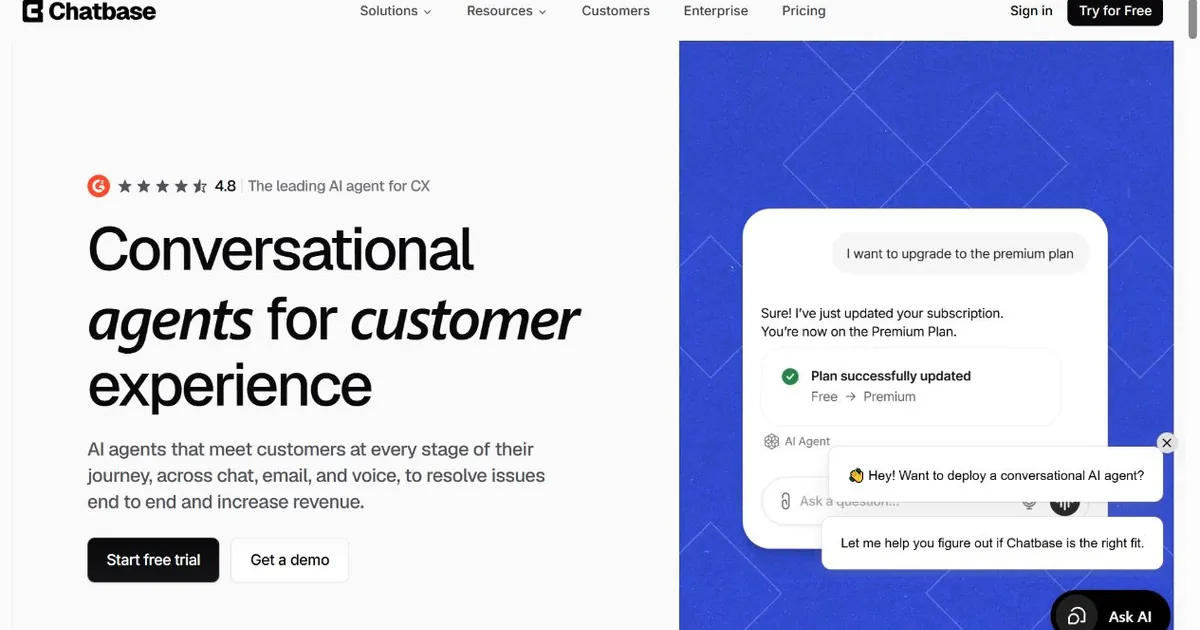
If what drew you to SiteGPT was the content-trained chatbot approach, Chatbase is the most direct alternative. Both platforms let you upload documents, point at a URL, and get a chatbot that answers questions based on your specific content rather than generic AI knowledge. The training experience is similar, the response quality on straightforward content-grounded questions is comparable, and the deployment is just as quick. Where they differ is in how the limits are structured and how widely reviewed the product is.
Chatbase has a genuinely larger review base on G2 and Capterra than SiteGPT, which gives you more third-party signal before committing. SiteGPT has strong reviews from a smaller sample; Chatbase has more voices, including some critical ones that surface honest limitations. For a team making a decision between two tools with similar feature profiles, that review depth is worth factoring in.
Pricing uses message credits rather than a conversation-count model. Chatbase currently lists Free at 50 message credits/month, Hobby at $40/mo with 700 credits, Standard at $150/mo with 4,000 credits, and Pro at $500/mo with 15,000 credits. The credit allowance is separate from SiteGPT's chatbot-answer quota, so compare both the allowance and the type of usage each platform meters.
Chatbase's current pricing page lists a $99/mo add-on to remove “Powered by Chatbase.” That is separate from the $40/mo Hobby subscription, so white-labeling costs $139/mo before any extra credits. SiteGPT's monthly branding add-on is $59/mo, while its annual documentation lists a $39/mo equivalent.
Pros
- Larger third-party review base than SiteGPT for pre-purchase research
- Similar training source flexibility: files, URLs, text, and integrations
- Credit model clearly separates usage from subscription price
- Free plan available, though limited to 50 credits and 400KB of training data
- Lead capture and human handoff built in
Cons
- Branding removal costs $99/mo on top of the plan
- Higher tiers add broader integrations, voice, and API access
- Free plan agents are deleted after 14 days of inactivity
- No native CRM integrations; webhook only for routing leads
Pricing
Best for: Teams that want a content-trained chatbot similar to SiteGPT, value a larger review base for due diligence, and do not need branding removal because the cost structure makes white-labeling financially painful.
Chatbot that qualifies leads instead of just answering questions?
Zappiq AI screens visitors by intent, sends you a qualified lead with the full conversation, and does not charge you a separate fee to remove its branding. Plans have clear monthly conversation allowances. No credit card to start.
Start Free Trial >No credit card | No developer needed | No branding on any plan
tidio">3. Tidio: Best for Ecommerce and Shopify Stores
Tidio
tidio.com | Live chat and AI chatbot platform with native Shopify and ecommerce store data integrations
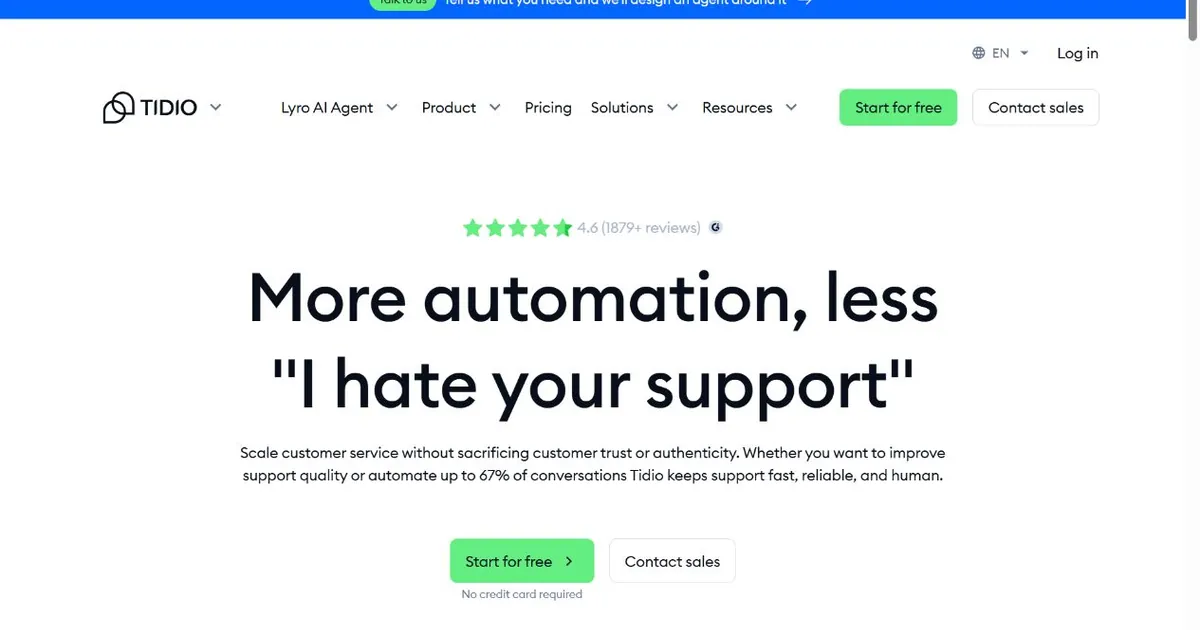
SiteGPT is a website chatbot. It does not know your inventory, your order status history, or your return policy as a live data feed. It knows your documentation about those things, which is a meaningful difference when a customer asks about a specific order number at 11pm on a Saturday. Tidio closes that gap for ecommerce stores by connecting directly to Shopify, pulling real store data into the conversation rather than relying on what was written in a knowledge base article.
For a Shopify merchant, the practical benefit is immediate. A customer asking about a delayed shipment gets a real status pulled from the store, not a generic answer about typical shipping timelines. Return inquiries can be handled against actual order data rather than a policy document. Those are common conversations for any online store, and handling them without human involvement requires real data access rather than trained content.
Tidio's current pricing separates billable conversations from Lyro AI conversations. Starter starts at $24.17/mo on annual billing with 100 billable conversations and 50 one-off Lyro AI conversations. Growth starts at $49.17/mo from 250 billable conversations, while Plus starts at $300/mo plus usage. That is a more useful comparison than describing Tidio as a free 50-conversation plan, because the current pricing page presents a trial and paid tiers rather than a permanent free plan.
For a business that was using SiteGPT primarily to answer product and shipping questions on a store site, Tidio handles that job better at a comparable entry price, with the added benefit of live chat fallback when a visitor needs a human answer that store data cannot provide.
Pros
- Native Shopify integration with real store data access
- Starter includes 100 billable conversations and 50 one-off Lyro conversations
- Live chat fallback when AI cannot resolve the question
- Visual flow builder with ecommerce-specific templates
- Branding included on paid plans without a separate add-on fee
Cons
- Lyro AI is a paid add-on, not bundled in base plans
- Plus starts at $300/mo plus monthly usage
- 10-seat cap on self-serve plans
- No document or cloud drive training like SiteGPT supports
Pricing
Best for: Shopify stores and ecommerce businesses that need a chatbot with real order and inventory data access, not just trained content, and want live chat coverage for the questions automation cannot handle.
botpress">4. Botpress: Best for Developers and Technical Teams
Botpress
botpress.com | Open-source AI chatbot framework with a cloud option, no per-message quota, and full customization control
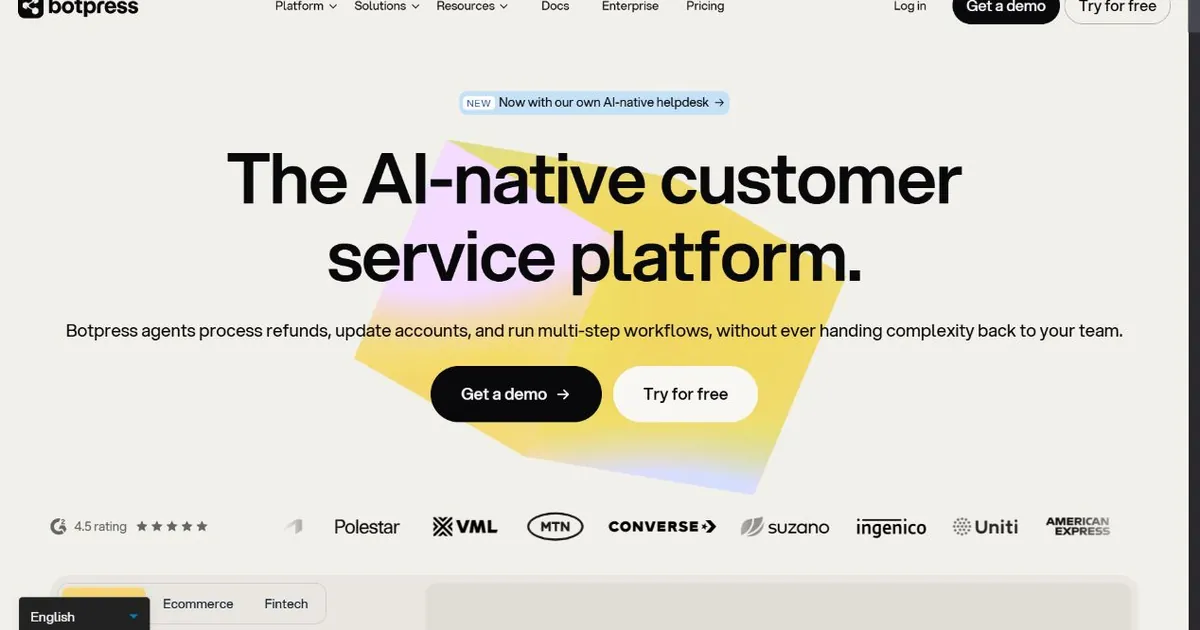
SiteGPT is a no-code tool. You do not need a developer to set it up, customize it within the platform's options, or deploy it. That accessibility is one of its strengths. But for a technical team that hit the ceiling on what SiteGPT's configuration allows, Botpress sits at the opposite end of the flexibility spectrum: you can make it do almost anything, because you are working with a framework rather than a product.
Botpress combines a cloud platform with an open-source framework. The current pricing page lists Pay-as-you-go at $0 platform fee plus AI spend, Plus at $89/mo plus AI spend, and Team at $495/mo plus AI spend; PAYG includes a $5 monthly AI credit. That is different from SiteGPT's packaged message allowance: Botpress gives developers more control, but the real cost depends on model usage and implementation effort.
The tradeoff is the setup investment. SiteGPT is live in minutes. Botpress, even on the cloud version, requires meaningful configuration before it handles real conversations the way you need it to. Building a flow, connecting your knowledge sources, configuring integrations, and testing the behavior all take time that non-technical teams typically do not have. The flexibility that makes Botpress powerful for a developer is the same flexibility that makes it impractical for a business owner who just wants a widget on the homepage by Friday.
For teams that had developer resources involved in their SiteGPT setup anyway, and kept running into things the platform could not do, Botpress is worth evaluating. For teams that chose SiteGPT specifically because it required no developer, Botpress is a step in the wrong direction.
Pros
- Open source, self-hosted option for full data and compliance control
- Pay-as-you-go starts at $0 platform fee plus AI spend
- No per-message quota on any plan
- Full customization: flow logic, integrations, model selection
- Strong developer community and documentation
Cons
- Requires meaningful technical investment to set up and maintain
- Not suitable for non-technical teams without developer support
- No native document training UI comparable to SiteGPT's drag-and-drop approach
- Cloud support quality varies compared to founder-led SiteGPT support
Pricing
Best for: Technical teams and developers who need chatbot flexibility beyond what any managed platform provides, have the resources to build and maintain the configuration, and want complete control over data residency and integration behavior.
crisp">5. Crisp: Best Bundled Inbox and Chatbot Option
Crisp
crisp.chat | Shared inbox, live chat, and AI chatbot bundled under a single flat workspace price, with native omnichannel channel support
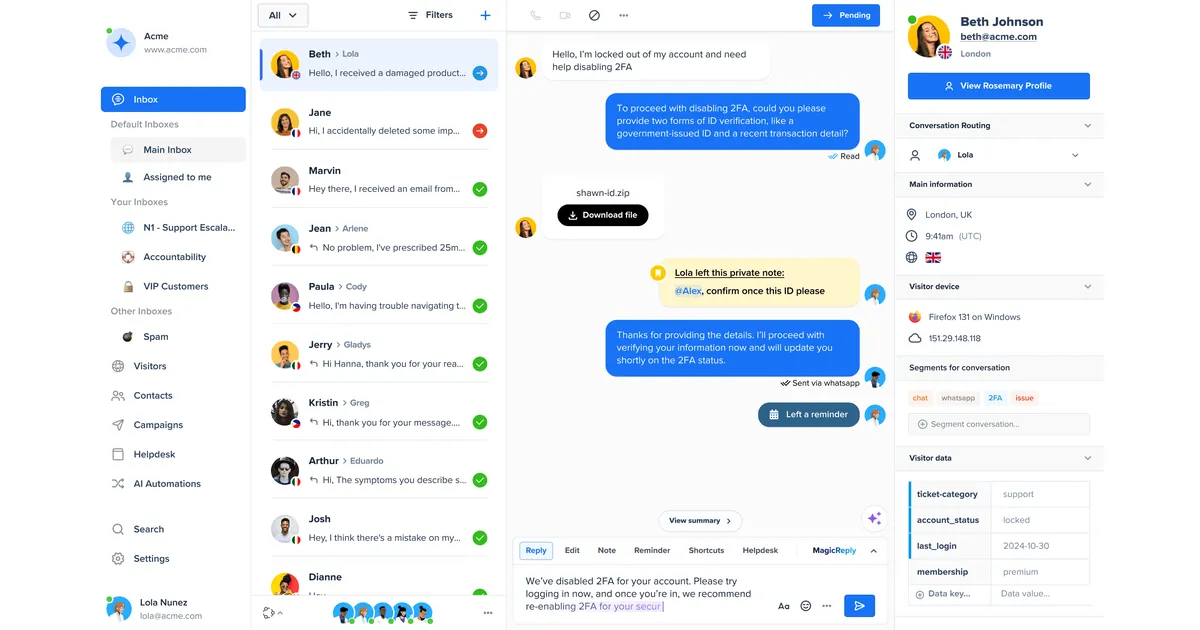
SiteGPT is a chatbot layer you add to a website. It does not come with a shared inbox, a CRM, or a team collaboration workspace. If your team needs those things alongside the chatbot, you end up paying for SiteGPT and then paying again for whatever inbox tool you use alongside it. Crisp bundles all of that into a single workspace price.
The Mini plan at forty-five dollars a month includes four seats, live chat, a shared inbox, basic automations, and a small Hugo AI credit allowance. Essentials at ninety-five dollars a month expands to ten seats, workflow automation, CRM records, analytics, and native WhatsApp and Messenger channels. That is a significantly broader feature set than SiteGPT offers at a comparable price point. Whether those features matter depends on whether your team actually needs a support platform or just a chatbot.
Hugo, Crisp's AI chatbot, trains on your knowledge base content rather than arbitrary URLs and cloud drives, which is a narrower training source than SiteGPT supports. The AI credit structure is also a consideration: Essentials caps Hugo at roughly fifty AI actions per day, which can run short on a busy site. The Plus plan at two hundred and ninety-five dollars a month raises that limit meaningfully. For a business whose primary comparison is SiteGPT's content-trained chatbot against Crisp's Hugo, SiteGPT is the stronger chatbot with broader training source support. For a business that needs the inbox alongside the bot, Crisp's bundled price is genuinely competitive.
Pros
- Shared inbox, chatbot, CRM, and omnichannel channels bundled together
- Workspace pricing does not grow with headcount the way per-seat tools do
- Free tier with 2 seats and unlimited live chat
- Native WhatsApp, Instagram, and Messenger from Essentials tier
- No separate branding removal fee on paid plans
Cons
- Hugo AI caps at ~50 actions/day on Essentials, lower than SiteGPT quotas
- Narrower AI training sources than SiteGPT's cloud drive support
- Hard agent seat caps at each tier, no incremental additions
- $200 gap between Essentials ($95/mo) and Plus ($295/mo)
Pricing
Best for: Teams that want the chatbot and the inbox bundled under one subscription rather than running SiteGPT alongside a separate live chat or inbox tool.
Every lead with the full conversation while it is still warm?
Zappiq AI does not wait for a batch report. The moment a visitor qualifies, you get an email with their contact details, intent, and every message they sent, typically while they are still browsing your site.
Start Free Trial >No credit card | No developer needed | No branding on any plan
6. tawk.to: Best Free Option
tawk.to
tawk.to | Free live chat with unlimited agents and no conversation cap, funded by an optional hire-a-live-agent service
SiteGPT has a 14-day free trial but no permanent free plan. tawk.to sits at the opposite end of that spectrum: its core live chat platform is free, with no limits on agents, chat volume, or sites. The tradeoff is that the core product is human live chat, while AI Assist is an optional add-on starting at $29/mo.
The trade is straightforward. tawk.to has no AI chatbot. Every conversation requires a human to respond. There is no knowledge base bot that handles common questions while your team is away, no qualification flow that filters visitors before they reach someone, and no automation that covers conversations outside business hours. If your primary reason for evaluating SiteGPT was to handle volume without staffing the chat window, tawk.to does not address that need at all.
For a business that was evaluating SiteGPT as a basic live chat widget with some added AI capability, and found the combination overbuilt and overpriced for what it actually uses, tawk.to covers the live chat portion completely. Removing the tawk.to logo from the widget costs about twenty-nine dollars a month if that matters. Everything else, including unlimited seats, is free and stays free.
The hire-a-live-agent service is worth knowing about separately. If your team cannot monitor the widget during business hours consistently, tawk.to lets you pay for real agents to staff it on your behalf rather than letting conversations go unanswered. That service is charged separately from the platform, which itself remains free.
Pros
- Completely free, unlimited agents, unlimited conversations
- No AI credits, message quotas, or overage fees of any kind
- Installs in under fifteen minutes on any website or CMS
- Optional hire-a-live-agent service for coverage during off-hours
Cons
- No AI chatbot, automation, or FAQ deflection capability
- Requires a human actively monitoring the widget to be useful
- Cannot handle conversations outside business hours without the paid agent service
- Reporting and analytics are basic compared to any paid tool
Pricing
Best for: Businesses with no budget for a chatbot subscription that need live chat on their site and have a person available to answer it during the hours that matter most to their customers.
7. HubSpot Chatflows: Best for Teams Already on HubSpot
HubSpot Chatflows
hubspot.com | Live chat and chatbot builder built into HubSpot's free CRM, with Breeze AI on paid tiers and no seat cap on the free plan

SiteGPT captures leads and can send them somewhere via webhook. HubSpot Chatflows captures leads and puts them directly on a contact record in your CRM where your sales history, email activity, deal stage, and form submissions already live. For a team that uses HubSpot for anything upstream of the chatbot, that difference changes whether the captured lead is immediately actionable or requires an import step before anyone can do anything with it.
The free HubSpot tier is more fully featured than SiteGPT's trial. Unlimited seats, a shared inbox, live chat, basic chatbot flows tied to the CRM, and ticketing are all included at no cost and do not expire. For a team paying for SiteGPT mainly to capture leads and route them to a CRM, the HubSpot free tier covers that job without a monthly subscription, provided the team is willing to work within HubSpot's interface.
HubSpot's current Breeze pricing is outcome- and credit-based. Customer Agent is listed at $0.50 per resolved conversation, Prospecting Agent at $1 per lead recommendation, and Data Agent at $0.10 per answer. Breeze Assistant is available in the free edition; Starter includes 500 HubSpot Credits, Professional includes 3,000 and unlocks Customer Agent, and Enterprise includes 5,000. Chatflows still makes the most sense when the CRM record is more important than standalone chatbot training.
The value of HubSpot Chatflows is entirely conditional on using HubSpot for something else. A team that is not already invested in HubSpot's CRM, marketing, or sales products is unlikely to find the chatbot compelling enough to adopt the whole platform just for a widget.
Pros
- Free tier includes unlimited seats, live chat, ticketing, and full CRM
- Every chat lead lands directly on a HubSpot contact record
- Customer Agent is priced at $0.50 per resolved conversation
- No separate branding removal fee on paid tiers
- Strong reporting when using HubSpot Marketing or Sales Hub alongside
Cons
- Chatbot does not train on URLs, cloud drives, or uploaded documents like SiteGPT
- Full value requires an existing HubSpot investment, not a standalone pick
- Widget customization is limited compared to purpose-built chatbot tools
- Breeze AI credit ceiling on lower tiers can push upgrades
Pricing
Best for: Teams already running HubSpot for marketing, sales, or support who want their chatbot conversations and captured contacts to live on the same record without adding a separate platform subscription.
How to Choose the Right SiteGPT Alternative
The clearest dividing line: Are you trying to answer repetitive support questions automatically, or are you trying to identify serious buyers in your website traffic? Those are two different jobs, and the best tool for one is not the best tool for the other.
SiteGPT was designed for the first job: train a chatbot on your content, deflect FAQ tickets, hand off to a human when needed. The tools in this comparison that do the same job best are Chatbase, which works almost identically to SiteGPT with a different pricing model, and Botpress, which goes further in terms of customization if your team has developer resources. Tidio adds ecommerce-specific data access that SiteGPT lacks. Crisp bundles a full inbox alongside the chatbot at a price that makes sense for teams that need both.
If your primary goal was lead generation rather than support deflection, none of those tools were the right fit in the first place, and neither is SiteGPT. A chatbot that answers questions without screening for intent is a different product than one that qualifies visitors before they leave their contact details. Zappiq was built around that qualification step, which is why it fits the lead generation job more directly than a tool designed around support ticket volume.
For the zero-budget case, tawk.to removes the cost entirely in exchange for requiring a human to answer every conversation. The tradeoff is clean and honest: if you have the person, you do not need the platform budget.
For teams already inside HubSpot, the free Chatflows tier is worth testing before paying for any standalone chatbot tool. The chatbot capability is limited compared to SiteGPT, but the CRM integration is genuinely better than any webhook-based lead routing, and the price is zero.
Before canceling SiteGPT: Export your training sources, your chatbot configuration, and any lead data the platform holds. Most alternatives here can import content from common file formats. Running the new tool alongside SiteGPT for a week before switching traffic gives you a real comparison rather than trusting the marketing page.
Frequently Asked Questions
Zappiq AI is the best SiteGPT alternative for small business websites where the goal is capturing and qualifying leads from existing traffic. It trains on your website automatically, qualifies visitors by intent before collecting their contact details, and emails every lead with the full conversation attached. Zappiq offers a 14-day trial with 100 conversations. Starter is $9/month equivalent billed annually for 350 conversations; Growth is $39 monthly or $27/month equivalent billed annually for 1,500; Pro is $99 monthly or $69/month equivalent billed annually for 5,000, with no separate branding fee.
No. SiteGPT offers a 14-day free trial but no permanent free plan. Current monthly pricing starts at $59 for Starter with 4,000 chatbot-answer messages. Branding removal is another $59/mo on monthly billing; the billing docs list $468/year ($39/mo equivalent) for the annual add-on.
The most common reasons are the finite answer allowance, the separate branding add-on, and the web-widget focus. SiteGPT lists 4,000 chatbot-answer messages on Starter, 10,000 on Growth, and 40,000 on Scale. Teams that need WhatsApp, SMS, Instagram, or voice channels may also find SiteGPT too focused on the website widget for their use case.
SiteGPT includes basic lead capture, but it is primarily a content-trained support chatbot rather than a purpose-built lead generation tool. It collects contact details and can escalate to a human, but it does not qualify visitors by buying intent before collecting their information, does not track ad attribution per lead, and does not send instant email alerts with conversation transcripts. For teams whose primary goal is lead generation rather than FAQ deflection, a purpose-built tool covers that job more directly.
Chatbase is the most structurally similar replacement. Both train on uploaded documents and website sources and deploy as embeddable widgets. Chatbase currently lists 50 free message credits, Hobby at $40/mo with 700 credits, and a $99/mo branding-removal add-on. SiteGPT starts at $59/mo monthly with 4,000 chatbot-answer messages and a $59/mo branding add-on.
The Bottom Line
SiteGPT does a specific job well: take a website's content, train a chatbot on it quickly, and answer visitor questions without requiring a developer. For a SaaS documentation site, a content-heavy knowledge base, or a business that gets the same dozen questions every day and wants to stop answering them manually, it is a capable and reasonably priced tool. The reviewer who said setup took minutes and the bot was trained on their site immediately was not exaggerating. That part works.
The friction shows up when you do the real math. Starter lists 4,000 chatbot-answer messages at $59/mo monthly, and branding removal adds another $59/mo. There is no permanent free plan, and the channel coverage is focused on the web widget: no WhatsApp, SMS, voice, or Instagram in the standard comparison.
The right alternative depends entirely on which gap matters. If you want another content-trained bot, Chatbase is the closest fit. If you need developer control, Botpress is more flexible. If you need ecommerce data or a shared inbox, Tidio and Crisp cover more of the support workflow. If you want lead qualification, Zappiq is the more direct fit.
If the underlying job was always more about lead generation than support deflection, Zappiq AI was built for that role specifically. The chatbot qualifies intent rather than just deflecting volume, sends you the lead with enough context to follow up while it is still relevant, and does not charge you a separate fee to remove its name from your widget.
The free trial is at zappiqai.com. No credit card required and no branding on the widget from day one.
Try the SiteGPT alternative built for lead qualification
Monthly conversation allowances are clearly tiered, with no per-lead fee. Zappiq qualifies visitors by intent before collecting their contact details, and sends you the lead with the full conversation the moment it happens.
Start Free Trial >No credit card | No developer needed | No branding on any plan
References
- eesel AI. "SiteGPT Pricing 2026: Real Monthly Cost, Plans and the 10x Catch." eesel.ai.
- That Marketing Buddy. "SiteGPT Review 2026: AI Support Chatbot Built for Agents." thatmarketingbuddy.com.
- Thareja AI. "SiteGPT Review 2026: Features, Pricing, Pros and Cons." thareja.ai.
- SQ Magazine. "SiteGPT Statistics 2026: MRR, Customers and Pricing." sqmagazine.co.uk.
- Hyperleap AI. "Best SiteGPT Alternatives in 2026." hyperleap.ai.
- SiteGPT Blog. "Chatbase Review 2026: Pricing, Features and Better Alternatives." sitegpt.ai.
- SoftwareWorld. "SiteGPT Reviews May 2026: Pricing and Features." softwareworld.co.
- Capterra. "SiteGPT Software Pricing, Alternatives and More 2026." capterra.com.

Ansar Ali
Ansar Ali founded Zappiq AI after spending time with small business owners who were paying for chatbots built around support deflection when what they actually needed was a smarter way to identify serious buyers in their existing traffic. He works on the qualification logic, attribution tracking, and lead delivery experience that makes Zappiq useful for the lead generation job rather than the FAQ job, and writes these comparisons to help teams understand the difference before they choose the wrong tool for their actual use case.