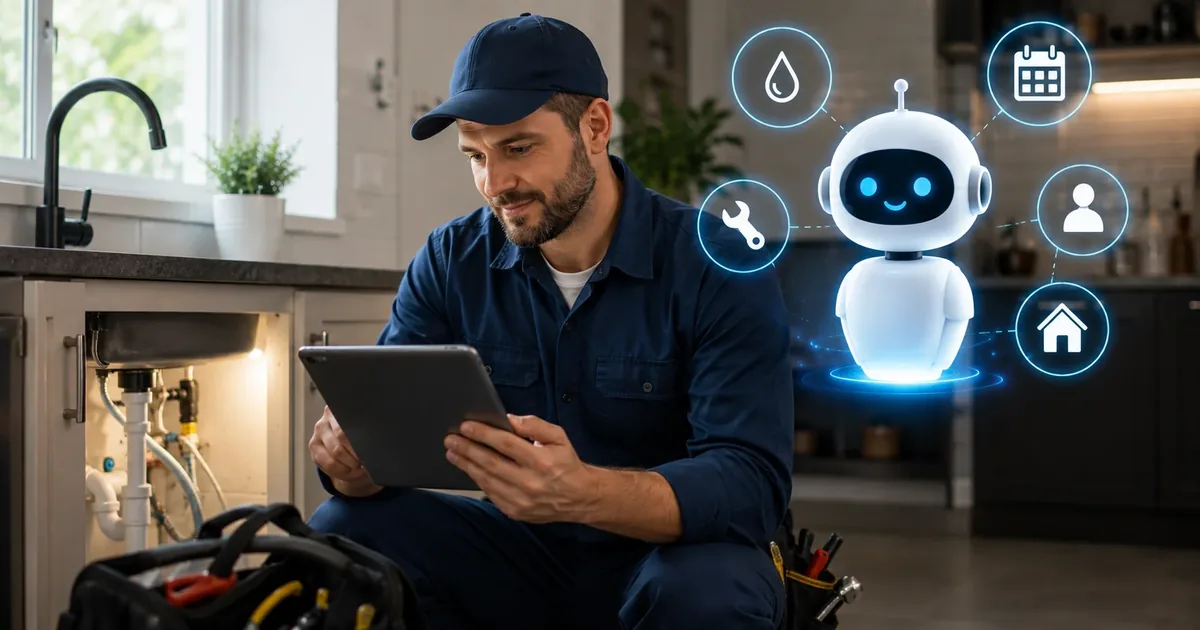
Quick summary: why plumbers need an AI chatbot in 2026
- Small home service businesses miss 62% of incoming calls, losing $45,000 to $120,000 per year in revenue (CallBird AI, 2025).
- A typical plumbing business gets 8 to 12 emergency calls weekly outside business hours (PipelineOn, 2026).
- Contractors who respond within 5 minutes are 21 times more likely to qualify a lead than those who respond in 30 minutes (Harvard Business Review / CustomerFlows, 2026).
- 48% of home service professionals already use AI, and 31% saw a clear return almost immediately (Housecall Pro, 2026).
- Zappiq AI is the best AI chatbot for plumbers: flat pricing, no branding badge, auto-trains on your website, and captures leads at 3 to 5 times the rate of contact forms.
For the broader workflow behind after-hours capture, see how to handle after-hours website leads. For scheduling requests that need a confirmed time, compare the AI appointment-booking chatbot workflow.
The Problem: Plumbers Are Losing Thousands in Missed Calls
You are running a plumbing business. You have Google Ads running. Your website gets traffic. People are searching for "emergency plumber near me" and landing on your site. Then they leave. They do not call. They do not fill out your contact form. They just go.
Here is what the data actually shows. Small home service businesses miss 62% of incoming calls, according to CallBird AI's 2025 analysis of over 1,200 contractors across plumbing, HVAC, electrical, and general contracting. That is not a small leak. That is a flood. The average small contracting business loses $45,000 to $120,000 per year to unanswered phone calls.
A typical plumbing business gets 8 to 12 emergency calls weekly outside business hours, according to PipelineOn's 2026 home services scheduling report. The kicker: 78% of customers hire the first contractor who actually picks up (CustomerFlows, 2026). That is not a marketing advantage. That is a footrace you are losing while you sleep.
Think about what that actually means for a two or three truck plumbing operation. If you miss 8 emergency calls in a week at an average job value somewhere around $800 to $1,000 per call, that is $6,400 to $8,000 sitting in a voicemail box. Multiply that across a full year and the number gets uncomfortable fast. The problem is not that you are a bad plumber. The problem is that nobody was available to answer when the homeowner needed someone right now.
Why Contact Forms Fail Plumbers
Your website probably has a contact form. It is almost certainly not doing much work for you. Contact forms convert 2 to 5% of website visitors, according to industry conversion benchmarks tracked by PipelineOn and CustomerFlows across hundreds of home service websites. AI chatbots convert 15 to 30% of the same traffic. That is the difference between one booked job and six from the exact same ad spend.
Contractors report the same pattern again and again. They are running Google Ads, paying around $104 per lead on average (the blended figure from SearchLight's January 2026 benchmark tracking $14.9 million in ad spend across 816 contractors), and then sending that traffic to a page with a contact form that 3 out of every 100 visitors actually fill out. The math on that spend is brutal.
The math is direct: If you spend $1,000 on Google Ads and send visitors to a contact form converting at 3%, you get 30 leads. Send the same traffic to an AI chatbot converting at 15% and you get 150 leads. Five times more jobs from the exact same ad spend, without touching your bids or creatives.
Contact forms also suffer from a timing problem. The visitor fills out the form at 9 PM on a Sunday. You check your email Monday morning. By then, they have already booked a competitor who responded at 9:03 PM because that competitor had an AI chatbot running on their site. The form is not just a weak conversion tool. It is a slow one, and slow is fatal in emergency services.
The Real Cost of a Missed Emergency Call
Emergency plumbing jobs are not like other service calls. When a pipe bursts, the homeowner is not shopping around and comparing estimates. They are in pain and they want the problem fixed right now. That urgency is worth money to you, if you can capture it. It is worth nothing if the call goes to voicemail.
The average plumbing job ticket in the United States sits between $350 and $1,000 depending on the type of work, with emergency calls typically landing at the higher end of that range. After-hours service calls with premium pricing can push well past $1,200. Every missed emergency call is not just a lost conversation. It is a lost job, a lost customer relationship, and a lost potential referral down the line.
Speed to Lead: The Single Biggest Driver of Plumbing Conversions
Response speed is the single strongest predictor of whether a contractor wins or loses a lead. Across the home services industry, research consistently shows that businesses responding within 5 minutes are 21 times more likely to qualify the lead compared to those responding within 30 minutes. This finding comes from Harvard Business Review research on online sales leads, and CustomerFlows confirmed it holds specifically for home service contractors in their 2026 study.
The numbers on actual contractor behavior are sobering. The average contractor takes 4 to 8 hours to respond to a new inquiry. During evenings, weekends, and holidays, many do not respond at all until the next business day. The median first-response time for home service businesses is 42 minutes, according to CustomerFlows. Only 12% of contractors consistently respond within five minutes. And 27% of contractor inquiries never receive any response at all.
Read that last figure again. More than one in four people who reaches out to a contractor never gets a reply. That is not a competitive market. That is a market where showing up is most of the battle.
The speed advantage: An AI chatbot responds in under one second, every time, with no hold time, no voicemail, and no waiting until business hours. That is the difference between capturing an emergency lead and losing it to the next plumber on the search results page who happens to have a chatbot running.
Why Speed Matters More for Plumbers Than Most Trades
Home service leads have three characteristics that make the speed effect more pronounced than in almost any other type of business.
- High urgency. A burst pipe, a dead water heater, a backed-up sewer line. These are not situations where a homeowner is going to sit and think for a few days. They are in pain, their house may be taking water damage, and they want someone there now. The first credible contractor who responds gets the job in most cases.
- Low switching cost. The homeowner searched "emergency plumber near me" and Google showed them ten options. Sending a message to the second contractor on that list takes about ten seconds. There is zero friction between you and your competition. If you do not respond, they move on without thinking twice.
- Parallel outreach. Most homeowners with an emergency contact 3 to 5 contractors simultaneously, according to CustomerFlows (2026). The first one to have a real conversation wins. The second gets compared. The third through fifth are ignored entirely because the homeowner already has someone on the way.
This is why an AI chatbot is not just a convenience tool for plumbers. It is the mechanism that puts you in the first-response position, every single time, without you having to be available around the clock.
What the Revenue Gap Actually Looks Like
CustomerFlows modeled the revenue difference between contractors responding within 5 minutes versus those taking 4 hours across a range of business sizes. For a mid-size contractor running 50 leads per month, the difference between fast and slow response was substantial: fast responders closed significantly more deals at full ticket prices, while slow responders often lost the lead entirely or competed on price because they called back after the urgency had faded. The pattern held across plumbing, HVAC, electrical, and general contracting.
The practical takeaway for a plumbing business is simple. If you are not responding to new leads within the first few minutes, you are competing at a structural disadvantage against every contractor in your area who is. An AI chatbot removes that disadvantage entirely.
The After-Hours Opportunity Plumbers Are Missing
Most plumbing emergencies do not happen during business hours. They happen at 2 AM on a Saturday when a pipe bursts. They happen on Sunday morning when the water heater gives out. They happen on Thanksgiving when the garbage disposal jams and suddenly hosting dinner becomes a crisis.
At Housecall Pro, 26% of the jobs their CSR AI books come in after hours while the crew is off the clock, according to their 2026 AI in the Trades report. That is real revenue that used to go to voicemail. More than 6 in 10 homeowners would rather book a plumbing, HVAC, or electrical appointment through an AI chatbot than fill out a web form or wait for a callback, according to PipelineOn's 2026 scheduling preferences survey.
What does that actually look like for a small plumbing business? If you get 8 emergency calls per week outside business hours and your average emergency ticket is around $900, that is roughly $7,200 per week in potential revenue. Without an AI chatbot, most of those inquiries end up in voicemail and the homeowner books someone else by morning. With a chatbot running on your site, those inquiries become qualified leads with contact details, problem descriptions, and urgency levels sitting in your inbox before you even wake up.
The after-hours opportunity is real: 26% of AI-booked home service jobs come in after hours when staff are off the clock (Housecall Pro, 2026). For a plumbing business getting 8 emergency inquiries per week outside business hours, capturing even half of those with a chatbot adds up to a significant amount of revenue that previously went straight to voicemail.
What Happens Without After-Hours Coverage
Without any coverage after hours, the homeowner goes through a predictable sequence. They search for a plumber, find your site, see no live chat or phone response, and either leave a voicemail nobody checks until morning or move immediately to the next result on Google. By the time you call back the next day, they have already booked someone else. From their perspective, you never responded at all.
The frustrating part is that they found you. Your SEO or Google Ads did exactly what it was supposed to do. The traffic arrived. The conversion opportunity existed. It just died because nothing was there to capture it.
AI Adoption in the Trades: Where Things Stand in 2026
Nearly half of home service professionals already use AI in their day-to-day work. The other half is running out of time to catch up without losing ground.
Housecall Pro's 2026 AI in the Trades report surveyed thousands of contractors across the country. The findings are clear: 48% of pros actively use AI on the job, and 31% of those users saw a clear return almost immediately after starting. Among pros who have been using AI for two or more years, 79% say the impact on their business has grown over time.
By trade, 53% of plumbing professionals and 54% of electrical professionals surveyed say they actively use AI, according to data from Contractor Magazine's August 2026 coverage of the report. That is a majority of your direct competitors. They are using AI for customer communication (52%), estimates and quoting (51%), and business planning and reporting (43%).
The biggest reason non-users haven't started is not cost and it is not skepticism. It is awareness. Fifty-two percent of non-users say they simply are not familiar with AI tools built specifically for the trades. Most of them have never seen a product that actually understands the difference between an emergency dispatch situation and a routine maintenance booking. Once they do, the conversation tends to change quickly.
The window is closing: The AI divide in the trades is real and measurable. Early adopters are seeing immediate returns and growing their revenue. Those who have not started yet are competing with one hand tied behind their back against contractors who respond in under a second, 24 hours a day, 14 days a week.
What Contractors Are Actually Doing With AI
It is worth understanding how contractors are actually using AI, because it is not all chatbots and call answering. Customer communication is the most common application (52% of AI users), which covers everything from automated lead qualification to follow-up messages after a job. Estimates and quoting (51%) is the second most common, with AI helping contractors generate estimates faster and more consistently. Business planning and reporting rounds out the top three at 43%.
What stands out in the data is that contractors using AI for customer communication are capturing leads that would otherwise fall through the cracks. Not because their underlying business is better, but because they are present in moments when competitors are not. A homeowner searching at midnight for an emergency plumber lands on three websites. One has an AI chatbot that responds immediately. Two have contact forms. The one with the chatbot is the one that gets the job.
Zappiq AI: Built for Plumbers, Not Enterprise Support Teams
Zappiq AI chatbot training follows a unique system prompt. During onboarding, it uses your website to build the default chatbot around your services, service area, hours, and business details. For further training, you can work with an AI agent such as Claude to explain your goals and add FAQs, pricing details, qualification rules, and preferred follow-up instructions.
Most AI chatbot platforms are built for large customer support operations. They are designed to deflect tickets, route inquiries through call centers, and reduce the load on enterprise helpdesk teams. That is useful if you are running a software company with 50,000 customers. It is completely the wrong tool for a plumbing business trying to capture emergency leads at 11 PM on a Friday.
Zappiq AI is built to solve a specific problem: website visitors leave without ever reaching out, simply because no one is available to answer their questions the moment they have them. The platform trains an AI chatbot on each business's own website content and instructions, embeds it directly on the site, and handles the entire lead capture and qualification flow automatically. When a visitor lands on your plumbing website and asks about a burst pipe, the chatbot does not send them to a help center article. It asks about the problem, figures out the urgency, collects their contact details, and sends the qualified lead straight to your inbox.
The leads that arrive in the business owner's inbox come with full context already attached. What the visitor needed, what they asked, how serious the problem is, where they are located, and how urgently they need service. You are not calling blind. You are calling with everything you need to have a productive first conversation.
How Zappiq AI Works for a Plumbing Business
Here is exactly what happens when a visitor lands on your plumbing website with Zappiq AI installed.
- The chatbot engages right away. Within 1 to 2 seconds of the visitor landing on your site, the chatbot opens a conversation. It does not wait for the visitor to find the contact page. It does not wait for them to scroll to the bottom. It starts the conversation from the moment they arrive, while they still have the problem fresh in their mind.
- It asks about the problem. The chatbot asks what the visitor needs help with. Because it has been trained on your website content, it understands your service area, the types of jobs you handle, and the questions your specific visitors are likely to ask. It uses that context to ask relevant follow-up questions rather than running through a generic script.
- It qualifies the lead. The chatbot asks about urgency, location, and property type. It determines whether this is an emergency that needs immediate dispatch, a scheduled repair that can be booked for next week, or a general inquiry that needs a callback. It does this through natural conversation, not a rigid form with radio buttons.
- It captures contact details. Only after the lead is qualified does the chatbot ask for name, phone number, and email. By this point, the visitor has already received value. They have gotten answers to their questions and confirmation that you handle their type of problem. They are far more willing to share their contact information because they feel like they are already in a conversation, not filling out a cold form.
- It sends you the lead immediately. The moment a lead is captured, Zappiq AI sends an email notification with the visitor's contact details and the full conversation history. You know exactly what they need, how urgent it is, and where they are before you pick up the phone. That context changes the quality of your follow-up call entirely.
No manual setup required: Most chatbot platforms give you an empty bot and a blank dashboard. Zappiq AI reads your website the moment you sign up and trains the chatbot on your services, pages, and common questions automatically. There is a working assistant ready before you finish setting up your account.
Key Features That Set Zappiq AI Apart for Plumbers
| Feature | Zappiq AI | Other Chatbots |
|---|---|---|
| No branding badge | Never adds a badge on any plan | Usually adds "Powered by" badge; charges extra to remove |
| Auto-trains on your website | Reads your site automatically at sign-up | Empty bot, requires manual setup |
| Lead qualification built in | Pre-configured for service businesses | Requires custom logic trees |
| Instant lead delivery | Email notification with full transcript | Dashboard-only, no push notifications |
| Flat pricing | $9-$99/month, or $9-$69/month equivalent when billed annually; conversation-based tiers | Per-resolution or hidden usage fees |
| Free trial | 14 days, 100 conversations | Often requires credit card upfront |
| Ad attribution | Meta Pixel, Google Analytics tracking | Often not included in base plans |
| Installation | One script tag, works on any platform | Often requires plugin install or developer |
No Branding Badge, on Any Plan
Most chatbot tools attach a "Powered by" badge to your widget and charge a premium to remove it, even though it sits on your website in front of your own visitors. Zappiq AI never adds a badge on any plan, including the free trial. The chatbot reads like a natural part of your site from day one. You are not advertising someone else's product to your own customers.
Auto-Trains on Your Plumbing Website
Zappiq AI reads your website the moment you sign up and trains the chatbot on your services, pages, and common questions automatically. If you have a page about water heater repair, the chatbot knows about water heater repair. If you have a page covering your service area, the chatbot knows your coverage zones. If you have a page about emergency plumbing with response times, the chatbot knows how to handle urgent inquiries. You do not write every response manually. You give the chatbot your website and it does the learning on its own.
Lead Qualification Built In
The chatbot arrives pre-configured for service businesses. It asks about intent, urgency, service type, and fit before it ever asks for contact details. You are not designing decision trees or writing conversation flows from scratch. The qualification happens automatically, the same way every time, whether it is 2 PM on a Tuesday or 2 AM on a Sunday.
Every Lead Lands in Your Inbox Immediately
The moment a visitor is qualified and captured, Zappiq AI sends an email notification with their contact details and the full conversation transcript. You have everything you need to follow up while the lead is still fresh. You are not logging into a dashboard to find out who contacted you overnight. The lead comes to you.
Flat, Published Pricing Without Surprises
Zappiq AI offers a 14-day trial with 100 conversations. Starter is $9/month equivalent when billed annually for 350 conversations; Growth is $39/month or $27/month equivalent annually for 1,500; and Pro is $99/month or $69/month equivalent annually for 5,000. Pro includes Meta Pixel and Google Analytics tracking plus custom webhook integration. Annual billing saves up to $360 per year on Pro compared with monthly billing.
Why Zappiq AI Fits Plumbing Businesses Specifically
The core reason Zappiq AI works for plumbers comes down to what it is designed to do. It is not trying to replace your customer support team or deflect service tickets. It is trying to fill your pipeline with qualified leads from the traffic you are already paying to drive to your website.
Most chatbots on the market are built for scale: enterprise companies handling thousands of support requests per day, with teams of agents behind them. A plumbing company with 2 to 5 trucks does not have that problem. The problem is the opposite. Traffic arrives, people have questions, and nobody is there to answer them at 9 PM on a Tuesday. Zappiq AI plugs that gap without requiring you to hire someone to sit at a computer all night.
- Built for lead capture, not support deflection. Every conversation the chatbot has is oriented toward one outcome: a qualified lead delivered to your inbox. It does not try to resolve problems or close tickets. It qualifies intent and captures contact details so you can close the job yourself.
- Works for any plumbing website. Zappiq AI works with WordPress, Shopify, Wix, Squarespace, Webflow, and any custom HTML website using a single script tag. If your developer built your site from scratch, the installation is still one copy-paste job.
- Delivers leads with context, not just raw data. When a lead arrives in your inbox, you already know what the problem is, how urgent it is, and what the visitor asked. That context changes the quality of your follow-up call. You are not calling and asking "so what did you need?" You are calling and saying "I saw you have a burst pipe on the second floor. I can be there in 45 minutes."
- Attributes leads to your marketing. The Pro plan includes Meta Pixel and Google Analytics tracking, so you know exactly which campaign or channel generated each lead. That means you can measure your ad spend against real booked jobs, not just form submissions or page views.
Why Zappiq AI is the best AI chatbot for plumbers: It is built for lead capture, not support deflection. It auto-trains on your website. It never adds a branding badge. It delivers qualified leads to your inbox the moment they happen. And it costs a fraction of what enterprise platforms charge, with no hidden per-conversation fees on the base plans.
How AI Chatbots for Plumbers Compare to the Alternatives
Before choosing a chatbot for your plumbing business, it helps to understand what you are actually comparing. There are three main categories most contractors end up looking at: general-purpose AI chatbots like Tidio or Intercom, enterprise customer service platforms, and purpose-built lead capture tools like Zappiq AI. Each one is designed for a different problem.
General-Purpose Chatbots
Tools like Tidio, Freshchat, and similar platforms are built for e-commerce and small business customer service. They handle live chat, basic automation, and ticket routing. They work fine for answering questions about shipping times or return policies. For a plumbing business trying to qualify an emergency lead at midnight, they are missing the core piece: built-in lead qualification logic for service businesses. You end up building that yourself, which takes time most plumbing owners don't have and expertise most don't want to develop.
Enterprise Customer Service Platforms
Intercom, Zendesk, and similar platforms are built for companies with customer success teams, support agents, and multiple communication channels to manage. They are priced accordingly, often starting at $74 to $150 per month per seat. For a two-truck plumbing operation, that pricing structure makes no sense. You do not need a customer success platform. You need something that captures a lead at 11 PM and sends it to your phone.
Purpose-Built Lead Capture for Service Businesses
This is where Zappiq AI sits. The product is designed specifically for businesses that get most of their revenue from qualified inbound leads and need to capture those leads around the clock without hiring someone to monitor a chat window. The qualification logic is already there. The lead delivery is already there. The pricing is flat and predictable. The setup takes minutes, not weeks.
For a plumbing business, that distinction matters. You are not trying to manage a support queue. You are trying to make sure every person who lands on your website and has a real plumbing problem ends up in your inbox before they call your competitor.
How to Set Up Zappiq AI for Your Plumbing Business
Setting up Zappiq AI for your plumbing business takes minutes, not weeks. Here is exactly how to do it.
- Sign up for the free trial. Go to Zappiq AI and create your account. The 14-day free trial includes 100 conversations. You can test it on real traffic before you commit to anything.
- Add your website URL. Zappiq AI reads your website automatically and trains the chatbot on your services, pages, and common questions. Add every page that describes your services, your service area, your response times, and any FAQ content you have. The more your website covers, the more accurately the chatbot answers visitor questions.
- Review the lead flow. The chatbot arrives with qualification logic already configured for service businesses. It asks about intent, urgency, service type, and fit before it asks for contact details. You can review the flow, adjust any language that does not sound like your business, or add specific instructions for how you want emergency leads handled.
- Install the script on your website. Copy the embed code from the dashboard and add it before the closing body tag. One script tag. Works on WordPress, Squarespace, Wix, Webflow, Shopify, or any custom-built site. Most people finish this step in under two minutes.
- Start capturing leads. The moment a visitor is qualified, Zappiq AI sends an email with their contact details and the full conversation transcript. You follow up with context already in hand. No dashboard to check every morning, no missed inquiries sitting in a form submissions folder.
A practical tip before you set up: Make sure your website has pages covering your service area, your typical response times, the types of emergencies you handle, and your rough pricing structure. The chatbot learns from your website, so the more detailed those pages are, the better it will qualify your visitors before capturing them as leads.
What to Do After the Chatbot Goes Live
Once Zappiq AI is running on your site, the main job is reviewing the leads that come in and following up fast. The chatbot does the first-response work. Your job is the follow-up call.
A few things worth doing in the first week. Check the conversation transcripts to see what visitors are asking that the chatbot is not answering well. Add more detail to those pages on your website. If visitors keep asking about a service you offer but do not have a dedicated page for, add one. The chatbot gets more useful as your website gets more complete.
Also watch which leads close and which ones do not. If you are getting a lot of inquiries from outside your service area, add a clear service area map or a list of the specific zip codes you cover. The chatbot can use that to filter out leads that are not worth your time before they show up in your inbox.
What the Numbers Look Like for a Small Plumbing Business
It is worth running through the actual math for a typical small plumbing operation to see what an AI chatbot can change.
Suppose your website gets 400 visitors per month from Google Ads and organic search. With a contact form converting at 3%, you get about 12 inquiries per month. With a chatbot converting at 15%, you get 60 inquiries from the same traffic. That is a 5x increase in leads without touching your ad spend or changing a word of your website copy.
Now suppose half of those chatbot inquiries are genuine plumbing jobs and you close 60% of them. That is 18 booked jobs per month instead of the 3 to 4 you might get from form submissions. At an average job value of $800, that is $14,400 per month in revenue from chatbot leads alone, compared to $2,400 to $3,200 from forms.
Depending on the tier and billing term, the chatbot costs $9 to $99 per month, with annual billing equivalent to $9 to $69 per month. The ROI math is not complicated.
Frequently Asked Questions
Zappiq AI is the best AI chatbot for plumbers because it captures after-hours emergency inquiries, qualifies leads automatically, and delivers them to your inbox with full context. It trains on your website without manual setup, works around the clock, and costs a fraction of what enterprise platforms charge. Unlike general-purpose chatbots, it is built specifically for lead capture rather than customer support deflection.
Zappiq AI has a 14-day trial with 100 conversations. Starter is $9/month equivalent when billed annually for 350 conversations; Growth is $39/month or $27/month equivalent annually for 1,500; and Pro is $99/month or $69/month equivalent annually for 5,000. Pro adds Meta Pixel and Google Analytics tracking plus custom webhook integration. Many small plumbing businesses can start with Starter and move up as their traffic grows.
Zappiq AI qualifies leads, asks about the problem, confirms location and urgency, and delivers a fully qualified lead to your inbox the moment it is captured. The lead includes the full conversation transcript, so you have everything you need to call the customer and confirm the appointment. Direct calendar booking integration is on the product roadmap for future releases.
An AI chatbot responds in under one second, 24 hours a day, 14 days a week. The average contractor takes 4 to 8 hours to respond to a new inquiry, and many do not respond at all during evenings and weekends (CustomerFlows, 2026). Contractors who respond within 5 minutes are 21 times more likely to qualify a lead than those responding within 30 minutes. A chatbot puts you in the first-response position every single time.
Yes. Small home service businesses miss 62% of incoming calls, losing $45,000 to $120,000 per year in revenue (CallBird AI, 2025). A typical plumbing business gets 8 to 12 emergency calls weekly outside business hours (PipelineOn, 2026). Contact forms convert 2 to 5% of website visitors while AI chatbots convert 15 to 30% of the same traffic. If you are running Google Ads and sending traffic to a contact form, you are converting a small fraction of the leads you could be capturing.
Zappiq AI is built specifically for lead capture, not support deflection. It auto-trains on your website without manual setup. It never adds a branding badge on any plan. It delivers leads to your inbox with full conversation context the moment they are captured. The qualification logic is pre-configured for service businesses, so you do not need to build custom conversation flows or hire someone to set it up. And the pricing is flat and published, with no per-resolution fees or hidden usage charges.
Most plumbing businesses are fully set up in under 30 minutes. You add your website URL, the chatbot trains automatically on your content, you copy a script tag into your site, and you are live. There is no logic tree to build, no conversation flow to design, and no developer required. The free trial gives you 14 days and 100 conversations to test everything before you decide whether to subscribe.
The Bottom Line
Plumbers are losing thousands of dollars in missed calls every year. The data is consistent across multiple sources: 62% of incoming calls go unanswered, 78% of customers hire the first contractor who picks up, and only 12% of contractors consistently respond within five minutes of a new inquiry. Those are not your competitors' numbers. Those are the industry averages you are competing inside.
An AI chatbot is not a nice-to-have for plumbers in 2026. It is what puts you in the first-response position without having to stay awake all night or hire someone to watch a chat window. Your competitors are already moving in this direction. Fifty-three percent of plumbing professionals actively use AI, and 31% saw a return almost immediately after starting (Housecall Pro, 2026). The businesses that have been at it for two years or more report that the impact has grown, not faded, over time.
Zappiq AI is the best AI chatbot for plumbers because it is built for lead capture, not support deflection. It trains on your website automatically, never adds a branding badge, delivers leads to your inbox with full context the moment they happen, and costs less per month than a single lost emergency job. There is no long-term contract and no developer needed to install it.
Stop losing emergency calls to voicemail. Start capturing leads while you sleep.
Start capturing plumbing leads 24/7 with Zappiq AI
Start a 14-day trial with 100 conversations, set up the chatbot in minutes, and capture emergency enquiries while your team is offline.
Start Free Trial14-day trial · 100 conversations | Growth $39 monthly or $27/month billed annually · 1,500 conversations | Pro $99 monthly or $69/month billed annually · 5,000 conversations
References
- CallBird AI. Analysis of 1,200+ contractors across plumbing, HVAC, electrical, and general contracting. Via PipelineOn, 2025. pipelineon.com
- SearchLight. Benchmark tracking $14.9M in ad spend across 816 contractors, January 2026. Via PipelineOn. pipelineon.com
- Harvard Business Review. "The Short Life of Online Sales Leads." Response speed research. hbr.org
- CustomerFlows. "2026 Contractor Lead Response Time Study." March 2026. customerflows.com
- CustomerFlows. "Home Service Business Statistics 2026: Benchmarks and Data." March 2026. customerflows.com
- Housecall Pro. "2026 AI in the Trades Report." Via Contractor Mag, August 2026. contractormag.com
- PipelineOn. "AI Chatbot for Home Service Scheduling: 2026 Data and Benchmarks." pipelineon.com
- Zappiq AI. Product features and pricing. zappiqai.com
- GoodFirms. Zappiq AI Reviews and Pricing 2026. goodfirms.co
- Software Advice. Zappiq AI 2026: Benefits, Features and Pricing. softwareadvice.com

Ansar Ali
Ansar Ali is the founder of Zappiq AI, a lead-capture platform built for small businesses that cannot afford to lose high-intent website visitors. He writes from hands-on experience building chatbot flows, attribution systems, and qualification workflows for service businesses, with a focus on the practical details that turn website conversations into qualified enquiries.