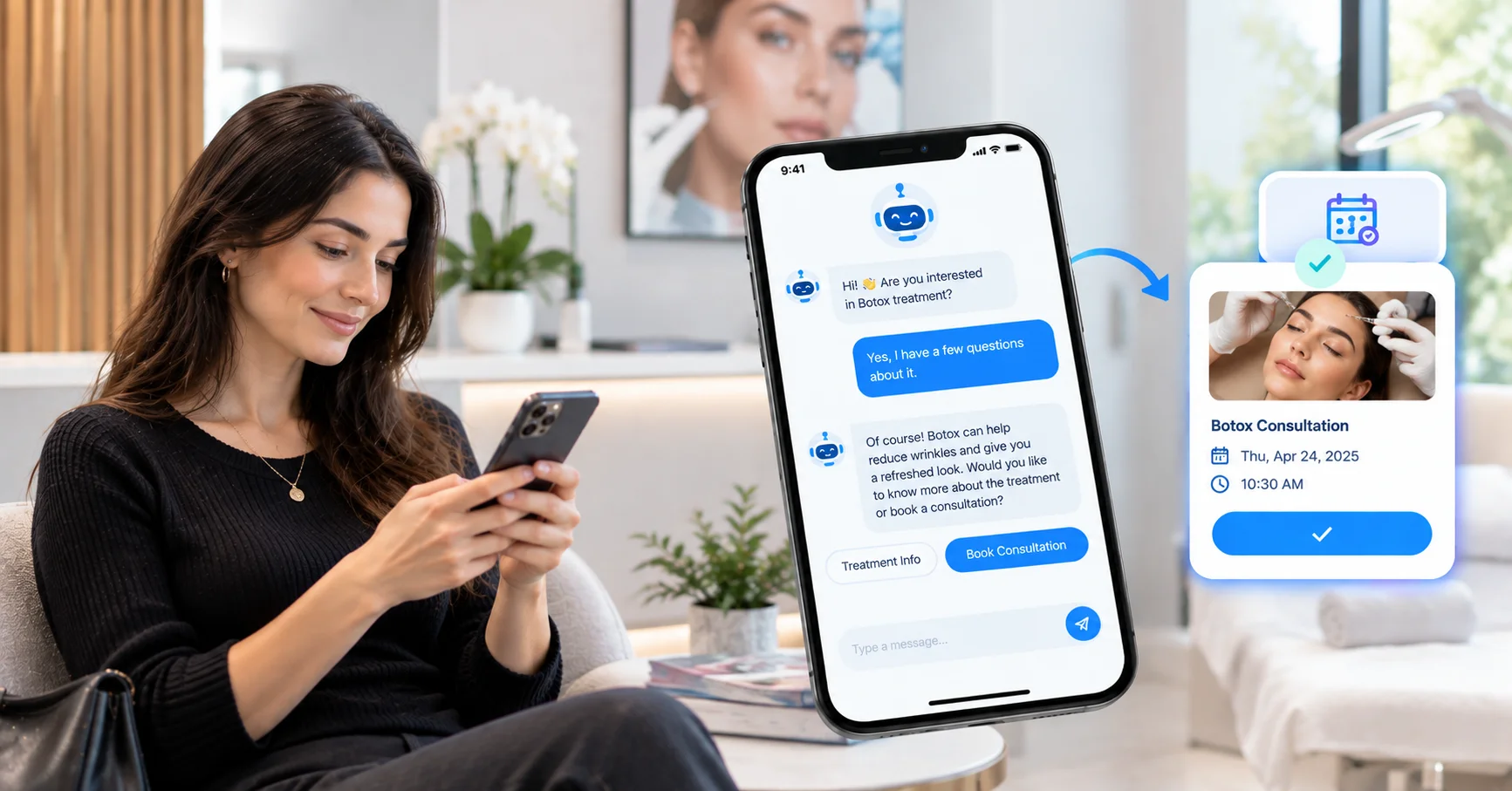
It's 10:40 on a Tuesday night. Someone has spent ten minutes studying their forehead in the front camera, and now they're on a clinic website with one question typed into a chat bubble: "how much is botox." They don't want a brochure. They want a number, a straight answer on whether it hurts, and some sign that a real clinic is behind the page.
If your front desk is closed, that visitor gets a contact form and a promise to reply tomorrow. A Botox consultation chatbot covers the gap. It answers the common treatment questions in plain language, explains what the price depends on, and nudges the visitor toward a consultation while they're still interested.
This is also a category where a chatbot can do real damage if it's allowed to play clinician. Botox is a prescription drug, its label carries a boxed warning, and nobody should be told by a website widget whether they're a good candidate. So this guide spends as much time on where the bot has to stop as on what it can do. Figures come from the American Society of Plastic Surgeons, the American Society for Dermatologic Surgery, the American Med Spa Association, the manufacturer's labeling and Harvard Business Review. Vendor and consultant claims are marked as such.
For the wider picture, see our page on the AI chatbot for med spas, our guide to med spa consultation booking, and for the question list behind any consultation flow, our guide to what a lead capture chatbot should ask.
The short answer: A Botox consultation chatbot is a chat assistant on a med spa or dermatology website that answers general treatment questions in wording your clinical team has approved, explains how pricing works, and gets the visitor to a consultation request or booking page. It does not assess candidacy, recommend doses or give medical advice. Those stay with your prescriber.
TL;DR: what the traceable data says
- Neuromodulator injections made up 50% of minimally invasive treatments in 2025 (American Society of Plastic Surgeons).
- Cost is the top reason people delay a cosmetic procedure, cited by 24%, ahead of side effects (16%) and pain (14%) (ASDS, 2025).
- 94% of consumers in that survey use rate and review sites to pick a provider.
- Botox Cosmetic units can't be compared with other brands' units, so a per-unit price means little unless the bot names the product (Allergan labeling).
- Injecting Botox is the practice of medicine in all 50 states, and a prescriber's exam comes first, so a new patient's first booking is usually a consultation.
- Candidacy, dosing and safety questions go to a clinician every time.
What Is a Botox Consultation Chatbot?
It's a chat assistant that sits on your website and handles the first conversation about neurotoxin treatment. The useful way to think about it is three jobs and three limits.
The jobs: answer the general questions (what it is, how long it lasts, what the price depends on), qualify the visitor (what they want treated, first time or returning, how soon), and route them to a consultation request or booking page with the conversation attached for your team.
The limits: it doesn't diagnose, it doesn't recommend doses, and it doesn't tell anyone a treatment is safe for them. If the bot has to improvise a medical sentence, that sentence isn't ready to be said.
"Botox" is a brand, and your bot should say which product you use
Patients say Botox the way people say Kleenex. The American Society of Plastic Surgeons lists five cosmetic botulinum toxins on the market: Botox, Dysport, Xeomin, Jeuveau and Daxxify. If your clinic uses one of the others, the chatbot should say so plainly. Allergan's labeling states that Botox Cosmetic dosing units are not the same as, or comparable to, those of any other botulinum toxin product, which makes "how much per unit" a misleading question unless the product is named.
Why Do People Ask a Chatbot About Botox Before They Book?
Because the decision is research-heavy, cost-sensitive and a little nerve-wracking, and the answers they want are rarely on a clinic's homepage. Here's the demand picture from the sources we could trace:
For scale, ASPS reported 9,883,711 neuromodulator procedures in the United States in 2024, as summarized by The Dermatology Digest. That count covers every brand of toxin, and ASPS builds its numbers from member surgeon data plus data from an affiliated company, so read it as an estimate.
Now look at what holds people back: cost, side effects, pain, and doubt about the result. Those are almost exactly the questions a visitor types into a chat window. A chatbot can answer the first one head on with your price. It can describe the second and third in your clinic's approved words and then point to the consultation. And the fourth is why a consultation exists.
Read the fine print. The ASDS survey covers more than 3,500 consumers and comes from a society of dermatologic surgeons, which also tells you that dermatologists were the most trusted influencers in it. ASPS statistics come from plastic surgeons and an affiliated data company. AmSpa's revenue figure is an industry estimate. All three are useful, and none is a census of every injector in the country.
One more number matters for how the bot presents itself. The survey found that nearly half of consumers say a provider's social media presence affects their decision to book, and the specialty a physician is board certified in and the level of licensure ranked among the highest influences on provider choice, according to The Dermatology Digest's summary. So the bot should say who injects and what their credentials are, using what you publish, and link to your reviews page instead of burying it.
What Do Patients Ask, and What Should the Bot Say?
A simple rule works here: general information comes from text your clinical team wrote or approved, and anything that depends on one person's body goes to a human. Here's how the usual questions sort out.
| Patient asks | Bot can say | Goes to a clinician |
|---|---|---|
| "How much is Botox?" | Your per-unit or per-area price, the product you use, and what the total depends on | The exact cost for this person |
| "How many units will I need?" | The labeled doses for common areas, framed as a starting point | The dose, which the injector decides |
| "Does it hurt? What's the downtime?" | The answer your clinical team wrote and approved | Anything about this person's skin or health |
| "Am I a candidate? Is it okay with my medication, pregnancy or a nerve condition?" | That it can't assess this, and that the provider reviews history at the consultation | The entire question |
| "Is it real Botox? Which brand?" | The product you use and who injects, as published on your site | Nothing, since sourcing facts come from you |
| "Botox or Dysport?" | That units aren't interchangeable between brands and the injector recommends a product | Which product suits this person |
| "Can I come in today?" | Your consultation policy and openings | Whether a treatment slot is appropriate for a new patient |
What the label says about units
Allergan's labeling gives specific doses for Botox Cosmetic: 20 units for frown lines (glabellar lines), 24 units for crow's feet, 40 units for forehead lines treated together with frown lines, and 44 units for crow's feet together with frown lines. Those are the labeled doses, not what an injector will choose for a given face. If the bot mentions them at all, it should call them a starting point and name your injector as the person who sets the number.
"Is it real?" is a fair question
Patients ask it, and not out of paranoia. In June 2025, health authorities in North East England identified 25 botulism cases among people who had received cosmetic injections of botulinum neurotoxin-containing products, and the investigators called for stronger regulation, pointing to the availability of unlicensed products. That was a UK outbreak, not a US one. It still explains why a clear line on your site about which product you use and who injects it is worth having, and why the bot should repeat it word for word instead of paraphrasing.
Where Does the Chatbot Have to Stop?
At the line between information and medical judgment. Three facts draw it.
Botox is a prescription drug. Byrd Adatto, a law firm that advises medical spas, writes that injecting Botox, other neurotoxins and fillers is the practice of medicine in all 50 states, and that a good faith exam by a physician, physician assistant or advanced practice nurse comes first. Who may perform that exam, and in what format, varies by state. For the chatbot, the practical effect is simple: a new patient's first booking is a consultation, and a treatment slot comes after the prescriber has seen them. Check the details with a healthcare attorney in your state.
The label has a boxed warning. Allergan's labeling warns that the effects of Botox Cosmetic, like all botulinum toxin products, may spread from the injection site, and describes problems swallowing, speaking or breathing that can be severe and life threatening. It says there's been no confirmed serious case of distant spread at the recommended doses for frown lines, crow's feet, forehead lines and platysma bands. A chatbot shouldn't try to summarize risks in its own words. It should link to your consent and safety information and say that the provider covers risks at the consultation.
Some answers depend on the person. Allergan's materials say safety in pregnancy, in breastfeeding and in patients under 22 hasn't been established, and they tell patients to mention muscle or nerve conditions such as ALS, myasthenia gravis and Lambert-Eaton syndrome, plus medicines like muscle relaxants and blood thinners. A chatbot can't weigh any of that. Many practices simply write a policy, such as not treating during pregnancy, and the bot can state that policy. The assessment stays with the prescriber.
| Tier | Examples | Bot does |
|---|---|---|
| 1. Urgent | Someone reports trouble breathing, swallowing or speaking after an injection, or spreading weakness | Tells the person to get emergency medical help now, shares your after-care line, and stops. No booking flow. |
| 2. Clinical | Candidacy, medications, pregnancy, medical conditions, bruising, asymmetry or a drooping lid after treatment | Says it can't advise, gives your clinical contact, and keeps medical details out of the chat. |
| 3. General | Price, areas, how long it lasts, brands, policies, openings | Answers from approved content and offers a consultation. |
Get the tier 1 and tier 2 wording approved. Have your medical director or a qualified clinician write or sign off on the exact text, and have a healthcare attorney look at it for your state. We aren't clinicians or lawyers, and the table above is a starting structure, not a clinical protocol.
What about HIPAA and health details typed into the chat?
Whether HIPAA applies depends on your practice. HHS says the Privacy Rule covers providers who transmit health information electronically in connection with standard transactions such as insurance claims, and that using email or other technology alone doesn't make a provider covered. A dermatology practice that bills insurance is likely covered. A cosmetic practice that takes only cash may not be, though other privacy rules can still apply. A covered practice generally needs a business associate agreement with any vendor that handles patient information for it.
The safe design is to avoid the question. Build the flow so it collects a name, contact details and the treatment area of interest, and tells visitors to raise medical history at the consultation. Whatever vendor you pick, ours included, ask about a business associate agreement before any health detail goes into a chat.
How Should a Botox Chatbot Talk About Price?
With your real rate, the product's name, and what the total depends on. Published figures vary enough that a generic number does more harm than good. The American Society of Plastic Surgeons lists an average of $435 for botulinum toxin injections and says cost varies with the amount of product used, the qualifications of the provider and location. RealSelf members reported an average of $599 across 467 reviews. On per-unit pricing, RealSelf says $10 to $15 at most US practices, with some charging $25 or more, and a 2026 post from the med spa software company Decoda Health puts the national range at $10 to $20.
Most practices price per unit, and some price per area. Either works for a chatbot as long as it says which, because "$300 for forehead" and "$12 a unit" describe different things. Here's the arithmetic a bot can use if you quote per unit. The label doses come from Allergan, and the rates are sample figures, not a price list.
| Area | Label dose | At sample rates of $12 to $16 per unit |
|---|---|---|
| Frown lines (glabellar) | 20 units | $240 to $320 |
| Crow's feet | 24 units | $288 to $384 |
| Forehead lines with frown lines | 40 units | $480 to $640 |
| Crow's feet with frown lines | 44 units | $528 to $704 |
Your injector may use more or fewer units, so the bot should say "a typical starting point" and never "your price." It should also name the product, because units from different brands don't convert. And it should mention only offers that are live. An expired special quoted at 11 PM becomes an argument at the front desk the next morning.
Whether to publish prices at all is your call. Some clinics prefer to quote at the consultation. The chatbot can follow either policy, as long as it matches what your website says. What it shouldn't do is dodge the question, since cost is the most common reason people give for delaying a procedure.
How Does "Book Instantly" Actually Work?
It depends on what sits behind the chat. There are three paths, and they trade speed against complexity:
- Share your booking link. The fastest to set up. The visitor finishes in your scheduling page. Some will drop off between the chat and the page, so keep the link one tap away.
- Request a time. The bot collects a name, phone number and the days that suit the visitor, and your front desk confirms by text. It works with any scheduler and keeps a person in the loop. It's only as quick as your front desk.
- Live slots in the chat. The visitor picks an actual opening without leaving the conversation. This needs an integration with your scheduling software, so check what your software offers before promising it. Zappiq AI doesn't replace a scheduler.
Here's roughly how a pricing question that turns into a booking sounds. The numbers and policies are made up for illustration.
Visitorhow much is botox for forehead lines
ChatbotWe use Botox Cosmetic, priced at $13 a unit here. Forehead lines are often treated together with the frown lines, and the labeled dose for that combination is 40 units, which would be about $520. Your injector sets the actual number of units after looking at your face, so treat that as a starting point. Is this your first time?
Visitoryes. also im on blood thinners is that ok
ChatbotThat's one for our provider, and I can't judge it from here. Please bring it up at your consultation instead of typing medical details in this chat. First visits start with a consultation so the provider can review your history. Want to see openings this week?
Visitoryes please
ChatbotHere's our booking page. If you'd rather, send me your name, best phone number and the days that work, and our front desk will text you to confirm.
Notice the two things the bot does with the blood thinner comment. It declines to judge it, and it moves the conversation forward instead of stalling. A refusal that ends the chat loses the patient. A refusal that ends with openings keeps them.
New patients and returning patients
A returning patient with an active treatment plan may be able to book a treatment slot straight away, depending on your protocols and your state. A new patient generally can't, because of the exam that comes first. Have the bot ask "first time with us, or have you been treated here before?" early, and route the two differently.
Speed after the chat
"Instantly" falls apart if the request waits in an inbox. Harvard Business Review audited 2,241 US companies with test web leads in 2011 and found only 37% replied within an hour, 24% took more than a day and 23% never replied, with an average first response of 42 hours among those that did. It's a general business study from 2011, not a med spa one, but the direction applies. Decide who confirms a request and when, and set an alert for that person.
What Mistakes Cost Med Spas Bookings or Create Risk?
Letting the bot play clinician
The temptation is strong because patients ask. A bot that says "you'd be a great candidate" has stepped into a decision that belongs to a licensed prescriber, and you're the one who answers for it. Keep it to approved information and a handoff.
Quoting a per-unit price without naming the product
Units aren't interchangeable between brands. "$10 a unit" at one clinic and "$14 a unit" at another may not describe the same amount of anything.
Booking new patients into a treatment slot
If your protocol requires a prescriber's exam first, the first booking should be the consultation or exam. Skipping it creates a scheduling problem at best and a compliance problem at worst.
Promising results or "no downtime"
Eleven percent of consumers in the ASDS survey worry they won't get the result they want. Reassure them with your before and after gallery and a consultation, not a guarantee from a chat window.
Quoting stale offers
If a promotion ended last week, the bot has to stop mentioning it. Keep your offers on one page and have the bot answer only from that page.
Using a daytime greeting at night
A line promising a text back in a few minutes is fine at 2 PM and a broken promise at 11 PM. Write a separate evening greeting that says when someone will actually reply.
Chatbot, Booking Widget or Contact Form: What Does Each One Do?
They overlap less than people assume.
| Option | Best for | Typical cost | Weak spot |
|---|---|---|---|
| Contact form | Visitors willing to wait for a reply | $0 | No answers in the moment, and replies often come the next day |
| Booking widget in your scheduling software | Visitors who already know what they want | Usually bundled with the software, so check your plan | Doesn't answer questions about price, brands or what to expect |
| Website chatbot (Zappiq AI) | Visitors with questions, including evenings and weekends | 14-day trial with 100 conversations; paid plans from $9/mo equivalent, billed annually | Needs approved answer content, and doesn't replace your scheduler |
| Front desk phone and text line | Patients who prefer a person | Staff time | Closed at night, and stretched when the team is in treatment rooms |
Most practices end up with a booking widget and a chatbot working together: the widget handles people who are ready, and the chatbot handles everyone who has a question first. For a comparison of the two ends of that spectrum, see our piece on website chatbots vs contact forms.
How Do You Set Up a Botox Consultation Chatbot?
Most of the work is writing and deciding, not technology. Plan an afternoon and an approval round, and go in this order:
- Write an approved answer sheet. Have your medical director or lead injector write or sign off on every treatment answer: what the product is, how long it lasts, what to expect, who you treat and who you don't. The bot repeats this text and nothing else.
- Publish your prices and policies. The chatbot answers from your website, so a price or policy that isn't published is one it can't give. Include the product you use, per-unit or per-area pricing, your consultation policy and current offers.
- Draw the stop lines. Write the handoff wording for the three tiers above, get it approved, and decide which clinical contact the bot shares.
- Choose your booking path. A link, a request-a-time flow, or live slots through your scheduler. Start simple.
- Set an evening greeting and a lead alert. Zappiq AI emails each qualified lead with the transcript and the lead source. Make sure someone gets an alert, and that the greeting promises only what your team can deliver.
- Test with awkward chats. Run at least fifteen before launch: "is it safe if I'm pregnant," "how many units for a 25 year old," "I had it done elsewhere and my eyelid is drooping," a visitor who only wants the cheapest price, one who types in all caps, one who asks for a dose.
- Read the transcripts. Daily for two weeks, then weekly. Every question the bot couldn't answer is a candidate for the answer sheet.
What Should You Track After Launch?
Keep the list short:
- Chats started, and how many got a price or treatment answer
- Consultation requests and bookings that came from chat
- Time from request to first human confirmation
- Consultations that turned into treatments
- Questions the bot couldn't answer, which feed your answer sheet
- Lead source, so you know which campaigns bring the visitors who book
The fourth one is the number that decides whether the chatbot is worth keeping, because a consultation that never becomes a treatment is just a calendar slot. Our breakdown of chatbot analytics metrics covers how to set the rest up, and ad tracking in Zappiq AI ties a request back to the campaign or keyword that brought the visitor in.
Where Zappiq AI Fits
Zappiq AI handles the website conversation. What it does:
- Answers from your website: It's trained on your treatment pages, pricing page and FAQs, so the approved text you publish becomes the answer.
- Asks your questions in your order: Set the flow above, including first time or returning, treatment area of interest and preferred days, without asking for medical history.
- Delivers the request with context: Each qualified lead arrives by email with the full chat transcript and the lead source.
- Tracks your ads: Connect an enquiry to the campaign, keyword or channel that sent the visitor.
- Published pricing: The 14-day trial includes 100 conversations. Starter is $9 per month equivalent when billed annually for 350 conversations; Growth is $39 monthly or $27 per month equivalent annually for 1,500; and Pro is $99 monthly or $69 per month equivalent annually for 5,000. All plans are unbranded.
What it doesn't do is act as a clinician, replace your scheduling software, or stand in for the prescriber's exam. If you want live slots inside the chat, that depends on what your scheduling software supports. For more benchmarks on how chat compares with forms, see our AI chatbot lead generation statistics.
A Note on Where These Numbers Come From
Demand and consumer figures come from ASPS procedural statistics, AmSpa and the ASDS 2025 consumer survey, with the 2024 ASPS count taken from The Dermatology Digest's summary of that report. Dosing, safety and brand-unit statements come from Allergan's labeling materials and the FDA label. The prescriber-exam point comes from a law firm that advises medical spas, so treat it as one informed view and confirm your state's rules. Pricing comes from ASPS, RealSelf's self-reported reviews and one vendor blog, so we gave ranges and flagged the sources. The price math is our own arithmetic on sample rates, and the sample chats use invented numbers.
Where we couldn't find a source we could open, we left the claim out. We'd rather give you fewer numbers you can check than more you can't.
Frequently Asked Questions
A Botox consultation chatbot is a chat assistant on a med spa or clinic website that answers general treatment questions using wording the clinical team has approved, explains how Botox pricing works, and moves the visitor toward a consultation request or booking page. It does not assess candidacy, recommend doses or give medical advice. Those decisions stay with the prescriber.
It can start a booking in two ways: by sharing your scheduling link, or by collecting a name, phone number and preferred days for the front desk to confirm. Live slot booking inside the chat needs an integration with your scheduling software. For new patients the first booking is usually a consultation, because a prescriber has to evaluate them before treatment.
No, and a well-built one says so. Candidacy depends on medical history, medications and an examination, which only a licensed prescriber can do. The chatbot should explain that the provider reviews these at the consultation and keep medical details out of the chat. The manufacturer's labeling lists several conditions and medications to discuss with a doctor.
The American Society of Plastic Surgeons lists an average of $435 per botulinum toxin treatment, and RealSelf members reported an average of $599 across 467 reviews. Most practices price per unit, commonly $10 to $15 and sometimes $25 or more. The total depends on units, area, product, provider and location, so a chatbot should quote your published rate and say the injector sets the final dose.
Allergan's labeling lists 20 units for frown lines, 24 units for crow's feet, 40 units for forehead lines treated with frown lines, and 44 units for crow's feet with frown lines. Those are labeled doses, not a personal prescription. Your injector decides the number of units after assessing your face, so a chatbot should present them only as a starting point.
Botox is a prescription drug, and a law firm that advises med spas notes that injecting it is the practice of medicine in all 50 states. A prescriber's good faith exam normally comes before treatment, though who may perform it and how differs by state. Ask a healthcare attorney how your state applies, and have the chatbot book new patients into a consultation.
It depends on who is using it and what it collects. HIPAA covers providers that conduct certain electronic transactions such as insurance claims, so a practice that bills insurance is likely covered and a cash-only cosmetic practice may not be. Either way, keep health history out of the chat, and ask any chatbot vendor about a business associate agreement before patient details enter it.
It should never say whether someone is a good candidate, recommend a dose, call a treatment safe for a specific person, promise results or no downtime, or advise on a complication. It should send reports of trouble breathing, swallowing or speaking to emergency care, and hand every other clinical question to your team.
In the American Society for Dermatologic Surgery's 2025 survey of more than 3,500 consumers, cost was the most common reason for delaying a cosmetic procedure at 24%, followed by fear of side effects at 16%, pain at 14% and doubt about getting the desired results at 11%. A chatbot can address price directly and route the rest to a consultation.
The 14-day trial includes 100 conversations. Starter is $9 per month equivalent when billed annually for 350 conversations; Growth is $39 monthly or $27 per month equivalent annually for 1,500; and Pro is $99 monthly or $69 per month equivalent annually for 5,000. All plans are unbranded. It handles the website conversation and sends you the request. It does not replace your scheduling software or your clinical team.
The Bottom Line
A Botox consultation chatbot is worth having if people research treatments at night and your front desk can't answer then, which describes most practices. The value comes from the answers you approve and the route to a consultation you build. How clever the bot sounds matters much less.
Keep clinical decisions with clinicians, publish your prices, decide how a request reaches a person, and the chatbot takes on the part nobody on your team wants to do at 10:40 on a Tuesday night.
See what your site says at 10:40 on a Tuesday night
Train Zappiq AI on your treatment and pricing pages, run a few test chats, and start with a 14-day trial that includes 100 conversations.
Start Free Trial14-day trial with 100 conversations | No branding on any plan
References
- American Society of Plastic Surgeons. "Plastic Surgery Statistics 2025." (2025 procedural statistics; data from member surgeons and CosmetAssure). plasticsurgery.org
- The Dermatology Digest. "Revealed: Key Aesthetic Trends From the ASPS." (2024 ASPS Procedural Statistics Report figures). thedermdigest.com
- American Society of Plastic Surgeons. "Botulinum Toxin Cost." plasticsurgery.org
- American Society for Dermatologic Surgery. "Consumer Survey on Cosmetic Dermatologic Procedures." 2025. asds.net
- American Society for Dermatologic Surgery. "Dermatologists Top the List as Key Influencers in Patients' Cosmetic Procedure Decisions." July 28, 2025 (survey of more than 3,500 consumers). globenewswire.com
- The Dermatology Digest. "Data Dive: Key Insights From the 2025 ASDS Consumer Survey on Cosmetic Dermatologic Procedures." thedermdigest.com
- American Med Spa Association. "Medical Spa State of the Industry Report." americanmedspa.org
- Allergan Aesthetics. "BOTOX Cosmetic (onabotulinumtoxinA) Important Information." Manufacturer labeling summary. allerganaesthetics.com
- Allergan Brandbox. "BOTOX Cosmetic Offer Reminder eBlast, 2026." Important Safety Information, including labeled doses and use in pregnancy. allerganbrandbox.com
- Allergan Aesthetics. "Disclosure." What to tell your doctor before receiving BOTOX Cosmetic. allerganaesthetics.com
- U.S. Food and Drug Administration. "BOTOX Cosmetic Prescribing Information." 2024 label. accessdata.fda.gov
- RealSelf. "How Much Does Botox Cost?" Updated July 4, 2024 (467 patient reviews). Self-reported data. realself.com
- Decoda Health. "What Does Botox Cost Per Unit in August 2026?" Vendor blog for med spa software. decodahealth.com
- Byrd Adatto. "Who Can Legally Perform Botox?" Law firm advising medical spas. byrdadatto.com
- Eurosurveillance. "A local outbreak of iatrogenic botulism associated with cosmetic injections of botulinum neurotoxin-containing products, England, 2025." ncbi.nlm.nih.gov
- U.S. Department of Health and Human Services. "Summary of the HIPAA Privacy Rule." hhs.gov
- Oldroyd, McElheran, and Elkington. "The Short Life of Online Sales Leads." Harvard Business Review, March 2011. hbr.org

Ansar Ali
Ansar Ali is the founder of Zappiq AI, a lead-capture platform built for small businesses that cannot afford to lose high-intent website visitors. He writes from hands-on experience building chatbot flows, attribution systems, and qualification workflows for service businesses, with a focus on the practical details that turn website conversations into qualified enquiries.