
Quick Summary
- Zappiq AI is the best Chatfuel alternative for businesses that want a website chatbot focused on capturing and qualifying leads, not a DM broadcast tool. Flat pricing, no per-contact scaling, no branding fee.
- ManyChat is the closest direct swap for Chatfuel's Instagram and WhatsApp automation, with contact-based billing that tends to undercut Chatfuel at smaller list sizes.
- WATI fits businesses whose automation need is WhatsApp and only WhatsApp, with a dedicated shared inbox built on the official Business API.
- Landbot is worth a look for teams that want a proper visual flow canvas rather than Chatfuel's more template-driven builder.
- Tidio pairs AI replies with a genuine live agent inbox, useful for ecommerce stores that need a human in the loop.
- Botpress suits technical teams that want an AI agent that reasons through open-ended conversation rather than following a fixed flow.
- Typebot is the open source option, with a self-hosted path for teams that would rather own their infrastructure than pay a monthly contact fee at all.
Why Businesses Look Past Chatfuel
Chatfuel has been around since 2015 and was one of the first tools that let ordinary marketers build a Messenger bot without writing code. That head start still shows. It has official Meta partner status, a real WhatsApp Business Solution Provider designation, and integrations with the tools most small businesses already run, Shopify, Kommo, Stripe, Calendly, Zapier. For a business that wants Facebook, Instagram, WhatsApp, and TikTok automation from one dashboard, Chatfuel genuinely covers a lot of ground.
The trouble people run into isn't the feature set. It's the 2026 pricing rework. Chatfuel used to have a usable free tier and a handful of low-cost plans. That structure is gone. What's left is a contact-based model built around two AI tiers, commonly called Fuely Super and Fuely Max, and there's no permanent free option anymore, only a 7-day trial before the card gets charged.
The entry price looks reasonable on the pricing page. It isn't the number that matters once your bot starts working. Chatfuel bills by active contacts, meaning any unique person who messages your bot within a rolling 30-day window, regardless of how many messages you exchange with them. A small operation might sit comfortably at $39 a month for 150 contacts. The moment a post goes semi-viral or an ad campaign performs well, that same account can land in the $169 to $279 a month range at a few thousand contacts, and the premium GPT-5 tier, Fuely Max, runs close to double the Fuely Super price at every level.
What a Growing Business Actually Pays on Chatfuel
WhatsApp complicates the picture further. Chatfuel's own subscription doesn't cover Meta's messaging fees. Every WhatsApp conversation sent through the platform is billed separately by Meta, based on message category and recipient country, generally $0.02 to $0.08 per marketing conversation. That's not unique to Chatfuel; every WhatsApp automation tool passes those fees through in some form. But it does mean the number on Chatfuel's pricing page is never the full bill for a business running active WhatsApp campaigns.
Support is the other recurring complaint in third-party reviews. Public review aggregators put Chatfuel's customer support score noticeably below its other categories, and a number of one-star reviews describe support responses that felt dismissive rather than helpful when contacts or billing questions came up. That's worth weighing for a business that expects to lean on support during setup or a billing dispute.
None of that erases what Chatfuel does well. Businesses that fit comfortably under a few thousand contacts, and mainly want WhatsApp, Instagram, and Facebook automation with AI replies layered on top of a visual flow, can still get real value here. The businesses shopping around tend to be the ones outgrowing the contact-based pricing, the ones who lost their free plan and never replaced it with a paid one, or the ones who came to Chatfuel expecting a website lead-generation tool and got a social DM platform instead.
Quick Comparison: 7 Chatfuel Alternatives
| Tool | Starting Price | Pricing Model | WhatsApp Support | Best For |
|---|---|---|---|---|
| Zappiq AI | Free trial | Flat by volume | No, email alerts instead | Lead generation, SMB websites |
| ManyChat | Free / $15/mo | Contact-based | Yes, add-on | Instagram and WhatsApp DM marketing |
| WATI | $59/mo | Seat + message based | Yes, WhatsApp-only focus | Dedicated WhatsApp support inbox |
| Landbot | Free / €40/mo | Chat + AI chat split | Yes, separate add-on plan | Visual flow builder for web and WhatsApp |
| Tidio | Free / $29/mo + AI add-on | Flat + Lyro add-on | No native channel | Live chat + AI, ecommerce |
| Botpress | Free / $89/mo + AI spend | Flat + usage | Yes, all paid plans | Developer-built AI agents |
| Typebot | Free / $39/mo | Usage-based, self-host option | Yes, Pro tier and up | Open source flow builder |
1. Zappiq AI: Best for Lead Generation on Business Websites
Zappiq AI
zappiqai.com | AI lead generation chatbot built for small and medium business websites
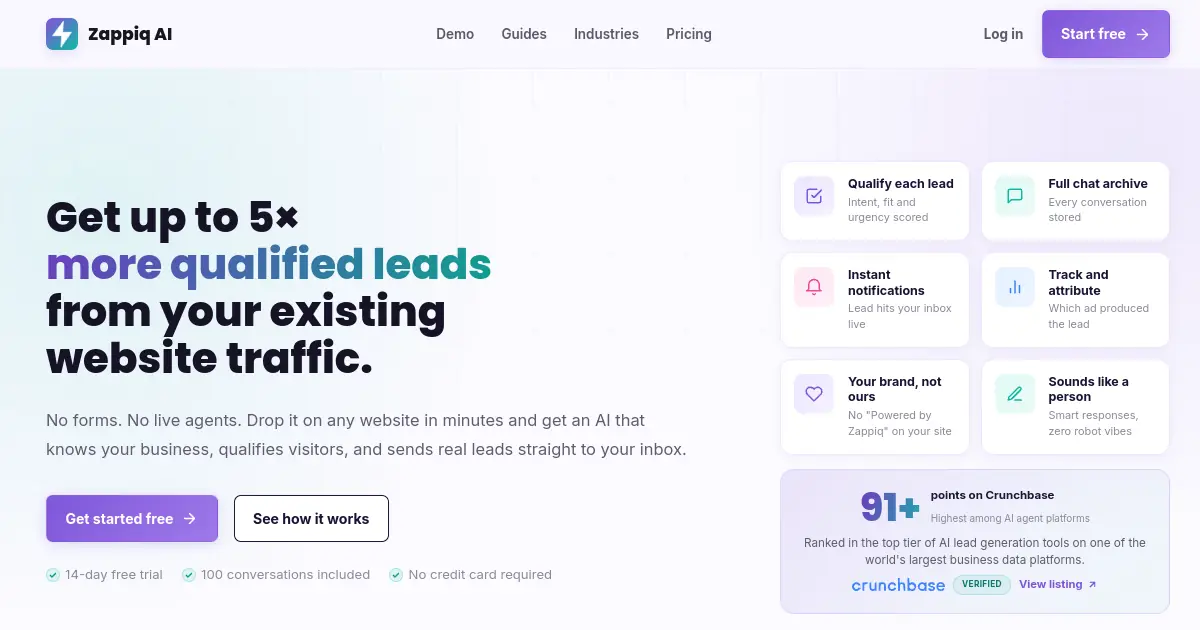
Chatfuel and Zappiq AI aren't really solving the same problem, and that's exactly why Zappiq belongs at the top of a Chatfuel alternatives list rather than being a feature-for-feature clone. Chatfuel was built to automate conversations on Facebook, Instagram, and WhatsApp, channels where your bot goes looking for the audience. Zappiq sits on your website, waiting for visitors who already showed up on their own, and its entire job is turning that visit into a qualified lead.
Setup reflects that difference. There's no flow to build, no contact list to import, no channel to connect one at a time. Zappiq reads your website when you sign up, trains itself on your services and pages automatically, and starts qualifying visitors right away. Compare that to Chatfuel's flow builder, which needs blocks, buttons, and AI prompts configured by hand before it does anything useful.
Billing is the other place the two diverge sharply. Chatfuel counts every unique person who messages your bot and charges more as that number climbs, which means a good month can quietly become an expensive one. Zappiq bills flat by conversation volume on your website. There's no per-contact counter creeping upward in the background, and no risk of a single busy week pushing you into a pricing tier you didn't plan for.
Lead qualification happens inside the conversation itself, not as a separate workflow you have to design. The bot asks about intent, timeline, and budget fit as visitors talk to it, and the second someone qualifies, an email lands in your inbox with their details and the full transcript. Every lead also carries the campaign or keyword that brought that visitor to your site in the first place, something neither Chatfuel nor most social automation tools are set up to track, since they live inside the messaging platform rather than on your ad landing pages.
For agencies: Zappiq ships white-label on client sites with no added branding fee. That matters if you were running Chatfuel across several client accounts and watching each one's active-contact count push the bill higher independently.
Pros
- Flat billing by conversation volume, not active contacts
- Auto-trains on your website, nothing to build first
- Lead qualification built into the conversation itself
- Instant email alerts with full conversation context
- Ad source and keyword tracking on every lead
- No branding fee on any plan
- Free trial, no card required to start
- White-label ready for agencies
Cons
- No Instagram or Facebook DM automation
- Smaller community than an established platform like Chatfuel
- No native WhatsApp channel yet
- Not built for broadcast campaigns or drip sequences
Why lead-focused teams choose Zappiq AI
Ad tracking: Connect each qualified enquiry to the campaign, keyword, or channel that generated it, so paid traffic can be measured against real leads.
Email lead delivery: Receive contact details, intent, source data, and the full conversation in your inbox as soon as the lead qualifies.
No branding: Keep the widget aligned with your brand without a third-party badge or a separate white-label fee.
Automatic website training: Let Zappiq learn from your services, pricing, and FAQ pages instead of building a social-channel flow library.
Natural qualification: Ask useful follow-up questions and identify genuine fit before collecting contact information.
Simple installation: Add one script to WordPress, Shopify, Webflow, Wix, Squarespace, or a custom website without configuring Meta-channel automations.
Pricing
Pricing: The 14-day trial includes 100 conversations. Starter is $9/month equivalent when billed annually for 350 conversations; Growth is $39/month or $27/month equivalent annually for 1,500; and Pro is $99/month or $69/month equivalent annually for 5,000, with no per-lead fees or Zappiq branding.
Best for: Small and medium business websites that want a chatbot built specifically to capture and qualify leads, rather than a general social automation tool repurposed for a website widget. Especially strong for service businesses and agencies running paid traffic who need every lead tied back to the campaign that produced it.
2. ManyChat: Closest Direct Swap for Social DM Automation
ManyChat
manychat.com | Contact-based marketing automation for Instagram, Messenger, WhatsApp, and SMS

If what you actually want out of Chatfuel is comment-to-DM triggers, broadcast sequences, and keyword automations across Instagram and WhatsApp, ManyChat covers essentially the same ground and has been doing it for longer. Both tools use a similar visual builder, both connect to the same Meta channels, and switching between them doesn't require relearning the concept of a flow.
Pricing is also contact-based here, same structural idea as Chatfuel's Fuely tiers, but the numbers land differently at the low end. ManyChat's Pro plan starts around $15 a month for 500 contacts and rises gradually from there, roughly $25 for 1,000 and $45 for 2,500. A small account tends to land cheaper on ManyChat than on Chatfuel's $39 entry tier, though the gap narrows and can reverse at higher contact counts depending on which AI tier you're comparing against.
The free plan is real but limited, capped at 25 active contacts on the current tier structure, which is enough to test the builder but not to run a live campaign. AI features sit on the Pro and Business tiers rather than the free plan, similar to how Chatfuel gates its Fuely AI behind a paid tier.
WhatsApp fees work the same way they do everywhere: Meta charges its own per-conversation rate on top of whatever ManyChat charges for the platform itself. The difference from Chatfuel is mostly in how predictable the base subscription feels at smaller list sizes, and in how deep the Instagram-specific automation goes, comment automation, story mention triggers, and DM funnels that Chatfuel's more general channel coverage doesn't match feature for feature.
Pros
- Nearly identical channel coverage to Chatfuel
- Cheaper entry pricing at small contact counts
- Deepest native Instagram automation of any tool on this list
- Broadcast campaigns and drip sequences built in
- Long track record and large template library
Cons
- Free plan capped at 25 contacts
- AI features gated behind paid tiers, same pattern as Chatfuel
- Contact-based billing still climbs with growth, just at different rates
- Not built as a website lead-capture widget
Pricing
Best for: Businesses that want to keep the same general workflow they had on Chatfuel, comment triggers, broadcasts, keyword automation, but at a lower entry cost for a smaller audience.
3. WATI: Best for WhatsApp-Only Support Teams
WATI
wati.io | WhatsApp Business API platform with a shared team inbox, broadcasts, and a no-code flow builder
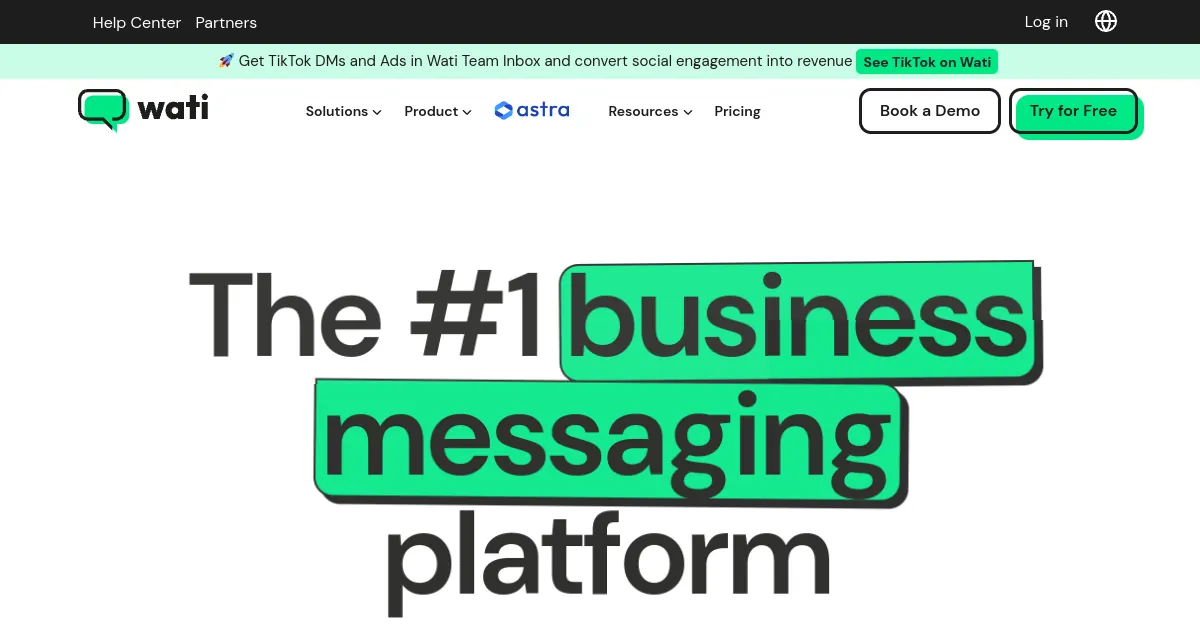
Chatfuel spreads itself across Facebook, Instagram, WhatsApp, and TikTok. WATI does one thing, WhatsApp, and goes deeper into it than a multi-channel tool typically can. If your actual usage of Chatfuel was almost entirely WhatsApp support and broadcast campaigns, and the other channels were never really used, WATI is worth a serious look specifically because it isn't trying to do everything else too.
The Growth plan starts at $59 a month for 5 users, 1,000 chatbot sessions, and 10 flows. Pro runs $119 a month, and Business lands between $279 and $349 a month depending on annual or monthly billing, aimed at teams with 15 or more agents doing checkout and payment work over WhatsApp. Extra seats cost roughly $24 a user on Pro and jump to about $69 a user on Business, a steep increase for adding headcount without new functionality.
Message costs sit on top of every plan, same as they do on Chatfuel. WATI passes through Meta's per-message rate and adds its own markup, commonly cited around 20 percent, on marketing, utility, and authentication messages. A single strong campaign or a seasonal spike can multiply that line item well beyond what the base subscription suggests, so the plan price is really a floor rather than the full picture.
Where WATI earns its keep is the shared inbox itself. Role-based agent assignment, quick replies, and campaign analytics are built specifically around WhatsApp conversations rather than adapted from a more general chatbot platform, and reviewers consistently point to that focus as the reason to pick WATI over a broader tool once a support team is doing serious volume through WhatsApp alone.
Pros
- Purpose-built for WhatsApp, no unused channels to configure
- Shared team inbox with role-based agent assignment
- Strong broadcast and template management tools
- No-code flow builder covers basic automation needs
- Well suited to checkout and payment workflows over WhatsApp
Cons
- Per-seat costs jump steeply between plan tiers
- Message fees plus a markup on top of Meta's own rate
- No free plan, only a short trial
- No coverage for Instagram, Facebook, or TikTok
Pricing
Best for: Support and sales teams whose Chatfuel usage was overwhelmingly WhatsApp, and who want a dedicated inbox rather than a multi-channel tool carrying features they never touch.
Tired of watching your contact count set your bill?
Zappiq AI bills flat by conversation volume, not by how many people happen to message your bot. Your chatbot trains itself on your website and emails you every qualified lead the moment it's captured.
Start Free Trial >No credit card | No per-contact scaling | No branding fee
4. Landbot: Best Visual Flow Builder for Web and WhatsApp
Landbot
landbot.io | Drag-and-drop conversational flow builder for websites and WhatsApp

Landbot and Chatfuel both let you drag blocks onto a canvas and wire up a conversation, but Landbot's builder goes further into conditional logic and personalized variables, which makes it a better fit for a team that wants tight control over exactly how a scripted conversation branches, rather than relying mostly on AI to fill the gaps the way Chatfuel's Fuely layer does.
Pricing works differently, and not necessarily better. Landbot splits every plan into regular chats and AI chats as two separate quotas, with the Starter plan including 500 regular chats but only 100 AI chats a month for around €40. WhatsApp isn't included in that price either; it's a separate plan starting at €80 a month for WhatsApp Starter. A business coming from Chatfuel, where WhatsApp is at least bundled into the base subscription, will find Landbot's split-plan structure adds a comparable cost in a different shape.
Where Landbot pulls ahead is a Sandbox free plan that actually persists, capped at 100 chats and one seat but with no expiration date, unlike Chatfuel's 7-day trial that runs out regardless of usage. For a very small business or a solo operator testing whether a chatbot is worth investing in at all, that's a meaningful difference.
Seats add roughly €25 a month each past the plan's included count, a cost structure Chatfuel doesn't really have in the same form, since Chatfuel's contact-based pricing scales with audience size rather than team size. Which one costs more depends heavily on whether your bottleneck is contact volume or headcount.
Pros
- Deeper visual flow logic than Chatfuel's block builder
- Genuinely persistent free Sandbox plan, no expiration
- Strong conditional branching and variable handling
- Covers both website and WhatsApp deployment
- Large integration and template catalog
Cons
- AI chats and regular chats billed as two separate quotas
- WhatsApp sold as a separate plan, not bundled
- Per-seat charges on top of chat costs
- No Instagram or Facebook DM automation like Chatfuel offers
Pricing
Best for: Teams that want granular control over a scripted flow with real conditional logic, and are comfortable with a split pricing model instead of Chatfuel's single contact-based meter.
5. Tidio: Best for Live Agent Handoff on Ecommerce Sites
Tidio
tidio.com | AI chatbot combined with a live chat inbox, strong Shopify integration
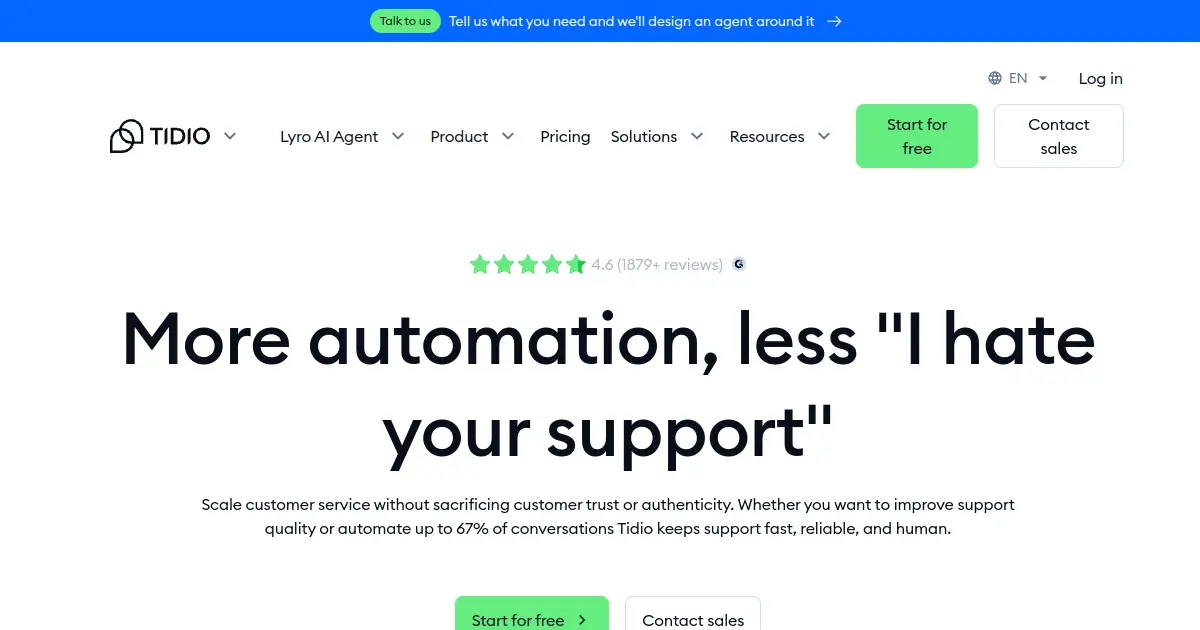
Chatfuel's Fuely AI handles free-text questions reasonably well within its own flows, but there's no built-in way for a human agent to step into the same conversation if the bot gets stuck. Tidio solves that specific gap by pairing an AI layer with an actual live chat inbox, so a support rep can take over mid-conversation without the visitor having to start over on a different channel.
The base plan starts at $29 a month, but the AI chatbot itself, called Lyro, is a separate add-on starting around $39 a month. Combined, a small business running both typically lands between $68 and $150 a month depending on volume, which is a similar shape to Chatfuel's tiered pricing, just split across two products instead of one contact-based meter.
The Shopify integration is the strongest reason to pick Tidio over Chatfuel for an ecommerce store specifically. Cart recovery flows, product recommendations, and order status lookups come as ready-made templates rather than something you build from scratch, and that ecommerce focus goes deeper than Chatfuel's more general-purpose automation.
What Tidio doesn't have is a native WhatsApp channel, which matters if WhatsApp was the main reason you were on Chatfuel in the first place. Businesses whose priority is WhatsApp specifically are better served by ManyChat, Landbot, or WATI on this list.
Pros
- Live agent inbox built in alongside the AI chatbot
- Strong native Shopify and WooCommerce templates
- Well documented, large existing user base
- Free plan available for testing before paying
- Over 100 platform integrations
Cons
- Lyro AI is a paid add-on, not included in the base plan
- No native WhatsApp channel
- No Instagram or Facebook DM automation
- Growth plan jumps steeply to the next tier
Pricing
Best for: Ecommerce stores, particularly on Shopify, that want a real human agent available alongside the AI chatbot, and don't rely on WhatsApp as a core channel.
6. Botpress: Best for Developer-Built AI Agents
Botpress
botpress.com | AI-native agent builder combining visual flows with autonomous LLM handling
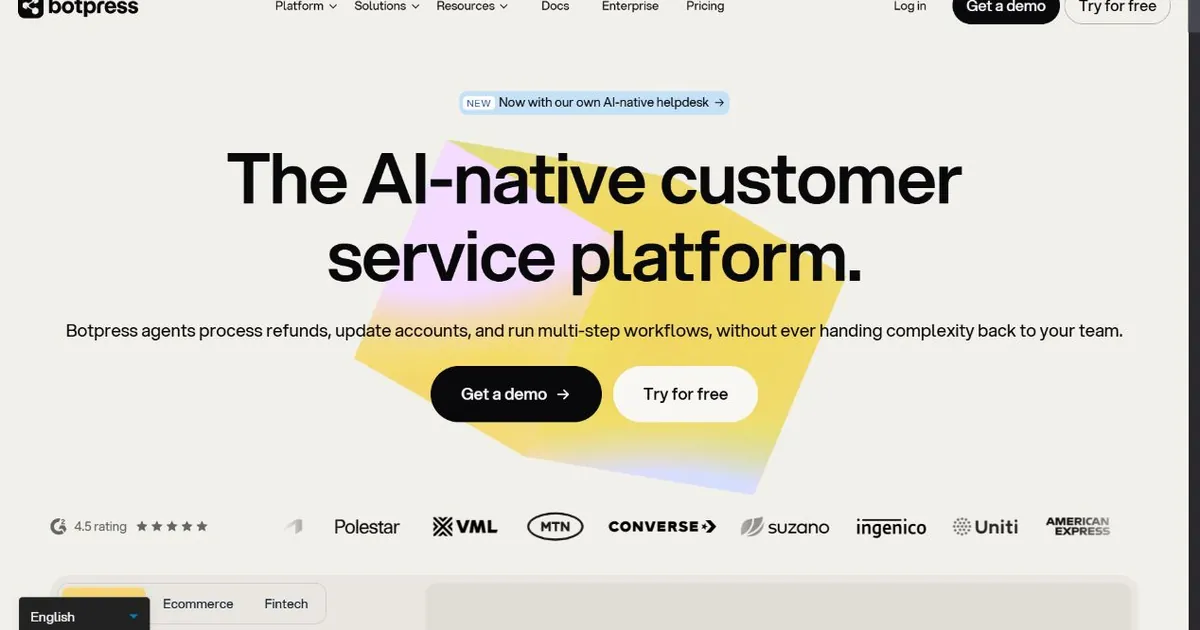
Chatfuel's Fuely AI layers GPT responses on top of a flow the same way most flow-first platforms add AI now, as a fallback for questions the buttons don't cover. Botpress inverts that relationship. Its Autonomous Node lets an LLM handle open-ended parts of a conversation on its own inside a structured flow, so the bot can reason through a question rather than pattern-match it against a script. For a team with developer resources that wants that level of flexibility, Botpress goes further than Chatfuel was ever designed to.
The free pay-as-you-go tier includes unlimited bots and a small monthly AI credit, enough to build and test a real prototype before paying anything. Plus runs around $89 a month and adds branding removal and live handoff to a human agent. Team sits around $495 a month for multi-seat collaboration and higher limits. AI usage, called AI Spend, bills separately based on which model handles each request, similar in spirit to how Chatfuel's Fuely Max costs more than Fuely Super for the stronger model.
That AI Spend line is worth modeling before committing, since a support-heavy bot on a frontier model can end up costing more than the base plan implies. Botpress also doesn't have Chatfuel's social marketing tooling, no broadcast campaigns, no comment-to-DM triggers. It's a conversational agent platform, not a marketing automation platform, and that distinction matters if lead generation campaigns rather than support automation are the actual goal.
Pros
- LLM reasons through open-ended conversation rather than following a script
- Free tier includes unlimited bots and a small AI credit
- Branding removal and live handoff on Plus
- Strong developer documentation and active community
- Connects to any API, CRM, or data source
Cons
- AI Spend is billed separately and can be hard to forecast
- Requires developer time to configure well
- No built-in campaign or broadcast tools
- Setup takes real time rather than Chatfuel's template-driven start
Pricing
Best for: Teams with developers who want an AI agent that can genuinely reason through a conversation rather than a flow chart with AI added as a fallback layer.
7. Typebot: Best Open Source Option
Typebot
typebot.com | Open source visual flow builder for conversational forms, with self-hosting available
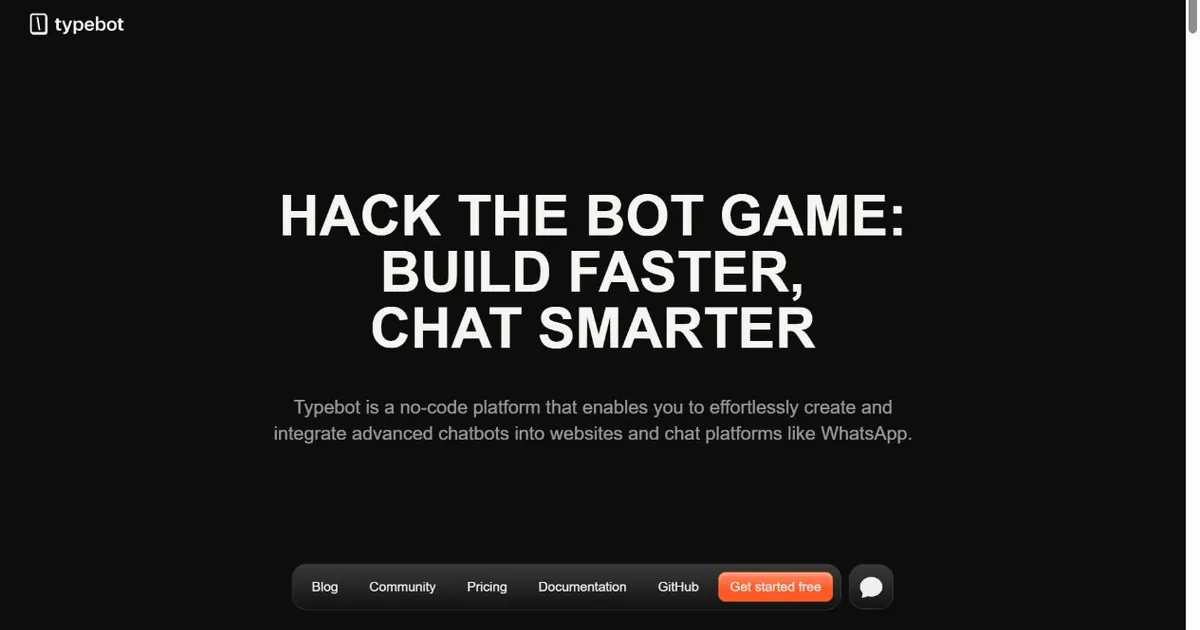
Every other tool on this list, Chatfuel included, ties you to a subscription that scales with usage in one form or another. Typebot is the one genuine exception. Its entire codebase is open source, and a team with the infrastructure to run it can self-host the whole platform and skip contact-based billing, seat fees, and AI Spend meters altogether.
For teams that would rather stay on a hosted plan, the free tier includes 200 chats a month, Starter runs $39 a month for 2,000 chats, and Pro is $89 a month for 10,000 chats plus WhatsApp access. There's no contact-count multiplier the way Chatfuel has; the meter is chats, not unique people, which behaves more predictably for a business that talks to the same visitors repeatedly.
AI isn't built in the way Chatfuel's Fuely layer is. Typebot connects to whichever model provider you supply an API key for, OpenAI, Anthropic, or Mistral among others, so the AI cost lives with your own provider account rather than inside Typebot's own metered tiers. That's more setup than Chatfuel requires out of the box, but it also means there's no separate AI pricing tier working against you.
The tradeoff is channel coverage. Typebot doesn't touch Instagram or Facebook DM automation at all; WhatsApp support arrives only on the Pro plan. A business whose Chatfuel usage leaned heavily on Instagram automation specifically won't find a replacement for that here.
Pros
- Genuine self-hosted option, skip subscription pricing entirely
- Billed by chats, not active contacts
- Free plan with 200 chats and no credit card
- Connects to your own AI provider
- Open source with an active community
Cons
- No Instagram or Facebook DM automation
- No native AI without your own API key
- WhatsApp only on the Pro plan
- Monthly billing only, no annual discount
Pricing
Best for: Technical teams that want out of contact-based and per-seat billing entirely, and are comfortable managing their own AI provider connection and, optionally, their own hosting.
How to Pick the Right Chatfuel Alternative
The seven tools here solve different pieces of what Chatfuel tries to cover in one product, so the right pick depends on which piece of Chatfuel you actually used.
If Chatfuel's value to you was Instagram and WhatsApp broadcast automation, ManyChat is the most direct swap and tends to be cheaper at smaller contact counts. If WhatsApp was the only channel that mattered and the others sat unused, WATI's dedicated inbox goes deeper than a multi-channel tool can.
If the contact-based pricing itself is the actual complaint, whether on Chatfuel, ManyChat, or WATI, both Zappiq AI and Typebot avoid that structure entirely. Zappiq is the better fit if lead capture from your website is the outcome you want. Typebot is the better fit if you want to keep a visual builder and either prefer chat-based billing or want the option to self-host and stop paying a subscription altogether.
If you want more control over scripted flows than Chatfuel's block builder gives you, Landbot's conditional logic goes further, with the tradeoff of its own split billing structure. If your visitors regularly need a human mid-conversation, Tidio's live inbox covers that gap. If you have developers and want an AI agent that reasons rather than follows a script, Botpress is built specifically for that.
Before you migrate: Export your Chatfuel contact list and any WhatsApp message templates before your trial or subscription ends. Most tools on this list can import a contact CSV directly, even if they can't import a Chatfuel flow. Test the new bot against your five most common visitor questions before switching your live traffic over, so gaps in coverage show up before customers find them.
Frequently Asked Questions
Zappiq AI is the best Chatfuel alternative for businesses that want a chatbot focused on capturing and qualifying website leads rather than running Instagram or WhatsApp broadcast campaigns. It trains itself on your site automatically, bills flat rather than by active contact count, and emails you the moment a visitor qualifies as a lead, along with the source campaign that brought them in.
Chatfuel removed its permanent free plan in its 2026 pricing update, leaving only a 7-day trial. Its contact-based pricing also climbs fast: the entry tier runs about $39 a month for 150 contacts, the commonly marketed plan is $69 a month for 500 contacts, and the same GPT-5 mini tier reaches $279 a month once you cross 5,000 active contacts, with the GPT-5 Fuely Max tier running close to double that. Meta's own WhatsApp conversation fees apply on top regardless of plan.
Yes. Chatfuel's subscription covers the platform and unlimited messages to each active contact within their 30-day window, but Meta bills WhatsApp conversations separately based on message category and recipient country, typically $0.02 to $0.08 for marketing messages. This fee applies on every WhatsApp automation platform, not just Chatfuel, but it's easy to miss when comparing sticker prices.
ManyChat still offers a free tier, currently capped at a small number of contacts, and Botpress has a free pay-as-you-go tier with unlimited bots and a small AI credit included. Zappiq AI offers a free trial with no credit card required. Chatfuel itself dropped its permanent free plan in 2026 and now offers only a 7-day trial.
ManyChat is the closest like-for-like replacement, covering the same Instagram, Messenger, and WhatsApp channels with a similar visual automation builder, but billed on a contact-based model that tends to be cheaper at smaller list sizes. WATI is a stronger fit for businesses that only need WhatsApp and want a dedicated shared inbox built directly on the WhatsApp Business API.
The Bottom Line
Chatfuel earned its long track record honestly, and the channel coverage across Facebook, Instagram, WhatsApp, and TikTok is still genuinely wide. What's changed is the pricing floor underneath all of that. Losing the permanent free plan and moving to a contact-based model that can quadruple your bill between a slow month and a busy one has pushed a lot of long-time users to start comparing options, especially once Meta's own WhatsApp fees get added on top of whatever tier you're paying for.
Which alternative makes sense depends on which part of Chatfuel you actually relied on. ManyChat is the straightforward swap for social DM automation at a lower entry cost. WATI goes deeper if WhatsApp was your only real channel. Landbot and Typebot both offer stronger visual flow control, with Typebot adding a genuine way to escape subscription billing altogether through self-hosting. Tidio and Botpress cover the two ends of the spectrum Chatfuel sits between, live agent handoff on one side, fully autonomous AI reasoning on the other.
For businesses whose real goal was never social broadcast automation but a chatbot that turns website visitors into qualified leads, Zappiq AI is the most direct fit here. It trains on your site automatically, qualifies visitors without a flow chart to build, alerts you the instant a lead comes in, and ties every lead back to the campaign that produced it, all on a flat bill that doesn't move every time your contact count does.
The free trial is at zappiqai.com. No credit card required.
Try the Chatfuel alternative built for lead generation
Zappiq AI is live in under 5 minutes. Trains itself on your website, qualifies visitors automatically, emails you every lead instantly. Flat pricing, no contact-count surprises, no branding fee.
Start Free Trial >No credit card | No branding fee | Flat monthly billing
References
- SetSmart. "Chatfuel Pricing 2026: Plans, Costs & Alternatives." setsmart.io.
- SetSmart. "Chatfuel Review 2026: Good for Instagram DMs?" setsmart.io.
- CheckThat.ai. "Chatfuel Pricing 2026: Plans, Costs & True TCO." checkthat.ai.
- SalesHive. "Chatfuel Reviews, Pricing & Features (2026)." saleshive.com.
- SetSmart. "Wati Pricing 2026: Is It Worth It for WhatsApp?" setsmart.io.
- Chatarmin. "Wati Pricing 2026: The Three Axes Where Wati Scales." chatarmin.com.

Ansar Ali
Ansar Ali is the founder of Zappiq AI, a lead-capture platform built for small businesses that cannot afford to lose high-intent website visitors. He writes from hands-on experience building chatbot flows, attribution systems, and qualification workflows for service businesses, with a focus on the practical details that turn website conversations into qualified enquiries.