
Quick Summary
Short answer: Decagon is an enterprise AI customer service agent platform with custom pricing, a $4.5 billion valuation, and an engineering-led deployment model. For teams that need AI customer service agents without the enterprise contract, Zappiq AI is the most practical option for website lead capture, while Ada is the strongest choice for mid-market teams that need high-volume containment at a lower entry point.
- Zappiq AI is the best Decagon alternative for teams that primarily need website visitor qualification and lead capture without enterprise pricing or engineering-led implementation.
- Ada is the strongest choice for mid-market teams that need high-volume containment and deflection at a lower entry point than Decagon, with a median contract around $73,500 annually.
- Fin (Intercom) is the proven default for teams that want AI resolution inside their existing helpdesk, with per-resolution pricing and a 14-day trial.
- Sierra is the closest peer to Decagon for enterprises that want bespoke branded agents with governance and release pipelines, though entry costs are higher.
- Zendesk AI is the natural choice for teams already on Zendesk that want to add AI resolution without switching platforms.
- Cognigy is worth evaluating if voice is the primary channel and you need strong IVR modernization capabilities.
- Kore.ai fits teams in regulated industries that need HIPAA, PCI DSS, and FedRAMP compliance with broad enterprise automation.
What Decagon Actually Is (And Why Teams Look Elsewhere)
Decagon built one of the most technically sophisticated AI customer service agent platforms in the market. The company raised $250 million in Series D funding in January 2026 at a $4.5 billion valuation, tripling its valuation in under six months. Total funding across six rounds reaches $536.5 million. Named customers include Notion, Duolingo, Substack, Bilt, Rippling, ClassPass, Eventbrite, Chime, and Hunter Douglas Group. The published results are real: Flashfood reports 90 percent or higher deflection across all tickets, ClassPass reports a 10x deflection rate increase at launch, and Oura reports a 3x improvement in CSAT.
The platform differentiator is its Agent Operating Procedures, or AOPs. Instead of configuring flows through a visual builder or writing code, support teams write agent behavior in plain English and the agent follows those procedures deterministically. The AOPs are Git-tracked, which means changes are versioned and reviewable, and non-technical CX staff can edit them without waiting on an engineering sprint. For compliance-sensitive enterprises where an off-script answer creates real risk, that deterministic core matters.
The problem is not the product. It is the packaging and the scope. Decagon is sold as an enterprise platform with no published pricing page, no self-serve trial, and no way to estimate cost without a sales conversation. Industry reports place contracts starting around $95,000 annually, with a platform fee plus per-conversation usage. Implementation is engineering-led, with your team wiring integrations and guardrails before CX takes over the AOPs. Average setup time runs four to eight weeks for sales-led discovery, knowledge base ingestion, AI agent training, and helpdesk integration.
The pricing and scope reality: Decagon does not publish pricing anywhere on its site. Reports place entry contracts around $95,000 annually, with a $50,000 platform fee plus per-conversation usage. The platform is built to resolve inbound support requests across chat, email, and voice. It does not originate outbound calls, run collections campaigns, or automate operational workflows beyond customer support. For mid-market teams that just need website lead capture or a simpler support solution, the scope and the pricing are both misaligned.
There is also the Agent Assist integration catch. Decagon's Agent Assist feature, the AI copilot for human agents, only integrates with Zendesk. For teams running Salesforce, Intercom, Freshdesk, or any non-Zendesk helpdesk, the agent assist functionality does not extend. If you are a Salesforce shop, what you are buying is a platform whose deepest human-agent integrations point somewhere else.
And there is the third-party proof gap. Decagon rates 4.7 on G2 from roughly 29 reviews and has no Gartner Peer Insights page. For procurement teams that require extensive peer validation before committing to a custom enterprise contract, that is a real consideration. The customer logos are strong. The independent review volume is thin.
Where Decagon Users Are Actually Looking in 2026
Decagon users are not all looking for the same replacement. Teams that used Decagon primarily for inbound support resolution across chat and email are evaluating different options than teams that need voice automation or multi-department orchestration. The important distinction is between replacing the enterprise AI agent function and replacing the specific job Decagon was doing for your team.
For teams that need a standalone AI agent platform above their helpdesk with precise behavioral control, Decagon and its closest peer Sierra are the natural comparison. For teams that need AI resolution inside their existing helpdesk, Fin is the proven default. For mid-market teams that need containment and deflection at a lower entry point, Ada covers that job. For teams that need website lead capture and qualification, that scope is different entirely.
- Website lead capture and qualification: Zappiq AI for automatic training, visitor qualification, and lead delivery without an enterprise contract or engineering-led deployment.
- Mid-market containment and deflection: Ada for high-volume deflection with a median contract around $73,500 annually.
- AI resolution inside existing helpdesk: Fin (Intercom) for per-resolution pricing and proven out-of-the-box resolution.
- Bespoke branded agents with governance: Sierra for enterprises that want release pipelines and SDK-based control.
- Zendesk ecosystem: Zendesk AI for teams already on the platform.
- Voice-first IVR modernization: Cognigy for enterprises prioritizing voice AI and European compliance.
- Regulated industry compliance: Kore.ai for HIPAA, PCI DSS, and FedRAMP coverage with broad enterprise automation.
What Decagon Actually Costs vs the Alternatives
The tools below replace different pieces of what Decagon does. No single product does everything Decagon does for every team, because Decagon itself is being stretched across jobs that range from enterprise contact center resolution to basic support chat. The honest answer is matching your actual use case to the tool built for it.
Quick Comparison: 7 Decagon Alternatives
| Tool | Starting Price | Best For | Setup Time | Free Option |
|---|---|---|---|---|
| Zappiq AI | Starter from $9/mo equivalent billed annually for 350 conversations | Website lead capture and qualification | Under 10 min | 100 conversations |
| Ada | ~$73,500/yr median contract | Mid-market containment and deflection | Weeks | No |
| Fin (Intercom) | $0.99/resolution + seats | AI resolution inside helpdesk | Hours to days | 14-day trial |
| Sierra | ~$150,000/yr | Bespoke branded agents with governance | Weeks to months | No |
| Zendesk AI | From ~$19/agent/mo | Teams already on Zendesk | Hours to days | Yes, trial only |
| Cognigy | Quote only | Voice-first IVR modernization | Weeks to months | No |
| Kore.ai | Quote only | Regulated industry automation | Weeks to months | No |
Before picking a replacement: Decide which job Decagon was doing for your team. If it was capturing and qualifying website visitors, the tools at the top of this list were purpose-built for that. If it was autonomous resolution across chat and email inside an enterprise support operation, you are looking at a different category with different requirements.
1. Zappiq AI: Best for Website Lead Capture Without Enterprise Overhead
Zappiq AI
zappiqai.com | AI lead generation chatbot for small and medium business websites, no engineering-led deployment required
- Live setup in minutes
- Automatically trains on your website
- Qualifies leads and tracks ad source
- No engineering-led deployment
- No branding on any plan
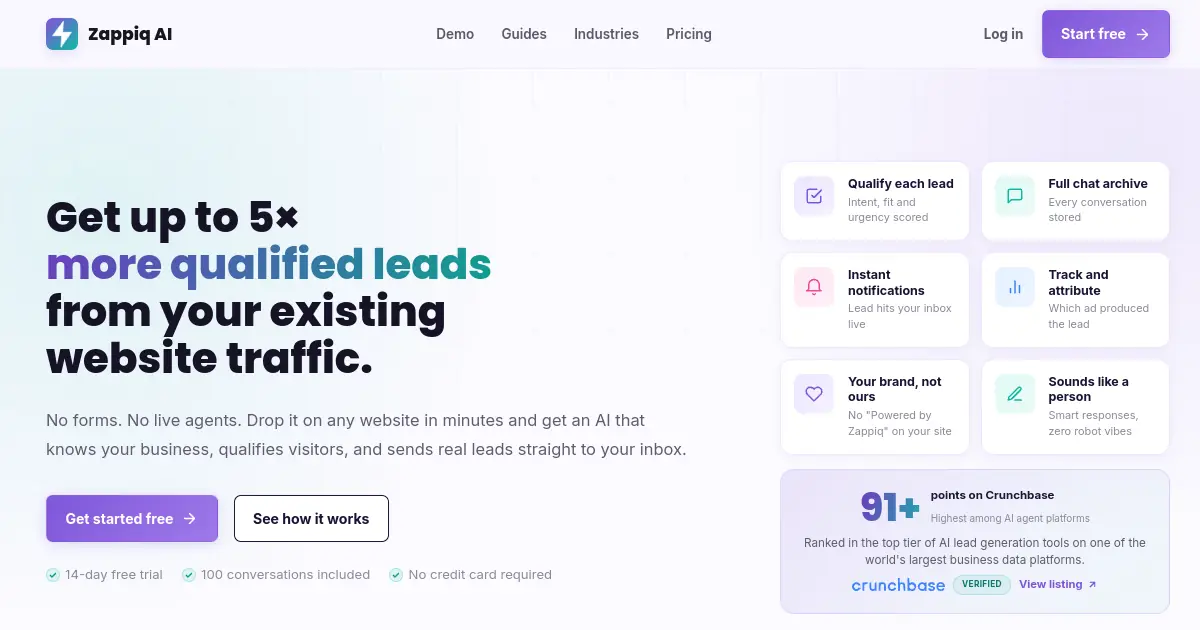
The comparison between Decagon and Zappiq AI is almost entirely about scope. Decagon is built to resolve inbound support conversations across chat, email, and voice with deterministic Agent Operating Procedures and full observability. Zappiq AI is built to do one thing well: turn website visitors into qualified leads and deliver them to your team while the conversation is still relevant.
For a mid-market team, that narrower scope is the point. You install a script, Zappiq reads your website, and there is a working chatbot answering visitor questions within minutes. There is no engineering-led deployment, no four to eight week setup, no knowledge base ingestion project before the first conversation. The AI trains itself on your content and starts from there. If something needs adjustment, you adjust it. The base state is already functional.
Decagon's setup process requires your engineering team to wire integrations and guardrails before CX takes over the AOPs. One verified reviewer noted that setup and fine-tuning take time. For enterprise support operations with dedicated resources, that is expected. For mid-market teams that just need a chatbot that answers questions and captures leads, that overhead is the reason they look elsewhere.
The moment a visitor qualifies, Zappiq emails you the full lead: contact details, intent summary, and the complete conversation transcript. That combination of speed and context matters because website visitors who are ready to buy do not stay ready for long. A lead that sits in a shared inbox for three hours is a different lead than one that arrives with context while the conversation is still fresh.
Pricing is structured around conversation volume rather than enterprise platform fees or outcome counts. The same traffic spike that would trigger a conversation about contract expansion at an enterprise vendor does not change your Zappiq bill. For a mid-market team running paid traffic, that predictability matters more than it might seem until the first month you run a campaign and watch volume spike.
Integration options: Zappiq connects to Zapier, Make, and n8n, which means a qualified lead can be pushed into your CRM, a Slack channel, or any other tool your team already uses without touching a line of code. Ad attribution is tracked per lead, so you know which campaign or keyword brought a visitor before they became a contact.
Decagon vs Zappiq AI
| Decision point | Decagon | Zappiq AI |
|---|---|---|
| Primary fit | Enterprise inbound support resolution | Mid-market website lead capture |
| Setup | Engineering-led, 4 to 8 weeks | Under 10 minutes, self-serve |
| Lead handoff | Resolution and escalation workflows | Email delivery with contact details, source data, summary, and transcript |
| Pricing approach | ~$95,000/yr plus usage, quote only | 14-day trial with 100 conversations; Starter $9/mo annual equivalent (350), Growth $39/mo monthly or $27/mo annual equivalent (1,500), Pro $99/mo monthly or $69/mo annual equivalent (5,000) |
Pros
- No engineering team or implementation partner needed to go live
- Trains automatically on your website from day one
- Flat pricing, no enterprise platform fee or usage meter
- Lead qualification built in, not a separate configuration layer
- Instant email alerts with full conversation transcript
- Ad source and campaign attribution per lead
- No branding added to the widget on any plan
- Webhook routing to Zapier, Make, and n8n
Cons
- Not a full contact center platform or helpdesk system
- No voice channel or IVR support
- No Agent Operating Procedures or deterministic workflow control
- Younger platform compared to enterprise vendors
Pricing
Best for: Mid-market teams that need website visitor qualification and lead capture without an enterprise contract, engineering-led deployment, or months-long setup. Service businesses, agencies, clinics, legal, real estate, home services, and anyone running paid traffic who wants to know exactly what a lead cost them.
2. Ada: Best for Mid-Market Containment and Deflection
Ada
ada.cx | No-code AI agent platform for high-volume containment and deflection
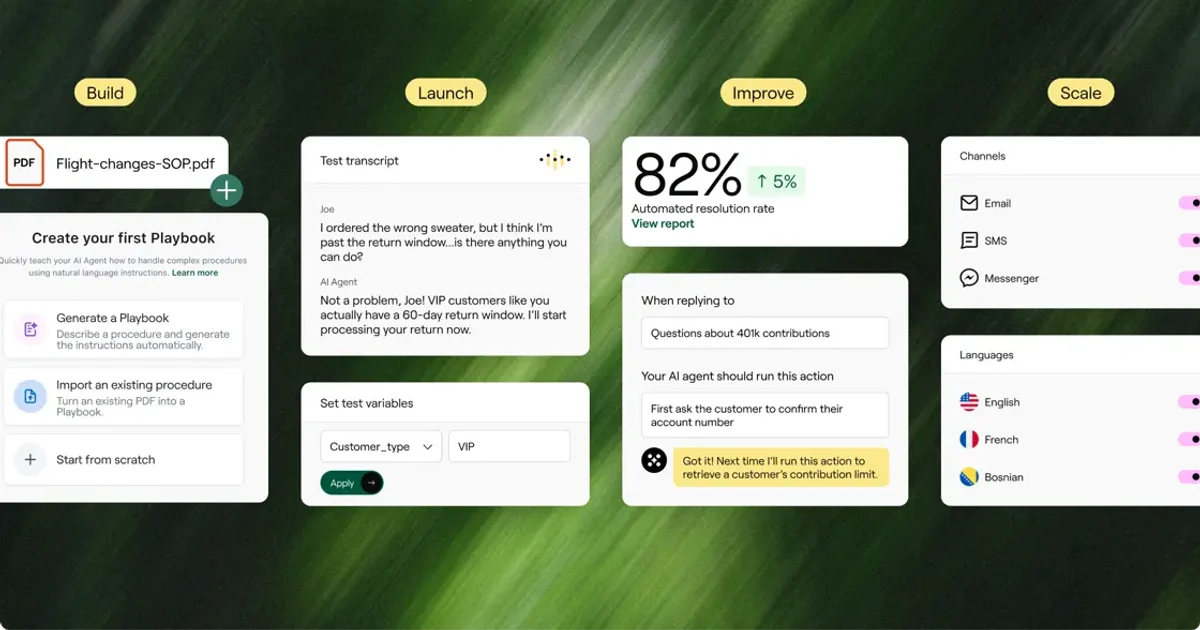
Ada is the sharpest head-to-head comparison to Decagon for mid-market teams. Both focus on containment and deflection. Both use standardized workflows rather than bespoke engineering. The difference is the entry point and the engineering dependency.
Ada has been in market longer than most AI-native platforms. The pitch is simplicity: non-technical operators build, train, and adjust AI agents without engineering involvement. Ada has powered over 6.4 billion interactions for brands like Ancestry, monday.com, Pinterest, Square, Meta, and Verizon. Pricing starts around $30,000 annually, with a reported median contract of $73,500 a year. That is far below Decagon's typical entry point and opens the platform to mid-market buyers that Decagon does not serve.
The tradeoff is depth. Ada's no-code approach trades workflow granularity for accessibility. For complex multi-step workflows that need precise behavioral control, Decagon's AOPs typically outperform. And at scale, Ada deployments can reach $300,000 or more annually, erasing the price advantage that drew mid-market buyers in the first place.
For teams that need high-volume containment at a lower entry point and do not have the engineering resources for a Decagon deployment, Ada is the natural starting point. For teams that need the deterministic control that Decagon provides, the tradeoff may not be worth it.
Decagon vs Ada
| Decision point | Decagon | Ada |
|---|---|---|
| Primary fit | Enterprise support with behavioral control | Mid-market containment and deflection |
| Entry price | ~$95,000/yr, quote only | ~$30,000/yr starting, $73,500 median |
| Agent authoring | AOPs in plain English, Git-tracked | No-code builder for non-technical operators |
| Engineering dependency | High, engineering wires integrations | Low, CX teams can self-serve |
Pros
- Lower entry point than Decagon, accessible to mid-market
- No-code agent builder without engineering involvement
- Multilingual depth with 50+ languages and cultural localization
- AIUC-1 certification, first in category
- 6.4 billion interactions powered to date
Cons
- Less granular control than Decagon's AOPs for complex workflows
- At-scale deployments can reach $300,000+ annually
- No published gaming or technical SaaS case studies
- Voice capability newer than Decagon's
Pricing
Best for: Mid-market and enterprise teams that want strong containment and deflection with minimal engineering dependency. Teams that need to move fast and do not have the resources for an engineering-led deployment.
Need website leads without a $95,000 annual contract?
Zappiq AI trains on your site in minutes, qualifies every visitor automatically, and sends you the lead before the conversation goes cold. No demo required. No engineering team needed.
Start Free TrialNo credit card | No developer needed | No branding on any plan
3. Fin (Intercom): Best AI Resolution Inside Existing Helpdesk
Fin (Intercom)
intercom.com | AI agent that runs inside Intercom and 8+ other helpdesks with per-resolution pricing
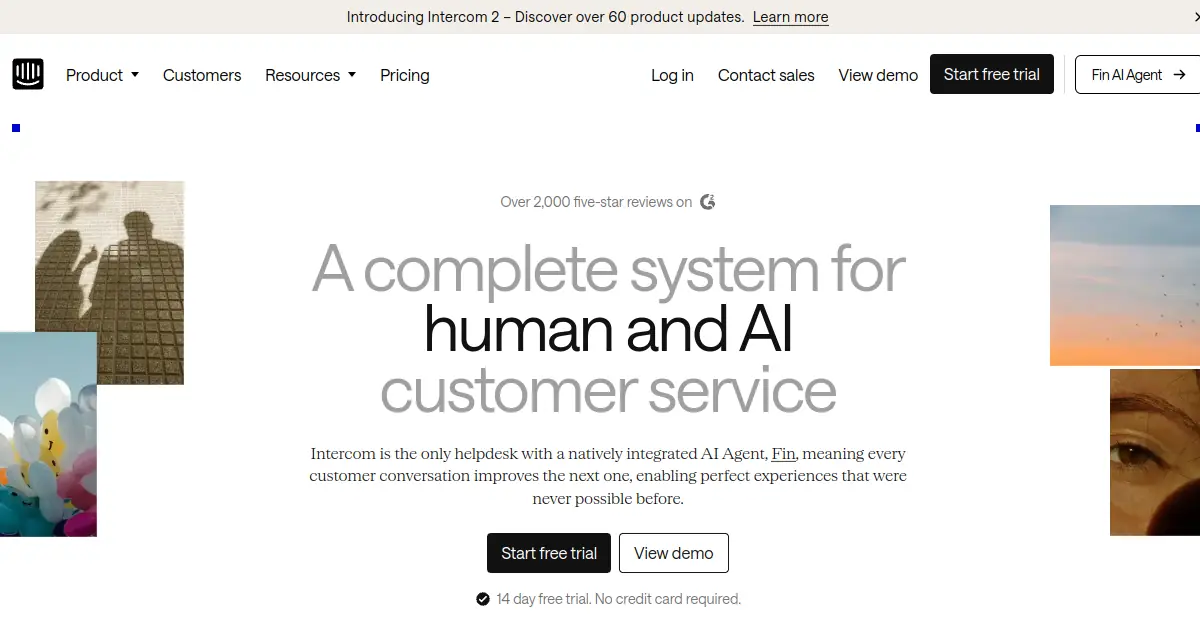
Fin is the proven default for teams that want AI resolution inside their existing helpdesk rather than a standalone platform above it. The agent runs on 8+ helpdesks, including Intercom's own, and prices at roughly $0.99 per resolution with seats ranging from $29 to $132. Fin claims a 76 percent average resolution rate across 12,000+ customers.
The architectural difference from Decagon is significant. Decagon is a standalone platform that sits above your helpdesk. Fin lives inside the helpdesk. For teams that do not want to manage a separate AI vendor alongside their existing support stack, Fin eliminates that layer. The tradeoff is less control over agent behavior than Decagon's AOPs provide.
Fin also offers a 14-day trial with unlimited outcomes, which Decagon does not. For teams that want to test before committing, that matters. And there is the acquisition context: Salesforce signed an agreement to acquire Fin in June 2026, which means the same company will soon hold both the platform agent and the category's mid-market default.
Decagon vs Fin
| Decision point | Decagon | Fin |
|---|---|---|
| Architecture | Standalone platform above helpdesk | Agent inside existing helpdesk |
| Pricing | ~$95,000/yr plus usage | ~$0.99/resolution plus seats |
| Control | AOPs with Git-tracked granular control | Proven out-of-the-box resolution |
| Free trial | No | 14-day trial with unlimited outcomes |
Pros
- Runs inside 8+ helpdesks without a separate platform
- Per-resolution pricing scales with actual usage
- 14-day trial with unlimited outcomes
- 12,000+ customers and 76% average resolution claim
- Proven out-of-the-box without extensive configuration
Cons
- Less control over agent behavior than Decagon's AOPs
- Salesforce acquisition pending, long-term direction uncertain
- Requires an existing helpdesk platform
- Not built for website lead generation or voice-first operations
Pricing
Best for: Teams that want AI resolution inside their existing helpdesk without adding a standalone platform. Best for organizations that value proven out-of-the-box resolution over granular behavioral control.
4. Sierra: Best for Bespoke Branded Agents with Governance
Sierra
sierra.ai | Bespoke AI agents with programmatic SDK and outcome-based pricing
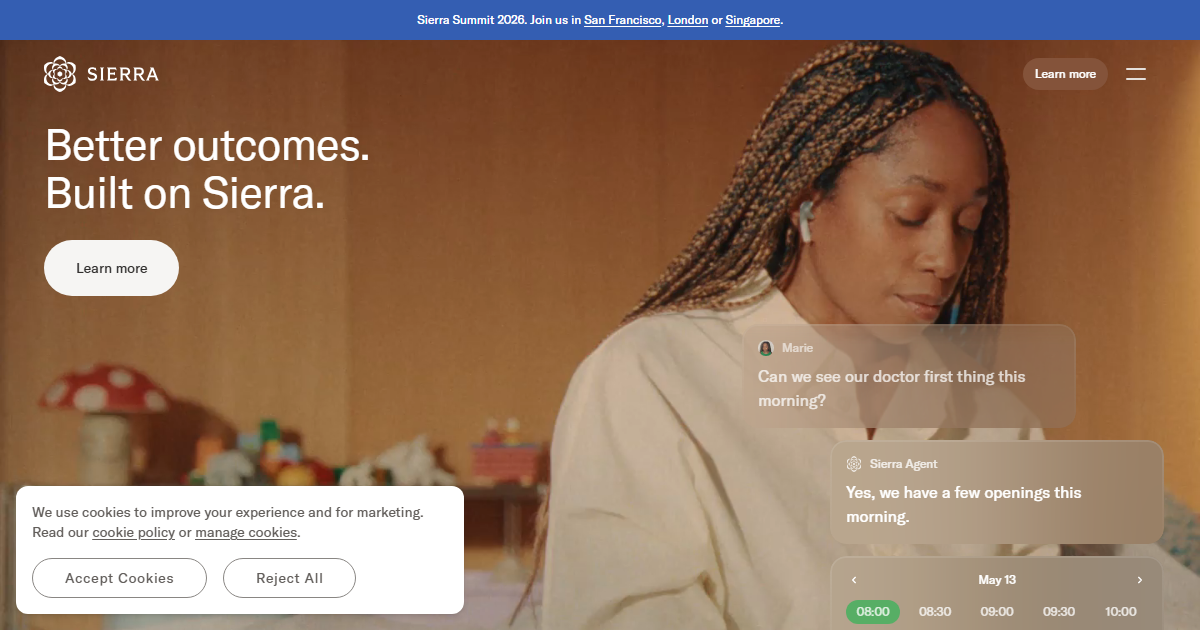
Sierra is Decagon's closest peer in the enterprise AI agent category. Both are standalone platforms that front the conversation. Both are sales-led with no public pricing and no self-serve signup. The difference is who controls the agent after launch.
Sierra routes changes through its Agent SDK, Agent Studio, and release pipelines, with forward-deployed engineers building alongside customers. That fits governance-focused organizations where agent changes go through review and approval. Decagon fits iteration speed, where CX teams can rewrite agent logic weekly without engineering in the loop.
Sierra generally costs more than Decagon. Contracts start around $150,000 annually, with Year-1 budgets often in the $200,000 to $350,000 range when forward-deployed engineering, onboarding, and integration work are included. Sierra has a $15 billion valuation with $150 million or more in stated ARR, roughly 3.4x Decagon's scale.
For enterprises that want bespoke branded agents with the deepest customization and are willing to pay for the engineering partnership, Sierra is the natural choice. For teams that want CX ownership of agent behavior without the engineering dependency, Decagon's AOP model is the better fit.
5. Zendesk AI: Best for Teams Already on Zendesk
Zendesk AI
zendesk.com | AI agents embedded in the Zendesk platform with 1,500+ marketplace integrations
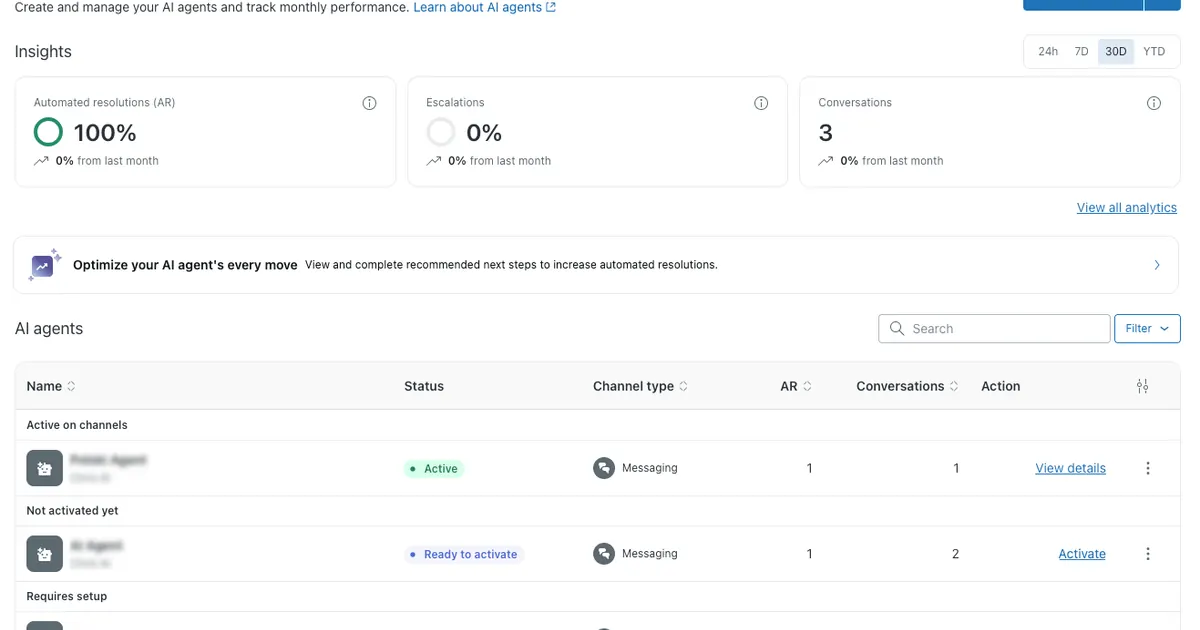
Zendesk AI is the natural choice for teams already running Zendesk for support. The 1,500+ marketplace integrations and the 19 billion ticket training corpus give it pattern recognition that standalone platforms cannot match. For teams already running Zendesk, the procurement path is "add AI to what we have" rather than "replace our stack," which closes faster.
The tradeoff is that Zendesk's AI is generalist by design. There is no vertical specialization, and no AOP-style granular workflow control out of the box. For autonomous resolution depth in complex multi-step workflows, Decagon typically outperforms. For teams that want AI added to a mature support operation without migrating platforms, Zendesk AI is the path of least resistance.
6. Cognigy: Best for Voice-First IVR Modernization
Cognigy
cognigy.com | Enterprise conversational AI platform built voice-first with deep CCaaS integration

Cognigy is more mature in voice than Decagon, which built text-first and added voice later. Cognigy was built voice-first, with native phone integration across SIP, WebRTC, and major contact center platforms. Native integration with Genesys, NICE, and Cisco makes Cognigy the natural fit for contact centers with established CCaaS infrastructure.
Cognigy serves Lufthansa, Toyota, Mercedes-Benz, Bosch, and Henkel, with strength in voice-heavy contact center operations and multi-language European deployments. European data residency and GDPR depth also exceed what Decagon's primarily US-anchored deployment model offers.
The tradeoff is that Cognigy's chat and email capabilities are solid but not the strongest in the market. For text-heavy support with complex AOP-style workflow automation, Decagon typically wins. Cognigy also does not publish gaming or technical SaaS case studies.
7. Kore.ai: Best for Regulated Industry Compliance
Kore.ai
kore.ai | Enterprise conversational AI platform built for regulated industries
Kore.ai serves over 200 Fortune 2000 customers including PNC Bank, Cisco, Pfizer, Coca-Cola, and Airbus, with particular depth in financial services and healthcare deployments. The platform covers HIPAA, PCI DSS, SOC 2 Type II, and GDPR compliance with field-level encryption and PII redaction. It offers 400+ pre-built integrations including Salesforce, ServiceNow, SAP, and Workday.
For teams in regulated industries that need broad enterprise automation across CX and EX with the deepest compliance coverage, Kore.ai is the natural fit. The tradeoff is the same as Decagon: enterprise pricing, enterprise implementation timelines, and enterprise resource requirements.
How to Evaluate a Decagon Alternative
Start with the job, not the feature list: The right replacement depends on which specific thing Decagon was doing for your team. Answering that question first saves time on comparisons that were never relevant.
Decagon was used differently by different teams, which is part of why this list does not have one obvious answer. Enterprise support organizations used Decagon for autonomous resolution across chat and email with deterministic control. Mid-market teams used it for containment and deflection. Marketing teams used it for website chat and lead qualification. None of those jobs requires the same replacement.
If your team needs autonomous resolution with granular behavioral control and has the engineering resources for an enterprise deployment, Decagon remains one of the strongest options in the market. The alternatives on this list that focus on enterprise support, like Ada or Fin, are worth evaluating if that is the primary requirement but the engineering dependency is not.
If your use case is website lead capture and qualification without the enterprise complexity, a focused tool like Zappiq AI covers that job directly. The key difference from Decagon is that Zappiq starts with a working chatbot from day one without requiring an engineering-led deployment before anything happens. For a mid-market team looking for a practical alternative, that simplicity matters a great deal.
For teams already on Zendesk, adding Zendesk AI is worth evaluating before paying for a separate platform. The integration with existing data is genuine, and the cost is often lower than a new vendor subscription.
Migration Checklist: Moving Away from Decagon
An AI agent migration is not complete when the new platform is live. The risky parts are the Agent Operating Procedures, routing logic, and integrations that your team built around Decagon. Use this checklist before turning the old workflow off.
- Document your Agent Operating Procedures. Save the AOPs, guardrails, escalation rules, and any custom logic before rebuilding them elsewhere.
- Record routing and integration details. Note ownership rules, CRM fields, webhooks, notifications, and any custom integrations that connect to the platform.
- Export conversation data. Keep transcripts, contact details, and outcomes in a format your team can search after the migration.
- Choose the replacement by job. Use a lead-generation tool for website qualification, a helpdesk-native AI for resolution, or a voice specialist for IVR modernization.
- Run the new tool in parallel for at least two weeks. Compare answers, resolution rates, lead delivery, routing, and handoffs before removing Decagon.
- Cut over and monitor the first month. Review unanswered questions, duplicate conversations, attribution, response time, and every integration that receives a qualified conversation.
Keep the old workflow available during testing. Parallel testing gives your team a way to compare real conversations and catch missing routing or knowledge gaps before it affects customer experience.
Frequently Asked Questions
Decagon does not publish pricing. Industry reports place Decagon contracts starting around $95,000 annually, with a platform fee plus per-conversation usage. The company offers both per-conversation and per-resolution billing options, though most customers choose per-conversation for forecastability.
The best alternative depends on the job. Zappiq AI is the most practical option for teams that primarily need website visitor qualification and lead capture without enterprise pricing or engineering-led implementation. Ada is the strongest choice for mid-market teams that need high-volume containment at a lower entry point. Fin (Intercom) is the proven default for teams that want resolution inside their existing helpdesk.
Zappiq AI offers a 14-day trial with 100 conversations. Fin (Intercom) offers a 14-day trial with unlimited outcomes. Freshdesk has a free tier for small teams. Most enterprise-focused alternatives do not offer free trials because they require sales engagement and implementation planning.
Both are standalone enterprise AI agent platforms that front the conversation. Decagon uses Agent Operating Procedures written in plain English, with per-conversation billing by default. Sierra uses a programmatic Agent SDK and Agent Studio, with outcome-based billing. Decagon fits teams that want CX ownership of agent behavior. Sierra fits teams that want governance and release pipelines.
Yes, Decagon has a deep integration with Zendesk. Its Agent Assist feature, the AI copilot for human agents, only integrates with Zendesk. For teams running Salesforce, Intercom, Freshdesk, or any non-Zendesk helpdesk, the agent assist functionality does not extend.
Published results include Flashfood at 90%+ deflection across all tickets, ClassPass at 10x deflection rate increase at launch, Oura at 3x CSAT improvement and 93% average AI agent quality score, and Hunter Douglas at 85% higher average order value among customers who interact with AI agents.
The Bottom Line
Decagon built one of the most technically sophisticated AI customer service agent platforms in the market, raised $250 million at a $4.5 billion valuation, and earned real results with named enterprise customers. The Agent Operating Procedures model gives support teams unusual control over agent behavior, and the published deflection numbers are genuine.
The problem is not the product. It is the packaging and the scope. Decagon is sold as an enterprise platform with a $95,000 annual starting price, opaque pricing, engineering-led implementation, and a four to eight week setup timeline. For enterprise support organizations with the budget and the resources, that is a reasonable tradeoff. For mid-market teams without either, it is the reason they look elsewhere.
The right replacement depends on which job Decagon was doing for your team. For teams that need mid-market containment at a lower entry point, Ada covers that job. For teams that want resolution inside their existing helpdesk, Fin is the proven default. For teams already on Zendesk, adding Zendesk AI is worth evaluating before paying for a new vendor. For enterprises that need bespoke branded agents with governance, Sierra is the closest peer.
For mid-market teams that primarily need website visitors qualified and delivered to a sales team, Zappiq AI covers that job without the enterprise contract, the engineering-led deployment, or the months-long setup. The chatbot reads your site and starts working on day one.
The free trial for Zappiq AI is at zappiqai.com. No credit card needed, no annual contract, no implementation project before your first visitor conversation.
Try the Decagon alternative built for lead generation
Zappiq AI is live in under ten minutes. Trains on your website, qualifies every visitor automatically, and sends you the lead while it is still fresh. No six-figure commitment required.
Start Free TrialNo credit card | No developer needed | No branding on any plan
References
- HappyRobot. "Decagon Pricing Explained: Costs, Review & Alternative." happyrobot.ai.
- Dutch Startup AI. "Hundreds of millions of dollars flow into AI customer service in quick succession." dutchstartup.ai.
- Decagon. "Decagon expands London hub amid growing EMEA customer momentum." decagon.ai.
- Helpshift. "Top 7 Decagon Alternatives & Competitors In 2026." helpshift.com.
- Cekura. "Sierra AI vs Decagon vs Cekura: My Honest 2026 Take." cekura.ai.
- DragApp. "Sierra vs Decagon vs Fin vs Ada (2026): The Honest Comparison." dragapp.com.
- Decagon. "Decagon closes employee tender at $4.5 billion valuation." decagon.ai.
- Decagon. "Flashfood Customer Success Story." decagon.ai.
- Manus. "7 Best AI Agents for Customer Service in 2026 (Compared)." manus.im.
- Helpshift. "Decagon Vs Sierra: A 2026 Comparison Guide." helpshift.com.
- Decagon. "Decagon's $250 million commitment to the AI concierge future." decagon.ai.
- Decagon. "ClassPass Customer Success Story." decagon.ai.
- DragApp. "Best Decagon Alternatives in 2026: Honest Pricing Across Every Tier." dragapp.com.
- Aissist. "Decagon AI Review 2026: Pricing, Features & Alternatives." aissist.io.
- The AI Agent Index. "Decagon Review (2026): AI Support for Notion, Duolingo." theaiagentindex.com.

Ansar Ali
Ansar Ali founded Zappiq AI after watching too many small business owners get quoted enterprise pricing for a job that really came down to answering questions on a website and identifying who was serious. He spends most of his time on lead qualification logic, attribution tracking, and making sure a chatbot install never slows a page down.