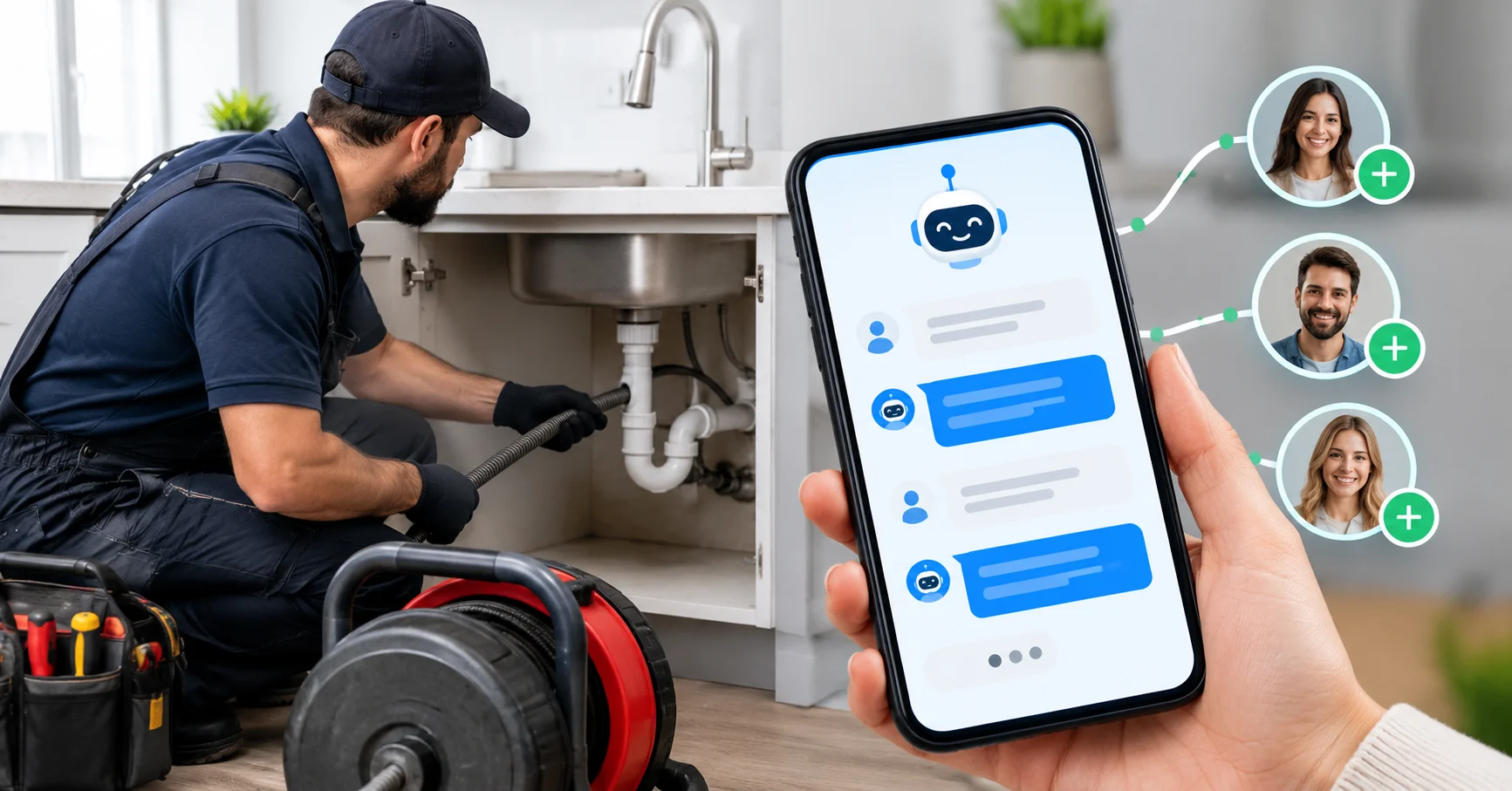
It's 6:40 on a Sunday evening. The kitchen sink has been slow all week, and now the tub gurgles every time the dishwasher drains. The homeowner isn't typing "licensed drainage contractor." They're typing "drain cleaning near me" with one thumb and opening three tabs before the phone goes down.
Your website gets about ten seconds to answer two questions: can you come, and what will it cost. A form that promises a reply "within one business day" answers neither, and for a backed-up drain a business day is a long time. A drain cleaning chatbot answers both on the spot. It asks a handful of questions about the clog, gives a price range for that kind of job, and passes the lead to your team with the whole conversation attached.
Two honest notes first. A chatbot can't see inside a pipe, so what it gives is a range, not a price anyone should hold you to. And drain cleaning marketing is stuffed with statistics that have no study behind them, like the claim that the first plumber to pick up wins nearly 80% of jobs. We found that figure attributed to several places and could open none of them. This guide sticks to numbers we could trace to published pricing guides, insurance explainers and a Harvard Business Review audit, and it flags anything that comes from a vendor.
For the wider picture, our guides on after-hours website leads and lead qualification questions cover the groundwork. The drain workflow borrows from both. For a 24/7 plumbing example, see our emergency plumber chatbot guide, and for broader home-service workflows see the home-service chatbot comparison.
The short answer: A drain cleaning chatbot is a chat assistant on your website that sorts emergencies from routine clogs, gives visitors a price range for the kind of job they describe, and sends the qualified lead and full transcript to your crew. It doesn't diagnose the pipe or promise a final price. That happens when a technician arrives.
TL;DR: what the traceable data says
- Pricing guides disagree. One puts the average to unclog a drain at $385 (range $175 to $600), while mainline hydro cleaning starts at $700 (Inch Calculator, 2026).
- Angi lists hydro jetting at $350 to $600, and a sewer line inspection at $275 to $1,800.
- Standard homeowners policies generally exclude sewer backups, so expect insurance questions at the worst moment (NerdWallet).
- The average company took 42 hours to reply to a web lead, and 23% never replied (Harvard Business Review, 2011).
- The popular "first plumber to answer wins 73%, 78% or 85% of jobs" claims have no study we could open.
What Is a Drain Cleaning Chatbot, and What Counts as a Lead?
It's a chat assistant that lives on your site and talks to visitors the way a good dispatcher would. The word that matters is "lead." A chat that ends with "thanks!" isn't one. For us a drain lead means a name, a phone number, a service address, a plain description of the problem and an agreed next step.
The bot does three jobs at once. Triage asks whether this is an emergency. Pricing offers a ballpark. Capture collects who and where. Drop any one and the others wobble. A ballpark without capture is a pleasant chat that earns nothing. Capture without triage wakes your on-call tech at 2 a.m. for a bathroom sink that has been slow since March.
What Are People Searching For When They Need a Drain Cleaned?
Drain searches fall into five rough groups, and each one wants something different from your site. We couldn't pull monthly search volumes from a paid keyword tool for this piece, so treat the table as a map of intent, not a volume claim.
| Group | Example searches | What the visitor wants | What the bot does |
|---|---|---|---|
| Emergency | emergency drain cleaning, sewer backup, 24 hour plumber | Someone, right now | Safety check, then straight to dispatch |
| Problem | clogged kitchen sink, slow shower drain, toilet keeps clogging, gurgling drains | A cause and a fix | Asks one fixture or several, offers a visit |
| Service | drain cleaning near me, hydro jetting, sewer line cleaning, drain camera inspection | A method and a provider | Explains in plain words, checks the ZIP code |
| Cost | drain cleaning cost, how much to clear a main line | A number | Range plus what it leaves out |
| Commercial | grease trap cleaning, restaurant drain cleaning | A scheduled contract | Hands off to a person, no range |
Problem and cost searches are where a chatbot earns the most, because those visitors are mid-decision and typing questions anyway. A practical move: give each group its own page, answer the question in the first two sentences, and show a price range. That reads well to a person, gives answer engines a clean passage to quote, and becomes material your chatbot learns from. The answer-engine part is our reasoning, not a measured result. Add the service area, emergency hours, accepted payment methods, and a clear next step so the page can qualify local drain-cleaning leads instead of collecting generic enquiries.
How Much Does Drain Cleaning Cost, and Why Can't a Chatbot Give One Number?
Because the same service is priced very differently depending on who you ask, and the biggest swings hide inside the pipe. Four published sources, side by side:
| Source | What it says | Assumption |
|---|---|---|
| Inch Calculator (2026 price guide) | Unclogging averages $385, range $175 to $600. Mainline hydro cleaning starts at $700. Video inspection $125 to $500 | National figures, mixed drain jobs |
| Angi (hydro jetting, 2026) | Averages $475, range $350 to $600. Sewer line inspection $275 to $1,800. Root removal adds $100 to $600 | Hydro jetting of a sewer line |
| Angi (hiring a sewer cleaning pro) | Average $380, from $100 for snaking a small clog to $1,600 for video inspection plus jetting | Main sewer line clogs |
| Four Seasons Heating and Cooling (March 2026) | National average $242 for standard service, emergency calls $250 to $750, hydro jetting $350 to $900 | Contractor guide, Chicago area |
Read across the rows and the problem is obvious. Hydro jetting averages $475 in one guide and sits near $1,000 in another. A bot that says "that'll be $385" is guessing. A bot that says "a single drain usually runs a couple hundred dollars, and a main line costs more, depending on what the technician finds" is telling the truth.
What the chat can't see
- Roots or a damaged pipe. Angi puts the average sewer line repair around $3,400, so a cleaning visit that turns into a repair is a different job entirely.
- One clog or a whole line. A visitor who says "my sink is slow" may have a main line problem. The question about other fixtures is the most useful one you can ask.
- Method. Angi notes some municipalities require a sewer line inspection before hydro jetting. The bot shouldn't promise jetting or rule it out.
- Access. No cleanout, a long run or a basement full of stored boxes all change the hours on site.
What Should the Chatbot Ask, and in What Order?
Start with the situation, not the contact form. A homeowner watching sewage rise in a floor drain and a homeowner whose bathroom sink drains slowly are having completely different evenings. A sequence that works:
- Is water or sewage coming up inside right now? If yes, skip everything else. Show the emergency number, ask for the address and alert your on-call tech.
- One drain or several? Several slow fixtures, gurgling, or a toilet that keeps clogging point toward the main line.
- Which fixtures, and for how long? Lowest drains in the house, like a basement floor drain or shower, tend to show main line trouble first.
- Has anything been tried? Plunger, snake or chemical cleaner. Techs want to know before they reach into a trap.
- House or business? Restaurants and multi-unit buildings go to a person.
- ZIP code and address. Ask the ZIP early. It saves out-of-area visitors three minutes of typing.
- Range, then next step. Show the range, what it leaves out, and a button for the earliest visit.
- Contact details last. Name, best phone number, repeat the number back.
Here's roughly how the range moment sounds. The numbers are invented for illustration.
Visitorkitchen sink and tub both draining slow, kinda gurgles when the washer runs
ChatbotThat sounds like it could be further down the line than one sink. Is any water or sewage coming up anywhere right now?
Visitorno just slow
ChatbotGood, that gives us some time. When more than one drain is slow, it's often the main line. Clearing one usually runs $200 to $500. If the technician wants a camera look or jetting, the price goes up, and they'll tell you before doing it. Want me to find you a visit today or tomorrow?
Visitortomorrow morning
Notice what the bot did. It checked for an emergency first, named the factor that moves the price, and ended on a next step instead of a goodbye.
Gas smells aren't a drain problem. If a visitor mentions one, the bot should tell them to leave the building and call the gas utility or emergency services, then flag your team. Have someone qualified write and review that wording.
How Should You Sort Drain Leads by Urgency?
Not every lead deserves the same treatment, and treating them equally is how on-call techs end up resentful. Five tiers cover most of what a drain company sees:
| Tier | Examples | Bot does |
|---|---|---|
| Emergency | Sewage in the tub, floor drain overflowing, backup after heavy rain | Shows the emergency number, alerts on-call, no price talk |
| Main line suspected | Several slow drains, gurgling, repeat toilet clogs | Gives a main line range, offers the earliest visit |
| Single fixture | One sink, tub or toilet | Gives a smaller range, books a routine slot |
| Inspection or upkeep | Camera inspection before buying a house, yearly jetting | Gives a range for the visit, schedules it |
| Commercial | Restaurant grease trap, apartment building | Hands off to a person, no range |
What About Sewer Backups and Insurance Questions?
Expect them, and keep the bot out of the answer. NerdWallet explains that standard home insurance generally won't cover damage from a sewer backup, and that homeowners need an add-on called water backup coverage. The Zebra says that endorsement typically runs about $50 to $250 extra a year, and Policygenius says some start as low as $30 a year, with limits commonly between $5,000 and $25,000. NerdWallet also points out you'll usually owe a deductible: on $10,000 of damage with a $1,000 deductible, the insurer pays $9,000.
So a homeowner with a flooded basement is about to find out whether they bought that add-on. What your chatbot should do is record whether damage has already happened, suggest the visitor photograph it and call their insurer, and hand off to a person. What it shouldn't do is promise coverage or guess what an adjuster will say.
What Mistakes Cost Drain Companies Leads?
Quoting hydro jetting before anyone has looked
The visitor hears "jetting" and "$600" and that is now the price in their head. Quote the visit and the line clearing range, and let the technician decide on the method.
Hiding behind "call for pricing"
People are searching "drain cleaning cost" because they want a number. A page with no range sends them to the competitor that has one.
Opening with a contact form
Asking for a name, phone and email before saying a word is how you collect fake numbers. Give a range first and earn the details.
Asking too many questions
Eight is our ceiling. That's a rule of thumb from reading chats, not a tested figure. Past it, people drop off, especially anyone with water on the floor.
Sending leads to an inbox nobody watches
A lead that arrives at 9 p.m. and gets read at 8 a.m. is a lead you paid for and handed to someone else.
Chatbot, Answering Service or Contact Form: What Does Each One Do?
| Option | Best for | Typical cost | Weak spot |
|---|---|---|---|
| Contact form | Non-urgent requests | $0 | No answer tonight, and the reply usually comes next business day |
| Website chatbot (Zappiq AI) | Visitors with questions, nights and weekends | 14-day trial with 100 conversations; paid plans from $9/mo equivalent billed annually | Doesn't answer phone calls or dispatch, and the range is only as good as your pricing |
| Answering service or AI voice agent | Callers who prefer to talk | Often billed per minute or per call, so get a written quote | Can't show a price page |
| Click-to-call button | Emergencies | Free | Only works if someone picks up |
These aren't rivals. Someone with a rising floor drain wants a human voice, and someone pricing a camera inspection for a house they're buying would rather type. Keep your number visible and let the chat catch everyone who won't call. Our comparison of chatbots and contact forms goes deeper. A website chatbot handles typed enquiries; an AI receptionist or answering service handles phone coverage. Label that difference clearly so visitors choose the fastest safe route.
How Fast Does a Drain Company Need to Respond to a Web Lead?
Faster than the average company does, which is a low bar. When Harvard Business Review's researchers sent test web leads to 2,241 US companies, only 37% replied within an hour, 24% took more than a day and 23% never replied. Among firms that did answer, the average was 42 hours. It's a 2011 study across many industries, not plumbers, so read it as direction, not benchmark. A chatbot answers in seconds. A human still has to follow up on what it captured.
The numbers we left out
Search "plumber answers first" and you'll find 73%, 78% and 85% attributed to different places, plus claims that 62% or 68% of plumbing emergencies happen after hours. We couldn't trace any of them to a study we could open. The widely repeated "five minutes makes a lead 100 times likelier to convert" line is attributed to an InsideSales study of web leads in general. We left all of it out and think you should be skeptical when you see it.
How Do You Set Up a Drain Cleaning Chatbot?
Most of the work is your pricing, not the technology. Set aside an afternoon and go in this order:
- Write your price ranges by job type. Set a low and a high for a single fixture clog, a main line clearing, a camera inspection and a jetting visit. Use real invoices from your last twenty jobs, not what you wish you charged.
- Publish the ranges on your website. The chatbot answers from your site content, so a range you have not published is a range it cannot give. Add a plain "what changes the price" section while you are there.
- Decide who skips the bot. Active sewage backups, restaurant grease traps, multi-unit buildings and anything involving a gas smell should go straight to a person with no range attached.
- Write the emergency message. Short and calm: your emergency number, a request for the address, and a promise that someone is being alerted. Have a qualified person review the safety wording.
- Set the handoff and the alerts. Zappiq AI emails each qualified lead with the transcript and lead source. An unread inbox is not a follow-up system, so set a loud alert on the phone of whoever gets those emails, including nights.
- Add click-to-call and a service area check. Every visitor needs a next step that does not require typing. Ask for a ZIP code early so out-of-area visitors do not burn three minutes of your lead time.
- Test with messy inputs, then read transcripts. Run at least fifteen test chats before launch: "toilet wont flush water coming up," a vague "drains slow," a restaurant owner, someone who guesses wrong about the pipe. After launch, read chats daily for two weeks.
What Should You Track After Launch?
- Chats started, and how many reached the range message
- Chats that left a phone number
- Emergency chats, and time until a human responded
- Visits booked from chat leads
- The gap between the range shown and the final invoice
- Close rate by lead source
The fifth one is what most shops skip. If final invoices land inside the range on seven jobs out of ten, you've built a decent range. If they land above it eight times out of ten, your visitors are being quoted a job they won't get. Our guide to chatbot analytics metrics covers the rest, and ad tracking in Zappiq AI ties a lead back to the campaign or keyword that sent the visitor.
Where Zappiq AI Fits
- Answers from your website: It learns from your pages, so published ranges, service area, hours and warranties become answers.
- Asks your questions in your order: Build the flow above, including the emergency check and the commercial handoff.
- Delivers the lead with context: Each qualified lead arrives by email with the full transcript and the lead source.
- Tracks your ads: Connect an enquiry to the campaign, keyword or channel behind it.
- Published pricing: The 14-day trial includes 100 conversations. Starter is $9 per month equivalent when billed annually for 350 conversations; Growth is $39 monthly or $27 per month equivalent annually for 1,500; and Pro is $99 monthly or $69 per month equivalent annually for 5,000. All plans are unbranded.
What it doesn't do: answer a ringing phone, dispatch a truck, or look inside a pipe. Pair it with click-to-call and a plan for who picks up. For benchmarks on chat versus forms, see AI chatbot lead generation statistics, and for a practical improvement plan see how to get more leads from existing website traffic.
A Note on Where These Numbers Come From
Price ranges come from Inch Calculator, Angi and a Chicago area contractor's guide, which is the weakest category here, so we show where they disagree. Insurance details come from NerdWallet, The Zebra and Policygenius. Response-time data is the 2011 Harvard Business Review audit. The sample chat uses invented numbers. Where we couldn't find a source we could open, we left the claim out. That cost us a few punchy statistics, and we're fine with the trade.
Frequently Asked Questions
A drain cleaning chatbot is a chat assistant on a plumber's or drain specialist's website. It asks a few triage questions about the clog, gives a price range for that type of job, and sends the qualified lead and full transcript to your team. The good ones sort emergencies from routine jobs before anything else.
Published guides disagree. Inch Calculator puts the average to unclog a drain at $385, with a range of $175 to $600. Angi lists hydro jetting at $350 to $600, averaging $475. A Chicagoland contractor guide lists emergency drain cleaning at $250 to $750. Method, location and access change the number, so a chatbot should show a range.
Not reliably. A chatbot can tell that several slow drains point toward the main line, but only a technician, usually with a camera, can say what is in the pipe. Angi notes some municipalities require a sewer line inspection before hydro jetting. The bot should offer a visit and a range, not a method.
It should skip the pricing talk. Ask whether water or sewage is coming up right now, then show your emergency phone number, alert your on-call technician and collect the address. If a visitor mentions a gas smell, the bot should tell them to leave the building and call the gas utility or emergency services. Have a qualified person write that wording.
Often it does not. NerdWallet explains that standard policies generally exclude sewer backup damage, and homeowners need a water backup endorsement. Your chatbot should never answer coverage questions. It should record whether damage has occurred, suggest the visitor photograph it and contact their insurer, and hand the lead to a person.
Answer the questions people actually search: what it costs, why several drains are slow, whether you come tonight. Put a price range and a click-to-call button on those pages, then add a chatbot that triages the visitor and captures a phone number. Respond fast, because Harvard Business Review found the average company took 42 hours.
They do different jobs. An answering service or AI voice agent picks up phone calls. A website chatbot talks to visitors who would rather type, and it can show a price range and capture an address. Many drain cleaning companies use both. Zappiq AI is the website chat side and does not answer phone calls.
The 14-day trial includes 100 conversations. Starter is $9 per month equivalent when billed annually for 350 conversations; Growth is $39 monthly or $27 per month equivalent annually for 1,500; and Pro is $99 monthly or $69 per month equivalent annually for 5,000. All plans are unbranded. It does not take phone calls or dispatch trucks, so pair it with a click-to-call button and a plan for who follows up.
The Bottom Line
Drain work is urgent, local and decided fast. The company that answers the first question, how much and can you come, is usually the one that gets the call. A chatbot won't unclog anything, and it shouldn't try to price what it can't see. Its job is to sort the emergency from the routine, give an honest range and get a phone number to a human before the homeowner opens the next tab.
Get three things right: a range built from your own invoices, a clear emergency path, and a person who follows up quickly. The rest is detail.
See what your site says when a homeowner asks about a clogged drain
Train Zappiq AI on your pricing page, run a few test chats, and start with a 14-day trial that includes 100 conversations.
Start Free Trial14-day trial with 100 conversations | No branding on any plan
References
- Inch Calculator. "Cost to Unclog a Drain Line, 2026 Price Guide." inchcalculator.com
- Angi. "How Much Does Hydro Jetting Cost? 2026 Data." angi.com
- Angi. "How to Hire a Sewer Cleaning Pro." angi.com
- Four Seasons Heating and Cooling. "Drain Cleaning Cost 2026 Guide." March 16, 2026. A regional contractor guide. fourseasonsheatingcooling.com
- NerdWallet. "What Is Water Backup Coverage, and Do You Need It?" nerdwallet.com
- The Zebra. "Sewer Backup Insurance." thezebra.com
- Policygenius. "What Is Water Backup Coverage?" policygenius.com
- Oldroyd, McElheran, and Elkington. "The Short Life of Online Sales Leads." Harvard Business Review, March 2011. hbr.org

Ansar Ali
Ansar Ali is the founder of Zappiq AI, a lead-capture platform built for small businesses that cannot afford to lose high-intent website visitors. He writes from hands-on experience building chatbot flows, attribution systems, and qualification workflows for service businesses, with a focus on the practical details that turn website conversations into qualified enquiries.