
Quick Summary
- Zappiq AI is the best ManyChat alternative for small business websites focused on capturing and qualifying leads, not running social broadcast campaigns. Flat pricing that never moves with contact count, auto-trains on your site from day one.
- Chatfuel is the closest direct competitor, with a single flat plan and unlimited contacts if Instagram, Messenger, and WhatsApp automation is the actual job.
- Tidio is the strongest pick for Shopify and ecommerce stores that want live chat plus an AI layer without adopting a full broadcast-marketing platform.
- SendPulse fits budget-conscious teams that want email, chatbots, and a basic CRM bundled into one generous free tier.
- tawk.to is the honest answer for anyone who wants live website chat running today and has zero budget for it.
- Respond.io is the best option for sales teams that need one shared inbox across every messaging channel their customers actually use.
- HubSpot Service Hub makes sense for teams already living inside HubSpot's CRM who want chat and contact history tied to the same record.
Why Businesses Are Rethinking ManyChat
ManyChat earned its place as the default starting point for Instagram and Messenger automation for a real reason. The drag-and-drop flow builder made comment-to-DM campaigns, giveaway funnels, and broadcast sequences accessible to creators and small business owners who had never touched a chatbot tool before. None of that changed. What changed is the pricing underneath it, and that shift is what has people re-evaluating the platform in 2026.
On March 2, 2026, ManyChat replaced its older, simpler pricing with a five-tier model built around what it calls active contacts, meaning anyone who messages your automation or receives a message from it within a given month. The free plan, which used to cover roughly 1,000 contacts, now covers just 25. For most accounts running even a modest comment-to-DM campaign, that limit disappears within the first week of real use, turning what used to be a genuine trial into little more than a demo.
The paid tiers follow the same active-contact logic, and the number does not simply cap out once you hit it. Essential runs about 14 dollars a month for 250 contacts, Pro about 29 dollars for 2,500, Business about 69 dollars for 7,500, and Advanced about 139 dollars for 25,000. Cross your tier's limit and ManyChat does not just block new contacts. It bills you per extra contact, roughly two and a half cents each on the Business plan, so a viral post or a successful ad campaign can turn a predictable monthly bill into a moving target overnight.
What counts as an active contact: Anyone who interacts with your automation, whether they messaged you or your bot messaged them, counts toward your monthly limit. Deleting old contacts from your list does not reduce this count for the current billing period, since it is based on activity, not storage.
What a Growing Instagram Shop on the Business Plan Actually Pays
WhatsApp adds a separate layer entirely. ManyChat's WhatsApp integration is billed on top of the platform fee at Meta's own per-message rates, which vary by country and message type. A marketing template message costs a few cents in the United States and less in markets like India, but it is never included in ManyChat's plan price, and it never shows up until the invoice does.
There is also a quieter limitation worth naming directly. ManyChat markets AI as one of its core features, but the AI Step inside a flow answers a single question and then hands the conversation back to buttons and branching logic. It is a chatbot with an AI moment inserted into it, not a free-form AI conversation the way a dedicated AI agent works, and real AI response capability is locked behind the Pro tier and above regardless.
None of this makes ManyChat a bad tool for what it was originally built to do: broadcast-style comment and DM marketing on Meta's platforms. It means the pricing now scales in step with exactly the kind of growth a marketing campaign is supposed to produce, which is an odd incentive to build into a marketing tool, and it is the single biggest reason people go looking for something else.
Quick Comparison: 7 ManyChat Alternatives
| Tool | Starting Price | Pricing Model | Free Plan | Setup Time | Best For |
|---|---|---|---|---|---|
| Zappiq AI | Starter $9/mo annual equivalent (350); Growth $39 monthly / $27 annual equivalent (1,500); Pro $99 monthly / $69 annual equivalent (5,000) | Flat, by conversation volume | Yes, no card needed | Under 5 min | SMB lead generation |
| Chatfuel | $69/mo | Flat, unlimited contacts | No, 7-day trial | 30 to 60 min | Meta-ecosystem ecommerce automation |
| Tidio | ~$29/mo (Starter) | Seat-based, Lyro AI add-on | Yes, 50 chats/mo | 30 to 60 min | Ecommerce live chat plus AI |
| SendPulse | Free / ~$8/mo | Subscriber-based, multichannel | Yes, 500 subscribers | 30 to 60 min | Budget multichannel marketing |
| tawk.to | Free | No AI, manual chat | Yes, unlimited | Under 15 min | Zero-budget website chat |
| Respond.io | $79/mo | Flat, unlimited contacts, AI extra | No, 7-day trial | Hours | Sales teams needing a shared inbox |
| HubSpot Service Hub | Free, paid from ~$20/seat | Bundled Breeze AI credits | Yes, unlimited seats | Hours | Teams already on HubSpot CRM |
Billing snapshot: Chatfuel and Respond.io moved to flat, unlimited-contact pricing specifically to avoid this problem. Zappiq AI and SendPulse never billed by contact count in the first place. Tidio still meters AI separately from its base plan.
1. Zappiq AI: Best for Lead Generation on SMB Websites
Zappiq AI
zappiqai.com | AI lead generation chatbot built for small and medium business websites, no developer required
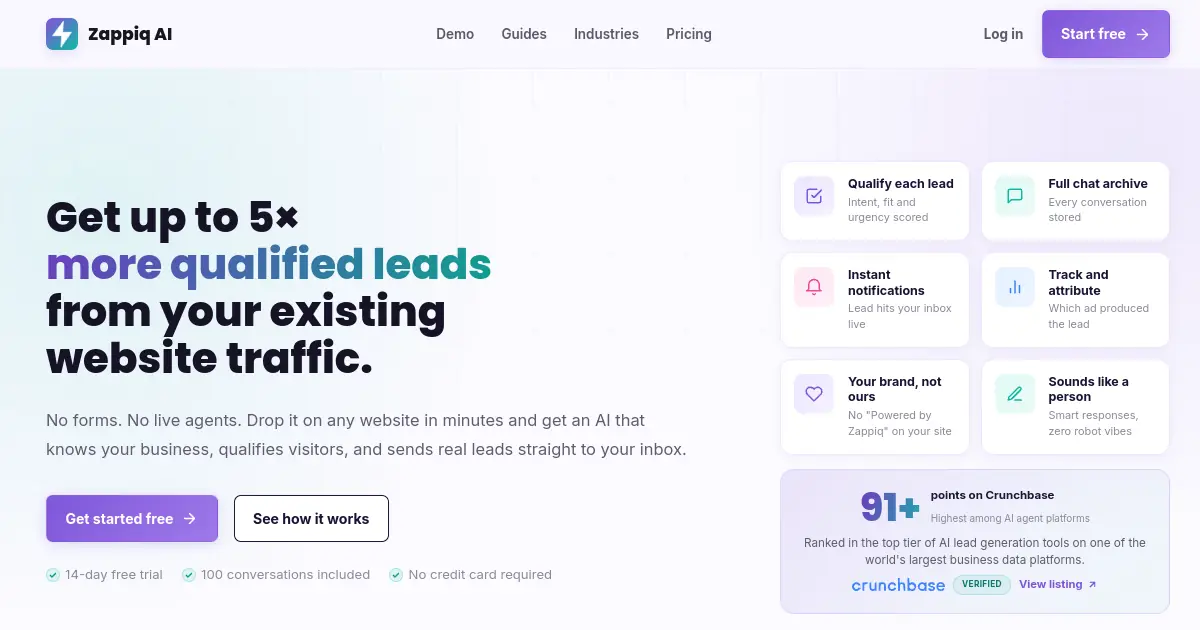
ManyChat and Zappiq AI are aimed at different starting points. ManyChat lives on social platforms, built around Instagram comments, Messenger threads, and broadcast campaigns that grow your audience count on purpose. Zappiq lives on your website, built around one narrower job: turning the visitors you already have into qualified leads, with pricing that has nothing to do with how many people that audience eventually grows to.
That distinction matters most at exactly the moment a ManyChat campaign succeeds. A comment-to-DM giveaway that goes well is the scenario where ManyChat's active-contact billing hurts the most, since your bill climbs in direct proportion to the reach you just paid ad spend to earn. Zappiq's flat, conversation-based pricing does not care whether last month was quiet or whether a campaign tripled your website traffic. The number you signed up for is the number you pay.
Setup follows the same philosophy. There is no flow builder to learn, no keyword triggers to configure, and no channel-by-channel setup across Instagram, Messenger, and WhatsApp. Zappiq reads your website the moment you sign up and trains itself on your services, pricing, and common questions automatically, so a working assistant is answering visitor questions before the account setup is finished.
Lead qualification is built into the core product rather than something you assemble out of flow logic. The chatbot asks about intent, timeline, and fit before it ever asks for a name or phone number, and the instant a visitor clears that bar, Zappiq emails you the lead with the full conversation transcript attached.
Ad attribution closes a gap that ManyChat, built primarily for organic and paid social reach rather than website conversion tracking, does not really address. Zappiq ties each captured lead back to the campaign, keyword, or channel that actually brought the visitor to your site, which matters for anyone running paid traffic to a landing page rather than relying purely on social comment triggers.
Webhook routing: Zappiq connects to Zapier, Make, and n8n, so a captured lead can land in your CRM, a Slack channel, or any tool already in your stack, no custom integration work required.
Pros
- No flow builder or channel setup required
- Trains itself on your website from day one
- Flat pricing, unaffected by contact count
- Lead qualification built in, nothing to configure
- Instant email alerts with full conversation transcript
- Ad source tracking on every captured lead
- No branding, even on the free trial
Cons
- Not built for Instagram or Messenger broadcast marketing
- No comment-to-DM or keyword trigger automation
- No native WhatsApp or SMS broadcast channel
- Younger platform, smaller template library than ManyChat
Why lead-focused teams choose Zappiq AI
Ad tracking: Connect each qualified enquiry to the campaign, keyword, or channel that generated it, so paid traffic can be measured against real leads.
Email lead delivery: Receive contact details, intent, source data, and the full conversation in your inbox as soon as the lead qualifies.
No branding: Keep the widget aligned with your brand without a third-party badge or a separate white-label fee.
Automatic website training: Let Zappiq learn from your services, pricing, and FAQ pages instead of building a channel-specific flow library.
Natural qualification: Ask useful follow-up questions and identify genuine fit before collecting contact information.
Simple installation: Add one script to WordPress, Shopify, Webflow, Wix, Squarespace, or a custom website without configuring social-channel automations.
Pricing
Pricing: Start with a 14-day trial that includes 100 conversations. Starter is $9/month equivalent billed annually for 350 conversations; Growth is $39 monthly or $27/month equivalent billed annually for 1,500; Pro is $99 monthly or $69/month equivalent billed annually for 5,000, with no per-lead fees.
Best for: Small and medium business websites where the goal is turning visitors into qualified enquiries, not running a social media broadcast operation. Service businesses, agencies, real estate, dental, legal, home services, and anyone running paid traffic who wants a bill that stays put.
2. Chatfuel: Best Flat-Rate Meta Automation Platform
Chatfuel
chatfuel.com | Instagram, Messenger, WhatsApp, and TikTok automation with Fuely AI bundled into a single flat plan
Chatfuel is ManyChat's oldest and closest direct rival, and it made a deliberate bet in 2026 that ManyChat did not: instead of adding more tiers around contact count, Chatfuel collapsed its pricing into a single plan at around 69 dollars a month covering unlimited contacts across WhatsApp, Instagram, Messenger, TikTok, and a website widget, with its AI agent, Fuely AI, bundled in rather than sold separately.
That flat structure changes the calculation entirely once your audience grows past a few thousand contacts. Below that point, ManyChat's Essential or Pro tiers are cheaper on paper. Past it, Chatfuel's fixed price stops moving while ManyChat's overage fees keep climbing, which flips the value comparison the larger your list gets.
Fuely AI is a genuine step up from ManyChat's AI Step in terms of what it can actually do inside a conversation, since it is built to hold a full exchange grounded in rules and content you define, rather than answering one question before handing control back to buttons. As an official Meta Business Partner and WhatsApp Business Solution Provider, Chatfuel also routes WhatsApp traffic natively rather than treating it as a bolt-on integration.
The trade-off is that Chatfuel has no permanent free tier, only a seven-day trial, and it does not cover channels outside the Meta and TikTok ecosystem. Telegram, SMS, and email are not natively supported, so businesses that need those channels alongside social automation will still need a second tool.
Pros
- Single flat plan, unlimited contacts, no overage fees
- Fuely AI holds a full conversation, not one AI step
- Official Meta Business Partner, native WhatsApp routing
- Covers Instagram, Messenger, WhatsApp, TikTok, and website chat
- Cheaper than ManyChat once your list passes a few thousand contacts
Cons
- No permanent free plan, only a 7-day trial
- More expensive than ManyChat for small, low-volume accounts
- No native Telegram, SMS, or email channel
- Meta still bills WhatsApp conversation fees separately
Pricing
Best for: Businesses with a growing Instagram or WhatsApp audience who want flat, predictable pricing and a more capable AI agent than ManyChat's flow-based AI Step.
3. Tidio: Best for Ecommerce and Shopify Chat
Tidio
tidio.com | Live chat and AI chatbot platform with native Shopify and ecommerce integrations
Where ManyChat is built around social comment and DM marketing, Tidio is built around the storefront itself. Order status lookups, abandoned cart recovery, and product recommendation widgets connect directly to your Shopify data rather than requiring you to build that logic yourself inside a generic flow builder.
The plan structure starts approachable and then hits a cliff. Free covers fifty conversations a month with three operator seats. Starter runs about 29 dollars a month, Growth around 59 dollars with five seats. The next step up, Plus, jumps to roughly 749 dollars a month with nothing in between, a gap that catches stores off guard the moment they outgrow Growth's limits.
Tidio's AI chatbot, Lyro, is not included in the base plan at any tier. It is a separate add-on starting around 32 to 39 dollars a month for a fixed quota of AI conversations, with overage priced near fifty cents each on the higher tiers. That is a real cost on top of the base plan, similar in spirit to how ManyChat treats AI as something you add rather than something that comes with the platform.
For a store owner who cares more about cart recovery and order-status automation than social DM marketing, Tidio's ecommerce-first design closes gaps ManyChat never really addressed, even though the pricing still requires some planning around the AI add-on and the seat limits.
Pros
- Native Shopify and ecommerce integrations
- Free plan covers 50 conversations with 3 seats
- Visual flow builder for cart recovery and FAQs
- Lyro AI trains on your store's product catalog
- Widget built specifically for online storefronts
Cons
- Lyro AI is a separate paid add-on, not included
- Steep jump from Growth ($59/mo) to Plus (~$749/mo)
- 10-seat cap on self-serve plans
- Not built for Instagram or Messenger broadcast marketing
Pricing
Best for: Shopify and ecommerce stores that want live chat built around store data and order status, rather than a broadcast-focused social marketing tool.
Want leads captured today, without a contact meter running underneath?
Zappiq AI trains itself on your website, qualifies visitors automatically, and emails you every lead. Flat pricing that stays flat, no matter how big your audience gets.
Start Free Trial >No credit card | No developer needed | No branding on any plan
4. SendPulse: Best Budget Multichannel Option
SendPulse
sendpulse.com | Email, SMS, chatbots, and a basic CRM bundled into one affordable multichannel platform

SendPulse takes a broader view of what a marketing automation platform should include than either ManyChat or Chatfuel. Rather than specializing purely in social DM automation, it bundles email marketing, SMS, chatbots for Instagram, Messenger, WhatsApp, and Telegram, and a basic CRM into one account, priced around subscriber count rather than active chatbot contacts specifically.
The free plan is the standout here. It includes 500 subscribers, 15,000 emails a month, three chatbots, and access to the CRM, which is a meaningfully wider free tier than ManyChat's 25-contact, 2-channel limit. Paid plans start under 10 dollars a month and scale from there based on subscriber count across channels.
The trade-off for that breadth is depth. SendPulse's chatbot builder does not match ManyChat's template library or flow complexity for pure Instagram and Messenger marketing campaigns, and its AI capability is comparatively basic. For a business that wants one affordable tool covering email, chat, and a lightweight CRM rather than a specialist chatbot platform, that trade-off is usually worth it. For a business whose entire strategy is built around sophisticated comment-to-DM funnels, it is a step down in chatbot sophistication specifically.
SendPulse is worth the closest look for teams that were never fully sold on ManyChat's social-first focus in the first place, and who would rather consolidate email, SMS, and chat into a single affordable account than run three separate subscriptions.
Pros
- Generous free plan: 500 subscribers, 15,000 emails, 3 chatbots
- Bundles email, SMS, chat, and a basic CRM in one account
- Paid plans start under $10/month
- Covers Instagram, Messenger, WhatsApp, and Telegram
Cons
- Chatbot builder less sophisticated than ManyChat's flow logic
- AI capability more basic than dedicated AI-first tools
- Smaller template library for comment-to-DM campaigns
- SMS still billed separately by volume and country
Pricing
Best for: Budget-conscious small businesses that want email, chatbots, and a basic CRM consolidated into one account, rather than paying for a specialist social DM tool alone.
5. tawk.to: Best Free Option
tawk.to
tawk.to | Fully free live chat with unlimited agents, no conversation caps, and no per-contact billing
ManyChat's shrunken free plan makes the contrast with tawk.to sharper than it used to be. Where ManyChat now caps free usage at 25 active contacts, tawk.to has stayed genuinely unlimited for years: unlimited agents, unlimited chat history, and unlimited conversations, funded through an optional hire-a-live-agent service rather than a subscription tier.
For a business that just wants a chat widget on its website and a reliable way to be notified when someone reaches out, tawk.to covers that job completely at zero monthly cost, with none of the active-contact math ManyChat's pricing page now requires before you can even estimate a bill.
The honest limitation is scope. tawk.to is manual live chat, not a social DM automation platform. There is no Instagram comment trigger, no Messenger broadcast sequence, and no AI agent handling conversations on its own. Every chat needs a human on the other end, which is a real constraint for anyone trying to replace ManyChat's automated flows specifically, and a non-issue for anyone who just wants a free widget for direct website visitors.
If the branded widget is a concern, removing it costs about 29 dollars a month on the paid tier, still a small fraction of what a single month of ManyChat's Business plan costs before any overage fees apply.
Pros
- Completely free, unlimited agents and chats
- No contact cap, no overage fees, no trial clock
- Simple to install on any website in minutes
- Branding removal is a small flat monthly add-on
Cons
- No AI agent, purely manual live chat
- No Instagram or Messenger comment-to-DM automation
- Requires a human watching the widget to be useful
- No broadcast or campaign functionality at all
Pricing
Best for: Businesses with genuinely no budget for chat software who just need a website widget and a human answering it, with no social automation required.
6. Respond.io: Best for Sales Teams Running Multiple Channels
Respond.io
respond.io | Omnichannel shared inbox and workflow automation for sales and support teams managing multiple messaging apps
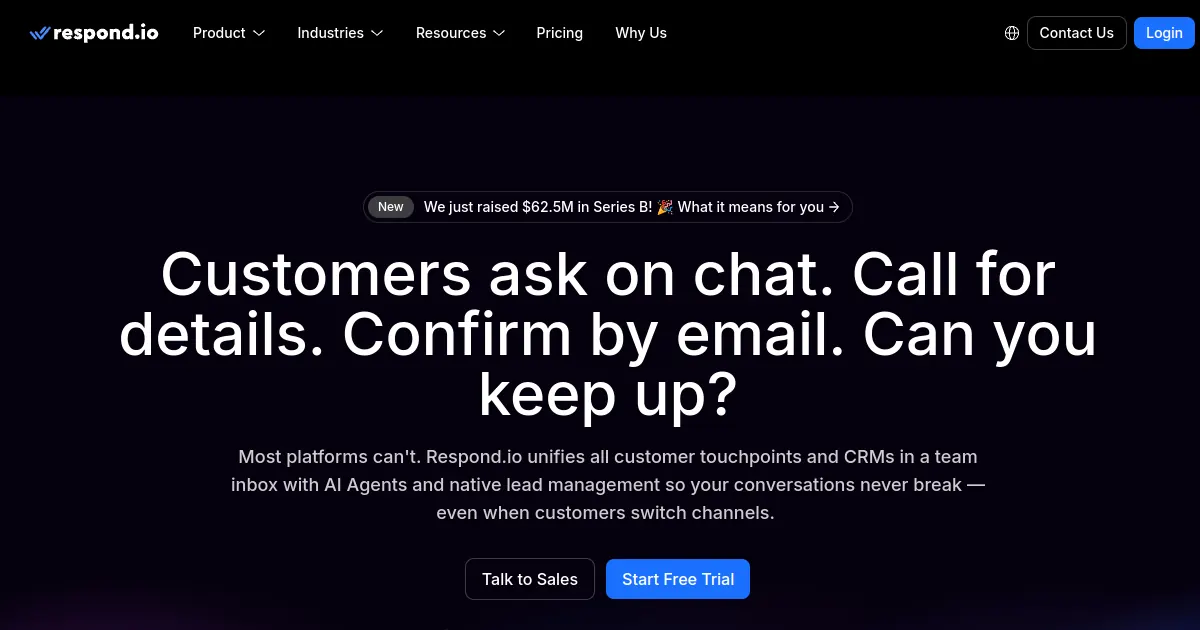
Respond.io solves a different problem than ManyChat solves. Instead of building broadcast marketing flows for one or two social channels, it pulls every messaging channel your customers actually use, WhatsApp, Instagram, Messenger, Telegram, SMS, and more, into a single shared inbox for a sales or support team to manage together, with routing rules and workflow automation layered on top.
Pricing is flat rather than contact-based. There is no free plan, but a seven-day trial is available, and the entry tier starts around 79 dollars a month billed annually with unlimited contacts included. That flat structure is the direct opposite of ManyChat's per-contact overage model, which makes Respond.io a natural landing spot for any team that got burned by a bill that grew alongside a successful campaign.
AI capability is not included at the entry tier. Respond.io's AI agents, which can greet visitors, answer FAQs, qualify leads, and route conversations automatically, require an upgrade to a higher plan starting around 159 dollars a month. That is a meaningful cost step, but it is a single predictable number rather than a per-resolution or per-contact meter that moves with volume.
The trade-off compared to ManyChat is that Respond.io was never built as a marketing-flow or broadcast tool. There is no comment-to-DM trigger library, no giveaway funnel template, and no growth-marketing feature set. It is a support and sales inbox first, which makes it a strong fit for teams whose actual pain point is managing conversations across too many apps, and a weaker fit for anyone whose core use case is social audience growth.
Pros
- Flat pricing, unlimited contacts, no overage fees
- One shared inbox across WhatsApp, Instagram, Messenger, SMS, and more
- Workflow automation and routing built for sales teams
- AI agents available on higher tiers for lead qualification
Cons
- No free plan, only a 7-day trial
- AI agents require a separate, more expensive tier
- No broadcast marketing or comment-to-DM feature set
- Setup takes longer than the fully no-code tools on this list
Pricing
Best for: Sales and support teams juggling customer conversations across several messaging channels who need one inbox and predictable, flat pricing instead of a contact meter.
7. HubSpot Service Hub: Best for Teams Already on HubSpot CRM
HubSpot Service Hub
hubspot.com/products/service | Live chat and ticketing built directly into HubSpot's free CRM

HubSpot's pitch is different from every social-first tool on this list. It is not a chatbot builder that happens to have a CRM attached. It is a CRM with chat and ticketing attached, and for a business already running marketing or sales through HubSpot, that changes the comparison, since every chat and every contact gets logged against the same record your other teams already work from.
The free tier is genuinely usable. It includes unlimited seats, a shared inbox, live chat, and ticketing, tied to HubSpot's free CRM with no seat cap forcing an early upgrade, unlike ManyChat's contact-based free tier that now runs out almost immediately. Paid tiers start around 20 dollars a seat and add automation, reporting, and Breeze, HubSpot's AI layer.
Breeze AI is billed as credits bundled into your plan tier rather than metered per contact or per resolution, which is a more predictable structure than ManyChat's active-contact overage model, though heavy AI usage on a lower tier will still hit a credit ceiling that forces an upgrade eventually.
The clear limitation is that HubSpot Service Hub was never built for Instagram or Messenger broadcast marketing the way ManyChat was. There is no comment-to-DM trigger, no giveaway funnel builder, and the live chat widget is noticeably less specialized for social commerce than a purpose-built tool like Chatfuel or Zappiq. For a business not already invested in HubSpot's ecosystem, adopting Service Hub purely to replace ManyChat is rarely the most direct path.
Pros
- Free tier includes unlimited seats and a real CRM
- Every chat and ticket tied to the same contact record
- Breeze AI billed as bundled credits, not per contact
- Strong reporting once paired with HubSpot Marketing or Sales
Cons
- No Instagram or Messenger comment-to-DM automation
- Widget customization more limited than social-first tools
- Real value only shows up alongside other HubSpot products
- AI credit ceilings can force an upgrade at moderate volume
Pricing
Best for: Businesses already running sales or marketing through HubSpot who want chat and support tickets tied to the same contact timeline, rather than a separate social marketing tool.
How to Choose the Right ManyChat Alternative
Decision rule: Start with the actual job, website lead capture, social DM marketing, ecommerce chat, or a shared support inbox, before comparing sticker prices.
The first question worth answering honestly is whether the real goal was ever social broadcast marketing in the first place, or whether ManyChat was chosen mainly because it was the well-known option, when the actual need is more qualified leads from an existing website. If that is the real job, Zappiq AI will outperform every tool on this list at it, since none of the others were designed around lead qualification and flat pricing as the core product.
If Instagram, Messenger, and WhatsApp automation genuinely is the job and the concern is purely ManyChat's contact-based billing, Chatfuel is the most direct swap, trading a slightly higher entry price for a flat unlimited-contact plan and a more capable AI agent. For ecommerce specifically, Tidio's native Shopify integrations are worth the AI add-on cost for most stores, since replicating that logic elsewhere usually means custom development.
If budget is the whole constraint, tawk.to gets a working chat widget live today for nothing, as long as a human is available to answer it, and SendPulse is worth a look if the plan is to consolidate email, SMS, and basic chat into one account rather than pay for several specialist tools. For sales or support teams drowning in messages across too many apps, Respond.io's unified inbox and flat pricing solve a different, often more painful problem than social growth marketing ever did. And if the business already runs on HubSpot, Service Hub deserves a look before adding yet another separate platform.
Before you migrate: Export your ManyChat flows, keyword triggers, and contact tags before canceling. Most tools on this list can import contact data directly, but flow logic rarely transfers automatically. Running your new tool alongside ManyChat for a week or two before redirecting your automation triggers will surface any gaps before your audience does.
Frequently Asked Questions
Zappiq AI is the best ManyChat alternative for small business websites that want to capture and qualify leads rather than run social DM broadcast campaigns. It charges a flat monthly rate that does not move when your contact count grows, trains itself on your website automatically, and emails you the moment a visitor qualifies. Chatfuel and SendPulse are worth a look if Instagram and WhatsApp automation specifically are the main requirement instead.
The main reason is the March 2026 pricing overhaul. ManyChat's free plan dropped from roughly 1,000 contacts to 25, and the paid tiers now bill by active contacts with per-contact overage fees once you cross your plan's limit. WhatsApp and SMS messages are billed separately on top of the platform fee, and real AI conversation capability is locked behind the Pro tier and above, which pushes the realistic monthly cost well past the advertised starting price for any business with real DM volume.
Yes. tawk.to is completely free with unlimited agents and no conversation cap, though it is manual live chat with no AI. SendPulse offers a free plan covering 500 subscribers, 15,000 emails, and three chatbots. HubSpot Service Hub has a free tier with unlimited seats. Zappiq AI offers a 14-day trial with 100 conversations, while Tidio has limited free usage and trials.
ManyChat's published 2026 pricing runs Free (25 active contacts), Essential at $14 a month (250 contacts), Pro at $29 a month (2,500 contacts, AI unlocked), Business at $69 a month (7,500 contacts), and Advanced at $139 a month (25,000 contacts). Overage fees apply once you exceed a plan's contact limit, roughly $0.025 per extra contact on Business. WhatsApp and SMS messages are billed separately through Meta, and a live-chat add-on called Inbox Pro costs an additional $99 a month for three seats, so a business with real volume across channels often pays several hundred dollars a month rather than the advertised starting price.
Not in the way a dedicated AI agent does. ManyChat's AI Step answers a single question inside a flow and then hands the conversation back to buttons and predefined branches, and it is only available starting on the Pro plan. Tools like Chatfuel's Fuely AI or a purpose-built AI agent are designed to hold a full, free-form exchange rather than a single AI-assisted step within a larger scripted flow.
The Bottom Line
ManyChat is still a capable, well-templated tool for exactly what it was built to do: comment-to-DM campaigns, broadcast marketing, and flow-based automation across Instagram and Messenger. The 2026 pricing changes did not make the product worse. They changed the economics of using it well, since a bill that grows every time a marketing campaign succeeds is a strange incentive to build into a marketing platform.
Most people reading this fall into a few groups. Some are small business owners who chose ManyChat expecting a simple chat widget and got a contact meter instead. Some are ecommerce stores that want automation wired directly into their storefront data. Some are sales and support teams drowning in messages across too many separate apps. And some just want their audience growth to stop directly costing them money every time it works.
For the first group, and for anyone whose real goal was always more qualified leads from a website rather than a social broadcast operation, Zappiq AI removes the exact cost that stings the most: a bill that climbs the moment a campaign succeeds. It trains on your site automatically, qualifies visitors before ever asking for contact details, and routes every lead to your inbox with the full conversation attached, at a price that stays where you left it.
For the other groups, the right pick depends on the specific need: Chatfuel for a flatter, more capable version of ManyChat's own social-first shape, Tidio for ecommerce and Shopify, SendPulse for budget-conscious multichannel marketing, tawk.to if the budget is genuinely zero, Respond.io for a team managing too many channels at once, and HubSpot Service Hub for teams already living inside HubSpot's CRM.
The free trial for Zappiq AI is at zappiqai.com. No credit card required, no contact meter, and no branding added to your widget on any plan.
Try the ManyChat alternative built for lead generation
Zappiq AI is live in under 5 minutes. Trains itself on your website, no flows to build, no contact meter to track. Just leads in your inbox the moment they are captured.
Start Free Trial >No credit card | No developer needed | No branding on any plan
References
- Voiceflow. "ManyChat [2026]: Pricing, Tutorial, Best Alternatives." voiceflow.com.
- SetSmart. "ManyChat Pricing 2026: Free Plan Truth & Hidden Fees." setsmart.io.
- Flowgent. "ManyChat Pricing 2026: Plans, WhatsApp Fees & Real Cost." flowgent.ai.
- LeadResponse. "ManyChat Pricing in 2026: What It Actually Costs." leadresponse.co.
- Chatbotscape. "Chatfuel Review 2026: One Simple Plan, Unlimited Contacts." chatbotscape.com.
- SetSmart. "Chatfuel Pricing 2026: Plans, Costs & Alternatives." setsmart.io.
- ToolRadar. "SendPulse Pricing 2026: Plans, Hidden Costs & Cheaper Alternatives." toolradar.com.
- SendPulse. "5 AI TikTok Chatbot Builders Compared." sendpulse.com.

Ansar Ali
Ansar Ali founded Zappiq AI after noticing how many small business owners were paying social-marketing prices for a job that was really just "answer questions on our website and tell us who's interested." He spends most of his time on lead qualification logic, attribution, and keeping a chatbot install invisible to page speed, and writes these comparisons from that practical angle rather than a neutral industry-report one.