
Quick Summary
Short answer: Omilia is a voice-first enterprise AI platform with transparent per-resolution pricing and no token pass-through. For teams that need voice AI without enterprise complexity, Five9 and Cognigy are the strongest choices for large contact centers, while Zappiq AI is the most practical option for website lead capture and qualification without enterprise pricing.
- Zappiq AI is the best Omilia alternative for teams that primarily need website visitor qualification and lead capture without enterprise pricing or complex setup.
- Five9 is the strongest choice for enterprises that need voice AI agents with a mature CCaaS platform, a unified Agent Studio, and proven enterprise deployment at scale.
- Cognigy is the top option for organizations that need broad conversational AI across voice and digital channels as part of the NiCE CXone stack.
- Kore.ai is worth evaluating for regulated industries that need HIPAA, PCI DSS, and FedRAMP compliance with broad enterprise automation.
- Yellow.ai fits teams that want agentic AI capabilities with faster deployment than traditional enterprise platforms.
- PolyAI, Replicant, and Skit.ai are options for voice-first automation in specific verticals like hospitality, insurance, and debt collection.
- Decagon and Sierra are worth evaluating for teams that need AI customer service agents with strong workflow control, though neither is voice-first.
- Tidio and Crisp are options for smaller teams that want live chat with an AI layer at an accessible price point.
What Omilia Actually Is (And Why Teams Look Elsewhere)
Omilia earned its place among the leaders in conversational AI. Forrester's April 2026 Wave for Conversational AI Platforms named Omilia among the three market leaders alongside NiCE Cognigy and Kore.ai, citing its significant OEM relationships, customer support services, and experience in delivering edge use cases. The company raised a $67 million Series B in August 2026, led by Expedition Growth Capital, to accelerate global expansion of its agentic self-learning CX platform. Live ARR has grown more than 10x to over $60 million without additional equity capital in the interim.
The platform is voice-first. Omilia supports both Conversational Voice for structured, deterministic voice automation and Agentic Voice for full autonomous platforms with Task Agents, zero-shot NLU, and self-learning capabilities. It runs its own purpose-built models rather than acting as a thin client on a frontier LLM, which keeps costs predictable and independent of external API pricing. The pricing model is explicit: one price per resolved interaction, with no token consumption billing and no compute overage.
The pricing and access reality: Omilia does not publish specific pricing tiers. The platform is sold through enterprise sales engagement with implementation planning. It supports on-premise deployment for Tier 1 financial institutions and government agencies with strict data residency mandates. There is no self-serve signup, no credit card trial, and no way to estimate cost without a sales conversation. For teams that need voice AI without an enterprise procurement process, that is the reason they look elsewhere.
There is also the scope reality. Omilia is built for large enterprises with significant call volumes and complex voice automation needs. The OEM relationships that Forrester cited as a strength are partnerships where Omilia powers voice AI for other platforms rather than direct customer relationships. For an SMB or mid-market team that needs a chatbot on its website or a simple voice agent, the platform is more than they need and priced accordingly.
The voice AI market is also consolidating rapidly. NiCE acquired Cognigy, Automation Anywhere picked up Aisera, and SoundHound acquired Amelia, Interactions, and most recently LivePerson. Omilia remains independent, which is a genuine advantage for buyers concerned about roadmap uncertainty following an acquisition. But independence also means Omilia must compete against platforms that are being folded into larger suites with broader distribution and integrated workflows.
Where Omilia Users Are Actually Looking in 2026
Omilia users are not all looking for the same replacement. Teams that used Omilia primarily for voice automation in a large contact center are evaluating different options than teams that need website lead capture or digital channel support. The important distinction is between replacing the enterprise voice AI function and replacing the specific job Omilia was doing for your team.
For teams that need voice AI agents with a mature CCaaS platform and enterprise deployment at scale, Five9 and Cognigy are the natural comparison. For teams that need broad conversational AI across multiple departments, Kore.ai and Yellow.ai are worth evaluating. For teams that need website lead capture and qualification without the enterprise complexity, that scope is different entirely.
- Website lead capture and qualification: Zappiq AI for automatic training, visitor qualification, and lead delivery without an enterprise contract or implementation project.
- Enterprise voice AI with CCaaS: Five9 for voice AI agents with a unified Agent Studio and proven enterprise deployment.
- Broad conversational AI across channels: Cognigy for voice and digital channels as part of the NiCE CXone stack.
- Regulated industry compliance: Kore.ai for HIPAA, PCI DSS, and FedRAMP coverage with broad enterprise automation.
- Agentic AI with faster deployment: Yellow.ai for automation capabilities without the traditional enterprise timeline.
- Vertical-specific voice automation: PolyAI, Replicant, and Skit.ai for hospitality, insurance, and debt collection use cases.
- AI customer service agents: Decagon and Sierra for strong workflow control, though neither is voice-first.
- Live chat with an AI layer: Tidio and Crisp for smaller teams that want accessible pricing and quick setup.
What Omilia Actually Costs vs the Alternatives
The tools below replace different pieces of what Omilia does. No single product does everything Omilia does for every team, because Omilia itself is being stretched across jobs that range from enterprise voice automation to OEM partnerships. The honest answer is matching your actual use case to the tool built for it.
Quick Comparison: 11 Omilia Alternatives
| Tool | Starting Price | Best For | Setup Time | Free Option |
|---|---|---|---|---|
| Zappiq AI | Free, then $27/mo | Website lead capture and qualification | Under 10 min | 100 conversations |
| Five9 | Quote only | Enterprise voice AI with CCaaS | Weeks to months | No |
| Cognigy | Quote only | Broad conversational AI across channels | Weeks to months | No |
| Kore.ai | Quote only, ~$300K/yr | Regulated industry compliance | Weeks to months | No |
| Yellow.ai | Quote only | Agentic AI with faster deployment | Weeks | No |
| PolyAI | Quote only | Hospitality and enterprise voice | Weeks | No |
| Replicant | Quote only | Contact center voice automation | Weeks | No |
| Skit.ai | Quote only | Debt collection and BFSI voice | Weeks | No |
| Decagon | ~$95,000/yr | AI customer service agents with workflow control | 4 to 8 weeks | No |
| Tidio | Free, paid from ~$29/mo | Live chat with AI for small business | 30 to 60 min | 50 conversations/mo |
| Crisp | $45/mo (Mini) | Flat-rate omnichannel inbox | 15 to 30 min | Yes, 2 seats |
Before picking a replacement: Decide which job Omilia was doing for your team. If it was capturing and qualifying website visitors, the tools at the top of this list were purpose-built for that. If it was voice automation in an enterprise contact center, you are looking at a different category with different requirements.
1. Zappiq AI: Best for Website Lead Capture Without Enterprise Overhead
Zappiq AI
zappiqai.com | AI lead generation chatbot for small and medium business websites, no implementation partner required
- Live setup in minutes
- Automatically trains on your website
- Qualifies leads and tracks ad source
- No engineering-led deployment
- No branding on any plan
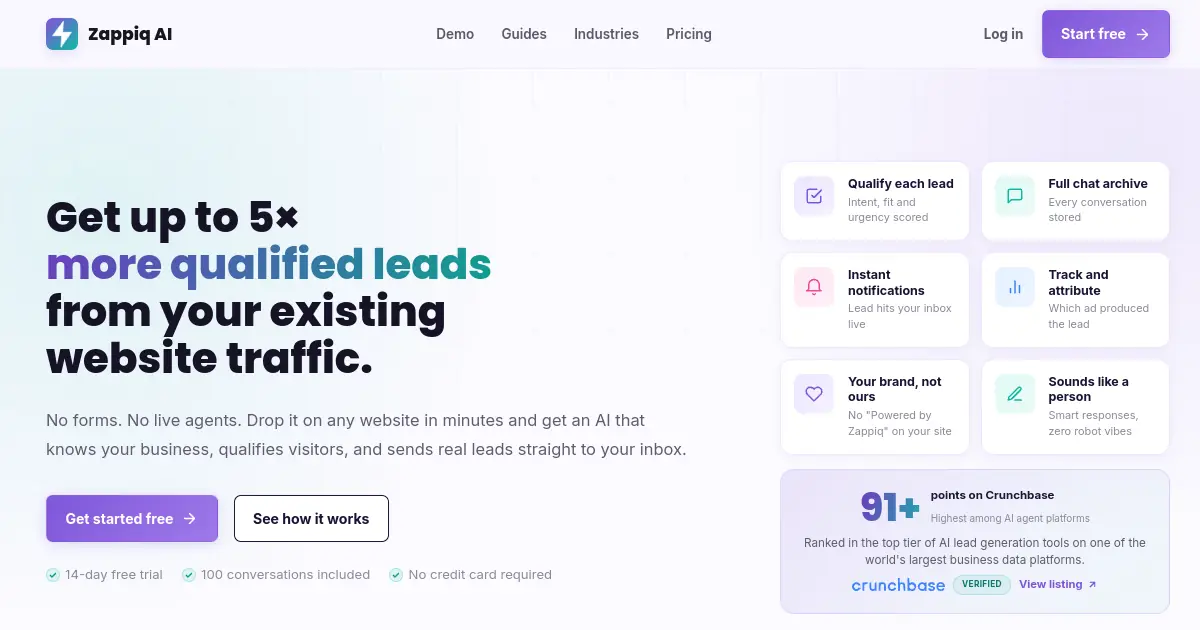
The comparison between Omilia and Zappiq AI is almost entirely about scope. Omilia is built to orchestrate voice conversations across an enterprise contact center with deterministic and agentic voice automation, on-premise deployment options, and OEM relationships that power other platforms. Zappiq AI is built to do one thing well: turn website visitors into qualified leads and deliver them to your team while the conversation is still relevant.
For an SMB, that narrower scope is the point. You install a script, Zappiq reads your website, and there is a working chatbot answering visitor questions within minutes. There is no enterprise sales engagement, no implementation project, no voice telephony integration before the first conversation. The AI trains itself on your content and starts from there. If something needs adjustment, you adjust it. The base state is already functional.
Omilia's setup process requires configuration before the platform does anything useful. The voice flows need to be designed, the intent models need to be trained, and the telephony integrations need to be mapped. For enterprise contact centers with implementation partners, that is expected. For SMBs that just need a chatbot that answers questions and captures leads, that overhead is the reason they look elsewhere.
The moment a visitor qualifies, Zappiq emails you the full lead: contact details, intent summary, and the complete conversation transcript. That combination of speed and context matters because website visitors who are ready to buy do not stay ready for long. A lead that sits in a shared inbox for three hours is a different lead than one that arrives with context while the conversation is still fresh.
Pricing is structured around conversation volume rather than per-resolution outcomes or enterprise platform fees. The same traffic spike that would trigger a conversation about contract expansion at an enterprise vendor does not change your Zappiq bill. For an SMB running paid traffic, that predictability matters more than it might seem until the first month you run a campaign and watch volume spike.
Integration options: Zappiq connects to Zapier, Make, and n8n, which means a qualified lead can be pushed into your CRM, a Slack channel, or any other tool your team already uses without touching a line of code. Ad attribution is tracked per lead, so you know which campaign or keyword brought a visitor before they became a contact.
Pricing
Best for: SMBs that need website visitor qualification and lead capture without an enterprise contract, implementation partner, or months-long deployment. Service businesses, agencies, clinics, legal, real estate, home services, and anyone running paid traffic who wants to know exactly what a lead cost them.
2. Five9: Best for Enterprise Voice AI with Mature CCaaS
Five9
five9.com | Cloud contact center platform with Voice AI Agents and a unified Agent Studio
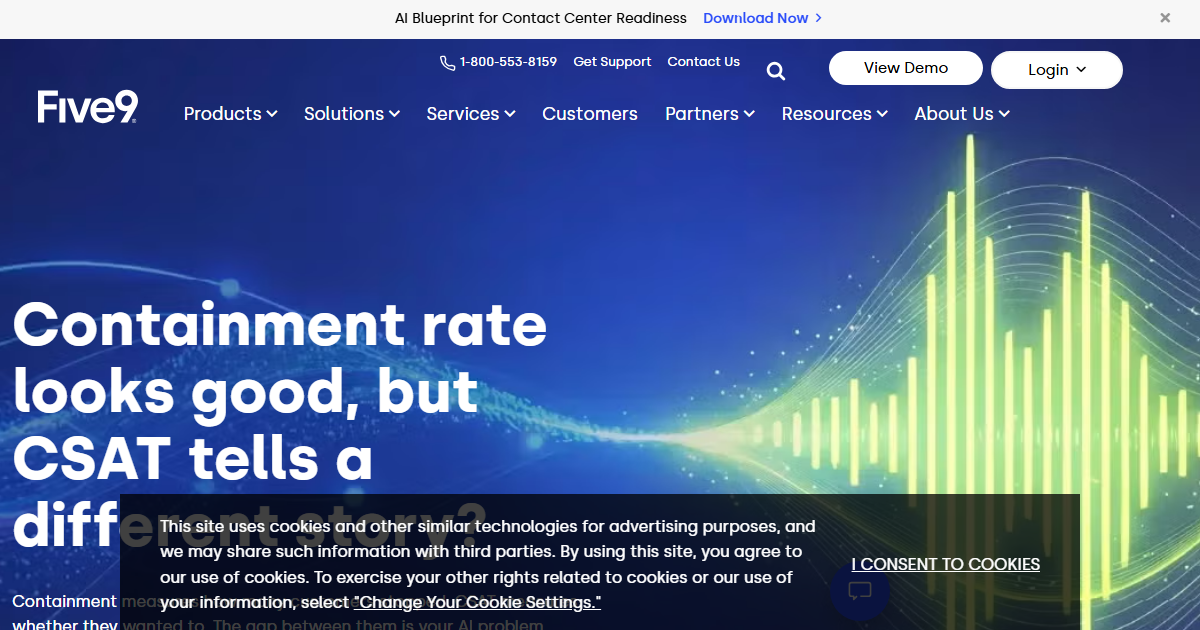
Five9 is the natural alternative for enterprises that need voice AI agents with a mature CCaaS platform. The company launched a new release of its Voice AI Agents in June 2026, targeting enterprises looking to move beyond scripted bots and legacy IVR systems with agentic AI for customer self-service. The release introduced AI Agent Studio, a unified environment for building, testing, deploying, and monitoring Voice AI Agents.
The platform includes multi-agent orchestration for complex, multi-step customer journeys, human-like voice interaction with low-latency streaming and multilingual support, secure tool calling for authentication and transactions, and context-rich warm handoffs between AI and human agents. A customer case study from PODS reported exceeding containment rate targets, reducing handle times, and delivering more consistent interactions, with expectations that Voice AI Agents will handle more than 100,000 service calls by year-end.
Five9 has been recognized as a Leader in Gartner's CCaaS Magic Quadrant for eight consecutive years and delivered record full-year 2025 revenue of $1.149 billion, with enterprise AI revenue surging 41%. For enterprises that need voice AI with a proven CCaaS platform and a unified agent studio, Five9 is the strongest direct alternative to Omilia.
Pricing
Best for: Enterprises that need voice AI agents with a mature CCaaS platform, unified agent studio, and proven deployment at scale. Strong for organizations already using Five9 for contact center operations.
3. Cognigy: Best for Broad Conversational AI Across Channels
Cognigy
cognigy.com | Enterprise conversational AI platform with voice and digital channels as part of the NiCE CXone stack

Cognigy is the strongest alternative for organizations that need broad conversational AI across voice and digital channels. Forrester's April 2026 Wave named NiCE Cognigy as a Leader, praising its strength of strategy and the potential for Cognigy to apply its AI across NiCE's portfolio. One reviewer noted the platform makes it quick and easy to build AI Agents without much IT expertise, with the ability to use different AI technologies side by side and choose individual LLM APIs.
The acquisition by NiCE means Cognigy is now part of a larger CXone stack with workforce engagement management capabilities. The roadmap includes a unified WEM platform for managing human and AI agents, which is a compelling prospect for enterprises that need coordinated automation. For teams that need voice AI as part of a broader contact center platform, Cognigy covers that job.
The tradeoff is that Cognigy is no longer an independent platform. Teams that want a standalone vendor with full control over roadmap direction may prefer Omilia or another independent option. For teams already on NiCE CXone, the integration works in your favor. For everyone else, the question is whether the NiCE stack is where you want to be.
Pricing
Best for: Enterprises that need broad conversational AI across voice and digital channels as part of a larger CX platform. Strong for organizations already using NiCE CXone.
Need website leads without enterprise sales engagement?
Zappiq AI trains on your site in minutes, qualifies every visitor automatically, and sends you the lead before the conversation goes cold. No demo required. No implementation partner.
Start Free TrialNo credit card | No developer needed | No branding on any plan
4. Kore.ai: Best for Regulated Industry Compliance
Kore.ai
kore.ai | Enterprise conversational AI platform built for regulated industries
Kore.ai is the strongest alternative for regulated industries that need deep compliance coverage alongside broad conversational AI capabilities. Forrester's April 2026 Wave named Kore.ai as a Leader and awarded it the field's highest current-offering score at 4.14, with top marks across ten criteria. Forrester specifically commended its AI model management, governance features, and back-end system integrations.
The platform serves over 200 Fortune 2000 customers including PNC Bank, Cisco, Pfizer, Coca-Cola, and Airbus, with particular depth in financial services and healthcare deployments. It covers HIPAA, PCI DSS, SOC 2 Type II, and GDPR compliance with field-level encryption and PII redaction. Gartner Peer Insights shows 174 verified reviews from large enterprises, with reviewers consistently praising the support partnership and the flexibility of the platform.
For teams in regulated industries that need broad automation across customer experience and employee experience with the deepest compliance coverage, Kore.ai is the natural fit. The tradeoff is the same as Omilia: enterprise pricing, enterprise implementation timelines, and enterprise resource requirements.
Pricing
Best for: Large enterprises in regulated industries that need broad automation across customer experience and employee experience with the deepest compliance coverage. Strong for organizations with dedicated technical resources to implement and maintain the platform.
5. Yellow.ai: Best for Agentic AI with Faster Deployment
Yellow.ai
yellow.ai | Agentic AI platform positioned for enterprises that want automation with faster time to value
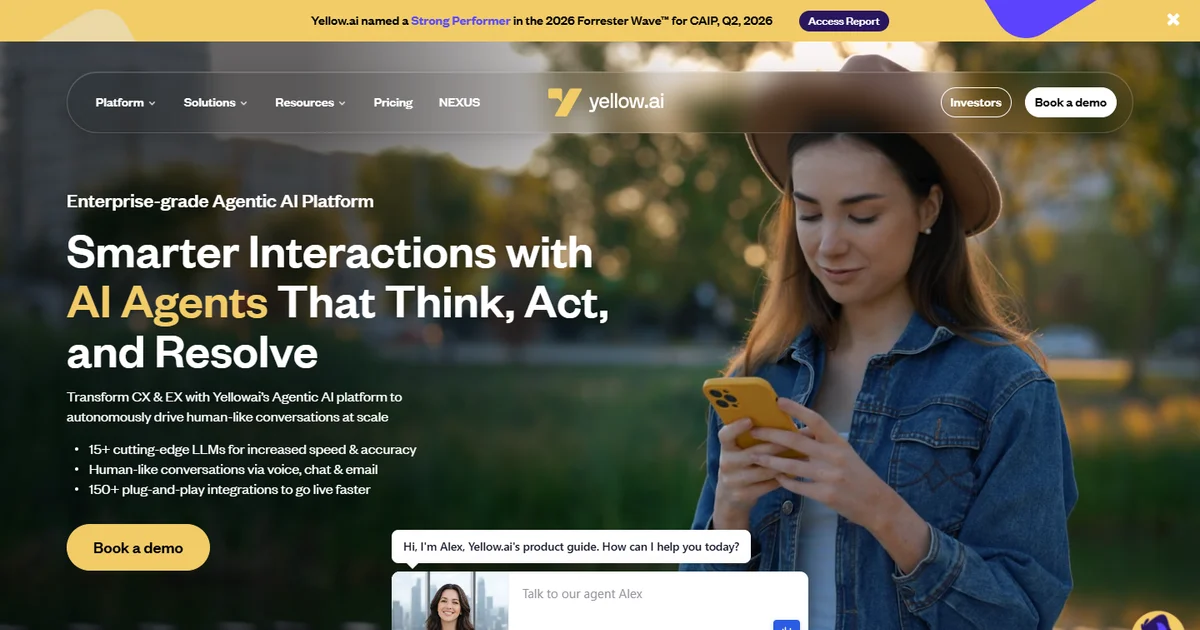
Yellow.ai is worth evaluating for enterprises that want agentic AI capabilities without the traditional enterprise timeline. The platform is positioned for organizations that need to move quickly on AI automation but still require enterprise-grade compliance and integration capabilities. A Gartner reviewer noted using Yellow.ai to centralize ticket complaints, promo queries, and warranty claims, with the platform summarizing context and auto-assigning tickets to the appropriate branch.
The platform appears in Forrester's Wave as a Strong Performer, with the analyst firm noting its legacy integration capabilities. For teams that need agentic AI across multiple departments with faster deployment than the traditional enterprise platforms, Yellow.ai is a practical option.
Pricing
Best for: Enterprises that need agentic AI capabilities with faster deployment than traditional enterprise platforms. Strong for organizations that need multi-department automation with compliance coverage.
6. PolyAI: Best for Hospitality and Enterprise Voice
PolyAI
polyai | Conversational voice assistants for enterprise customer service
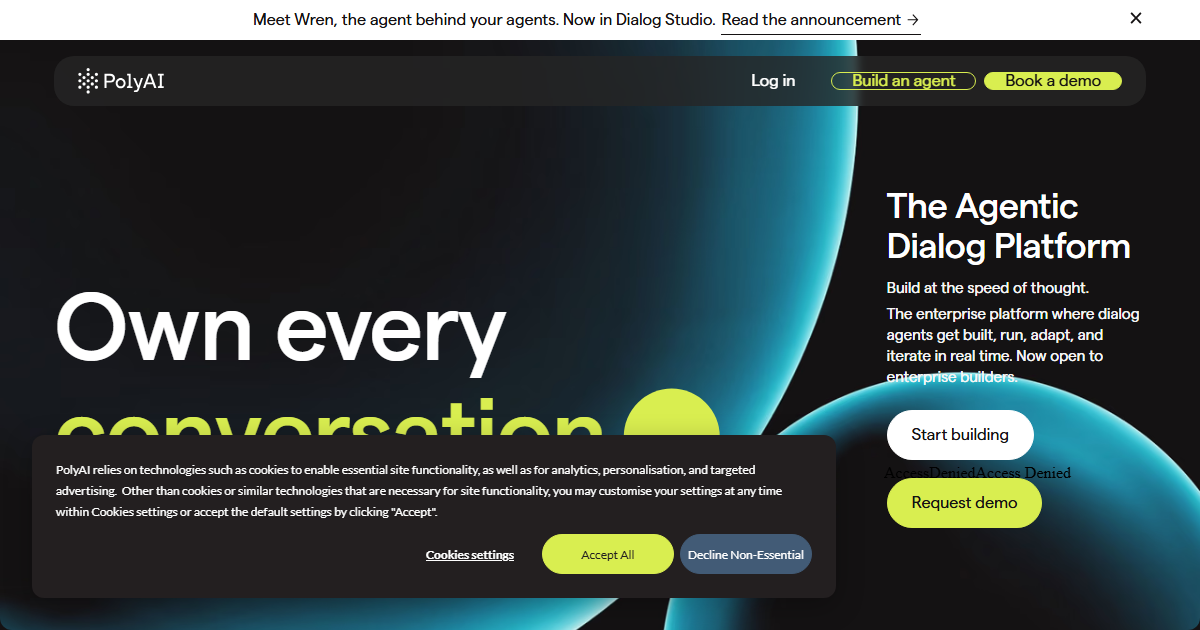
PolyAI is a voice-first specialist that develops conversational assistants for enterprise-level use. The company is particularly strong in hospitality, where voice AI handles reservations, guest inquiries, and service requests. StartupHub.ai lists PolyAI among the closest alternatives to Omilia, with a score of 28 and enterprise positioning.
The platform focuses on delivering lifelike conversational voice assistants that resolve millions of customer inquiries. For enterprises in hospitality and related verticals that need voice automation with a natural conversational feel, PolyAI covers that job. The tradeoff is that PolyAI is less broad than Omilia or Cognigy, with narrower channel coverage and less multi-department orchestration.
Pricing
Best for: Enterprises in hospitality and related verticals that need voice AI with natural conversational capabilities for reservations and guest service.
7. Replicant: Best for Contact Center Voice Automation
Replicant
replicant.ai | AI-powered voice agents for enterprise customer service
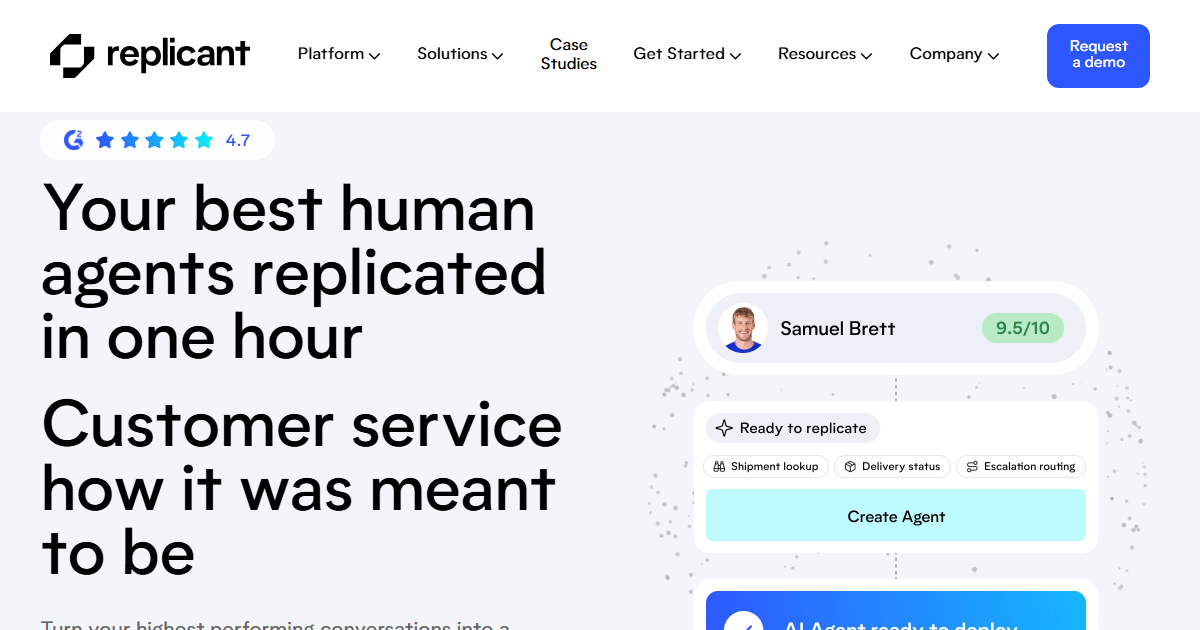
Replicant automates enterprise customer service with AI-powered voice agents that handle complex conversations. StartupHub.ai lists Replicant among the closest alternatives to Omilia, with a score of 63 and enterprise positioning. The platform is built for contact center voice automation across industries including insurance, healthcare, and retail.
For enterprises that need voice AI agents for customer service calls with complex conversation handling, Replicant covers that job. The platform is not as broad as Omilia on digital channels, but for voice-first operations, it delivers the core capability.
Pricing
Best for: Enterprises that need voice AI agents for contact center customer service across insurance, healthcare, and retail verticals.
8. Skit.ai: Best for Debt Collection and BFSI Voice
Skit.ai
skit.ai | Conversational AI for debt collection and customer service
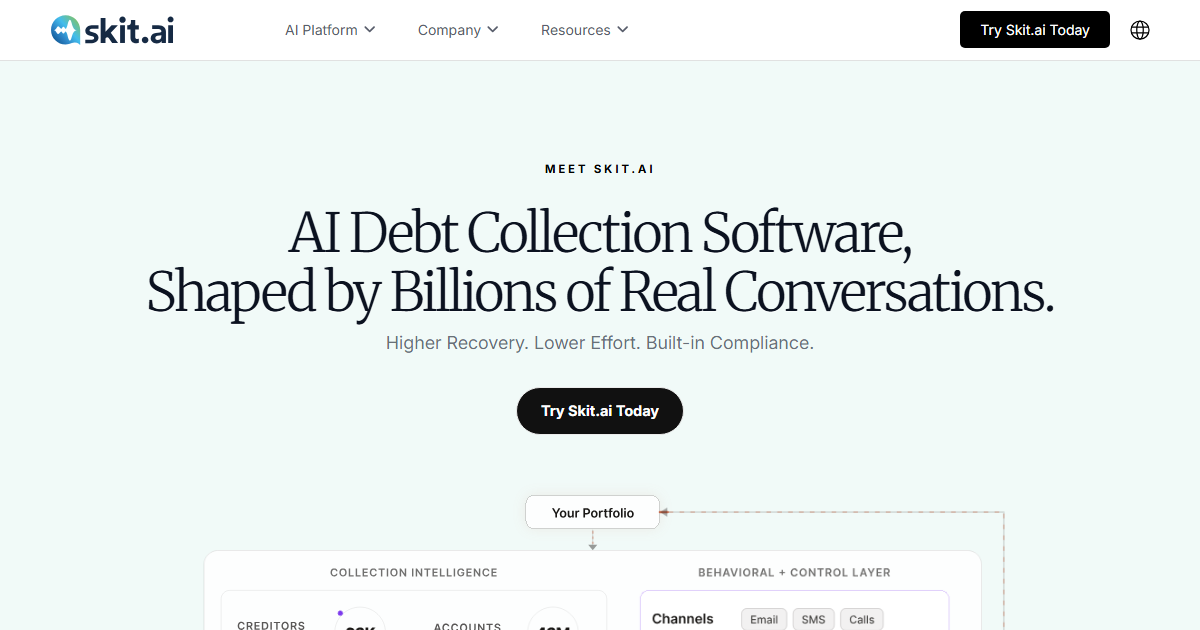
Skit.ai is an AI-powered conversational platform focused on automating customer service and debt collection interactions. StartupHub.ai lists Skit.ai as the closest alternative to Omilia, with a score of 61 and $53.9M in funding. The platform is particularly strong in BFSI, where it handles collections, payment reminders, and customer service calls.
For enterprises in banking, financial services, and insurance that need voice AI for debt collection and related use cases, Skit.ai covers that job with deep vertical specialization. The tradeoff is the same as other vertical specialists: narrower scope than Omilia, with less multi-channel and multi-department orchestration.
Pricing
Best for: Banks, financial services firms, and insurance companies that need voice AI for debt collection, payment reminders, and customer service calls.
9. Decagon: Best for AI Customer Service Agents with Workflow Control
Decagon
decagon.ai | Enterprise AI customer service agent platform with Agent Operating Procedures

Decagon is worth evaluating for teams that need AI customer service agents with strong workflow control, though it is not voice-first. The platform uses Agent Operating Procedures written in plain English, with Git-tracked version control that lets non-technical CX staff edit agent behavior without engineering involvement. The company raised $250 million at a $4.5 billion valuation in January 2026.
For teams that need AI customer service agents across chat and email with precise behavioral control, Decagon covers that job. For voice-first operations, Omilia or Five9 are the stronger choices. The tradeoff is the same as other enterprise platforms: custom pricing, engineering-led implementation, and a four to eight week setup timeline.
Pricing
Best for: Enterprises that need AI customer service agents across chat and email with precise workflow control. Strong for support operations with dedicated CX resources.
10. Tidio: Best for Live Chat with AI on a Small Budget
Tidio
tidio.com | Live chat and AI chatbot platform for small businesses, Shopify stores, and ecommerce sites
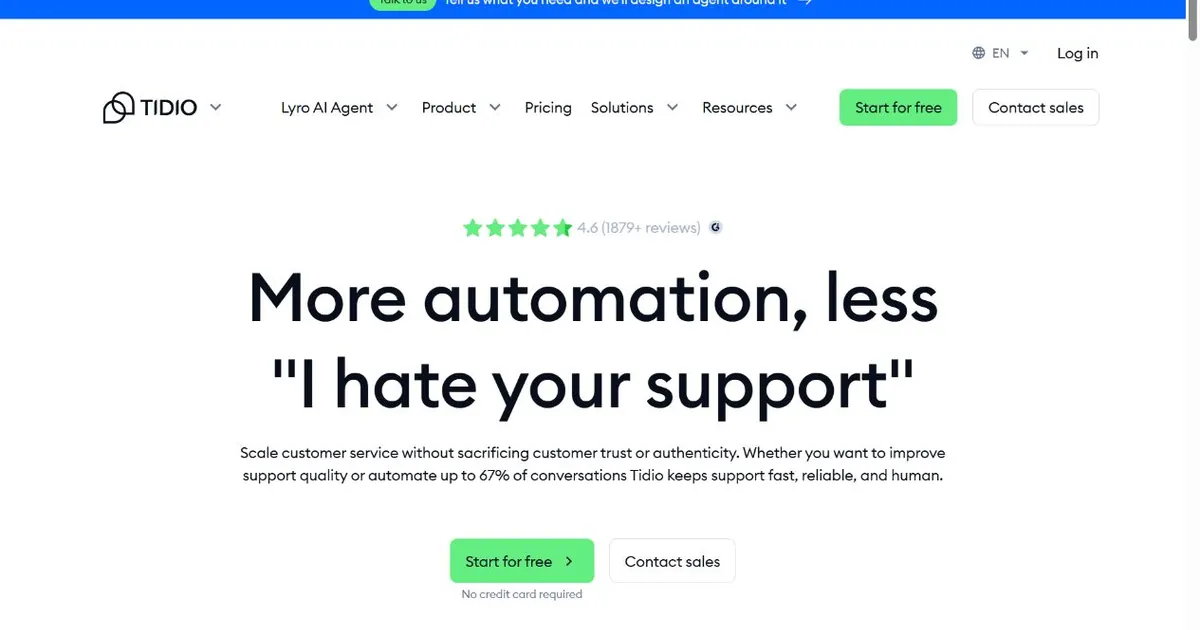
Tidio is what Omilia looks like when the pricing is public and the setup does not require an enterprise sales engagement. The core job is similar: greet visitors, answer questions, qualify leads, hand the good ones to a human. The execution is designed for someone who does not have an enterprise budget or a technical team.
The free plan covers fifty conversations a month with three operator seats. Starter runs around twenty-nine dollars a month, and Growth at about fifty-nine dollars adds more seats and automation. Lyro, Tidio's AI chatbot, is sold as a separate add-on starting around thirty-two dollars a month.
The tradeoff is depth. Tidio does not have the voice automation, agentic AI, or OEM relationships that Omilia offers. It is a chat and lead capture tool, not a voice AI platform. For teams that need live chat with an AI layer at an accessible price point, Tidio covers that job.
Pricing
Best for: Small businesses and ecommerce stores that want live chat with an AI layer at an accessible price point. Strong for teams that need quick setup without enterprise sales engagement.
11. Crisp: Best Flat-Rate Omnichannel Inbox
Crisp
crisp.chat | Shared inbox, live chat, and AI chatbot billed per workspace rather than per agent
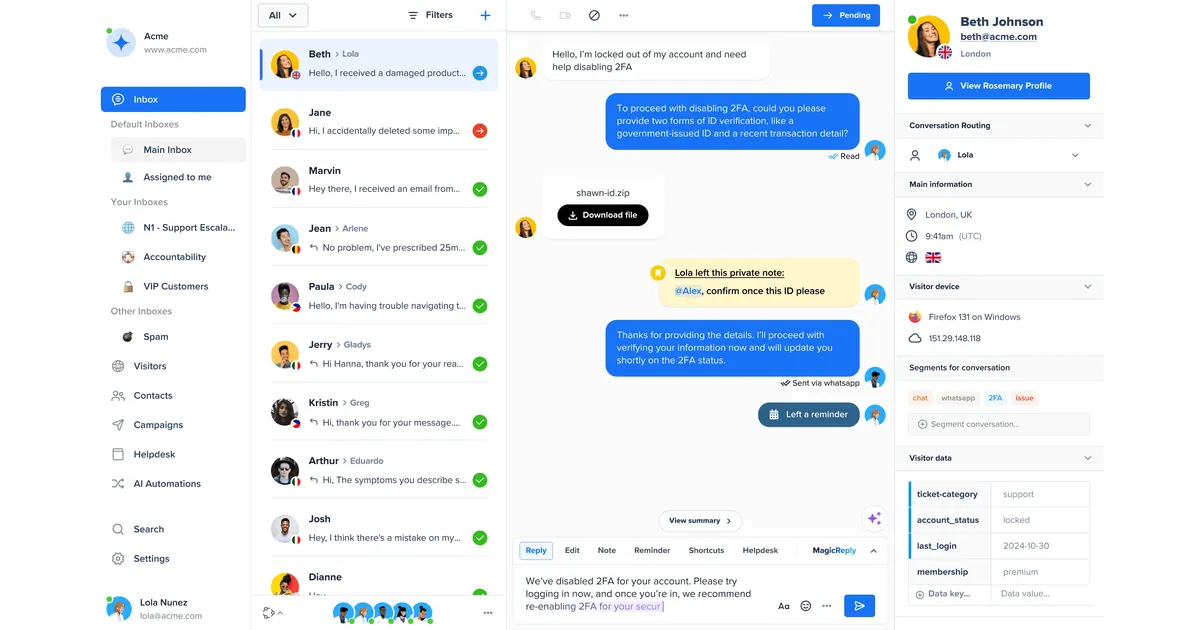
Crisp sits at an interesting spot in this comparison. It is not trying to replace Omilia's voice automation features. What it does well is give a small to mid-size team everything it needs to handle website conversations without a billing structure that grows with headcount. The workspace pricing model is the headline: adding a fifth or sixth teammate to your plan costs nothing extra below the Plus tier's per-seat cap.
The plan lineup starts with a genuinely useful free tier covering two seats and unlimited live chat. Mini runs forty-five dollars a month, Essentials ninety-five dollars a month, and Plus two hundred and ninety-five dollars a month for teams that need unlimited AI automation. Every paid tier bundles AI credits for Hugo, Crisp's chatbot, rather than charging a separate subscription for AI.
Pricing
Best for: Small teams that want live chat, a shared inbox, and a bundled AI chatbot on a single predictable bill without a seat-based charge that grows with every hire.
How to Evaluate an Omilia Alternative
Start with the job, not the feature list: The right replacement depends on which specific thing Omilia was doing for your team. Answering that question first saves time on comparisons that were never relevant.
Omilia was used differently by different teams, which is part of why this list does not have one obvious answer. Enterprise contact centers used Omilia for voice automation and IVR modernization. OEM partners used Omilia to power voice AI for their own platforms. Support teams used it for customer service calls. None of those jobs requires the same replacement.
If your team needs voice AI agents with a mature CCaaS platform and enterprise deployment at scale, Five9 is the strongest direct alternative. For organizations that need broad conversational AI across voice and digital channels as part of a larger CX stack, Cognigy covers that job. For regulated industries that need deep compliance coverage, Kore.ai is the natural fit.
If your use case is website lead capture and qualification without the enterprise complexity, a focused tool like Zappiq AI covers that job directly. The key difference from Omilia is that Zappiq starts with a working chatbot from day one without requiring an enterprise sales engagement before anything happens. For an SMB looking for a practical alternative, that simplicity matters a great deal.
For teams that need voice AI but are not ready for an enterprise platform, the market is evolving quickly. Vapi, Retell AI, ElevenLabs Agents, LiveKit, and Pipecat are runtime options that pair streaming ASR, an LLM core, and streaming TTS for IVR replacement, with a focused migration running 6 to 12 weeks for a single deployment. These are not direct Omilia alternatives, but they represent the emerging self-serve voice AI stack that enterprise platforms do not yet offer.
Migration Checklist: Moving Away from Omilia
A voice AI migration is not complete when the new platform is live. The risky parts are the call flows, intent models, and telephony integrations that your team built around Omilia. Use this checklist before turning the old workflow off.
- Document your call flows and intent models. Save the conversation logic, fallback messages, escalation rules, and any audience-specific variations before rebuilding them elsewhere.
- Record routing and integration details. Note ownership rules, CRM fields, webhooks, notifications, and any custom telephony integrations that connect to the platform.
- Export call recordings and transcripts. Keep recordings, transcripts, contact details, and outcomes in a format your team can search after the migration.
- Choose the replacement by job. Use a voice AI platform for IVR modernization, a lead-generation tool for website qualification, or a chat platform for digital support.
- Run the new tool in parallel for at least two weeks. Compare call quality, containment rates, lead delivery, routing, and handoffs before removing Omilia. Most runtimes support DTMF fallback alongside speech for a dual-stack cutover.
- Cut over and monitor the first month. Review unanswered calls, duplicate conversations, attribution, response time, and every integration that receives a qualified conversation.
Keep the old workflow available during testing. Parallel testing gives your team a way to compare real calls and catch missing routing or knowledge gaps before it affects customer experience.
Frequently Asked Questions
Omilia does not publish specific pricing tiers, but the company is explicit about its pricing model: one price per resolved interaction, with no token consumption billing and no compute overage. This transparent model is a deliberate differentiator against platforms that pass through LLM token costs. Omilia runs its own purpose-built models rather than acting as a thin client on a frontier LLM, which keeps costs predictable and independent of external API pricing.
The best alternative depends on the job. Zappiq AI is the most practical option for teams that primarily need website visitor qualification and lead capture without enterprise pricing or complex setup. Five9 is the strongest choice for teams that need enterprise voice AI with a mature CCaaS platform. Cognigy and Kore.ai are worth evaluating for organizations that need broad conversational AI across multiple departments.
Zappiq AI offers 100 free conversations to start with no credit card required. Most enterprise-focused voice AI platforms do not offer free trials because they require sales engagement, implementation planning, and telephony integration before anything works. Teams that want to test voice AI should look for platforms with sandbox environments or pilot programs.
Both are recognized Leaders in Forrester's 2026 Wave for Conversational AI Platforms. Omilia earned its place on significant OEM relationships, customer support services, and edge-case voice work. Cognigy leads on strength of strategy following its acquisition by NiCE. Omilia is voice-first with transparent per-resolution pricing. Cognigy is broader, covering voice and digital channels as part of the NiCE CXone stack.
No. Omilia is sold through enterprise sales engagement with implementation planning. The platform supports on-premise deployment for Tier 1 financial institutions and government agencies with strict data residency mandates. Teams that need self-serve signup should evaluate alternatives with free tiers or credit card trials.
For enterprise IVR modernization with a mature CCaaS platform, Five9 Voice AI Agents are the strongest direct alternative. Cognigy also covers voice automation as part of the NiCE CXone stack. For teams that want to build their own voice AI stack, Vapi, Retell AI, ElevenLabs Agents, LiveKit, and Pipecat are runtime options that pair streaming ASR, an LLM core, and streaming TTS, with a focused migration running 6 to 12 weeks for a single deployment.
The Bottom Line
Omilia built one of the strongest voice-first conversational AI platforms in the market and earned its place among the Leaders in Forrester's 2026 Wave. The transparent per-resolution pricing model and purpose-built models are genuine differentiators. The $67 million Series B and 10x ARR growth demonstrate real enterprise traction.
For SMBs and mid-market teams, the problem is not the product. It is the access and the scope. Omilia is sold through enterprise sales engagement with no self-serve signup, no public pricing, and implementation planning that requires dedicated resources. For enterprise contact centers with the budget and the resources, that is a reasonable tradeoff. For teams without either, it is the reason they look elsewhere.
The right replacement depends on which job Omilia was doing for your team. For teams that need enterprise voice AI with a mature CCaaS platform, Five9 covers that job. For organizations that need broad conversational AI as part of a larger CX stack, Cognigy and Kore.ai are worth evaluating. For teams that need voice AI for specific verticals like hospitality, insurance, or debt collection, PolyAI, Replicant, and Skit.ai provide deeper specialization.
For SMBs that primarily need website visitors qualified and delivered to a sales team, Zappiq AI covers that job without the enterprise contract, the implementation partner, or the months-long setup. The chatbot reads your site and starts working on day one.
The free trial for Zappiq AI is at zappiqai.com. No credit card needed, no annual contract, no implementation project before your first visitor conversation.
Try the Omilia alternative built for lead generation
Zappiq AI is live in under ten minutes. Trains on your website, qualifies every visitor automatically, and sends you the lead while it is still fresh. No enterprise commitment required.
Start Free TrialNo credit card | No developer needed | No branding on any plan
References
- Gartner Peer Insights. "Top Omilia Cloud Platform Alternatives & Competitors 2026." gartner.com.
- Moveo.AI. "Mapa de IA conversacional 2026: guia para compradores enterprise." moveo.ai.
- Omilia. "Enterprise Voice AI Platform for Contact Centers." omilia.com.
- CMSWire. "Five9 Debuts Agentic Voice AI Agents for Contact Centers." cmswire.com.
- StartupHub.ai. "Top 59 Alternatives to Omilia in 2026." startuphub.ai.
- Distill Intelligence. "Omilia Competitors: Complete List & Market Landscape." distillintelligence.com.
- CX Foundation. "Forrester Wave for Conversational AI Platforms, Customer Service 2026: Top Takeaways." cxfoundation.com.
- CMSWire. "Omilia Secures $67M Series B to Expand U.S. Voice AI." cmswire.com.
- Future AGI. "IVR Modernization: Migrate Legacy IVR to AI Voice Agents in 2026." futureagi.com.
- TMCnet. "Omilia Secures $67 Million in Series B Funding." tmcnet.com.

Ansar Ali
Ansar Ali founded Zappiq AI after watching too many small business owners get quoted enterprise pricing for a job that really came down to answering questions on a website and identifying who was serious. He spends most of his time on lead qualification logic, attribution tracking, and making sure a chatbot install never slows a page down.