Quick summary: what a pool builder estimate chatbot does
- Published inground pool prices run from about $25,000 to over $200,000 depending on the source, with averages near $62,500 to $65,909 (HomeGuide, Angi, 2026). Visitors arrive with very different price expectations.
- Premium pool sales take 90 to 180 days from first inquiry to signed contract, and some run past a year (J. Weis, M.Wolf Media, 2026).
- One pool marketing agency reports close rates moving from 8% to 25% when a proper qualification filter sits in front of the sales team (J. Weis, 2026).
- Over 88% of homeowners who reach a general voicemail call the next builder, and 55% of inquiries land after 5 PM (Pitchit, 2026, vendor data).
- Zappiq AI asks about material, features, budget range, payment plan, timeline and site, then emails you the lead with the transcript. It doesn't replace your designer. It decides who deserves their time.
It's 9:40 on a Sunday night. A couple has spent the evening scrolling backyard pool photos and finally lands on your site. They type the question everyone types: how much for a pool? A form wants their name, number, address and a message. Maybe they fill it in. Maybe they close the tab and message the next builder on the list.
Say they do fill it in. On Tuesday your designer calls, and twenty minutes later learns three things the form never asked. The budget is $35,000. The HOA bans anything that needs a crane or a front-yard dig. And what they really want is a lap pool, a spa and an outdoor kitchen. That call wasn't free. Multiply it by a full spring of inquiries and your best salesperson spends half the season talking to the wrong people.
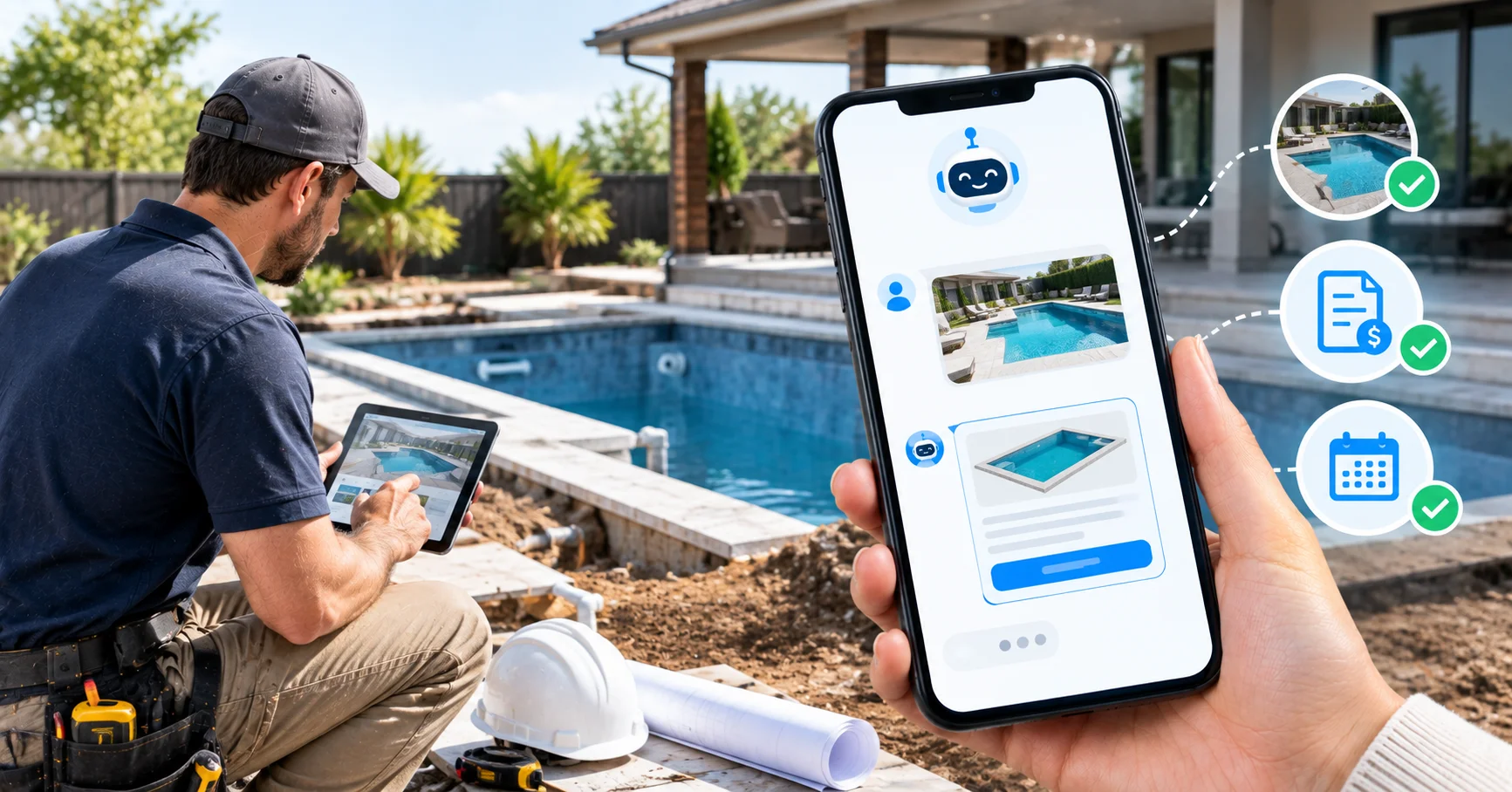
A pool builder estimate chatbot changes the order of operations. It talks to the visitor right away, asks what your designer would ask, and hands you the answers. This guide covers what to ask, how to bring up money and HOA rules without being awkward, how to sort the results, and what the math can look like. If you want the product page first, here is Zappiq AI for pool builders.
The Free Quote Problem in Pool Building
Pool builders have a pricing problem that plumbers and roofers don't. There is no menu. A 14 by 28 vinyl liner pool and a custom gunite pool with a raised spa and a vanishing edge are both "a pool," and the gap between them is six figures. Homeowners half know this. They also remember the first number they saw online, and that number sticks.
The numbers online don't agree with each other, either. Here is what four recent sources say an inground pool costs:
| Source | What it says an inground pool costs | Read it as |
|---|---|---|
| HomeGuide (2026) | $25,000 to $100,000, national average $62,500 | A wide range across vinyl, fiberglass and concrete |
| Angi (2026) | Average $65,909, most projects $44,499 to $87,349 | The middle of the market |
| Thursday Pools dealer survey | Fiberglass $45,000 to $100,000 | One material, one builder network |
| River Pools and Spas | Turnkey gunite $95,000 to $225,000 | Full-scope custom projects |
A visitor who read the first row and a visitor who read the last row show up with expectations that sit six figures apart. Neither is wrong. They're answering different questions. The chatbot's first job is working out which question this particular visitor is asking.
That last figure comes from a vendor that sells phone automation, so treat it as directional. The direction is believable, though. People shopping for a $60,000 purchase still behave like people shopping for anything else when nobody picks up.
What a High-Budget Pool Prospect Actually Looks Like
Let's define the term, because "high-budget" can slide into "looks wealthy," and that is a bad filter. Plenty of people with real budgets don't look the part, and plenty with a big dream and a small budget do. What you want is fit: a match between what they want built and what you build, at a price you both can live with.
In practice the strong signals are these.
- Scope that matches your work. You build custom gunite and they want gunite. They aren't asking for a $20,000 above-ground kit.
- A budget for the whole backyard. Decking alone runs roughly $4,700 to $13,500 (Latham Pool), and concrete or paver surrounds can pass $20,000 (Landscapi AI). Someone who says "around $50,000 all in" for a pool, spa and patio has a gap to close, and it's better to find that out in the first chat than the second meeting.
- A timeline with a reason. A graduation party in June, a Memorial Day goal, a house they're staying in for ten years.
- A payment plan that exists. Cash, home equity, a lender they've talked to. It doesn't need to be approved yet.
- Everyone who decides is involved. "My husband hasn't seen any of this" is useful information, not a dealbreaker.
- A site that can be built on. HOA, access, slope, utilities.
Qualify the project, never the person. Don't have the chatbot ask about income, credit scores, or who lives in the home. Ask every visitor the same questions in the same order. It's fairer, it's easier to defend if anyone asks, and it works better too, because project details predict a sale far more reliably than a guess about someone's wallet.
The Questions a Pool Estimate Chatbot Should Ask
Order matters. Lead with what the visitor cares about, which is their pool, and keep contact details for the end, after they've gotten something back. Nine steps looks long on paper. In a chat window it reads like a conversation, as long as each question follows the last answer.
- What they're picturing. A new pool, a replacement, or a spa added to an existing build.
- Material leaning. Fiberglass, concrete or gunite, vinyl liner, or "not sure yet," which is a perfectly good answer and a cue to explain the differences.
- Must-haves. Spa, tanning ledge, beach entry, lighting, water features, heating, cover, outdoor kitchen.
- How it will be used. Family swim, laps, entertaining, kids and dogs.
- Budget comfort for the whole backyard project, offered as bands they can pick from.
- How they plan to pay. Cash, home equity, a lender, or undecided.
- When they want to swim. A month, not "soon."
- Site basics. HOA yes, no or unsure, rough lot size, slope, a clear path for equipment.
- Contact details, and who else is in the decision.
Asking About Budget Without Scaring Anyone Off
"What's your budget?" gets dodged, or answered with a number the visitor made up to protect themselves. Bands work better. Something like: "Most backyard pool projects fall into a few ranges. Which feels closest to what you've been thinking, counting decking and landscaping?" Then offer choices that mirror your real project tiers.
A visitor who picks the lowest band when your minimum sits well above it hasn't been insulted. They've been given a graceful exit, and you've kept a consultation slot. If someone says they have no idea, that's common and fine. Let the chatbot explain what moves the price (material, size, depth, features, site access) and offer a range from similar projects.
What it can sound like
Visitor: how much does a pool cost
Chatbot: It depends a lot on the material, the size and what your yard looks like, so I'd rather not toss out a number that's useless to you. Are you leaning toward fiberglass, concrete or vinyl, or still figuring that out?
Visitor: concrete probably. we want a spa and somewhere shallow for the kids
Chatbot: Nice combination. A shallow ledge plus a spa is a popular pairing for exactly that. Thinking about the whole backyard, decking and landscaping included, which of these ranges feels closest to your plan?
Three messages in, you know the material, two must-haves and how the family will use it. Nobody has been asked for a phone number yet.
Financing: Ask About the Plan, Not the Credit Score
A "pool loan" usually isn't a special product. It's typically a personal loan or a home equity product used for a pool (The Mortgage Reports). That matters to you for one practical reason: timing. A buyer using cash or a personal loan can be funded in days. A buyer waiting on a home equity appraisal is weeks away from being able to sign.
| Path | Typical APR (2026) | Typical speed |
|---|---|---|
| Personal or pool loan | 7.99% to 24% | 1 to 3 days |
| Home equity loan or HELOC | 8% to 10% | 2 to 6 weeks |
| Cash-out refinance | 6.5% to 8% | 30 to 45 days |
| Pool company financing | 0% to 29% | Same day |
Source: Build-folio, 2026. These are market examples, not advice, and your lending partner's terms will differ. Lenders also tend to cap total monthly debt at roughly 36% to 43% of gross income (Creative Edge Pools), which is why you shouldn't assume a motivated buyer is an approved one.
So the chatbot asks one simple thing: "How are you planning to pay for it?" The answer sorts the lead. "Cash" and "already approved" go to the top. "Haven't looked into it" is a friendly cue to mention your financing partner. It never asks for a credit score, never talks about who would be approved, and never quotes a monthly payment unless you've deliberately set that up.
Site Readiness: The Questions That Kill Deals Late
Some pool deals die at the finish line for reasons that were knowable on day one. HOA approval can be required separately from government permits, and it can come with stricter design or setback rules (Premier Pools of Central Florida). Some boards take several weeks to review an application (Cimarron Circle Construction). And if the only route to the backyard crosses a neighbor's lot, you need that neighbor's written permission before equipment goes anywhere near it (Luxury Pools Guide).
You don't need the chatbot to judge any of that. You need it to notice. Three light questions do the job:
- Is there an HOA or community architectural committee? Yes, no, or not sure.
- Is there a clear side or rear path that equipment could use? Or would it have to cross a neighbor's property or a finished patio?
- Anything unusual about the lot? Steep slope, septic, a well, large trees, easements, drainage trouble.
Those answers don't disqualify anyone. They tell your designer what to bring up on the first call and whether the lead needs a site review before a full consultation. A homeowner who hears "we'd want to check HOA rules before you spend money on drawings" from your chatbot at 10 PM tends to trust you more, not less.
Sorting the Results Into Four Tiers
Once the chatbot has the answers, the point is to give your team four buckets instead of one pile.
| Tier | What the chatbot heard | Your next move |
|---|---|---|
| Ready to design | Material and features chosen, budget band fits, payment plan set, wants to swim this season, HOA clear or underway | Call the same day and book the design consultation |
| Planning | Right budget band, timeline is next year, still comparing materials | Start a nurture sequence and invite them to see a finished pool |
| Needs an answer first | Good fit, but HOA unknown, access unclear, or financing not started | Send a short checklist and offer a site review before a full consultation |
| Not a fit | Budget far below your minimum, outside your territory, or wants something you don't build | Polite reply, a referral if you have one, no designer time |
Your wording will differ. What matters is that a designer opening the inbox on Monday knows which three leads to call first, then reads the transcript before dialing. You can write the tier rules into the chatbot's instructions. During the free trial, check how they show up in your lead emails and adjust until they read the way your team wants.
Working With a Sales Cycle Measured in Months
Pool deals take time. A pool marketing agency puts the average at 90 to 180 days from first inquiry to signed contract on premium builds, with some closing in two weeks and others taking fourteen months (J. Weis, 2026). Seasonality stacks on top of that: more than 70% of inquiries arrive between March and July, while people who start researching in January and February often want the pool finished by Memorial Day (J. Weis; Webtonic, 2026).
Two things follow for a chatbot. First, a good share of the people it talks to aren't buying this month, and treating them like they are burns goodwill. Second, the transcript becomes the memory of the relationship. When your designer follows up in April, "You mentioned a tanning ledge and wanting to swim by June" lands very differently from "Just checking in on your inquiry."
Tag the Source, Because the Offer Sets the Budget
The same agency found that Facebook leads from a premium-pool video ad averaged $90,000 builds, while leads from a generic "free quote" ad averaged $42,000 (J. Weis, 2026). Your message decides who shows up. Zappiq AI's Pro plan adds Meta Pixel and Google Analytics tracking, which helps tie conversations back to the campaign that brought them in. If you run ads, it's worth turning on, so you can see which ones produce serious projects and not just volume. Use the same discipline described in our guide to getting more leads from website traffic without increasing ad spend, and review the chatbot analytics metrics that matter before increasing budget.
Keep the Pre-Consultation Gap Warm
One more number from the same source: a short "what to expect" video from the lead designer, sent the day before a consultation, moved show rates on premium builds from roughly 60% to roughly 85%. That's one agency's claim, so test it yourself. The principle is sound either way. A qualified lead who booked on Sunday night and hears nothing until Thursday is cooling off.
Should the Chatbot Quote Prices?
Owners argue about this one. There are really three options.
- No numbers at all. Safest, and the most irritating. The visitor came for a price and leaves without one.
- Honest ranges. "Projects like the one you're describing usually run from X to Y before decking and permits. Your yard and your choices move it."
- Instant online quotes. Tools exist, but most custom builders shouldn't use them, because the site decides the price.
My view is the middle option, with ranges taken from your own recent projects instead of national averages. You sound like someone who knows their business, and anyone who flinches at the range has told you something useful. Whatever you choose, write down what the chatbot must never do: give a firm price, promise a start date, say that the HOA or permits will be approved, or tell someone their lot can definitely be built on.
Give it something to read. The chatbot learns from your website at sign-up. If you have a "what affects pool cost" page, a material comparison and a financing page, it can answer from them. If you don't, writing them is the best thing you can do for both search rankings and the chatbot.
How Zappiq AI Handles Pool Estimate Requests
Zappiq AI reads your website when you sign up and builds the chatbot around your pool types, service area and the projects you show. On top of that you add instructions: the nine questions, your budget bands, the four tiers, and the list of things it must never promise. When a visitor is qualified, you get an email with their contact details and the full conversation. There is no branding badge on any plan.
Pricing is flat. Starter is $9/month equivalent billed annually for 350 conversations. Growth is $39 monthly or $27/month equivalent billed annually for 1,500; Pro is $99 monthly or $69/month equivalent billed annually for 5,000 and adds Meta Pixel and Google Analytics tracking plus custom webhook integration for pushing leads into other tools. The 14-day trial includes 100 conversations.
Two honest limits. It is a website chatbot, so it doesn't answer your phone line. And it doesn't book consultations straight into a calendar yet, which is on the roadmap. Today it hands you a qualified lead with context, and you confirm the time. For a business where every consultation is a real chunk of designer time, a human confirming the slot isn't a bad thing. If scheduling is your main concern, compare the AI appointment-booking chatbot workflow, and for evenings and weekends see how to handle after-hours website leads.
Setting It Up Before Peak Season
- Write your bands. Three or four project tiers with price ranges you're comfortable stating, plus the smallest project you'll take.
- Put the answers on your site. A cost factors page, a material comparison, financing options, HOA help, and your service area.
- Start the free trial and add your URL. You get 14 days and 100 conversations to test on real traffic.
- Add your instructions. The nine questions in order, the tiers, and the never-promise list.
- Install the script tag. One line before the closing body tag, on WordPress, Wix, Webflow, Squarespace, Shopify or a custom site.
- Test with awkward visitors. Try "just curious," "$20k for a pool," and "my HOA hates pools." Read the transcripts, fix what sounds off, then go live.
For the wording side of this, our guide to AI chatbot lead qualification best practices goes through how to phrase questions so people actually answer them. Plan to read transcripts weekly during the first month. They'll show you what visitors ask that your site never answered.
A Worked Example With Cautious Numbers
Take a builder whose designer can run 20 consultations a month in peak season. With no filter, use the lower end of a pool marketing benchmark of 8% to 12% close rate on pool construction leads, say 10% (Webtonic, 2026). That's 2 jobs. At the $65,909 national average, roughly $132,000.
Now suppose the chatbot screens out the 8 conversations that were never going to work (wrong budget band, an HOA ban, outside the territory). That leaves 12 consultations. If the close rate on those rises to 25%, the figure one agency reports for a properly filtered pipeline, that's 3 jobs and about $198,000. You've also freed 8 consultation slots for follow-up, nurture, or more of the leads that fit. Depending on the tier and billing term, the chatbot costs $9 to $99 per month, with lower monthly equivalents on annual billing.
An illustration, not a forecast. Your close rate may not move that far, and filtering has a cost of its own. If the chatbot is too strict you'll turn away people who would have bought. Review the "not a fit" transcripts every month and loosen the rules if good leads are landing there.
Frequently Asked Questions
It is an AI chat assistant on a pool builder's website. When a visitor asks about pricing, it asks what kind of pool they want, their budget range, how they plan to pay, when they want to swim, and what the site looks like, then emails the builder a qualified lead with the full conversation. Its job is to sort serious, well-matched prospects from casual browsers before a designer spends time on a consultation.
It qualifies the project, not the person. It asks about material, size, features, the budget range for the whole backyard, the payment plan, the target swim date, and any HOA or access issues. Those answers are compared with your own project tiers. A visitor with a realistic budget band and a clear plan is flagged as ready to call. A visitor far below your minimum gets a polite reply instead of a consultation slot.
Start with what they want to build, then the material they lean toward, must-have features, how the pool will be used, budget range for the whole project, payment plan, target swim date, and site basics such as HOA, slope and equipment access. Ask for name, phone and email last, and ask who else is part of the decision. Skip questions about income and credit scores.
It can share broad ranges drawn from your own typical projects, as long as it says plainly that the final price depends on the site, materials, features, decking and permits. It should never give a firm quote, promise a start date, or say an HOA or permit will be approved. Many builders find that honest ranges build trust and quietly filter out visitors who are far below their minimum.
Published ranges vary a lot. Angi puts the average at $65,909, with most projects between $44,499 and $87,349. HomeGuide lists $25,000 to $100,000 with an average of $62,500. Custom turnkey gunite projects can run $95,000 to $225,000 (River Pools and Spas). Material, size, features, site conditions and decking explain most of the gap.
Premium pool builds commonly take 90 to 180 days from first inquiry to signed contract, according to pool marketing agencies. Some close in about two weeks and others take over a year (J. Weis, 2026). Most inquiries arrive between March and July, and homeowners who start researching in January or February often want a finished pool by Memorial Day. Plan for follow-up that stretches over months.
Zappiq AI qualifies the visitor and emails you the lead with the full transcript so you can confirm a consultation time. Direct calendar booking is on the product roadmap. For custom pool builders, a quick human confirmation is often fine, since each design consultation costs real designer time.
Zappiq AI offers a 14-day trial with 100 conversations. Starter is $9/month equivalent billed annually for 350 conversations; Growth is $39 monthly or $27/month equivalent billed annually for 1,500; Pro is $99 monthly or $69/month equivalent billed annually for 5,000. Pro includes Meta Pixel and Google Analytics tracking plus custom webhook integration. A single pool project averages about $65,909 (Angi, 2026), so one extra signed job is worth far more than a year of either plan.
The Bottom Line
Pool leads are expensive to earn and slow to close, and the quote request form treats them all the same. The visitor with a $120,000 plan and a signed-off HOA gets the same reply as the one who wants a $20,000 pool in a community that bans them. Your designer then sorts it out by phone, one afternoon at a time.
A pool builder estimate chatbot moves that sorting to the front. It asks about the project instead of the person, handles money and HOA questions without drama, keeps its price talk honest, and gives you a transcript worth calling back with. Write your bands, build the pages that answer the obvious questions, and test it on real traffic before the spring rush starts.
Qualify pool prospects before the first consultation
Start with a 14-day trial and 100 conversations, train the chatbot on your site in minutes, and let it handle the questions your designer keeps repeating.
Start Free Trial14-day trial: 100 conversations | Starter: $9/mo annual equivalent (350) | Growth: $39 monthly / $27 annual equivalent (1,500) | Pro: $99 monthly / $69 annual equivalent (5,000)
References
- HomeGuide. "How Much Does an Inground Pool Cost?" 2026. homeguide.com
- Angi. "How Much Does It Cost to Install a Pool?" 2026. angi.com
- Thursday Pools. "Inground Pool Cost Breakdown." 2026. thursdaypools.com
- River Pools and Spas. "Inground Swimming Pool Cost and Pricing Guide." riverpoolsandspas.com
- J. Weis. "Pool Builder Marketing in 2026: How to Sell $80K+ Pools With Paid Ads." jweis.com
- Webtonic. "Pool Building Reddit Ads Statistics: 2026 Costs, Reach and Benchmarks." webtonic.io
- Webtonic. "Pool Building Ad Creative Stats (2026)." webtonic.io
- M.Wolf Media. "Google Ads for Pool Builders: 2026 Lead Guide." mwolfmedia.com
- Pitchit. "Pool Builder Phone Statistics: 12 Key Call Benchmarks for 2026." pitchit.ai
- Build-folio. "Pool Financing Options: How to Pay for a Pool in 2026." build-folio.com
- Creative Edge Pools. "The Ultimate Guide to Pool Financing Options." creativeedgepools.com
- The Mortgage Reports. "How to Finance a Pool." themortgagereports.com
- Premier Pools of Central Florida. "Central Florida Pool Planning Guide." premierpoolsofcentralfl.com
- Luxury Pools Guide. "HOA Pool Approval: What to Prepare Before You Apply." luxurypoolsguide.com
- Cimarron Circle Construction. "Building a Backyard Pool in an HOA Community." cimarroncircle.com
- Latham Pool. "Things to Know Before Building a Pool." lathampool.com
- Landscapi AI. "Inground Pool Cost Guide 2026." landscapioai.com
- Zappiq AI. Product features and pricing. zappiqai.com

Ansar Ali
Ansar Ali is the founder of Zappiq AI, a lead-capture platform built for small businesses that cannot afford to lose high-intent website visitors. He writes from hands-on experience building chatbot flows, attribution systems, and qualification workflows for service businesses, with a focus on the practical details that turn website conversations into qualified enquiries.