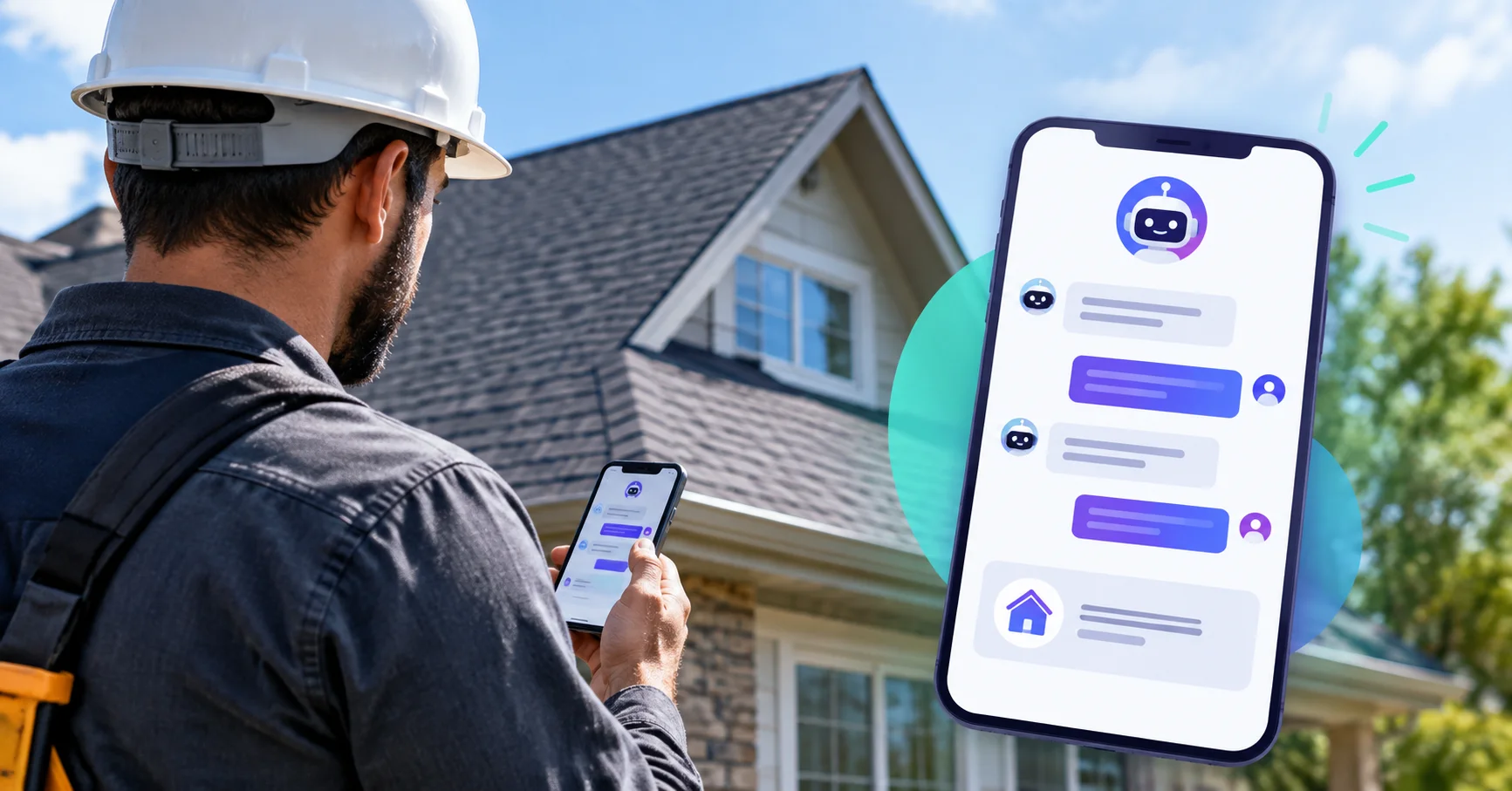
Saturday night's storm is long gone by Sunday morning, but there's a brown ring on the bedroom ceiling that wasn't there on Friday. The homeowner is standing under it with a phone. What they type first usually isn't "best roofer near me." It's "how much does a new roof cost."
That one question is the whole game for a roofing website. If your page answers it, you're in the running for the call. If your page says "contact us for a free estimate," the visitor goes back to the search results and opens the next tab. A roofing instant estimate chatbot is one way to answer on your own site. It talks to the visitor, gives a price range built from your pricing, asks a few things to tighten it, and hands the lead to your team with the whole conversation attached.
Two honest notes before we go further. "Instant estimate" is a stretchy phrase. A chatbot can't see your decking, count your shingle layers, or spot a cracked chimney flashing, so what it gives is a range, not a price anyone should sign. And plenty of roofing marketing statistics float around with no study behind them. This guide sticks to figures we could trace to Roofing Contractor magazine's 2026 homeowner survey, Roofr's 2026 homeowner study, Harvard Business Review, state insurance departments and published pricing guides, and it marks the ones that come from vendors.
If you want the overview first, start with our page on the AI chatbot for roofing companies. For the after-hours side of storm work, see our roofing storm-damage lead guide and the general after-hours website lead playbook. The estimate workflow and the storm workflow can share one chatbot, but they should use different routing rules.
The short answer: A roofing instant estimate chatbot is a chat assistant on your website that gives homeowners a ballpark price range for a roof repair or replacement, asks a few questions to narrow it, and passes the lead and the full conversation to your team for a real inspection. The range comes from your own pricing. It is a starting point, not a quote.
TL;DR: what the traceable data says
- 65% of homeowners are more likely to call a roofer with pricing on the website, down from 78% a year earlier, yet 33% of roofers list no pricing at all (Roofing Contractor, 2026).
- 66% of homeowners plan to gather three quotes, and 1% would take just one (Roofing Contractor, 2026).
- 74% would not hire a roofer without an inspection first (Roofr, 2026, 292 homeowners).
- 2026 cost guides disagree widely. One gives $6,885 to $23,993 for a 2,000 square foot asphalt job, so give a range, never one number.
- Rotted decking, extra layers and steep pitch never show up in a satellite image.
- The average company took 42 hours to answer a web lead in Harvard Business Review's 2011 audit.
What Is a Roofing Instant Estimate Chatbot?
It's a chat assistant on a roofing company's website that gives a homeowner a ballpark price, asks a handful of questions to narrow it, and passes the lead to the sales team. The word that matters in the name is "chatbot." The conversation is the product, and the number is one moment inside it.
"Instant estimate" gets built in three different ways, and they aren't interchangeable:
- A range from your own rules. The visitor says roughly how big the house is and what material they want, and the bot answers with a range from your price book. No maps involved. It's quick to set up and only as good as the pricing you give it.
- A satellite-measured quote. The visitor types an address, software outlines the roof from aerial imagery, and your per-square price is applied to the measurement. Roofle, Roofr, Instant Roofer and RoofD AI all sell versions of this.
- Both together. A quote widget does the math, and a chatbot sits beside it to answer what a calculator can't, like whether you handle insurance work or how soon someone can come out.
Zappiq AI sits in the first group and works fine alongside the third. We'll be clear about that boundary later, because it matters when you're choosing. For the qualification layer behind the flow, see our guide to the AI lead qualification chatbot.
Estimate, quote and inspection are three different things
Contractors use these words loosely and homeowners use them looser. In this guide, an estimate is a range based on limited information. A quote is a price the company commits to after someone has looked at the roof. An inspection is the visit that turns the first into the second. Your chatbot should say "estimate" and never "quote," and your contract should do the rest.
What Do Homeowners Expect From a Roofer's Website?
They want to see a price, and they want a person to show up and look at the roof, in that order. Roofing Contractor's 2026 homeowner survey found that 65% of homeowners are more likely to call a roofer who shows pricing on the website. That's down from 78% the year before and roughly back to the 66% recorded two years earlier, so the pull is real but not enormous. Another 34% said pricing made no difference to them.
The gap between the first two numbers is the opportunity. Most homeowners lean toward roofers who show prices, and a third of roofers show nothing. In the contractor half of the same survey, 37% listed starting prices or ranges and 30% listed prices for specific services.
Now look at the other side of the picture. Two-thirds of homeowners plan to collect three quotes, and nearly three-quarters of Roofr's respondents wouldn't hire anyone without an inspection. So a price range on your site doesn't win the job. It gets you onto the list of three, and it gives the homeowner a reason to book you for the inspection first. The conversion basics are covered in our guide to getting more leads from existing website traffic.
Read the fine print on both surveys. Roofing Contractor's respondents had a mean age of 58, 76% were men, more than half reported household income of $150,000 or more, and each received a $10 gift card. Roofr's study covers 292 homeowners who hired a roofer in the previous two years, and Roofr sells instant quote tools, so it has a stake in the subject. Both are useful. Neither is a census.
Roofing Contractor's write-up also called AI a wild card for this peak season, noting that roofers need to be visible to AI agents. We'd add our own view: a page with a clear price range and plain answers is easier for an answer engine to quote than a page that says "call us." That's reasoning, not data.
How Much Does a New Roof Cost, and Why Can't a Chatbot Give One Number?
Because published prices for the same job disagree wildly, and the biggest swings are hidden under the shingles. Here are three 2026 sources describing asphalt shingles on a job of roughly 2,000 square feet:
| Source | What it says | Assumption |
|---|---|---|
| This Old House (updated March 2026) | $6,885 to $23,993 total, or $3.44 to $12 per square foot | 2,000 square foot home, asphalt shingles |
| Modernize (2026) | $7,000 to $17,000, with most homeowners paying about $10,250 | Standard 2,000 square foot roof, asphalt shingles |
| Empire Home Protect, citing HomeAdvisor data (September 2026) | Average $11,450, with most paying $8,700 to $16,200 | Typical single-family home, asphalt shingles |
The top of the first range is about three and a half times the bottom. A bot that blurts "$10,250" is guessing. A bot that says "$11,000 to $16,000, depending on what an inspection finds" is telling the truth.
Repairs live in a different world. NerdWallet puts typical roof repairs at $400 to $2,000, a fraction of a replacement. A chatbot needs to work out early which of the two the visitor means, because the ranges barely touch.
What a satellite image can't see
| Item | Typical figure | Why a chatbot cannot see it |
|---|---|---|
| Extra shingle layer | Removing two old layers instead of one adds $1,000 to $3,000 (Empire Home Protect) | Layers show at the roof edge, not from above |
| Rotted decking | Quoted anywhere from $50 to $150 per 4 by 8 sheet, most often $70 to $100. Finding 3 to 10 bad sheets is "not unusual" (SupplementSnap) | Nobody sees the wood until the old roof comes off |
| Steep pitch and access | Can add 10% to 25% (Empire Home Protect) | Pitch is estimated from imagery, not measured on the roof |
| Shingle grade | Per square foot: 3-tab $3.50 to $5, architectural $4 to $8.50, luxury $7 to $16 (Modernize) | Visitors often don't know which one they want |
| Flashing, vents, chimneys | Varies by roof | Details around penetrations are hard to judge from above (Joyland Roofing) |
Vendors say satellite measurement lands within 2 to 5 percent of a tape measure on a standard residential roof, and one instant-quote vendor says most online calculators finish within 10 to 20 percent of the later in-person quote. Those are vendor claims, so hold them loosely. Even taken at face value they point the same way: measuring the roof is the easy part. What breaks an estimate is the price per square you feed it and the surprises under the shingles. One Louisville contractor's guide suggests homeowners hold back another 10 to 15 percent above the base number for exactly that reason.
What Should the Chatbot Ask, and in What Order?
Start with the situation, not the contact form. A homeowner with water coming through the ceiling and a homeowner pricing a replacement for next spring need very different conversations. A sequence that works:
- Is water coming in right now? If yes, and especially if the ceiling is sagging or the water is near light fixtures, send the visitor to your emergency line before anything else. Write that rule yourself and have someone qualified review the wording.
- Repair or replacement? They need different ranges, and the visitor usually knows which one they want even if they don't know the words.
- Where is the house? A ZIP code, asked early, saves out-of-area visitors three minutes of typing.
- How big is it? Ask for the home's square footage and number of stories, and let "no idea" be a valid answer. Size buckets beat exact figures.
- What's on the roof now, and what do they want? Shingle, metal, tile or flat. Ask whether they know of more than one layer. Anything outside your normal work should go straight to a person.
- Is insurance involved? A simple yes or no, and whether a claim has been filed. The bot records it and does not opine on it.
- Show the range, then the next step. The range, what it leaves out, and a button for a free inspection.
- Contact details last. Name, best phone number, property address. Repeat the number back.
Here's roughly how the range moment sounds. The numbers are made up for illustration.
Visitorhow much for a new roof
ChatbotHappy to give you a ballpark. Is this a full replacement or a repair?
Visitorreplacement. about 2000 sq ft, one story, regular shingles
ChatbotFor a house that size with architectural shingles, jobs like yours usually run between $11,400 and $15,600. That covers tearing off one layer, new underlayment, shingles and cleanup. It doesn't cover rotted wood or permit fees, because we can only see those once we're on the roof. Want me to set up a free inspection so we can give you a firm price?
Visitorok sure
Notice what the bot does and doesn't do. It names what's left out of the range. It says "ballpark," never "quote." And it ends on a next step instead of a goodbye.
How Do You Build the Price Range Behind the Chat?
Start from your own jobs. Roofers price by the square, which is 100 square feet of roof surface, and Empire Home Protect's cost guide says an average American home has 17 to 25 of them. Here's a hypothetical for a visitor who says they live in a 2,000 square foot one-story house:
| Step | Assumption | Result |
|---|---|---|
| Roof size | Visitor reports 2,000 square feet, one story. Your past jobs say that's about 24 squares | 24 squares |
| Low price per square | Your architectural shingle price, one-layer tear-off, simple roof | $475 |
| High price per square | Same material on a steeper or more cut-up roof | $650 |
| Range shown | 24 squares at $475 to $650 each | $11,400 to $15,600 |
| Decking, as a separate line | Your per-sheet price, charged only if bad wood is found | $75 to $100 per sheet |
Every number there is invented for the example. Use your own price book and your own square counts, and review them each season because material costs move. The point is the structure: a low and a high, a stated size assumption, and a separate line for the things nobody can price until the roof is open.
Some quote tools make the visitor enter a name, phone number and email before showing any number. That collects contacts, and some visitors will simply type a fake number to get past it. Our preference is to show a wide range first and offer a tighter one in exchange for contact details. That's an opinion, not a tested result, so split-test it on your own traffic.
What Mistakes Cost Roofers Jobs With Instant Estimates?
Showing one number
A single figure turns into a promise in the homeowner's head, and the contract that arrives two weeks later rarely matches it. A range with a stated assumption is much easier to defend.
Leaving out the exclusions
If rotted decking, extra layers and permits aren't in the range, say so in the same message. About a third of homeowners in Roofing Contractor's survey named unclear or unexpected costs and a lack of transparency as their biggest challenge when working with a roofer. That's the complaint you're heading off.
Offering no next step
With 74% of homeowners refusing to hire without an inspection, put the inspection right there. Most roofers in the contractor survey don't charge to assess a roof, so a free inspection is normal, not a special offer. A range with no button after it is a dead end.
Never comparing the range to the final price
Most shops track leads and forget this one. After a month, pull ten jobs and set the range the chatbot showed next to the price that got signed. If the signed numbers sit above the range every time, the range is too low, and you're spending trust at the inspection.
Letting the bot talk about insurance
We cover this in its own section below. The short version: record the facts and hand them to a person.
Chatbot, Quote Widget or Contact Form: What Does Each One Do?
They solve different problems, and the cost gap is bigger than most roofers expect.
| Option | Best for | Typical cost | Weak spot |
|---|---|---|---|
| Contact form | Visitors who already decided to call you | $0 | No number shown, and the reply usually comes the next day |
| Website chatbot with published ranges (Zappiq AI) | Visitors with questions, including nights and weekends | Starter: $9/month annual equivalent (350 conversations); Growth: $39 monthly or $27 annual equivalent (1,500); Pro: $99 monthly or $69 annual equivalent (5,000); 14-day trial with 100 conversations | Doesn't measure roofs from satellite imagery, and the range is only as good as your pricing |
| Satellite quote widget (Roofle, Roofr, Instant Roofer, RoofD AI) | Visitors ready to type an address and see a number | From about $99 a month (RoofD AI's published price) to $350 a month plus a $2,000 setup fee (Roofle's plans page when we checked) | Needs your per-square pricing set up well, and a displayed number can read like a firm price |
| Phone answering service | The 56% of homeowners who prefer to call | Usually billed by the minute, so get a written quote | A voice can't show a price page |
Prices in that table come from vendor pages we read in 2026, and the Roofle figure came from a plans page that may be out of date. Check before you buy.
Roofle's CMO has said its widget averages a lead conversion of 8 to 10 percent on form completions, with some contractors above 15 percent. That figure is vendor-reported, and the definition of "conversion" is the vendor's own. We mention it because it shows what a good quote tool can do, not to promise the same for any chatbot, ours included.
These aren't really rivals. A quote widget is a calculator. A chatbot is a conversation, and a good chunk of roofing questions have nothing to do with square footage: do you work on metal, do you deal with insurance, how soon can someone come out, do you offer financing. If you already run a widget, put the chatbot beside it for everything the calculator can't answer. Keep your phone number visible too, since phone is still the first choice for 56% of homeowners who reach out to a roofer.
How Fast Does a Roofer Need to Respond to a Web Lead?
Faster than the average company does, which is a low bar. When Harvard Business Review's researchers sent test web leads to 2,241 US companies, only 37% replied within an hour, 24% took more than a day and 23% never replied at all. Among the firms that did answer, the average was 42 hours. The same article reports that firms reaching out within an hour were nearly seven times as likely to qualify a lead as firms that waited even an hour longer. It's a 2011 study of companies across many industries, not roofers, so read it as a direction and not a benchmark.
Roofing homeowners, interestingly, report lower expectations than the speed-to-lead crowd would have you believe. In Roofing Contractor's survey, 56% expected to hear back within one to two days, 39% the same day and only 2% within an hour. On the contractor side, 45% aim for a same-day response and 14% say they reply in under five minutes. What people say they expect and what they do don't line up neatly, though. Two-thirds collect three quotes, so the first company to offer a real range and a real appointment time gets to set the frame for the other two. That's our reading, not a finding.
The numbers we left out
You'll see claims that responding within five minutes makes a lead 100 times likelier to convert. VICIstack traces that figure to a 2007 InsideSales.com study of web leads that wasn't about roofing, and it gets repeated in nearly every roofing CRM blog. The "first responder wins 62% or 81% of jobs" figures in vendor posts didn't lead us to a study we could open, so we left them out too.
What About Storm Damage and Insurance Questions?
Expect them, especially after hail season, and keep the bot out of the answer. Coverage depends on the policy, and the deductible often surprises people. The Ohio Department of Insurance gives a plain example: a home insured for $300,000 with a 2% wind and hail deductible leaves the homeowner responsible for $6,000 of the repair costs, no matter how big the damage is. Percentage deductibles like that are common in storm-prone areas.
What the chatbot should do is record whether a claim has been filed and when the storm hit, tell the visitor that an inspector can document the roof, and hand off to a person. What it shouldn't do is promise coverage, guess what an adjuster will decide, or say anything about waiving a deductible. Check your state's rules on that last one before anyone on your team says it out loud. State regulators also warn homeowners about door-knocking contractors after big storms (Colorado's insurance division issued a consumer advisory on exactly that), so a local company that explains things calmly has a real edge.
How Do You Set Up a Roofing Instant Estimate Chatbot?
Most of the work is your pricing, not the technology. Set aside an afternoon and go in this order:
- Turn your price book into ranges. For each material you install, set a low and a high per square, plus your per-sheet decking price. Pull the numbers from the last twenty jobs you won.
- Publish the numbers on your website. The chatbot answers from your site content, so a range you haven't published is a range it can't give. Add a short "what affects the price" section while you're there.
- Decide who goes straight to a person. Active leaks, slate, tile, flat commercial roofs and very large homes shouldn't get a range from a bot.
- Write the range message. Range, size assumption, exclusions, next step. Four parts, a few sentences.
- Decide how a lead reaches a human. Zappiq AI emails each qualified lead with the transcript and the lead source. An unread inbox isn't a follow-up system, so set a loud alert on the phone of whoever receives those emails.
- Add click-to-call and an inspection link beside the chat. Every visitor should have a next step that doesn't need the bot.
- Test with ugly inputs, then read the transcripts. Run at least fifteen test chats before launch: "NEW ROOF PRICE???", a house with three layers, someone who guesses the size badly, a metal roof request, a visitor whose only question is whether you handle insurance claims. After launch, read chats daily for two weeks and weekly after that.
What Should You Track After Launch?
Keep the list short:
- Chats started, and how many reached the range message
- Chats that left contact details
- Inspections booked from chat leads
- Time from lead to first human contact
- The gap between the range shown and the final signed price
- Close rate by lead source
The fifth one is what most shops skip, and it tells you more than the rest. If the final price lands inside the range on seven jobs out of ten, you've built a decent range. If it lands above it eight times out of ten, your visitors are being shown a roof they won't be offered. For the other metrics, our breakdown of chatbot analytics metrics covers the setup, and ad tracking in Zappiq AI ties a lead back to the campaign or keyword that brought the visitor in.
Where Zappiq AI Fits
Zappiq AI handles the conversation half of this. What it does:
- Answers from your website: It's trained on your pages, so the price ranges, service area, materials, warranties and financing you've published become answers.
- Asks your questions in your order: Set the flow above, including the active leak check, the repair or replacement split and the insurance yes or no.
- Delivers the lead with context: Each qualified lead arrives by email with the full chat transcript and the lead source.
- Tracks your ads: Connect an enquiry to the campaign, keyword or channel that sent the visitor.
- Published pricing: 14-day trial with 100 conversations. Starter is $9/month equivalent billed annually for 350 conversations; Growth is $39 monthly or $27/month equivalent billed annually for 1,500; Pro is $99 monthly or $69/month equivalent billed annually for 5,000. No plan includes Zappiq branding.
What it doesn't do is measure a roof from satellite imagery, calculate an exact price for a specific address, or answer a ringing phone. If you want a satellite-measured number, run a quote widget beside the chat. If you want phone coverage, add a click-to-call button and a plan for who picks up. For more benchmarks on how chat compares with forms, see our AI chatbot lead generation statistics, and for the question list behind the flow above, read what questions a lead capture chatbot should ask.
A Note on Where These Numbers Come From
Homeowner behavior figures come from Roofing Contractor's 2026 survey (research partner Owens Corning, fieldwork finished in October 2025) and Roofr's 2026 homeowner study. Response-time data comes from the 2011 Harvard Business Review audit. The insurance example comes from the Ohio Department of Insurance. Price ranges come from consumer cost guides and contractor sites, which is the weakest category here, so we gave ranges and showed where they disagree. Satellite accuracy figures and quote-tool prices come from vendors and are marked that way. The worked example is our own arithmetic with invented inputs.
Where we couldn't find a source we could open, we left the claim out. That cost us a few punchy statistics, and we're fine with the trade.
Frequently Asked Questions
A roofing instant estimate chatbot is a chat assistant on a roofer's website that gives homeowners a ballpark price range for a repair or replacement, asks a few questions to narrow it, and sends the lead and full transcript to the roofing team. The range comes from the company's own pricing. It is a starting point for an inspection, not a binding quote.
It can give a useful range, not a precise price. Satellite tools measure roof size well on simple roofs, and vendors claim results within 2 to 5% of manual measurements. The final price still depends on things nobody can see from above: extra layers, rotted decking, flashing and pitch. That is why 74% of homeowners in Roofr's 2026 study would not hire without an inspection.
It depends heavily on material and size. For asphalt shingles on a roughly 2,000 square foot job, 2026 guides put typical totals between about $7,000 and $17,000, and one guide's full range runs from $6,885 to $23,993. Repairs usually cost far less, around $400 to $2,000. Local pricing and the condition of your roof move the number, so an inspection decides it.
Most homeowners lean that way. In Roofing Contractor's 2026 survey, 65% said they were more likely to call a roofer with pricing on the website, though 34% said it made no difference. About a third of roofers list no pricing at all. A range with clear exclusions is a safer approach than a single fixed number.
Trust is conditional. In Roofr's 2026 study of 292 homeowners, 59% ranked transparent pricing in their top three factors when reaching out, and 74% said they would not hire without an inspection. Homeowners appear to want an honest number first and a person looking at the roof second. An estimate that says what it leaves out earns more trust than one that sounds exact.
Terms vary by company, but the common split is this. An estimate is an approximate range based on limited information, such as the size and material a homeowner reports. A quote is a price the contractor commits to after inspecting the roof. A chatbot should only give estimates, and it should say what the range leaves out, like rotted decking and permit fees.
A quote widget is a calculator. The visitor enters an address, software measures the roof from aerial imagery, and your per-square price produces a number. A chatbot is a conversation that also answers questions about materials, insurance work, timing and financing, then passes the lead to your team. Many roofers use both. Zappiq AI is the chatbot side and does not do satellite measurement.
It should never present one number as a firm quote, promise that insurance will cover a repair, guess what an adjuster will decide, or offer to waive a deductible. It should not diagnose leaks or promise arrival times a person has not confirmed. Its job is to give a range, say what is excluded, collect details and hand off.
As fast as you can. Harvard Business Review's 2011 audit of 2,241 US companies found an average first reply of 42 hours, with 37% answering within an hour and 23% never answering. Roofing Contractor's 2026 survey found 56% of homeowners expect a reply within one to two days and 39% the same day. A chatbot answers in seconds, but a person still has to follow up.
Zappiq AI offers a 14-day trial with 100 conversations. Starter is $9/month equivalent billed annually for 350 conversations; Growth is $39 monthly or $27/month equivalent billed annually for 1,500; Pro is $99 monthly or $69/month equivalent billed annually for 5,000. No plan includes Zappiq branding. It does not include satellite roof measurement, so some roofers pair it with a dedicated quote widget.
The Bottom Line
A roofing instant estimate chatbot earns its place if homeowners tend to find your website before they find your phone number, which for most roofers is most of the time. It won't replace the inspection and it shouldn't try. Its job is to answer the first question, how much, honestly enough that the homeowner puts you on their list of three.
Get three things right and the rest follows: a range built from your own jobs, a message that says what's excluded, and a human who follows up fast. The chatbot makes sure the person standing under that stained ceiling gets a straight answer while the other sites on their screen are still saying "contact us."
See what your site says when a homeowner asks for a price
Train Zappiq AI on your pricing page, run a few test chats, and start with its 14-day trial, which includes 100 conversations.
Start Free Trial14-day trial: 100 conversations | Starter $9/mo annual equivalent (350) | Growth $39 monthly / $27 annual equivalent (1,500) | Pro $99 monthly / $69 annual equivalent (5,000)
References
- Roofing Contractor. "The Homeowners Roofing Journey in 2026." August 2026 (survey with research partner Owens Corning, fieldwork completed October 2025). digital.roofingcontractor.com
- Roofing Contractor. "What Homeowners Actually Want From Their Roofer (And It's Probably Not What You Think)." August 1, 2026 (Roofr 2026 Homeowner Study, 292 homeowners). roofingcontractor.com
- Oldroyd, McElheran, and Elkington. "The Short Life of Online Sales Leads." Harvard Business Review, March 2011. hbr.org
- This Old House. "How Much Does a Shingle Roof Cost? (2026 Guide)." Updated March 12, 2026. thisoldhouse.com
- Modernize. "Asphalt Roof Shingles: Costs per Square Foot, Types, and Benefits." 2026. modernize.com
- Empire Home Protect. "Roof Replacement Cost in 2026: What Homeowners Pay." September 22, 2026 (cites HomeAdvisor cost data). empirehomeprotect.com
- NerdWallet. "Cost to Replace Roof Shingles in 2026." nerdwallet.com
- Jamar Roofing. "Key Factors That Drive Up Roof Replacement Costs in 2026." jamarroofing.com
- SupplementSnap. "Roof Tear-Off Cost in 2026." supplementsnap.io
- Home Run Improvement. "How Much Does a Roof Replacement Really Cost in 2026?" homerunimprovement.com
- Joyland Roofing. "Instant Roof Quote." A roofer's view of what instant quote tools miss. joylandroofing.com
- RoofSnap. "How Accurate Are Satellite Roof Measurements?" Vendor claim. learn.roofsnap.com
- Instant Roofer. "AI Roof Calculator: How Accurate Is It?" Vendor claim. instantroofer.com
- QXO. "Roofle: RoofQuotePRO." Vendor-reported conversion figure from Roofle's CMO. qxo.com
- Roofle. "RoofQuote PRO plans." Published pricing, checked in 2026 and may have changed. offers.roofle.com
- RoofD AI. "Instant Roof Estimate Widget for Roofer Websites." Published pricing from the vendor. roofdai.com
- Ohio Department of Insurance. "Roof Insurance, Repair and Replacement." insurance.ohio.gov
- Colorado Division of Insurance. "Consumer Advisory: Division of Insurance Shares Tips to Prepare for Hailstorm Forecasted to Batter Metro Denver." doi.colorado.gov
- VICIstack. "Speed to Lead for Roofing Companies." Traces the five-minute claim to a 2007 InsideSales.com study. vicistack.com

Ansar Ali
Ansar Ali is the founder of Zappiq AI, a lead-capture platform built for small businesses that cannot afford to lose high-intent website visitors. He writes from hands-on experience building chatbot flows, attribution systems, and qualification workflows for service businesses, with a focus on the practical details that turn website conversations into qualified enquiries.