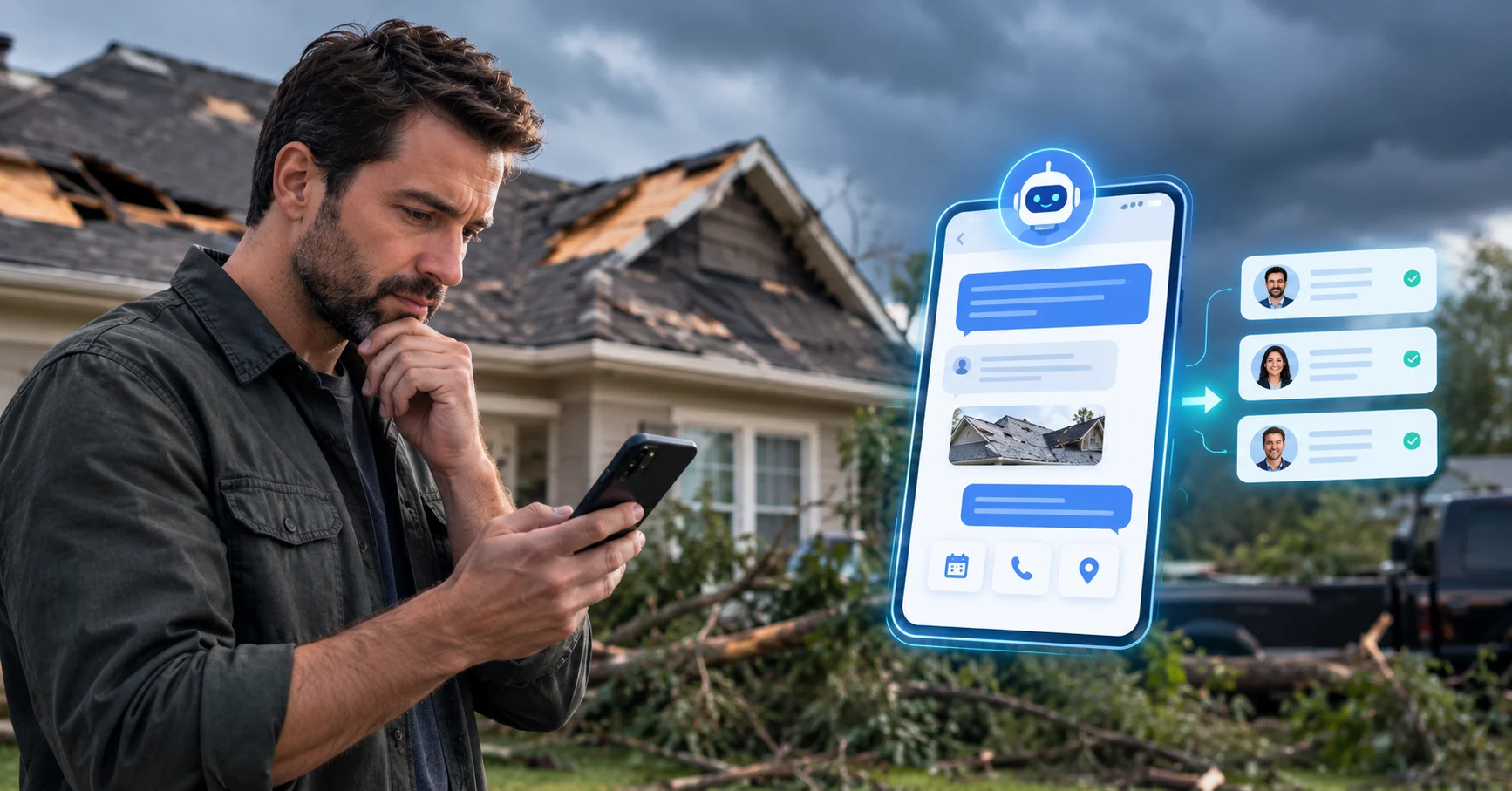
Quick summary: what a roofing storm damage leads chatbot does for you
- Severe convective storms caused $51 billion in US insured losses in 2025, the third straight year above $50 billion, and hail drives as much as 80% of those claims (Triple-I, 2026).
- About 80% of storm-affected homeowners pick a contractor within 72 hours, while the average roofer takes around 18 hours to respond (PipelineOn, 2026).
- Searches for roof repair jump 400% to 800% in the 48 hours after a major hail event, then fade within two weeks (PipelineOn, 2026).
- Emergency roofing leads convert at 40% or better when answered within 15 minutes, and about 8% after two hours (Lead Gen Jay, via PipelineOn).
- A chatbot won't swing a hammer. It answers in under a second, asks about storm date, active leaks and insurance stage, and emails you a lead with the transcript attached.
Picture the night after a hailstorm. The office line has been busy since dinner, two of your estimators are still up on roofs, and a homeowner is lying in bed staring at a fresh brown stain on the ceiling. She searches "roof repair after storm," opens the first three results, and messages whoever answers. She is not going to leave a voicemail and wait.
That moment is exactly what a roofing storm damage leads chatbot is for. It sits on your website, replies in about a second, asks the questions you would ask on the phone, and sends you a lead you can call back with the whole story in hand. Some roofers call this an AI receptionist or roofing AI assistant; in this workflow it is specifically a website chatbot for storm lead capture and qualification. This guide covers why storm leads behave differently, what the chatbot should ask, how to handle the insurance conversation without overpromising, and what the numbers can look like. Want the product page first? Here is Zappiq AI for roofing companies. For the general playbook, see how to handle after-hours website leads, and for conversion fundamentals see how to get more leads from existing website traffic.
Why Storm Leads Don't Behave Like Normal Roofing Leads
Roofing is a weather business, and storm demand arrives in bursts. The published loss and hail figures below provide context, but they are directional benchmarks rather than a forecast for every market. What matters operationally is the same: a large number of homeowners may search for help at once, and the companies that answer quickly have more chances to earn an inspection.
Demand also arrives in a heap. Those searches fall about 60% within a week and are back to normal by week two. One roofing SEO agency estimates a big storm can bring in 60% to 80% of a company's yearly leads in six to ten weeks. Treat that as a rough guide, but the shape is right: a short, loud burst, then quiet.
Not Every Storm Lead Is a 2 AM Emergency
This Old House surveyed 1,000 homeowners who had recently finished a roofing project, and 40% said storm or weather damage was the reason. Among those who replaced a roof because of weather, 15% called it an emergency and another 43% needed repairs within weeks. So you get a mix: a few people with water coming through the ceiling, plenty who want an inspection soon, and a pile who heard hail hit the car and just want to know if the roof is okay. A good chatbot sorts those groups so you don't spend your night calling the wrong one first.
The 72 Hour Clock
PipelineOn reports that about 80% of homeowners with a storm claim choose a contractor within 72 hours, and most contact two or three companies in the first day or two. The average roofer, by the same report, takes about 18 hours to respond. A separate roofing benchmark puts average follow-up on a web form at 42 hours (Pitchit, 2026). These are vendor-published numbers, so read them as directional. Still, the distance between "homeowner is shopping tonight" and "roofer replies tomorrow afternoon" is hard to argue with. For a broader measurement framework, see our guide to AI chatbot lead-generation statistics.
What a Storm Lead Is Worth, and What It Costs You
Storm work is bigger work. Storm damage jobs average $15,000 to $50,000 or more, against $3,000 to $8,000 for routine service calls (PinkCallers, 2026, via PipelineOn). Materials haven't helped: Allianz Commercial's analysis found asphalt roof replacement costs up roughly 250% since 2000, including 45% in the last five years. Bigger tickets make every missed lead sting more.
| Lead source | Typical cost per lead | Storm effect |
|---|---|---|
| Google Search Ads, non-branded (Q1 2026) | $124 | Climbs fast once a storm hits |
| Google Ads, roofing and gutters average (2025) | $228.15 | Highest of any home services category |
| Post-storm Google Ads, first 48 to 72 hours | 30% to 60% above baseline | Every local roofer bids at once |
| Door knocking | Labor only | Fast, but you reach one street at a time |
Sources: SearchLight Digital and LocaliQ, as reported by PipelineOn (2026). If ads are costing you $124 to $228 per lead, the page those clicks land on carries a lot of weight. Send them to a form that three in a hundred visitors finish and most of the spend leaks out after the ad did its job. Our chatbot vs contact form comparison digs into that gap.
Where Roofers Actually Lose Storm Leads
It is rarely the ad and rarely the quote. Storm leads usually die in the first hour, in one of four places. A simple qualification flow can expose which requests are urgent, in-area, and ready for a callback; our AI lead qualification chatbot guide explains the same routing logic in more detail.
- The phone line jams. A company that normally takes 5 to 10 calls a day can see 50 to 100 or more within hours of one storm (PinkCallers, via PipelineOn). Callers hit voicemail and dial the next number.
- The form waits for morning. Someone submits at 9 PM. You see it at 7:30 AM. They hired a roofer at 9:15 PM.
- Your crew is on a roof. The people who can answer are the people who can't.
- The site can't answer a simple question. "Does hail this size matter?" "Do you work with my insurance?" "Can someone tarp it tonight?" If the page doesn't say, the visitor goes looking elsewhere.
Speed is most of the game: leads answered within 15 minutes convert at 40% or better, and about 8% after two hours (Lead Gen Jay, via PipelineOn). A chatbot gets you to minute zero on every lead, whatever the hour.
How Homeowners Search After a Storm
The phrases that bring storm traffic are urgent and local: roof repair after storm, storm damage roof repair in your city, hail damage roof inspection near me, emergency roof tarping, roof leak after storm, wind damage roof repair, and free roof inspection (W3era groups roofing keywords this way). If you have pages built for those searches, put the chatbot on every one of them. The page earns the click. The chat catches the person.
What a Roofing Storm Damage Chatbot Should Ask
Chatting isn't the goal. Sorting is. In a handful of messages the chatbot should learn enough that you know who to call first and what to say when you do. A solid storm flow covers:
- What happened and when. Hail, wind, a fallen tree, and the storm date.
- Is water coming in right now? This one question decides the order of your callbacks.
- Roof basics. Shingle, metal, tile or flat, rough age, and number of stories.
- What they can see. Missing shingles, dents, exposed felt, bent flashing, sagging.
- Insurance stage. Not filed, filed, adjuster scheduled, or approved.
- Address or zip code. Enough to know whether it's inside your service area.
- Best number and time to call.
Four Lead Types to Sort Into
| Lead type | What you'll hear | Your move |
|---|---|---|
| Active leak | "Water is coming through the ceiling" | Call first, offer emergency roof tarping |
| Storm inspection | "Hail last night, no leak yet" | Book the next open inspection slot |
| Claim in progress | "Adjuster comes Thursday" | Send your estimator with documentation ready |
| Out of area or just curious | Zip code outside your territory | Polite decline, no phone time spent |
Write the rules down. You can build these questions and lead types into the chatbot's instructions, including asking for a phone number right away when someone mentions active water. Our guide to AI chatbot lead qualification best practices covers how to word questions so people actually answer them.
The Insurance Question, and Why Trust Wins Storm Jobs
Most storm roofing runs through an insurance claim, so homeowners will ask about it within the first minute. Your chatbot can walk through the general process: document the damage, call the carrier, get the roof inspected. It can also mention timing. Filing windows vary by carrier and state. Often it is about a year from the storm date, though some policies run as short as 30 days and others as long as two years, and the clock usually starts on the date of loss, not the day someone notices a stain.
What it should not do is decide coverage or promise an outcome. "Your insurance will pay for a new roof" is the sentence that gets contractors in trouble, and it's the one storm chasers lean on.
Keep it neutral. The Better Business Bureau warns about out-of-town "storm chasers" who offer free inspections and then exaggerate damage, and it tells homeowners not to sign over insurance checks or claim rights. Don't write chatbot instructions that sound like that. Explain the process, record the claim stage, and point coverage questions to the carrier. Add a clear note that the chatbot is not an adjuster, attorney, or insurance adviser.
Looking Local When Storm Chasers Roll In
Homeowners are told to check licenses, insurance and local presence before hiring anyone. Your chatbot learns from your website, so if your license number, proof of insurance, local address, years in business and reviews are on the site, it can say so. If they aren't on the site, it can't. Put them on a page before storm season, not after.
How Zappiq AI Handles Roofing Storm Leads
Zappiq AI reads your website when you sign up and builds the chatbot around your services, service area and hours. On top of that you add your own instructions: the storm questions above, your insurance explainer, the zip codes you cover, and how you want active leaks handled. When a visitor is qualified, you get an email with their contact details and the full transcript, so your callback opens with "I saw water is coming through above the kitchen" instead of "how can I help?" There is no branding badge on any plan, and pricing is flat by conversation tier: Starter is $9/month equivalent billed annually for 350 conversations; Growth is $39 monthly or $27/month equivalent billed annually for 1,500; Pro is $99 monthly or $69/month equivalent billed annually for 5,000. Review captured conversations and source data with our chatbot analytics metrics guide so you can improve the flow after each storm.
Two honest limits. Zappiq AI is a website chatbot, so it doesn't answer your phone line, and direct calendar booking is on the roadmap rather than live today. If most of your storm leads call, pair it with whatever you use for phones. The website chat covers the person who found you on Google at 11 PM. If scheduling matters most to you, compare the AI appointment-booking chatbot workflow.
A Storm Playbook to Set Up Before the Hail
- Build the pages. One each for hail damage inspection, storm damage roof repair, emergency tarping and the insurance process, with your service area and license details on every one.
- Start the free trial and add your URL. You get 14 days and 100 conversations, enough to test on real traffic.
- Add your storm rules. The seven questions, the four lead types, and a plain list of what the chatbot must never promise.
- Install the script tag. One line before the closing body tag. It works on WordPress, Wix, Webflow, Squarespace, Shopify or a custom site.
- Point alerts at whoever is on call. Then set a 15-minute callback rule for anything flagged as an active leak.
What to Do Once the Storm Has Passed
- First 24 hours: call active leaks first, then inspection requests.
- Days 2 and 3: finish your callbacks. This is when most homeowners decide.
- Week one: read the transcripts, then add answers to your site for anything the chatbot struggled with.
- Weeks 2 to 4: follow up with claim-in-progress leads. Search interest has faded by then, but their claims haven't.
A Worked Example With Cautious Numbers
Say a hailstorm sends 600 visitors to your site over three days. A contact form converting at 3% gives you 18 inquiries. A chatbot converting at 15%, the low end of the range cited in our plumbing guide, gives you 90. Assume one in three is a real roof job inside your service area: 6 from the form, 30 from the chatbot. Close 30% of those and you land about 2 jobs versus 9. At $12,000 per job, which sits below the $15,000 low end quoted for storm work, that is roughly $22,000 against $108,000. Depending on the tier and billing term, the chatbot costs $9 to $99 per month, with lower monthly equivalents on annual billing.
This is an illustration, not a promise. Your traffic, close rate and average ticket will differ. Swap in your own numbers. The point is the ratio: the same storm traffic produces several times more conversations when someone answers instantly.
Frequently Asked Questions
It is an AI chat assistant on a roofing company's website that answers homeowners' storm damage questions, asks about the storm date, active leaks, roof details and insurance stage, and sends the contractor a qualified lead with the full transcript. It works around the clock, so inquiries that arrive at night or during a post-storm rush do not wait for office hours.
The fastest channels are door knocking, local search ads, and website pages built for searches like hail damage roof inspection and roof repair after storm. What decides who wins is response speed. About 80% of homeowners choose a contractor within 72 hours (PipelineOn, 2026), so a chatbot, quick callbacks and clear trust signals on your site matter as much as ad budget.
Within 15 minutes if you can. Emergency roofing leads convert at 40% or more at that speed and about 8% after two hours (Lead Gen Jay, via PipelineOn). A chatbot replies instantly, then you call back inside that window with the details already in front of you.
The storm date, whether water is coming in right now, roof type and age, visible damage, the insurance claim stage, the address or zip code, and the best time to call. Those answers let you sort leads into active leaks, inspection requests, claims in progress, and out-of-area inquiries.
It can explain the general process, mention that filing deadlines vary by carrier (often about a year, sometimes 30 days to two years), and record where the homeowner is in the claim. It should not decide coverage or promise approval. Those calls belong to the insurance company.
Zappiq AI offers a 14-day trial with 100 conversations. Starter is $9/month equivalent billed annually for 350 conversations; Growth is $39 monthly or $27/month equivalent billed annually for 1,500; Pro is $99 monthly or $69/month equivalent billed annually for 5,000, with Meta Pixel and Google Analytics tracking available on Pro. Paid roofing leads, by comparison, ran $124 to $228 each in recent benchmarks (SearchLight Digital, LocaliQ).
They solve different problems. A chatbot covers website visitors and sends you a written lead with a transcript. An answering service or voice agent covers phone calls. Roofers with heavy call volume often want both. If your leads come from Google Ads and SEO landing pages, the chatbot is the cheaper place to start.
The Bottom Line
Storm demand is real, it is expensive to buy, and it disappears fast. Most homeowners choose a roofer within three days, and the average roofer is still composing a reply. You can't staff every night after every hailstorm, but you can make sure your website answers like someone is home. The goal is not to promise a roof outcome; it is to capture the request, set expectations, and make the next human response better.
A roofing storm damage leads chatbot does that one job: it catches the 11 PM searcher, sorts the active leak from the casual question, keeps its promises modest around insurance, and gives you a transcript to call back with. Build your storm pages now, set the rules, and test it on real traffic before the next forecast turns red.
Catch your next round of storm leads with Zappiq AI
Start with a 14-day trial and 100 conversations, train the chatbot on your site in minutes, and let it handle the hours when your crew is off the roof.
Start Free Trial14-day trial: 100 conversations | Starter $9/mo annual equivalent (350) | Growth $39 monthly / $27 annual equivalent (1,500) | Pro $99 monthly / $69 annual equivalent (5,000)
References
- Triple-I. "Severe Convective Storms Generate More Than $50B in Insured Losses for Third Consecutive Year." April 14, 2026. iii.org
- Leader's Edge. "Hail Is Falling, Losses Aren't" (Verisk and Gallagher Re data). leadersedge.com
- Risk & Insurance. Allianz Commercial severe convective storm report coverage. riskandinsurance.com
- PipelineOn. "How to Get Roofing Leads After a Storm." June 4, 2026 (cites PinkCallers, Lead Gen Jay, SearchLight Digital, LocaliQ). pipelineon.com
- This Old House. "How To Repair a Roof With Storm Damage," 2026 roofing survey of 1,000 homeowners. thisoldhouse.com
- Pitchit. "Roofing Lead Statistics: 15 Numbers Every Roofing Company Should Know in 2026." pitchit.ai
- Website & SEO Agency. "40+ Roofing Industry Statistics on Market Size, Costs, and Lead Sources in 2026." websiteandseoagency.com
- W3era. "Roofing Company SEO: Get More Jobs From Google (2026 Guide)." w3era.com
- Better Business Bureau. "Protect yourself from storm chasers after a natural disaster." bbb.org
- ViuByHub. "My roof just got hit by hail, now what?" June 2026 (claim filing windows). viubyhub.com
- Zappiq AI. Product features and pricing. zappiqai.com

Ansar Ali
Ansar Ali is the founder of Zappiq AI, a lead-capture platform built for small businesses that cannot afford to lose high-intent website visitors. He writes from hands-on experience building chatbot flows, attribution systems, and qualification workflows for service businesses, with a focus on the practical details that turn website conversations into qualified enquiries.