
Quick Summary
- Zappiq AI is the best Ada alternative for small and medium businesses that got quoted an enterprise support platform and actually just wanted a chatbot to capture leads from their website. Flat, published pricing, no sales call.
- Intercom Fin is the closest match to Ada's outcome-based logic with a rate you can actually see: $0.99 per resolution, published since 2023.
- Zendesk AI Agents make sense if you already run Zendesk and want AI resolution without standing up a second enterprise contract.
- Freshdesk Freddy AI is the equivalent move for teams already on Freshworks, with published per-session rates.
- eesel AI sits on top of whatever helpdesk you already use and bills a flat $0.40 per ticket, no seats, no platform fee.
- My AskAI is the fastest and cheapest floor on this list, starting at $199 a month with setup measured in days.
- Featurebase's Fibi agent charges $0.29 per resolution on paid plans, giving teams a clear outcome-based alternative to Fin.
Why Businesses Look Past Ada
Ada has been building AI customer service automation since 2016, and it's genuinely earned its reputation in the enterprise segment. The platform has reportedly powered over 6 billion interactions across 350-plus customers in 85 countries, names like Pinterest, Square, Monday.com, and Verizon among them. Its Reasoning Engine, relaunched in February 2026, runs one unified AI brain across chat, email, voice, SMS, and social rather than separate logic for each channel. For a company genuinely handling hundreds of thousands of support conversations a year, that's a real engineering accomplishment, not marketing language.
The problem almost everyone else runs into is that Ada was never built with a smaller company in mind, and the pricing shows it on every axis. There is no pricing page on ada.cx. No starting number, no per-seat rate, no self-serve trial, nothing you can look at before talking to sales. The only figure Ada has volunteered publicly is operational rather than financial: its own materials have referenced a floor of at least 300,000 annual customer service conversations, language that reportedly disappeared from the public demo page around August 2026, though the underlying enterprise focus doesn't appear to have changed with it.
What you actually pay only becomes clear deep into a sales process. Marketplace listings and procurement platforms put the base entry point around $30,000 a year, functioning less like a starting price and more like a cover charge before any usage is counted. On top of that base, Ada has used both outcome-based pricing, roughly $1 to $3.50 per resolved conversation, and a newer conversation-based model that bills for every AI-handled interaction whether or not it actually solved anything. Reported first-year totals, including implementation, commonly land between $50,000 and $150,000, with public accounts of full enterprise deals reaching $100,000 to $300,000 or more annually. One Reddit user described a company handling around 150,000 tickets a month paying over $300,000 a year.
What a Mid-Sized Deployment on Ada Can Realistically Cost
Implementation is its own separate commitment on top of the money. Independent reviews and buyer guides converge on an 8 to 16 week rollout for a full deployment, a long runway if what you actually wanted was a working chatbot this quarter. And because none of the pricing sits anywhere public, there's no way to sanity-check a quote against a rate card the way you can with Intercom's Fin or Zendesk's AI agents, both of which at least publish or report a number you can plug into a spreadsheet before a sales call ever happens.
None of this makes Ada a bad platform for the buyer it's actually built for. A large enterprise with genuine six-figure conversation volume, real omnichannel coverage across chat, voice, and social, and the budget and patience for a multi-month rollout can get real value from Ada's reasoning engine and its integration catalog. The businesses shopping for alternatives tend to be the ones who got a quote and found the number impossible to justify, the ones who don't have anywhere near 300,000 annual conversations and never will, or the ones who just wanted a straightforward AI chatbot with a price they could see before a sales call.
Quick Comparison: 7 Ada Alternatives
| Tool | Starting Price | Pricing Model | Published Pricing? | Best For |
|---|---|---|---|---|
| Zappiq AI | 14-day trial (100 conversations); Starter $9/mo billed annually (350); Growth $39/mo month-to-month or $27/mo billed annually (1,500); Pro $99/mo month-to-month or $69/mo billed annually (5,000) | Flat by volume | Yes | Lead generation, SMB websites |
| Intercom Fin | $0.99/resolution | Per-outcome + seats | Yes | Mid-market support teams |
| Zendesk AI Agents | Usage-based automated resolutions | Per-resolution + seats | Reported, not official | Teams already on Zendesk |
| Freshdesk Freddy AI | $0.10-0.49/session | Session-based + seats | Yes | Teams already on Freshworks |
| eesel AI | $0.40/ticket | Pay-per-ticket, no seats | Yes | AI layer on an existing helpdesk |
| My AskAI | $199/mo + $0.10/ticket | Flat + per-ticket | Yes | Small teams, fastest setup |
| Featurebase (Fibi) | Free / $0.29/resolution | Free tier + per-outcome | Yes | Startups wanting cheap outcome pricing |
1. Zappiq AI: Best for SMBs Who Don't Need Enterprise-Scale Deflection
Zappiq AI
zappiqai.com | AI lead generation chatbot built for small and medium business websites
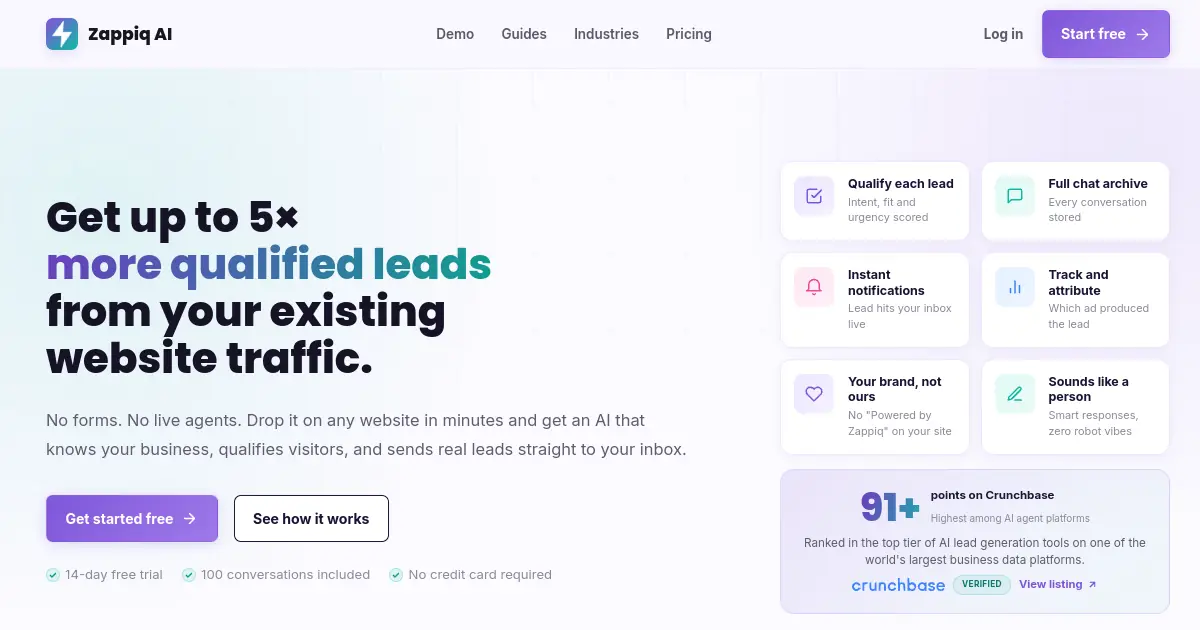
Ada and Zappiq AI aren't built for the same size of company, and it's worth saying that plainly before anything else. Ada is an enterprise support deflection platform designed around six-figure conversation volumes and multi-month rollouts. Zappiq is a website chatbot built for small and medium businesses that want to turn visitors into qualified leads. If you genuinely need what Ada does, deflecting hundreds of thousands of support tickets a year across ten channels, nothing on this list, Zappiq included, replaces that.
But a lot of the businesses who end up on an Ada sales call don't actually need that. They wanted a chatbot for their website, got quoted a $30,000 platform fee before a single conversation was resolved, and started looking for something that fits their actual size. That's the gap Zappiq fills. Setup takes minutes instead of an 8 to 16 week implementation, there's no sales call required to learn what it costs, and there's no per-resolution meter that can turn a good month into an expensive one, since billing is flat by conversation volume from the first day.
The bot trains itself on your website automatically and starts qualifying visitors right away, asking about intent, timeline, and fit as part of a normal-feeling conversation rather than a rigid intake form. The moment someone qualifies as a lead, you get an email with their details and the full transcript, plus the campaign or keyword that brought them to your site, so a real person can follow up while the interest is still fresh.
For agencies: Zappiq ships white-label on client sites at no added branding fee. If you were ever quoted Ada's per-client enterprise pricing for a roster of small business clients, that math never worked in the first place, this is built for exactly that use case instead.
Pros
- Published, flat pricing, no quote or sales call required
- Setup in minutes, not an 8 to 16 week rollout
- Auto-trains on your website, nothing to configure first
- Lead qualification built into the conversation itself
- Instant email alerts with full transcript and lead source
- No branding fee, white-label ready for agencies
- 100 free conversations on sign-up, no card required
Cons
- Not built for high-volume, omnichannel ticket deflection
- No voice, SMS, or social channel support
- Smaller company than an established enterprise vendor like Ada
- Not a fit for genuine 300,000-plus annual conversation volume
Why lead-focused teams choose Zappiq AI
Ad tracking: Connect each qualified enquiry to the campaign, keyword, or channel that generated it, so paid traffic can be measured against real leads.
Email lead delivery: Receive contact details, intent, source data, and the full conversation in your inbox as soon as the lead qualifies.
No branding: Keep the widget visually native to your website without a third-party badge or an enterprise white-label fee.
Automatic website training: Let Zappiq learn from your services, pricing, and FAQ pages without building a large support knowledge operation first.
Natural qualification: Ask useful follow-up questions and identify genuine fit before collecting contact information.
Simple installation: Add one script to WordPress, Shopify, Webflow, Wix, Squarespace, or a custom website without an enterprise implementation.
Pricing
Pricing: Every sign-up includes a 14-day trial with 100 conversations. Starter is $9/month billed annually for 350 conversations; Growth is $39/month month-to-month or $27/month billed annually for 1,500; Pro is $99/month month-to-month or $69/month billed annually for 5,000. There are no per-lead fees, surprise overage charges, or branding on any plan.
Best for: Small and medium business websites that want a chatbot built to capture and qualify leads, especially the businesses who got an Ada quote and realized it was built for a scale they don't operate at. Not a substitute for Ada's actual enterprise support deflection use case.
2. Intercom Fin: Best Published Rate for Mid-Market Support Teams
Intercom Fin
fin.ai | AI support agent billed per resolution, with a published rate since 2023
If what you actually wanted from Ada was a genuinely capable AI agent that resolves real support conversations across channels, Fin is the closest match in ambition, and the biggest practical difference is that its price is public. Intercom has documented $0.99 per resolution as Fin's headline rate, a number that doesn't require a sales call to obtain the way Ada's numbers always have.
The mechanics run deeper than that single figure suggests. Fin bills per outcome rather than one flat fee: each billable outcome costs $0.99 and is charged once per conversation. Fin can be used with an existing helpdesk at $0.99 per outcome without seat costs for Fin itself. Full Intercom plans add seat and channel pricing, so the total depends on the plan and messaging mix. Intercom's own published case studies report real-world resolution rates of 42 to 50 percent, which is the number worth modeling your bill against rather than assuming every conversation resolves cleanly.
One development worth knowing before signing anything long-term: in June 2026, Salesforce agreed to acquire Fin, the company Intercom renamed itself into, for roughly $3.6 billion. Pricing hasn't moved as a direct result yet, but a business signing a multi-year contract should factor in that packaging and roadmap will likely shift once that deal closes.
Set against Ada, Fin is a meaningfully smaller commitment on every axis that matters to a smaller buyer: published pricing, a genuine self-serve entry point, and a platform built to onboard teams far below Ada's stated conversation floor. It won't match Ada's channel reach at true enterprise scale, but for a mid-market team, it's the AI agent most likely to sit on a spreadsheet next to an Ada quote and actually win the comparison on price transparency alone.
Pros
- Published $0.99 per-resolution rate, no quote needed
- Self-serve entry point, no mandatory sales call
- Case-study-backed resolution rate data (42-50%)
- Works standalone on non-Intercom helpdesks
- Established brand with wide independent review coverage
Cons
- Pending Salesforce acquisition adds roadmap uncertainty
- Seat pricing stacks on top of per-resolution fees
- $9.99 lead-qualification outcome is a steep multiplier
- 50-outcome monthly minimum on standalone deployments
Pricing
Best for: Mid-market support teams that want Ada-level ambition on AI resolution with a rate they can actually see before signing anything, especially teams with real ticket volume to model against Fin's per-outcome pricing.
Tired of chasing a number sales won't give you?
Zappiq AI publishes flat pricing you can see right now. Your chatbot trains itself on your website and emails you every qualified lead the moment it's captured, no quote required.
Start Free Trial >No credit card | No sales call | No branding fee
3. Zendesk AI Agents: Best if You're Already Running Zendesk
Zendesk AI Agents
zendesk.com | Outcome-based AI resolution built into the Zendesk Suite
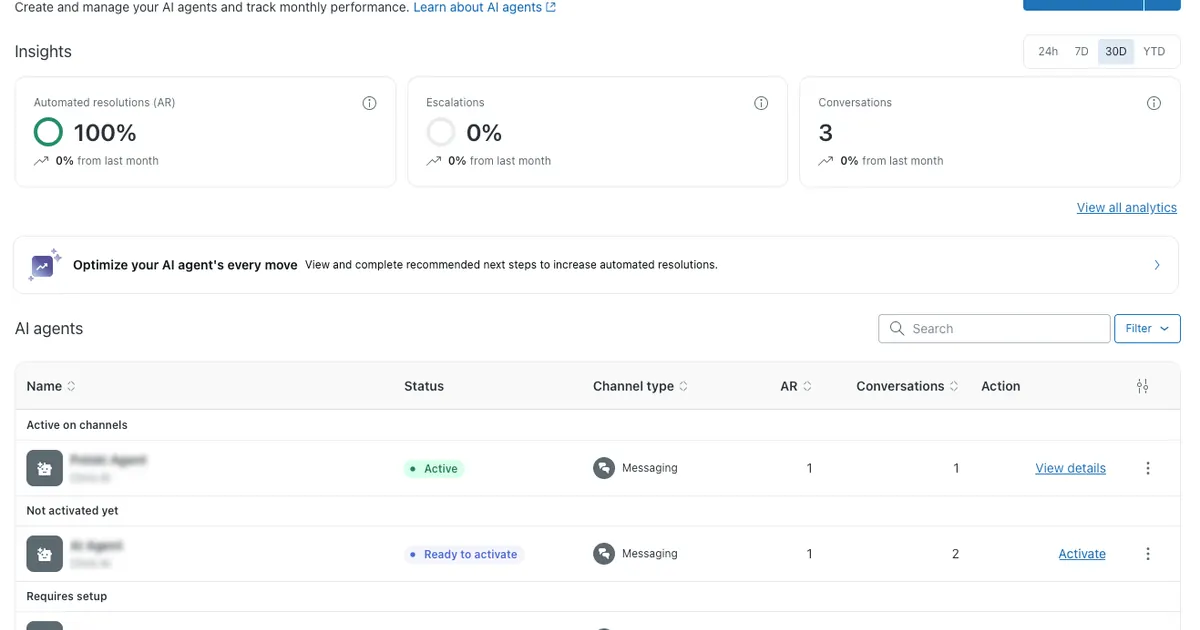
A meaningful share of businesses evaluating Ada already run a helpdesk, and if that helpdesk happens to be Zendesk, its native AI agents are worth checking before adding a second enterprise platform on top. Zendesk's AI Agents bill on roughly the same outcome logic Ada uses internally, per resolution rather than per seat, but the rate is at least reported publicly rather than living entirely behind a sales quote.
Zendesk AI agents are now billed through automated-resolution usage tiers and the exact effective rate depends on the account and plan. Suite plans remain seat-based, with Copilot and other capabilities packaged separately depending on the contract. Since January 2026, resolutions above your committed volume bill automatically without a warning, a change worth watching closely if your ticket volume swings seasonally.
The appeal here isn't that Zendesk is cheap. A 20-agent team doing meaningful AI volume can land in the $6,000 to $8,000 a month range once every add-on is counted, and one worked example for a 500-agent enterprise puts the AI line alone at $75,000 a month. The appeal is that the rate is at least reported, and if you're already paying for Zendesk seats, adding its native AI agent avoids standing up an entirely separate enterprise contract the way switching to Ada would require.
Where this genuinely beats Ada is integration depth with a platform you already run, plus a rate card you can model against your actual ticket volume before committing to anything. Where it falls short of Ada is channel breadth outside the Zendesk ecosystem itself.
Pros
- Reported per-resolution rate, not a hidden quote
- Native to a helpdesk many teams already run
- No separate enterprise contract required
- Automated resolution definitions are documented
- Volume commitments can lower the per-resolution rate
Cons
- Costs stack across seats, Copilot, and resolutions as three meters
- Automatic overage billing since January 2026, no warning
- Rate is reported by third parties, not officially published by Zendesk
- Less channel breadth than Ada outside its own ecosystem
Pricing
Best for: Teams already running Zendesk who want AI resolution without standing up a second enterprise-scale platform, and who are comfortable with reported rather than officially published per-resolution numbers.
4. Freshdesk Freddy AI: Best if You're Already on Freshworks
Freshdesk Freddy AI
freshworks.com | Session-based AI agent built into Freshdesk and Freshdesk Omni
The same logic that applies to Zendesk applies to Freshworks: if your team already runs Freshdesk, its native Freddy AI agent is worth pricing out before adding Ada as a second platform, and unlike Ada, Freshworks actually publishes its session rates on the pricing page.
Freddy AI Agent bills per session rather than per resolution, and the rate depends heavily on which product line you're on. The email-based AI Agent on classic Freshdesk runs about $0.49 a session, while the chat-based agent on Freshdesk Omni runs closer to $0.10 a session, a five-times difference for what most businesses would assume was the same feature. Each plan includes 500 sessions before you start paying, then $49 per additional 100 sessions with no rollover between billing cycles.
Freddy AI Copilot, the assistant layer for human agents rather than the customer-facing bot, is a separate add-on at $29 a seat a month, restricted to the Pro and Enterprise plans, so Growth-tier customers can't add it at any price. Base ticketing plans run $19 to $89 a seat a month, meaning a real deployment stacks three separate line items, seats, Copilot, and AI Agent sessions, a layered-meter pattern that makes forecasting harder than the entry price suggests, though still considerably more forecastable than Ada's undisclosed model.
What Freddy AI offers over Ada is a published rate card you can build a real forecast from, and the option to add AI incrementally to a helpdesk you may already be paying for, rather than committing to an entirely new enterprise platform from scratch.
Pros
- Published per-session rates for both channels
- Incremental AI adoption on an existing Freshdesk deployment
- 500 free sessions included with every plan
- Copilot and AI Agent sold separately, buy only what you need
- Strong ecosystem depth for existing Freshworks customers
Cons
- Five times the per-session cost on email vs chat, easy to miss
- Copilot locked to Pro and Enterprise tiers
- Sessions expire each billing cycle with no rollover
- Base ticketing plan doesn't include any AI by default
Pricing
Best for: Teams already running Freshdesk or Freshdesk Omni who want to add AI resolution incrementally with a published rate card, rather than replacing their helpdesk with a new enterprise platform.
5. eesel AI: Best Lightweight Layer on Top of an Existing Helpdesk
eesel AI
eesel.ai | AI layer that connects to Zendesk, Intercom, Freshdesk, Gorgias, and other helpdesks
eesel AI takes a different approach from every other tool on this list, Ada included: instead of being a helpdesk or a platform you migrate onto, it's a layer that connects to the helpdesk you already run and learns from your actual historical tickets, wikis, and docs rather than only a curated help center.
Pricing moved to a genuinely simple model in early 2026: $0.40 per ticket, no seats, no monthly minimum, and no interaction cap the way the old subscription tiers used to have. That's a real departure from Ada's structure, where the base platform fee alone can run $30,000 a year before a single ticket is resolved. eesel's model means a small team handling a few hundred tickets a month pays close to nothing, while a larger team scales up linearly and predictably as volume grows.
The tradeoff is that eesel isn't a replacement for your helpdesk, it's an addition to it, so you're still paying for Zendesk, Intercom, or whichever platform you already run underneath. For a business specifically trying to avoid stacking a second enterprise contract on top of an existing one, the way an Ada deployment would require, that's the whole point rather than a downside.
One feature worth calling out that Ada doesn't really offer at any comparable price point: eesel's simulation mode lets you test the AI against thousands of your own historical tickets before it ever talks to a real customer, giving you an actual performance estimate rather than a projected resolution rate from a sales deck.
Pros
- $0.40 per ticket, no seats, no interaction cap
- Connects to your existing helpdesk instead of replacing it
- Simulation mode tests against real historical tickets first
- Trains on tickets, wikis, and docs, not just a help center
- Predictable, linear cost as volume grows
Cons
- Not a standalone helpdesk, you keep paying for the one underneath
- Per-ticket cost adds up at very high volume, same as any usage meter
- Smaller integration list than an enterprise platform like Ada
- Newer pricing model, still settling as of 2026
Pricing
Best for: Teams that already have a helpdesk and want to add AI resolution as a thin, predictable-cost layer on top, rather than migrating to an entirely new enterprise platform the way an Ada deployment requires.
6. My AskAI: Fastest Setup and Lowest Published Floor
My AskAI
myaskai.com | AI support agent connecting to your existing helpdesk, flat starting price
My AskAI sits at the opposite end of the market from Ada almost entirely on purpose. Where Ada's sales materials describe a floor of hundreds of thousands of annual conversations, My AskAI's plans start from $199 a month, a number printed directly on the pricing page rather than gated behind a form.
The base plan covers a working AI agent connected to your existing helpdesk, Zendesk, Intercom, Freshdesk, Gorgias, or HubSpot, with additional ticket volume billed at $0.10 per ticket past what's included. That combination, a low flat floor plus a cheap per-ticket rate, makes it one of the more forecastable options on this list for a business that isn't sure yet how much volume its AI agent will actually handle.
What you're trading against Ada's enterprise reach is scale and channel depth. My AskAI is built for a small support team layering AI onto one existing platform, not an omnichannel deployment spanning voice, SMS, and social alongside chat and email. For a business that outgrew a simple FAQ widget but has no interest in a six-figure enterprise contract, that tradeoff is usually the right one.
Setup is also considerably faster than Ada's reported 8 to 16 week rollout. Most reviews describe a working deployment within days rather than months, since the product is built to connect to an existing helpdesk rather than replace the whole support stack.
Pros
- Published flat starting price, no sales call required
- Low per-ticket overage rate past the included allowance
- Connects to major existing helpdesks rather than requiring migration
- Fast setup, typically days rather than months
- Predictable cost curve for smaller support volumes
Cons
- Not built for omnichannel deployment across voice, SMS, and social
- Smaller company and support team than an enterprise-scale operation
- Less deep integration catalog than a platform built for large deployments
- Fewer published case studies at true enterprise scale
Pricing
Best for: Small support teams that want a working AI agent added to their existing helpdesk quickly, without an enterprise sales process or a six-figure annual commitment.
7. Featurebase (Fibi): Cheapest Outcome-Based Pricing With a Free Tier
Featurebase (Fibi)
featurebase.app | Outcome-based AI support agent available through paid Featurebase plans
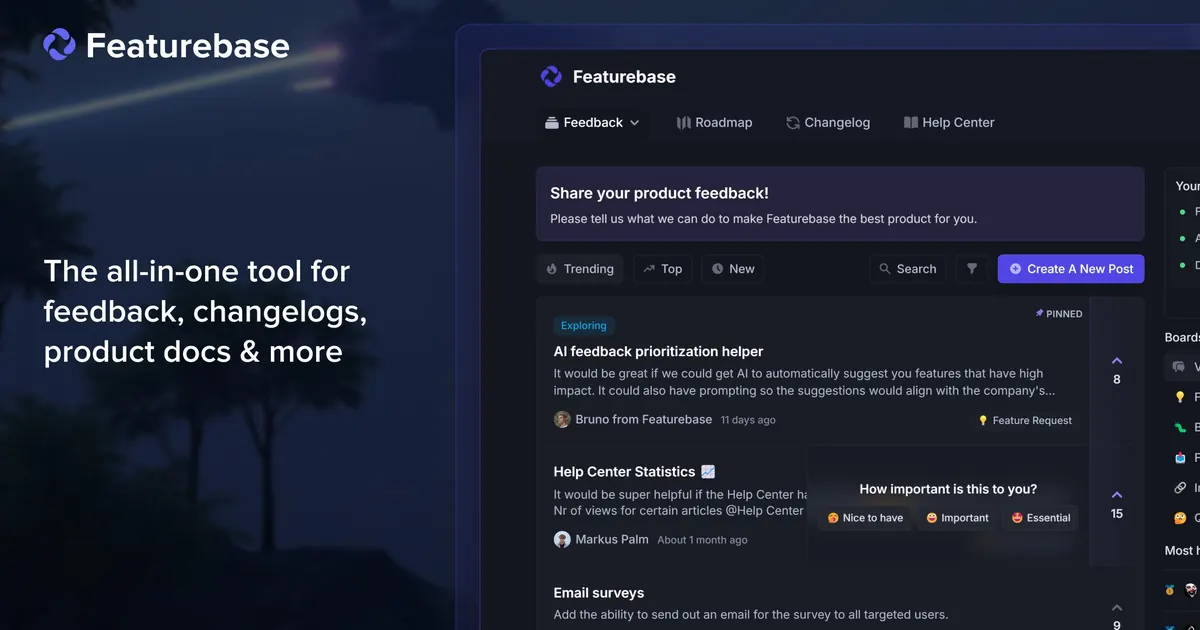
Featurebase's AI agent, Fibi, competes most directly with Ada and Intercom Fin on the same outcome-based logic, pay per resolved conversation, but undercuts both on price with a clear per-resolution rate for paid plans.
Fibi is priced at $0.29 per resolution, roughly half of Fin's $0.99 and a fraction of the $1 to $3.50 per resolution Ada has reportedly charged depending on the deal. For a business trying to model AI support costs against real ticket volume, that's a meaningfully lower ceiling to plan around, especially compared to Ada's opaque combination of a platform fee plus per-resolution usage on top.
Featurebase's paid support plans give teams a transparent way to test Fibi against real support volume and model whether outcome-based pricing fits their ticket mix before considering an enterprise platform.
The honest tradeoff is company maturity. Featurebase is a newer, smaller company than Ada, with a shorter track record and a narrower set of published enterprise case studies. For a business at genuine Ada-scale volume, that history gap matters. For most businesses evaluating Ada and getting sticker shock at the quote, it's a reasonable exchange for transparent pricing and a lower per-resolution rate.
Pros
- $0.29 per resolution, about half of Fin's published rate
- Paid-plan access to Fibi with transparent resolution billing
- Outcome-based billing, pay only for resolved conversations
- Native product docs and custom workflow support included
- Fast to start, no enterprise sales process required
Cons
- Newer company with a shorter track record than Ada
- Fewer published enterprise-scale case studies
- Narrower channel coverage than an omnichannel platform
- Per-resolution cost can still add up at true high volume
Pricing
Best for: Startups and growing businesses that want outcome-based pricing similar to Ada's model, at roughly half the per-resolution cost, with transparent resolution billing for real ticket volume.
How to Pick the Right Ada Alternative
Every tool here solves a version of what Ada tries to do at enterprise scale, but almost none of them are trying to be Ada, and that's mostly the point.
If what actually brought you to Ada was wanting a chatbot to capture and qualify leads from your website rather than deflect support tickets, Zappiq AI is built for exactly that and skips the enterprise sales process entirely.
If you specifically need outcome-based AI resolution with a published rate, Intercom Fin and Featurebase's Fibi are the closest match to Ada's per-resolution logic, at $0.99 and $0.29 respectively, both a fraction of Ada's reported $1 to $3.50 range and both without a mandatory sales call just to find out the price.
If you already run Zendesk or Freshdesk, check their native AI agents before adding a second platform on top, since both at least report a rate card where Ada offers none. If you'd rather add a thin AI layer to whatever helpdesk you already run instead of migrating anywhere, eesel AI's flat $0.40 per ticket is built for exactly that. And if your team is small enough that a $199 a month floor sounds more realistic than a $30,000 platform fee, My AskAI is worth the first look.
Before you sign anything with Ada: Ask for the number in writing before the sales call ends, and specifically ask whether the quote is outcome-based (per resolution) or conversation-based (billed regardless of outcome), since Ada's leadership has publicly discussed moving between the two models. Run your own ticket volume against a couple of the published-pricing alternatives on this list first, so you have a real number to compare the Ada quote against.
Frequently Asked Questions
Zappiq AI is the best option for small and medium businesses that got an Ada quote for a website chatbot and realized they don't need Ada's enterprise-scale support deflection platform. It's built for capturing and qualifying website leads rather than automating high-volume support tickets, and it publishes flat pricing with a free trial and no sales call required.
Ada sells enterprise contracts custom-quoted around each customer's conversation volume, channel mix, and integration needs. Third-party procurement data and marketplace listings suggest a base platform fee around $30,000 a year, with usage-based charges of roughly $1 to $3.50 per resolution on top, and real reported contracts ranging from $50,000 to over $300,000 annually depending on scale.
Ada is designed for large enterprises handling very high customer service volume, historically referencing a floor of at least 300,000 annual conversations, across channels including chat, email, voice, SMS, and social. Companies like Pinterest, Square, and Verizon use it. It's a strong fit for organizations with that scale, budget, and the patience for an 8 to 16 week implementation, and a poor fit for smaller businesses who just want a working chatbot without an enterprise sales process.
Yes. Intercom Fin publishes $0.99 per resolution, and Featurebase's Fibi agent publishes $0.29 per resolution with a free plan to test first. Both let you calculate a real cost estimate before talking to sales, unlike Ada, which requires a quote conversation to get any number at all.
My AskAI and eesel AI are both built to connect to an existing helpdesk, Zendesk, Intercom, Freshdesk, Gorgias, or HubSpot, and most reviews describe a working deployment within days. That's a significant difference from Ada's reported 8 to 16 week implementation timeline for a full enterprise rollout.
The Bottom Line
Ada built a genuinely capable platform for the specific problem of deflecting massive support volume across many channels from one AI brain, and its customer list, Pinterest, Square, Verizon, Monday.com, reflects real enterprise trust in what it does. The reason so many businesses go looking for alternatives isn't that Ada doesn't work. It's that almost nobody outside a narrow band of large enterprises can see a price before committing serious time to a sales process, and the numbers that do leak out, a $30,000 base fee, $1 to $3.50 per resolution, real contracts reaching $300,000 a year, are simply out of reach for the vast majority of businesses evaluating an AI chatbot.
The right alternative depends on what you actually need. If you're already running Zendesk or Freshdesk, their native AI agents at least publish a rate card before you commit to anything. If outcome-based pricing similar to Ada's model is what you want, Intercom Fin and Featurebase's Fibi both publish a per-resolution rate a fraction of Ada's reported range. If you'd rather add AI to a helpdesk you already run than replace it, eesel AI's flat per-ticket rate does that without a platform migration. And if speed matters more than scale, My AskAI gets a working deployment live in days rather than months.
For businesses whose real need was never enterprise-scale support deflection but a chatbot that turns website visitors into qualified leads, Zappiq AI is the most direct fit here, and it arguably shouldn't be compared to Ada at all except that a lot of small businesses end up on an Ada sales call looking for exactly that and get quoted a platform built for a completely different scale. It trains on your site automatically, qualifies leads without any setup call, and bills flat, with no per-resolution meter and no six-figure floor.
The free trial is at zappiqai.com. No credit card required.
Try the alternative that skips the enterprise sales call
Zappiq AI is live in under 5 minutes. Trains itself on your website, qualifies visitors automatically, emails you every lead instantly. Flat pricing, no quote required, no branding fee.
Start Free Trial >No credit card | No branding fee | Flat monthly billing
References
- eesel AI. "Ada CX review (2026): Features, pricing & a better alternative." eesel.ai.
- Fin AI. "Ada CX Pricing: Is It Worth the Cost in 2026?" fin.ai.
- CorePiper. "Ada AI Review 2026: Is $30K-$300K/Year Worth It?" corepiper.com.
- Featurebase. "Ada.CX Pricing 2026: How Much Does It Really Cost?" featurebase.app.
- Get Macha. "Intercom Fin AI Explained (2026): What It Does, How It Works & Costs." getmacha.com.
- Voiceflow. "Zendesk AI Agents 2026: Pricing, Setup, and Best Alternatives." voiceflow.com.

Ansar Ali
Ansar Ali is the founder of Zappiq AI, a lead-capture platform built for small businesses that cannot afford to lose high-intent website visitors. He writes from hands-on experience building chatbot flows, attribution systems, and qualification workflows for service businesses, with a focus on the practical details that turn website conversations into qualified enquiries.