
Quick Summary
Short answer: The best Intercom alternative depends on whether you need lead generation, a shared support inbox, ecommerce chat, or a full service desk. For small businesses focused on qualified website leads, Zappiq AI is the simpler flat-pricing option; support teams may prefer a dedicated Intercom competitor such as Crisp or Freshchat.
- Zappiq AI is the best Intercom alternative for small business websites where the goal is capturing and qualifying leads, not staffing a full support desk. Flat pricing, no per-outcome AI charge, auto-trains on your site from day one.
- Crisp is the best flat, workspace-priced inbox for teams that want live chat, email, and a basic AI chatbot bundled together instead of billed per seat.
- Tidio is the best fit for ecommerce and Shopify stores that need live chat with an AI layer without adopting a full enterprise helpdesk.
- Freshchat is the best option for growing support teams already leaning on the Freshworks stack who need routing rules and multichannel messaging.
- Help Scout is the best choice for lean teams who would rather run support out of something that still feels like a shared email inbox.
- tawk.to is the honest answer for anyone who needs live chat running today and has no budget for it at all.
- HubSpot Service Hub is the best pick for teams already living inside HubSpot's CRM who want tickets and chat tied to the same contact record.
Methodology: How We Compared These Tools
We checked each platform against the same buyer questions: what the vendor publishes, what the AI meter charges for, whether a free plan or trial exists, how the tool fits into a real support or lead-generation workflow, and where a human handoff is needed. Pricing figures are based on vendor pages or clearly labeled third-party estimates checked in September 2026. We did not treat a sales demo as a hands-on test. Where a public trial or product demo was accessible, the workflow was checked with common questions about pricing, setup, integrations, and escalation. Products that require a sales conversation are marked as custom or quote-based rather than presented as self-serve bargains.
12 Best Intercom Alternatives at a Glance
| Tool | Starting Price | AI Cost Structure | Free Plan | Best For | G2 Rating |
|---|---|---|---|---|---|
| Zappiq AI | 14-day trial: 100 conversations; Starter $9/mo annual equivalent (350) | Included, no per-resolution fee | 14-day trial with 100 conversations | SMB website lead generation | Not listed |
| Crisp | From $45/mo | AI credits by tier | Yes, 2 seats | Flat-rate shared inbox | Approx. 4.5/5 |
| Tidio | From about $29/mo | Lyro quota plus usage | Limited free AI chats | Ecommerce and Shopify chat | Approx. 4.6/5 |
| Freshchat | From about $19/agent/mo | Freddy sessions and add-ons | Limited free tier | Freshworks-stack support | Approx. 4.4/5 |
| Help Scout | From about $25/user/mo | Seat-based AI assistance | Yes, limited free plan | Lean email-first support | Approx. 4.4/5 |
| tawk.to | Free | No built-in AI agent | Yes, unlimited agents | Zero-budget live chat | Approx. 4.5/5 |
| HubSpot Service Hub | Free CRM tools; paid AI tiers | Breeze credits by plan | Yes, free CRM tools | HubSpot-native teams | Approx. 4.4/5 |
| Kayako | Custom platform pricing | Kay AI at $1/resolution | No public free plan | Action-taking AI support | Not listed |
| Zendesk | From about $19/agent/mo | Plan plus advanced AI usage | Trial, no permanent free plan | Enterprise omnichannel service | Approx. 4.3/5 |
| Freshdesk | From about $19/agent/mo | Freddy AI add-ons or sessions | Limited trial or free tier | Budget-conscious helpdesk teams | Approx. 4.4/5 |
| Gorgias | From about $50/mo | AI Agent per resolved conversation | Trial only | Shopify and DTC support | Approx. 4.6/5 |
| Chatwoot | Free self-hosted; cloud from $19/agent | Captain AI credits on paid tiers | Yes, 2 agents and 500 conversations | Open source and data control | Approx. 4.5/5 |
How to read the table: A lower seat price does not always mean a lower AI bill. Kayako, Gorgias, and Fin use resolution-based pricing in some form, while Zappiq AI uses a conversation-volume plan for website lead generation. Confirm current vendor pricing before signing up because plans and AI quotas change.
Why Businesses Are Looking Past Intercom
Intercom earned its reputation the hard way. The Messenger widget, the shared inbox, the automation rules, and the Fin AI agent are all genuinely well engineered, and for years it set the standard that most of this category copied. None of that is really in dispute. The reasons people go looking for something else are less about whether Intercom works and more about what it costs to keep it running once support volume actually grows.
The first issue is the billing structure itself. Intercom charges a per-seat fee that climbs by tier, from $39 on the entry plan up toward $139 on the top tier, and then adds Fin AI Agent on top at $0.99 for each resolution, procedure handoff, or disqualification. Other messaging channels can add usage charges. Those numbers do not move together. A quiet month costs one thing. A month where a campaign, a product launch, or a bad outage drives a spike in traffic costs something else entirely, and you generally do not know which one you are getting until the invoice lands.
The second issue is what actually counts as a resolution. Intercom defines a Fin resolution as a conversation where no further help is requested after the last AI answer. That can include a visitor leaving without asking anything else, so teams that expected to pay only for clearly successful conversations may also be billed when a visitor simply stops engaging.
What counts as a resolution: Intercom defines a Fin resolution as a conversation where no further help is requested after the last AI answer. Each resolution is billed at $0.99, which is a big part of why the monthly total is hard to predict in advance.
What Intercom's Fin Actually Costs: 5 Seats and 1,000 AI Conversations
How the math works: $99 x 5 Advanced seats equals $495, and 1,000 Fin outcomes at $0.99 equals $990, for $1,485 per month before other channel charges. This is a full-resolution scenario, not a promise that every conversation becomes billable. Zappiq AI Growth includes 1,500 conversations for $39 monthly or $27/month equivalent billed annually, with no per-seat or per-resolution fee.
The third reason has nothing to do with the product and everything to do with ownership. In June 2026, Salesforce signed a definitive agreement to acquire Fin, formerly Intercom, for roughly $3.6 billion. The deal remains subject to closing conditions, so the roadmap, packaging, and pricing philosophy may change once a much larger company finishes folding it into its own stack. For teams that just want a stable tool they can budget around for the next few years, that uncertainty alone is reason enough to look elsewhere.
None of this makes Intercom a bad product. It makes it a specific bet: a platform built for support organizations with real headcount and real AI volume, priced in a way that assumes both will keep growing. For a small business trying to capture leads from a marketing site, or a lean team that just wants predictable support costs, that bet does not pay off the same way.
1. Zappiq AI: Best for Lead Generation on SMB Websites
Zappiq AI
zappiqai.com | AI lead generation chatbot built for small and medium business websites, no developer required
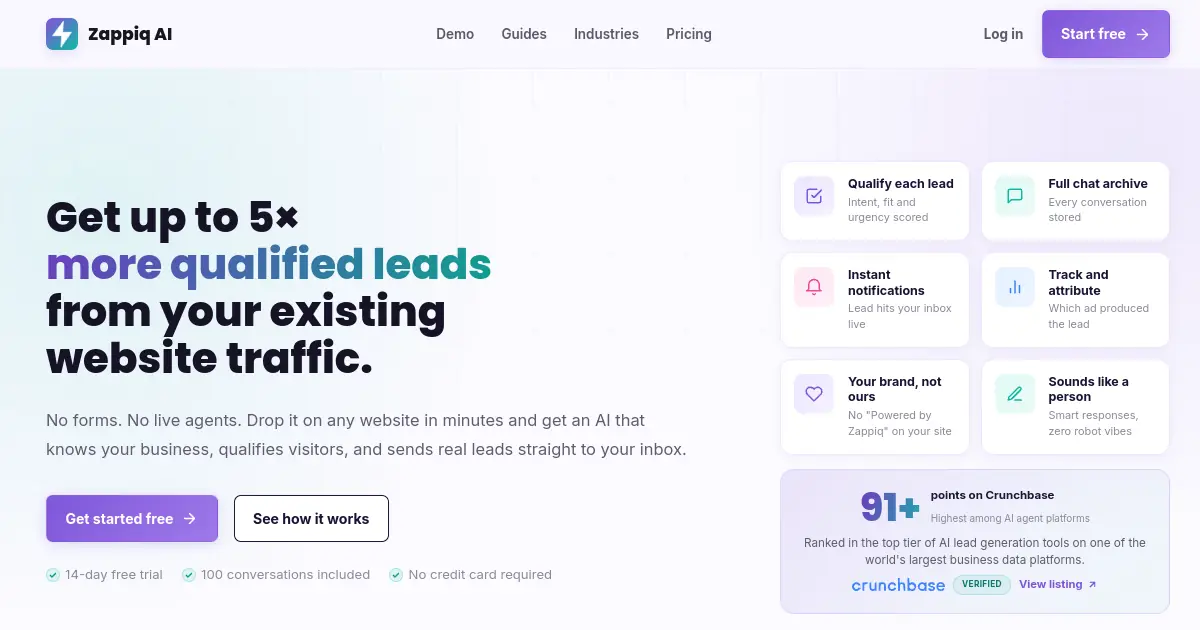
Intercom and Zappiq AI are not really trying to win the same job. Intercom is a full customer messaging platform built for support organizations that need a shared inbox, ticketing, and an AI agent that scales with headcount and conversation volume. Zappiq is built for one outcome: turning website visitors into qualified leads, without a seat count that grows every time you hire, and without a per-outcome meter that grows every time traffic does.
The setup gap is where this shows up first. Getting Intercom production-ready means configuring the Messenger, setting up Fin's knowledge sources, deciding on resolution rules, and picking a seat tier before you know your real usage. Zappiq reads your website the moment you sign up and trains the chatbot on your services, pricing, and common questions automatically. There is a working assistant answering visitor questions before the account setup is even finished.
Pricing is flat and tied to conversation volume, not to how many of those conversations an AI happens to close. A campaign that sends triple the usual traffic to your site for a week does not trigger a surprise Fin-style bill at the end of the month. The number you signed up for is the number you pay.
Lead qualification is built into the core product rather than something you configure. The chatbot asks about intent, timeline, and fit before it ever collects a name or phone number, and the moment a visitor clears that bar, Zappiq emails you the lead along with the full conversation transcript so you have context while it is still fresh.
Ad attribution is another gap Intercom leaves open. Zappiq ties each captured lead back to the campaign, keyword, or channel that brought the visitor to your site in the first place, which matters a great deal if any part of your traffic comes from paid ads rather than organic search.
Webhook routing: Zappiq connects to Zapier, Make, and n8n, so a captured lead can land in your CRM, a Slack channel, or any tool already in your stack without writing a single line of integration code.
Pros
- No developer or admin setup required
- Trains itself on your website from day one
- Flat pricing, no per-outcome AI charge
- Lead qualification built in, nothing to configure
- Instant email alerts with full transcript
- Ad source tracking on every captured lead
- No branding, even on the free trial
Cons
- Not built as a full ticketing or helpdesk system
- No shared team inbox for multi-agent support queues
- No voice channel
- Younger platform, smaller community than Intercom
Why lead-focused teams choose Zappiq AI
Ad tracking: Match each qualified enquiry to the campaign, keyword, or channel that produced it, so paid traffic can be measured against real leads.
Email lead delivery: Receive contact details, intent, source data, and conversation context in your inbox without building a separate support workflow.
No branding: Keep the widget focused on your business without a third-party badge or a separate white-label charge.
Automatic website training: Let Zappiq learn from the pages you already maintain instead of setting up a support knowledge operation.
Natural qualification: Let the AI ask useful follow-up questions and identify fit before requesting contact information.
Simple installation: Add one script to WordPress, Shopify, Webflow, Wix, Squarespace, or a custom website without configuring an Intercom-style inbox.
Pricing
Pricing: Start with a 14-day trial that includes 100 conversations. Starter is $9/month equivalent billed annually for 350 conversations; Growth is $39 monthly or $27/month equivalent annually for 1,500; Pro is $99 monthly or $69/month equivalent annually for 5,000, with no per-lead fees.
Best for: Small and medium business websites where the goal is turning visitors into qualified enquiries, not running an enterprise support desk. Service businesses, agencies, real estate, dental, legal, home services, and anyone running paid traffic who wants to know exactly what it costs.
crisp">2. Crisp: Best Flat-Rate Omnichannel Inbox
Crisp
crisp.chat | Live chat, shared inbox, and AI chatbot billed per workspace instead of per agent
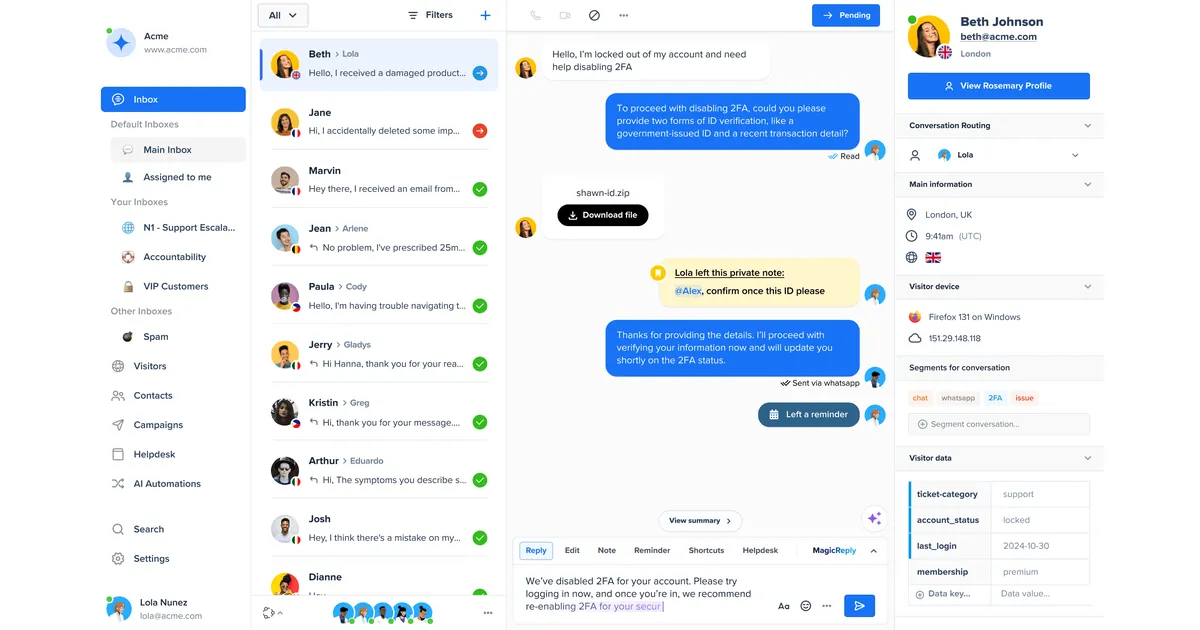
Crisp takes the opposite approach from Intercom on the one line item most people complain about. Instead of billing per agent, Crisp prices by workspace, so adding a fourth or fifth teammate to a plan that already includes enough seats does not move the bill at all. For a small team that expects to grow headcount before it grows revenue, that structure alone removes a lot of the anxiety around scaling support.
The plan lineup runs from a genuinely usable free tier with two seats and unlimited live chat, through Mini at 45 dollars a month, Essentials at 95 dollars a month, up to Plus at 295 dollars a month for larger teams that want unlimited AI automation. Every paid tier folds in a pool of AI credits for Crisp's chatbot, called Hugo, rather than charging a separate subscription for it the way Intercom does with Fin.
The catch worth knowing before you commit is that Hugo is not unlimited outside the top plan. Essentials caps AI actions at roughly fifty a day, which is fine for a small site and tight for anything with real volume. Getting past that cap means moving to Plus, which is a meaningful jump from Essentials but still well under what an equivalent Intercom setup with Fin resolutions tends to cost at the same conversation volume.
Crisp also bundles a knowledge base, co-browsing for technical walkthroughs, and native channels for WhatsApp, Instagram, and Messenger starting at the Essentials tier, so teams that need more than a website widget are not immediately pushed toward a separate tool.
Pros
- Workspace pricing, not billed per agent
- Genuinely usable free plan with two seats
- AI credits bundled into paid tiers
- Knowledge base and co-browsing included
- Native WhatsApp, Instagram, and Messenger channels
- Extra seats on Plus cost a flat $10/mo each
Cons
- AI actions capped on lower tiers, around 50/day on Essentials
- Unlimited AI only available on the $295/mo Plus plan
- No lead qualification or ad attribution built in
- Multi-product companies pay for a separate workspace each
Pricing
Best for: Startups and small teams that want live chat, a shared inbox, and a basic AI chatbot bundled into one predictable bill instead of a per-seat charge that climbs with headcount.
tidio">3. Tidio: Best for Ecommerce and Shopify Chat
Tidio
tidio.com | Live chat and AI chatbot platform with native Shopify and ecommerce integrations
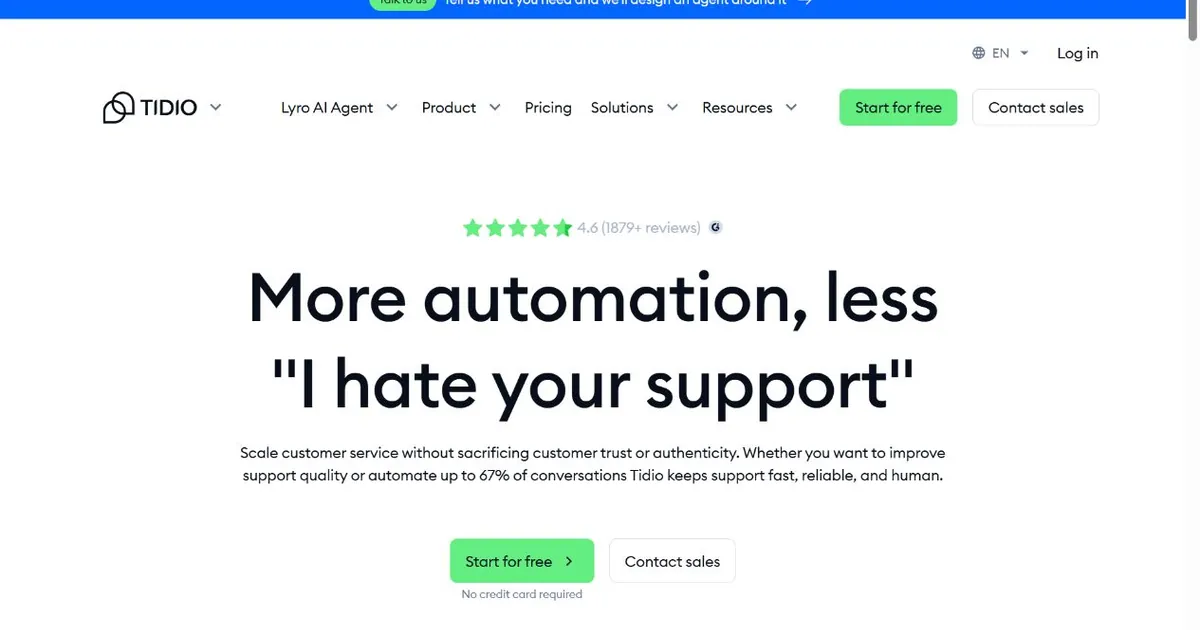
Tidio built its reputation with Shopify merchants, and that focus still shows. Order status lookups, cart recovery flows, and product recommendation widgets are set up through native store integrations rather than custom logic you would have to build yourself in a general-purpose tool like Intercom. For a store owner without a developer on staff, that head start matters.
The plan structure is straightforward at the low end and gets awkward fast. Free covers fifty conversations a month with three operator seats. Starter runs about 29 dollars a month, Growth around 59 dollars a month with five seats. Past that, the next tier, called Plus, jumps to roughly 749 dollars a month with no step in between, which is a steep cliff for a store that has simply outgrown Growth's seat or conversation limits.
Tidio's AI chatbot, Lyro, is where the comparison to Intercom gets interesting. Lyro is not included in the base plans at all. It is a separate add-on starting around 32 to 39 dollars a month for a fixed quota of AI conversations, with overage priced near 50 cents per conversation on the higher tiers. That is a different shape of cost than Intercom's Fin, but it is still a second meter running alongside your base plan rather than one flat number.
Lyro also does not currently support voice, and WhatsApp coverage has been inconsistent by region according to user reports, so stores relying heavily on WhatsApp for customer messages should test that channel specifically before committing budget to the AI add-on.
Pros
- Native Shopify and ecommerce integrations
- Free plan covers 50 conversations with 3 seats
- Visual flow builder for cart recovery and FAQs
- Lyro AI trains on your store's product catalog
- Widget customization built for online storefronts
Cons
- Lyro AI is a separate paid add-on, not included
- Steep jump from Growth ($59/mo) to Plus ($749/mo)
- 10-seat cap on self-serve plans
- No voice support, inconsistent WhatsApp coverage
Pricing
Best for: Shopify and ecommerce stores that want live chat built around store data and order status, and are comfortable treating AI as a separate line item rather than a bundled feature.
Want leads captured today, without a seat plan or a resolution meter?
Zappiq AI trains itself on your website, qualifies visitors automatically, and emails you every lead. Flat pricing. No AI charge stacked on top.
Start Free TrialNo credit card | No developer needed | No branding on any plan
freshchat">4. Freshchat: Best for Freshworks-Stack Support Teams
Freshchat
freshworks.com/live-chat-software | Freshworks' live chat and messaging product with AI agent and copilot add-ons
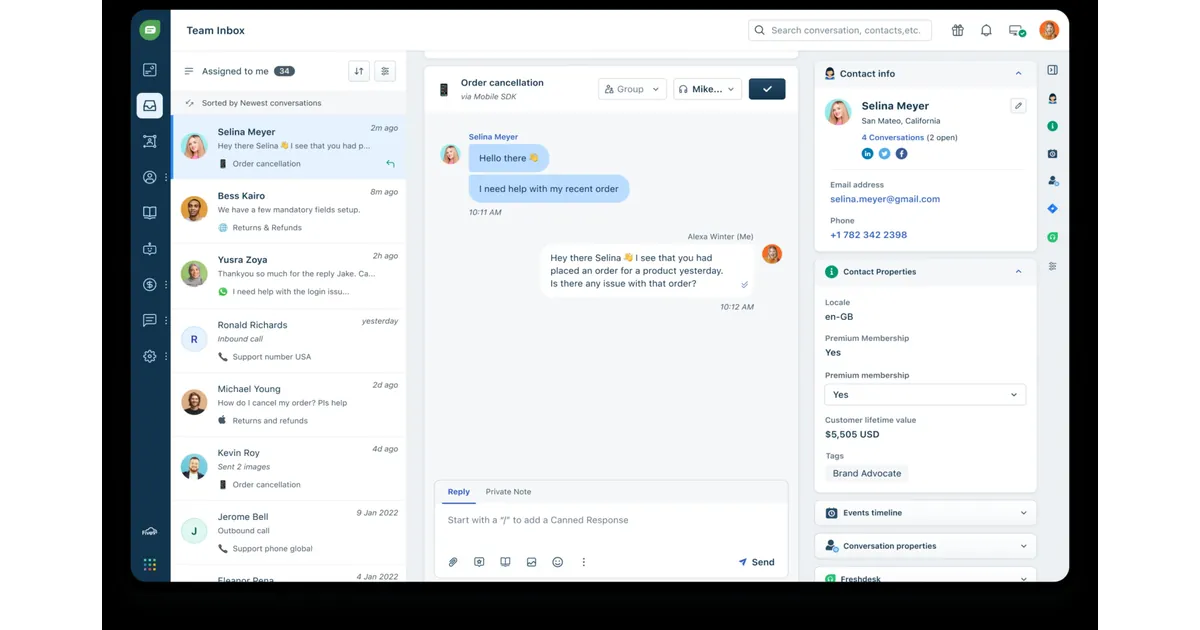
Freshchat sits closest to Intercom in shape out of every tool on this list, which makes it a fairly direct swap for teams that mainly want a cheaper seat price without giving up routing rules, SLAs, and a real omnichannel inbox. Free covers up to ten agents, Growth runs about 19 dollars a seat a month, Pro around 49 dollars, and Enterprise near 79 dollars, all billed annually.
The AI layer is called Freddy, and it is split into two separate products the same way Intercom splits Fin from its base plan. Freddy AI Agent handles customer-facing conversations and includes 500 free sessions a month on paid tiers, with additional sessions priced at 49 dollars per hundred, working out to roughly 49 cents each, about half of what Intercom charges per Fin resolution. Freddy AI Copilot, which assists human agents rather than replacing them, is a separate 29 dollar per agent add-on available only on Pro and Enterprise.
That two-meter structure means Freshchat is not actually free of the problem people are trying to escape when they leave Intercom. It is a meaningfully cheaper version of the same problem. A team with real AI volume still needs to model seats, AI sessions, and Copilot licenses separately before trusting the sticker price on the pricing page.
Where Freshchat earns its place on this list is integration depth if you are already running other Freshworks products. Teams already on Freshdesk for ticketing get a much tighter handoff between chat and tickets than bolting a separate live chat tool onto an existing helpdesk would allow.
Pros
- Free tier covers up to 10 agents
- Freddy AI sessions roughly half Intercom's per-outcome price
- Tight integration if already using Freshdesk
- Skill-based routing and SLA policies on higher tiers
- 68 pre-built templates for the no-code bot builder
Cons
- Two separate AI meters: Agent sessions and Copilot seats
- Copilot only available on Pro and Enterprise tiers
- AI sessions expire each cycle with no rollover
- Setup takes longer than the fully no-code tools on this list
Pricing
Best for: Growing support teams that want Intercom-style routing and multichannel messaging at a meaningfully lower seat price, particularly if they already run other Freshworks tools.
5. Help Scout: Best for Lean Teams Running Support by Email
Help Scout
helpscout.com | Shared inbox, knowledge base, and live chat widget built to feel like email rather than a support console
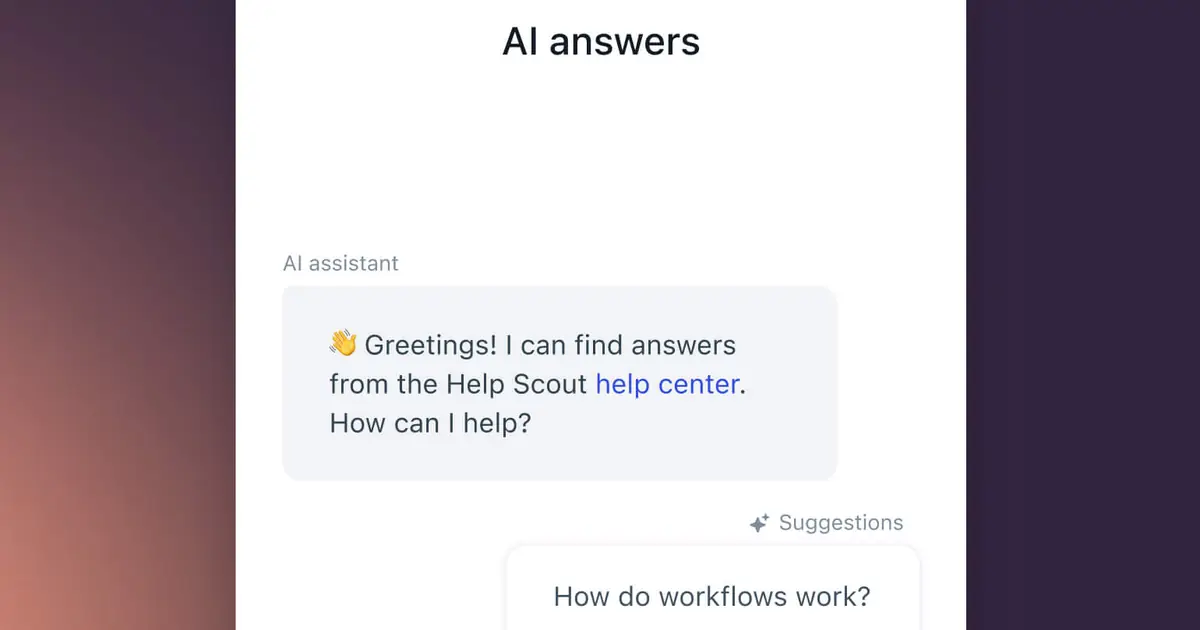
Help Scout takes a deliberately quieter approach than Intercom. There is no busy dashboard covered in automation nodes and AI settings. Conversations look and feel like an email thread, which is exactly the point for small teams whose support volume does not justify learning a full support platform, only to answer questions the same way they always have.
The free plan includes five users, one shared inbox, a public knowledge base, and Beacon, Help Scout's embeddable widget that combines live chat, a contact form, and searchable help articles in one place. Paid plans start around 25 dollars per user a month and add multiple inboxes, workflows, and reporting.
Where Help Scout differs most from Intercom is that it does not build its pricing around a per-outcome AI meter. There is AI-assisted drafting and summarization built into the product, but the billing model stays anchored to seats rather than to how many conversations an AI happens to close, which is the exact line item that tends to surprise Intercom customers once volume grows.
The trade-off is depth. Help Scout does not attempt the flow builder, the multichannel routing, or the standalone customer-facing AI agent that Intercom, Freshchat, and Crisp all offer in some form. For a five or ten person team answering support email and the occasional chat, that is rarely a real limitation. For a team that wants an AI agent handling first-line resolution end to end, it is worth knowing upfront.
Pros
- Free plan includes 5 users and a full knowledge base
- No per-outcome AI billing
- Genuinely simple to learn, closer to email than a console
- Beacon widget bundles chat, forms, and docs in one place
- Strong reporting for a tool this lightweight
Cons
- No standalone customer-facing AI resolution agent
- No visual flow builder for complex automation
- Limited native ecommerce and Shopify tooling
- Not built for high-volume, multichannel operations
Pricing
Best for: Small teams that want their support inbox to feel like email, without learning a full support console or budgeting for a per-outcome AI meter.
6. tawk.to: Best Free Option
tawk.to
tawk.to | Fully free live chat with unlimited agents, no conversation caps, and no per-seat billing
Most tools that claim to be free eventually reveal a catch: a seat cap, a conversation cap, or a trial clock quietly counting down. tawk.to is one of the rare exceptions. The core platform, unlimited agents, unlimited chat history, and unlimited conversations, has stayed genuinely free for years, funded instead by an optional hire-a-live-agent service and a modest branding removal fee.
For a business that just needs a chat widget on its site and a reliable way to get pinged when someone reaches out, tawk.to covers that job completely at zero monthly cost, which is a stark contrast to Intercom's cheapest published seat price alone running well over 300 dollars a year before any AI usage is added.
The honest limitation is that tawk.to is manual live chat, not an AI platform. There is no customer-facing resolution agent, no automated flow builder in the sense Crisp or Tidio offer, and no knowledge base trained on your content the way Zappiq or SiteGPT-style tools work. Every conversation needs a human on the other end, which is fine for a small team watching the widget during business hours and a real constraint for anyone hoping to deflect volume automatically.
If the branded widget bothers you, removing it costs about 29 dollars a month on the paid tier, still a small fraction of what a single Intercom seat costs before Fin is even switched on.
Pros
- Completely free, unlimited agents and chats
- No seat cap, no conversation cap, no trial clock
- Simple to install on any website in minutes
- Branding removal is a small flat monthly add-on
Cons
- No AI agent, purely manual live chat
- No automated lead qualification or website training
- Requires a human watching the widget to be useful
- Reporting and automation are basic compared to paid tools
Pricing
Best for: Businesses with genuinely no budget for support software who just need a chat widget and a human answering it, without any AI layer at all.
7. HubSpot Service Hub: Best for Teams Already on HubSpot CRM
HubSpot Service Hub
hubspot.com/products/service | Support ticketing and live chat built directly into HubSpot's free CRM
HubSpot's pitch is different from every other tool on this list. It is not primarily a chat widget with a support desk attached. It is a CRM with a support desk attached, and for a business already running marketing and sales through HubSpot, that changes the comparison entirely. Every conversation, ticket, and chat gets logged against the same contact record your sales team already sees.
The free tier is genuinely usable, not a stripped trial. It includes unlimited seats, a shared inbox, live chat, and ticketing, tied to HubSpot's free CRM with no seat limit forcing an upgrade the way most competitors do. Paid tiers start around 20 dollars a seat and add automation, reporting, and Breeze, HubSpot's AI layer.
Breeze is billed differently than Intercom's Fin. Rather than a per-outcome charge, AI capability comes bundled as credits included in your plan tier, so the bill does not move conversation by conversation the same way. That structure is more predictable, though it also means heavy AI usage on a lower tier runs into a credit ceiling rather than simply costing more, which is its own kind of constraint to plan around.
The trade-off is depth outside the CRM use case. HubSpot Service Hub is not built as a standalone lead-qualification chatbot for a marketing site, and its live chat widget is noticeably less customizable than Crisp's or Zappiq's. For a business that is not already invested in HubSpot's ecosystem, adopting Service Hub mainly for support alone is rarely the most efficient path.
Pros
- Free tier includes unlimited seats and a real CRM
- Every chat and ticket tied to the same contact record
- Breeze AI billed as bundled credits, not per resolution
- Strong reporting once paired with HubSpot Marketing or Sales
Cons
- Not built as a standalone lead-qualification chatbot
- Widget customization more limited than dedicated chat tools
- Real value only shows up alongside other HubSpot products
- AI credit ceilings can force an upgrade at moderate volume
Pricing
Best for: Businesses already running sales or marketing through HubSpot who want support tickets and chat tied to the same contact timeline, without adding a completely separate platform.
8. Kayako: Best for Action-Taking AI Support
Kayako
kayako.com | Modern helpdesk with Kay AI, unified support channels, and action-taking workflows
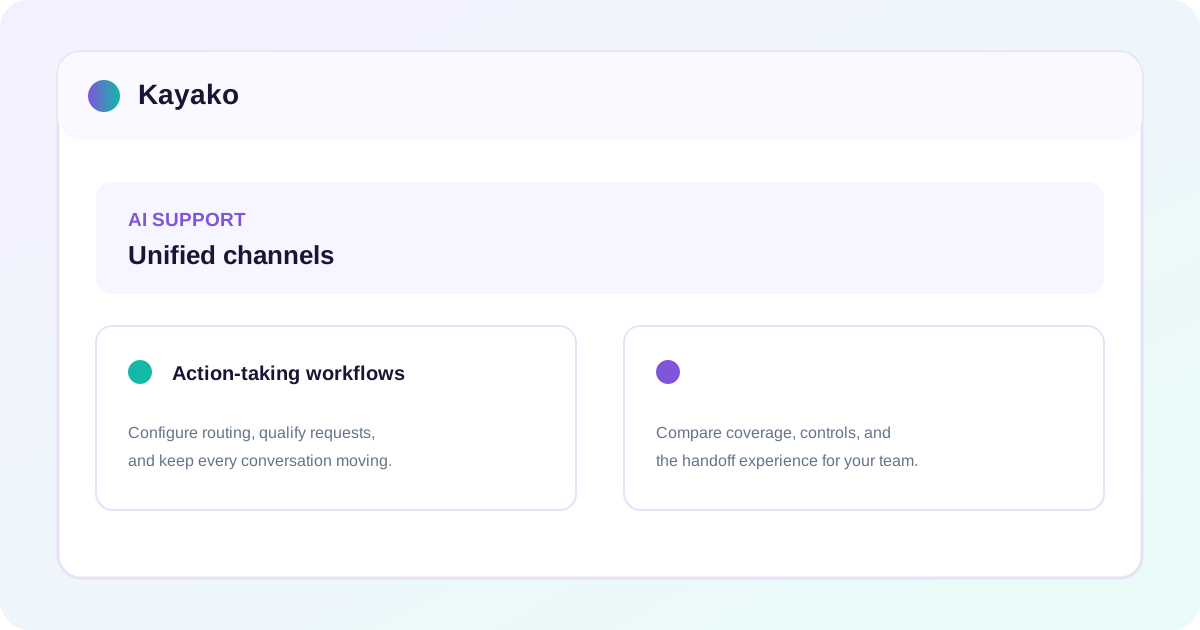
Kayako is one of the closest alternatives for teams that want an AI agent to resolve support issues rather than only draft replies. Kay can work across chat, email, and voice, and the product demonstrates action-taking workflows such as exchanges, refunds, and account updates. That puts it closer to Fin than a basic live-chat widget, although the buyer should still compare the underlying helpdesk features and implementation process.
The important pricing detail is that Kay AI uses outcome-style billing at $1 per resolution, with no charge when a conversation is escalated or only partially handled. Kayako One includes the helpdesk, unified inbox, knowledge base, automation, reporting, and Kay AI, but the platform pricing itself is handled through a pricing conversation rather than a public self-serve rate card.
Best for: Support teams that want a modern AI agent with the ability to complete actions, and that are comfortable evaluating a quote-based helpdesk rather than a simple monthly chat plan.
zendesk">9. Zendesk: Best for Enterprise Omnichannel Support
Zendesk
zendesk.com | Ticketing, omnichannel support, reporting, and advanced AI for larger service teams
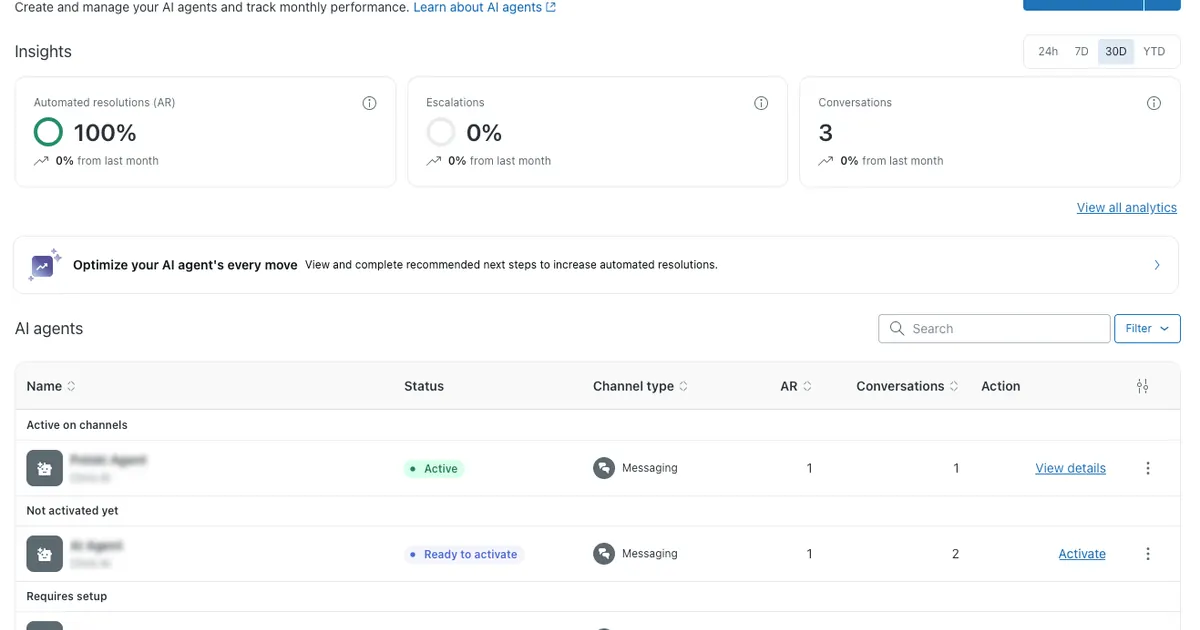
Zendesk is the safer Intercom alternative when the center of the operation is a serious ticketing system. It handles email, messaging, voice, knowledge bases, SLAs, skills-based routing, reporting, and internal collaboration at a scale that simpler inbox products are not designed to match.
Entry pricing is commonly published from around $19 per agent per month for support features, while full Suite plans and advanced AI raise the total. AI costs depend on the plan and add-ons, so a team should calculate agent seats, automated resolutions, voice, and messaging separately rather than comparing only the starting number.
Best for: Mid-market and enterprise support organizations that need governance, ticket history, SLAs, and multiple service channels more than a lightweight marketing chat experience.
freshdesk">10. Freshdesk: Best Budget-Friendly Helpdesk Alternative
Freshdesk
freshdesk.com | Helpdesk ticketing, knowledge base, automation, and Freddy AI
Freshdesk is a practical Intercom alternative for teams that want conventional ticketing at a lower entry cost. Email support, a knowledge base, automation, collision detection, and reporting are the core experience. It is less focused on product-led messaging than Intercom, but that is an advantage when the team mainly needs reliable case management.
Freddy AI can add automated responses, summaries, and agent assistance, but the AI layer should be modeled separately from the agent subscription. Freshworks offers different packaging across Freshdesk and Freshchat, so verify whether the quote includes Freddy sessions, Copilot features, or only the helpdesk seats.
Best for: Cost-conscious customer service teams that want a conventional helpdesk and can accept a separate AI quota or add-on instead of Intercom's integrated Messenger experience.
11. Gorgias: Best for Shopify and DTC Support
Gorgias
gorgias.com | Ecommerce helpdesk with Shopify data, macros, automation, and AI Agent
Gorgias is a stronger Intercom alternative for an online store than for a SaaS company. The helpdesk can connect support conversations to orders, refunds, subscriptions, shipping, and customer records, which lets an agent answer a store question without switching between the inbox and the ecommerce admin.
The cost model needs careful attention. Gorgias plans are tied to ticket or conversation volume, and its AI Agent is separate. The official pricing information describes AI Agent billing per conversation the AI resolves, with a lower rate on annual billing and a higher monthly rate. If a store has a high return or order-status volume, estimate both helpdesk tickets and AI-resolved conversations before comparing Gorgias with Fin.
Best for: Shopify and direct-to-consumer brands where the support team needs ecommerce actions and order context inside the conversation.
12. Chatwoot: Best Open-Source Intercom Alternative
Chatwoot
chatwoot.com | Shared inbox, live chat, omnichannel messaging, and self-hosting options
Chatwoot is the most flexible option in this list for teams that care about data control or want to host the support stack themselves. Its cloud Hacker plan includes up to two agents and 500 conversations per month, while the paid cloud plans start at $19 per agent per month when billed annually. Teams can also run the open-source edition on their own infrastructure, but hosting, updates, backups, monitoring, and security become part of the real cost.
Captain AI is available through credits on paid cloud tiers, so Chatwoot is not automatically a flat-rate AI replacement for Fin. Its advantage is ownership and deployment flexibility: the inbox, channels, and data model are easier to adapt than a closed enterprise helpdesk.
Best for: Technical teams and privacy-conscious businesses that want an Intercom-style inbox with self-hosting or a lower-cost cloud path.
Common Intercom Alternative Questions
What is a cheaper alternative to Intercom?
A cheaper alternative to Intercom depends on whether you need a full customer support desk or only the job your team actually uses Intercom for. If the goal is capturing and qualifying website leads, Zappiq AI is the most direct lower-cost option for website lead capture: its 14-day trial includes 100 conversations, with paid plans from Starter ($9/month equivalent billed annually for 350 conversations) through Growth ($39 monthly or $27/month equivalent annually for 1,500) and Pro ($99 monthly or $69/month equivalent annually for 5,000), without seat or per-resolution charges. Crisp is a better fit for a shared inbox with flat workspace pricing, while tawk.to is the lowest-cost choice for manual live chat because the core product is free. For ecommerce, Tidio and Gorgias are more relevant than a general lead-generation chatbot because they connect support to store data. Compare the full workflow, including AI cost, human seats, routing, email delivery, and integrations, instead of comparing only the headline subscription.
Which Intercom competitors are worth considering?
The strongest Intercom competitors fall into several groups. Zendesk and Freshdesk are established helpdesks for teams that need ticketing, SLAs, reporting, and omnichannel support. Crisp and Freshchat are closer to Intercom's shared inbox and messaging experience, with different approaches to AI billing. Kayako is worth considering when an AI agent should take actions inside a support workflow, while Chatwoot is attractive to teams that want open-source control or self-hosting. Gorgias is built around ecommerce support and store operations rather than general SaaS messaging. HubSpot Service Hub makes the most sense when customer conversations should live inside an existing HubSpot CRM. Zappiq AI is a different category, focused on website lead qualification, ad attribution, and email delivery for small and medium businesses. The best competitor is the one that matches your primary job.
What are the best free Intercom alternatives?
tawk.to is the clearest free Intercom alternative if you need a human live-chat widget with unlimited agents and conversations. Chatwoot also has a free path through self-hosting, and its cloud Hacker plan includes two agents and a limited conversation allowance. HubSpot offers free CRM and basic chat tools, but more advanced automation and AI depend on the paid tier. Crisp has a limited free plan for a small team, while Tidio and Freshchat offer limited free usage or trials that should not be confused with unlimited AI. Zappiq AI offers a 14-day trial with 100 conversations for teams whose goal is website lead capture and qualification, not ticket management. Free plans are useful for testing the workflow, but check limits on history, channels, branding, automation, AI sessions, and the number of teammates before treating one as a permanent Intercom replacement.
Intercom vs Olark: which is better?
Intercom is the broader platform. It combines a shared inbox, ticketing, help center, automation, outbound messaging, and Fin AI, but the bill combines seat charges with usage-based outcomes. Olark is a simpler live-chat product built around human support, transcripts, automation rules, and chat reporting. That makes Olark easier to understand for a small team that wants a focused chat widget, but it does not replace every Intercom workflow. Choose Intercom when you need a full support operation with multiple channels, self-service, and an AI agent. Choose Olark when you want live chat without building a large customer-messaging stack. If your real goal is qualifying website visitors and sending leads to a business inbox, neither platform is a perfect fit by default. Compare that use case with the Olark alternatives guide and evaluate lead capture, attribution, and handoff separately from support ticket volume.
What is the best Intercom Fin alternative?
The best Intercom Fin alternative depends on how you define success. Kayako and Gorgias are closer when the AI agent should resolve support issues and charge around successful outcomes. Zendesk and Freshdesk are better when the human helpdesk, ticket routing, SLA controls, and reporting matter more than the chatbot itself. Chatwoot offers a different path for teams that want an open-source inbox and control over deployment. Zappiq AI is the better Fin alternative for website lead qualification because it learns from the site during onboarding, asks qualifying questions, tracks the source of each lead, and delivers the conversation by email. It is not a replacement for an enterprise ticketing system, and Fin is not a specialist paid-traffic lead attribution tool. The decision should follow the job, not the product name.
How to Choose the Best Intercom Alternative or Competitor
Decision rule: Start with what you are actually trying to accomplish, lead generation, ticketed support, or ecommerce chat, before comparing sticker prices.
The first question worth answering honestly is whether you need a support desk at all, or whether what you actually want is more qualified leads from your existing website traffic. Those are different jobs wearing the same chat widget disguise. If lead generation is the real goal, conversational marketing software can turn website visitors into qualified leads, and Zappiq AI is built specifically for that outcome. It will outperform every general-purpose helpdesk on this list at the thing you actually care about, because none of the others were designed around lead qualification and ad attribution in the first place.
If you are running real support volume and mainly want to escape Intercom's billing structure without giving up routing rules or an omnichannel inbox, Crisp and Freshchat are the closest functional replacements. Crisp fits better if you want AI bundled into a flat workspace price. Freshchat fits better if you already run other Freshworks products or need deeper routing and SLA controls.
For ecommerce specifically, Tidio's native Shopify integrations are hard to match without custom development, even though its pricing has its own quirks worth planning around. For a lean team that mostly answers support by email and does not need a customer-facing AI agent, Help Scout keeps things simple without sacrificing a decent knowledge base and reporting.
If budget is the entire constraint, tawk.to gets a working chat widget live today for nothing, as long as you accept that a human has to be the one answering. And if your business already runs on HubSpot for marketing or sales, Service Hub is worth evaluating before adding a separate support tool, purely because of how tightly it ties conversations back to the same contact record your other teams already use.
Before you migrate: Export your Intercom knowledge base articles, saved replies, and any Fin training sources before canceling. Most tools on this list can ingest that content directly. Running your new tool alongside Intercom for a week or two before cutting over traffic will surface any gaps before your visitors do.
Frequently Asked Questions
Zappiq AI is the best Intercom alternative for small business websites focused on capturing and qualifying leads rather than running a full support desk. It charges a flat monthly rate with no per-outcome AI fee, trains itself on your website automatically, and emails you the moment a visitor qualifies as a lead. Crisp and tawk.to are strong picks if live chat and a shared inbox are the main requirement instead.
The two most common reasons are the seat-plus-outcome billing model and the uncertainty created by Salesforce's pending acquisition of Fin, formerly Intercom. Fin charges $0.99 for resolutions, procedure handoffs, and disqualifications; other messaging channels can add usage charges. That combination makes monthly costs genuinely hard to forecast once volume grows.
Yes. tawk.to is completely free with unlimited agents and no conversation cap. HubSpot Service Hub offers a free tier with unlimited seats tied to its free CRM. Zappiq AI, Crisp, Tidio, Freshchat, and Help Scout offer trials or limited free tiers, though most paid features and AI capability require an upgrade.
Fin AI Agent starts at $0.99 per outcome for resolutions, procedure handoffs, and disqualifications. Current Intercom seat plans start at $39 per agent per month and rise to $139 depending on tier. A five-agent team with 1,000 billable resolutions on the $99 Advanced tier would pay about $1,485 per month before other usage charges.
Yes. Fin is priced at $0.99 per outcome, which Intercom calls a resolution when the customer confirms the answer or does not ask for more help after Fin responds. That usage charge sits alongside the plan seat cost when you buy the full Intercom platform. The exact bill depends on the plan, outcomes, minimum commitments, and any extra channels such as WhatsApp, SMS, email campaigns, or phone.
In June 2026, Salesforce signed a definitive agreement to acquire Fin, formerly Intercom, for roughly $3.6 billion. The deal remains subject to closing conditions, so buyers evaluating Intercom today are effectively signing up mid-acquisition, with the eventual roadmap and packaging likely shaped by Salesforce once the deal closes.
For a small business focused on website lead generation, Zappiq AI is a lower-cost alternative for website lead capture, with a 14-day trial that includes 100 conversations. Starter is $9/month equivalent billed annually for 350 conversations; Growth is $39 monthly or $27/month equivalent billed annually for 1,500; Pro is $99 monthly or $69/month equivalent billed annually for 5,000. It does not add per-seat or per-outcome AI charges. Crisp and tawk.to can be cheaper for teams whose main need is live chat, so compare the workflow as well as the monthly price.
The Bottom Line
Intercom remains one of the most complete customer messaging platforms available, and for a support organization with real headcount, real AI volume, and a budget to match, it is still a defensible choice. That profile fits a specific kind of buyer, and most businesses shopping for an alternative do not actually fit it.
Most people reading this fall into one of a few groups. Some are non-technical teams that signed up expecting a simple chat widget and got a seat-plus-outcome bill instead. Some are lean support teams that never needed the full weight of Intercom's console in the first place. Some are ecommerce stores that want chat wired directly into their storefront data. And some are just uneasy about committing further to a platform that is currently mid-acquisition, with its long-term direction genuinely unknown.
For the first group, particularly anyone whose real goal is more qualified leads from their website rather than a full support desk, Zappiq AI removes the two costs that hurt the most: the per-seat fee and the per-outcome AI charge. It trains on your site automatically, qualifies visitors before ever asking for contact details, and routes every lead to your inbox with the full conversation attached. That is the entire job, done, without a bill that changes shape every month.
For the other groups, the right pick depends on the specific need: Crisp or Freshchat for a flatter, cheaper version of Intercom's own shape, Tidio for ecommerce and Shopify, Help Scout for a lean team that wants support to feel like email, tawk.to if the budget is genuinely zero, and HubSpot Service Hub for teams already living inside HubSpot's CRM.
The free trial for Zappiq AI is at zappiqai.com. No credit card required, no per-outcome meter, and no branding added to your widget on any plan.
Try the Intercom alternative built for lead generation
Zappiq AI is live in under 5 minutes. Trains itself on your website, no flows to build, no AI meter to track. Just leads in your inbox the moment they are captured.
Start Free TrialNo credit card | No developer needed | No branding on any plan
References
- Salesforce. "Salesforce Signs Definitive Agreement to Acquire Fin." salesforce.com.
- Metageeks. "Intercom Fin Pricing 2026: The Real Cost of $0.99/Resolution." metageeks.tech.
- Featurebase. "How Much Does Intercom's Fin AI Cost? 2026 Pricing." featurebase.app.
- Aimdoc AI. "Intercom Fin Pricing: What $0.99 Per Resolution Really Costs." aimdoc.ai.
- Boei. "10 Best Intercom Alternatives for Small Business (2026)." boei.help.
- getmacha. "Intercom Fin AI Agent: Complete Guide & Pricing (2026)." getmacha.com.
- Chatarmin. "Tidio Pricing 2026: $59 to $749, Nothing In Between." chatarmin.com.
- checkthat.ai. "Crisp Pricing 2026: Plans, Costs & Savings vs Competitors." checkthat.ai.
- eesel AI. "How to Add AI to Freshchat: a Practical 2026 Guide." eesel.ai.

Ansar Ali
Ansar Ali founded Zappiq AI after watching too many small business owners get quoted enterprise support pricing for a job that was really just "answer questions on our website and tell us who's interested." He spends most of his time on lead qualification logic, attribution, and making sure a chatbot install never touches a business owner's page speed, and writes these comparisons from that same practical angle rather than a neutral industry-report one.