TL;DR: Quick Summary
- AI chatbots and live chat can both support lead generation, but they differ in availability, response workflow, qualification, staffing, and handoff.
- Choose an AI chatbot for consistent first responses and after-hours capture, live chat for nuanced conversations, or both when the business can support a clear escalation path.
- Compare qualified leads, follow-up quality, total operating effort, and visitor experience instead of assuming one channel wins for every business.
The two faces of website chat
You know you need to engage website visitors. The question is: do you hire a live chat team or deploy an AI chatbot? Both have their place, but they serve fundamentally different purposes.
Home-service operators can see the practical lead-capture use case in this guide to the best AI chatbot for plumbers.
Live chat puts a human in the conversation. AI chatbots use artificial intelligence to handle conversations automatically. The difference sounds simple, but the implications for lead generation are significant. The right live-chat approach to lead generation depends on response coverage, qualification questions, source tracking, and follow-up.
This guide compares AI chatbots and live chat across seven key dimensions. By the end, you will know which one fits your business, and when to use both. If your priority is converting website visitors into qualified enquiries, our conversational marketing software guide covers the broader workflow.
For current benchmarks on chatbot conversion, response time, qualification, and ROI, see our AI chatbot lead generation statistics for 2026.
AI chatbot vs live chat: key differences
| Factor | AI Chatbot | Live Chat |
|---|---|---|
| Cost per month | Varies by plan and usage | Varies by team and coverage |
| Availability | 24/7 when configured | Business hours (or expensive after-hours) |
| Response time | Immediate for approved questions | Depends on queue and staffing |
| Scalability | Handles many conversations, subject to plan limits | Limited by number of agents |
| Lead qualification | Automatic and consistent | Depends on agent skill |
| Conversation quality | Consistent within its knowledge and rules | Varies by availability, training, and skill |
| Setup time | Depends on content and installation | Depends on team and hiring model |
Cost comparison
The cost depends on the product, traffic, support hours, staffing model, integrations, and the amount of follow-up the business needs. An AI chatbot usually has a software subscription, while live chat adds human coverage and the management time required to maintain it.
For 24/7 coverage, compare the cost of staffing and scheduling against the cost of an automated first response. A chatbot is not automatically cheaper in every workflow, but it can reduce repetitive work and capture enquiries when no agent is available.
Zappiq AI offers a 14-day trial with 100 conversations. Starter is $9/month billed annually for 350 conversations; Growth is $39/month month-to-month or $27/month billed annually for 1,500; Pro is $99/month month-to-month or $69/month billed annually for 5,000. Live chat costs vary widely by team size, coverage, outsourcing, and support requirements.
Cost comparison: Compare software, staffing, setup, maintenance, response coverage, and the value of qualified follow-up. Headline prices alone do not describe the full lead-generation cost.
Availability and response time
Response time matters because a visitor may compare several providers while waiting. An AI chatbot can answer approved questions immediately and collect an enquiry outside business hours.
Live chat can provide a richer conversation when an agent is available, but response time depends on queue size, staffing, schedules, and the complexity of the question. A hybrid workflow can let automation answer first and notify a person when the visitor needs help.
Set a clear expectation in both models. Do not imply that a person is online when the visitor is actually waiting for the next working period.
Lead qualification
AI chatbots can ask consistent questions about intent, timing, service fit, location, or the preferred next step. This makes the first filter repeatable and gives the team useful context before follow-up.
Live chat agents can adapt more naturally to unusual needs and explain tradeoffs, but qualification quality can vary between agents and shifts. Training, prompts, and clear handoff rules help both models.
Measure qualified leads and sales acceptance in your own workflow. Published conversion studies often use different audiences, definitions, traffic sources, and implementation details, so one experiment should not be treated as a universal benchmark.
Scalability
Live chat capacity is tied to the number of agents available and the number of conversations each agent can handle well. During a traffic spike, visitors may wait longer or receive shorter replies.
AI chatbots can handle many conversations at the same time, subject to the provider's plan, system limits, and the quality of the knowledge and routing behind the flow. That makes automation useful for first responses, but it does not remove the need for a human queue when a conversation is escalated.
Consistency
Every visitor gets the same experience with an AI chatbot. The answers are consistent, the qualification process is consistent, and the tone is consistent. No variations.
Live chat is inconsistent. Agent A might be friendly and thorough. Agent B might be rushed and dismissive. Agent C might be new and unsure. Your visitors get different experiences depending on who answers.
For lead generation, consistency matters. You want every potential customer to be qualified the same way, with the same questions and the same attention to detail.
When to use each (or both)
AI chatbots and live chat are not mutually exclusive. Many businesses use both.
Use an AI chatbot when
You need 24/7 lead capture, you have a budget, you need consistent qualification, or you want to scale without adding headcount.
Use live chat when
You have complex technical support questions, you need to handle sensitive data, or your visitors require human empathy.
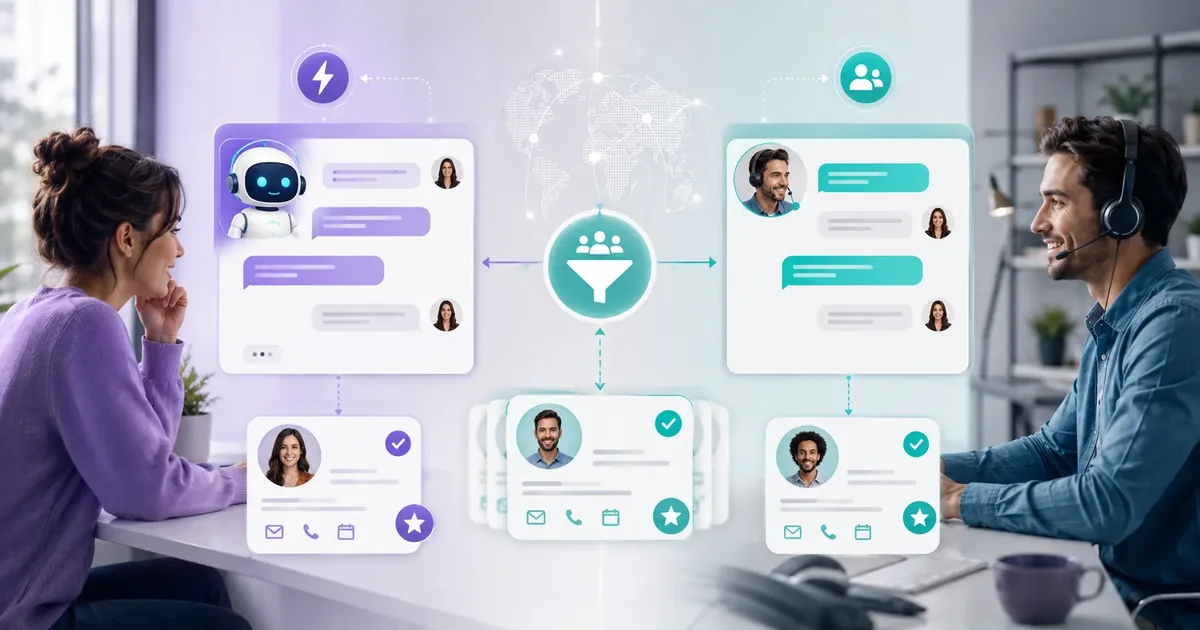
The hybrid approach: Many businesses use an AI chatbot for first-line engagement. The chatbot captures the lead, qualifies them, and sends them to the sales team. For complex support questions, the chatbot can escalate to a human agent.
This gives you the best of both worlds. The chatbot handles the volume, and your team handles the high-value conversations.
What the evidence can and cannot show
There is no single conversion rate that proves an AI chatbot or live chat is better for every website. Results depend on the audience, page intent, offer, traffic source, implementation, definition of a qualified lead, and follow-up process.
Use external studies as context, then test both workflows with the same pages and visitor questions. Compare response time, completed conversations, qualified leads, sales acceptance, appointments, and final outcomes. Read a sample of transcripts so the numbers have an explanation.
Key insight: The right choice is the one that produces useful conversations and reliable follow-up for your business, not the one with the strongest generic benchmark.
Why Zappiq AI fits lead-generation workflows
Zappiq AI is designed for businesses that want automated website lead capture, consistent first responses, and useful context for follow-up. It can answer approved website questions, collect contact details when appropriate, deliver leads by email, support webhook routing on Pro, and show conversation activity in the dashboard.
- After-hours capture: Visitors can ask questions and submit enquiries while the team is offline.
- Consistent qualification: The business can define the questions and information needed for the next step.
- Context in the handoff: The team receives the visitor's details and conversation context instead of a bare form notification.
- Marketing visibility: Supported advertising events and analytics help connect conversations with acquisition activity.
- Clear pricing: Start with a 14-day trial and 100 conversations. Starter is $9/month billed annually for 350 conversations; Growth is $39/month month-to-month or $27/month billed annually for 1,500; Pro is $99/month month-to-month or $69/month billed annually for 5,000.
It is not a replacement for a CRM, a staffed support team, or human judgment in complex conversations. For measurement guidance, see the chatbot analytics metrics guide.
Ready to capture more leads with an AI chatbot?
Start with 100 free conversations and test the complete lead handoff before choosing a paid plan.
Start Free Trial100 free conversations | Cancel anytime
The choice matters less than what happens before a lead reaches your team. This AI lead qualification chatbot guide explains how to make that handoff more useful.
The lead-generation workflow that actually converts
Answer-first workflow: greet the visitor, answer the immediate question, identify intent and fit, ask only the qualification questions you need, and deliver the contact details with the full conversation context. This keeps the experience useful before the visitor is asked to share information.
Start with service, location, urgency, budget or timeline, and the preferred next step. Connect those answers to an owner and a response-time promise. The AI lead qualification chatbot guide explains how to turn those answers into a repeatable flow, while automated lead qualification covers routing and follow-up.
After launch, review qualified-lead rate, sales acceptance, response time, and appointment outcomes—not just chat volume. Use the chatbot performance metrics guide to create a monthly review loop.
Frequently asked questions
It depends on the workflow. An AI chatbot is often useful for instant first responses, after-hours capture, and consistent qualification. Live chat can be better for nuanced questions and human reassurance. Compare qualified outcomes in your own visitor journey.
An AI chatbot automates the first conversation using approved content and rules. Live chat connects the visitor with a person. The key differences are availability, response workflow, capacity, handoff, and the type of questions each can handle well.
An AI chatbot can answer approved questions immediately. Live chat response time depends on whether an agent is available and how many conversations are already in the queue. Make the expected response clear in either setup.
An AI chatbot can apply the same questions and routing rules consistently. A live agent can understand unusual context and adapt the conversation more naturally. The better option depends on whether consistency or human judgment is the main requirement.
It can cover the first response and many repeatable enquiries, but it should not replace human help for sensitive issues, complex support, complaints, or conversations that need judgment. A clear human handoff is part of a reliable chatbot workflow.
A hybrid setup can work well when the chatbot answers common questions, captures context, and notifies or routes the team when a visitor needs a person. Define who receives the handoff and how quickly they respond before launching it.
Costs vary by provider and staffing model. Zappiq AI offers a 14-day trial with 100 conversations. Starter is $9/month billed annually for 350 conversations; Growth is $39/month month-to-month or $27/month billed annually for 1,500; Pro is $99/month month-to-month or $69/month billed annually for 5,000. Live chat also includes agent coverage, scheduling, training, and management time, so compare the whole workflow.
An AI chatbot may fit a small business that needs after-hours capture or cannot staff every conversation. Live chat may fit when a team is already available and human interaction is central. Start with the problem to solve, not the product category.
Zappiq AI can preserve the enquiry and deliver the lead and conversation context by email, with supported webhook routing on Pro. The business can use that handoff to assign a response or callback according to its own process.
Use the same pages, traffic sources, questions, qualification criteria, and follow-up process. Compare response time, completed conversations, qualified leads, sales acceptance, appointments, and final outcomes. Review transcripts instead of relying on lead volume alone.
Track qualified leads, response and follow-up time, unanswered questions, appointments, and final outcomes. Use the chatbot analytics metrics guide to build a consistent review process.
The chatbot should acknowledge the limit and create a human handoff. A live agent should explain what they can confirm and route the visitor to the right person or resource. Neither option should invent a confident answer.
The bottom line
AI chatbots and live chat solve different parts of the lead-generation problem. A chatbot can provide consistent first responses, collect context, and cover after-hours enquiries. Live chat can provide human judgment and reassurance when the request is complex.
Test the visitor journey with the same questions and follow-up process, then compare qualified outcomes rather than generic claims about conversion rates or cost.
Zappiq AI is a focused option for businesses that want automated website lead capture with email delivery, conversation context, analytics, supported ad tracking, and a clear path to human follow-up.
Try Zappiq AI free for 14 days
Build your AI chatbot, test the lead handoff, and start with 100 free conversations.
Get Started Free100 conversations included | Cancel anytime
References
- HubSpot. "Live Chat Pricing: How Much Does It Cost in 2025?" blog.hubspot.com/service/live-chat-pricing.↩
- Drift. "The State of Conversational Marketing Report." drift.com/state-of-conversational-marketing.↩
- Kayako. "Live Chat Statistics: The Definitive Collection." kayako.com/live-chat-statistics.↩
- Conferbot. "Chatbot vs Live Chat vs Contact Form: 2026 Data Comparison." conferbot.com/blog/chatbot-vs-live-chat-vs-form.↩
- Conferbot. "Chatbot vs Forms: Which Gets More Leads? 2026." conferbot.com/blog/chatbot-vs-forms.↩
- Ruler Analytics. "Average Form Conversion Rate Benchmark Report." ruleranalytics.com.↩
- Tidio. "Live Chat vs Chatbot: Which One Should You Choose?" tidio.com/blog/live-chat-vs-chatbot.↩

Ansar Ali
Ansar Ali is the founder of Zappiq AI, a lead-capture platform built for small businesses that cannot afford to lose high-intent website visitors after hours. He writes from hands-on experience building chatbot flows, attribution, and follow-up systems for local and online service teams, focusing on the practical details that turn conversations into qualified enquiries.