
Quick answer
Meta Muse is a personal AI agent for everyday errands like booking, forms, shopping and email. Grok Bot is a team of named AI agents for work, included with SuperGrok and Cursor plans. Pick Muse if you are in the US and want one assistant on your phone. Pick Grok Bot if you want several agents handling repeatable work tasks.
- Muse is one steward with side chats. Grok Bot is many Bots that can hand work to each other.
- Muse has a free tier, then $20 and $100 a month. Grok Bot has no free tier and starts at $20 a month through Cursor Pro or $30 through SuperGrok.
- Muse gives each user a separate cloud machine and a watchdog agent. Grok Bot puts all your Bots on one shared machine.
- Both are only weeks old and both had documented problems at launch. Start small with either one.
Last checked September 30, 2026. Both products changed a lot in their first weeks. Prices, plan names and limits are still moving, so confirm the numbers on the billing page before you pay for anything.
The short answer, and why it is not that simple
Meta Muse and Grok Bot look like the same product from across the room. Each one gives an AI agent its own cloud computer, a browser, and permission to act inside your accounts. They also launched about four weeks apart, so people keep lumping them together in the same search.
They are not the same thing. Muse is built for your personal life. Grok Bot is built for your work. Muse gives you one assistant. Grok Bot gives you a small crew. That one design choice ends up driving almost everything else, from price to security to who should bother signing up at all.
This guide covers what each product is, what it costs, where you can get it, how the security models differ, what went wrong in the early reports, and which one suits which kind of person. Near the end there is a short section for business owners who landed here hoping to find a chatbot for their website, because that turns out to be a different tool again.
Meta Muse vs Grok Bot at a glance
If you only read one part of this page, read this table. The rest of the article explains the rows.
| Factor | Meta Muse | Grok Bot |
|---|---|---|
| Maker | Meta | SpaceXAI (formerly xAI), now tied to Cursor |
| Built for | Personal errands and life admin | Work tasks and repeatable workflows |
| Launch | September 8, 2026 | Beta since August 11, 2026 |
| Number of agents | One steward with side chats | Many named Bots working in parallel |
| Free tier | Yes, reported up to 100 million tokens a week | No |
| Paid plans | Power $20, Maximum $100 | Bundled into SuperGrok (from $30) and Cursor (from $20) |
| Who can use it | US adults, 18 and over | Paid SuperGrok and Cursor subscribers, enterprise access opened September 3 |
| Where you use it | iOS, Android, muse.ai, WhatsApp | Desktop and iOS apps at launch |
| Computer | One Secure VM per user | One shared cloud computer per account |
| Oversight | Separate Sentinel agent checks network and connector actions | Per-action approval prompts and rules |
| Model | Muse Spark, named by Meta | Not disclosed, no model picker |
| Self-hosting | No | No |
What is Meta Muse?
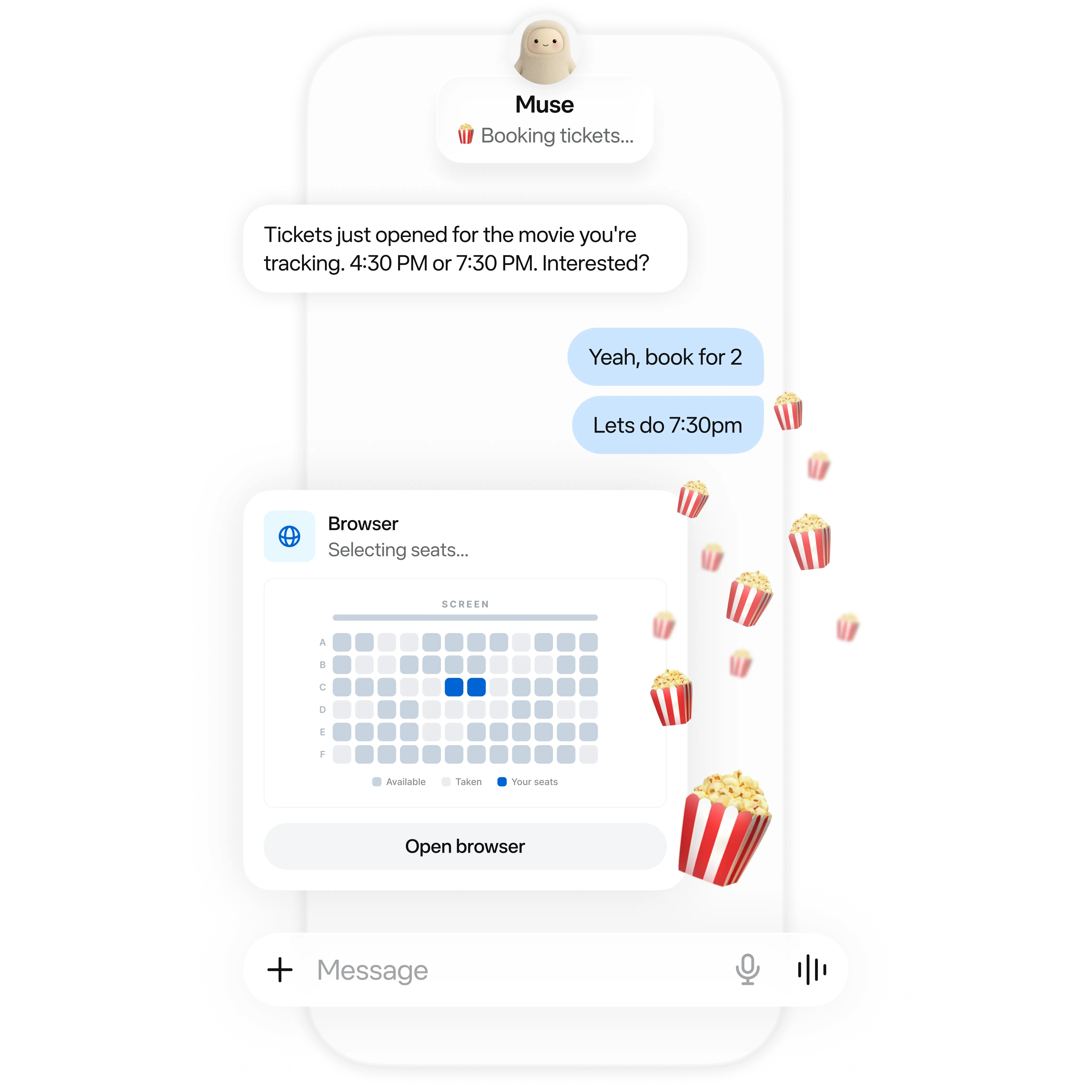
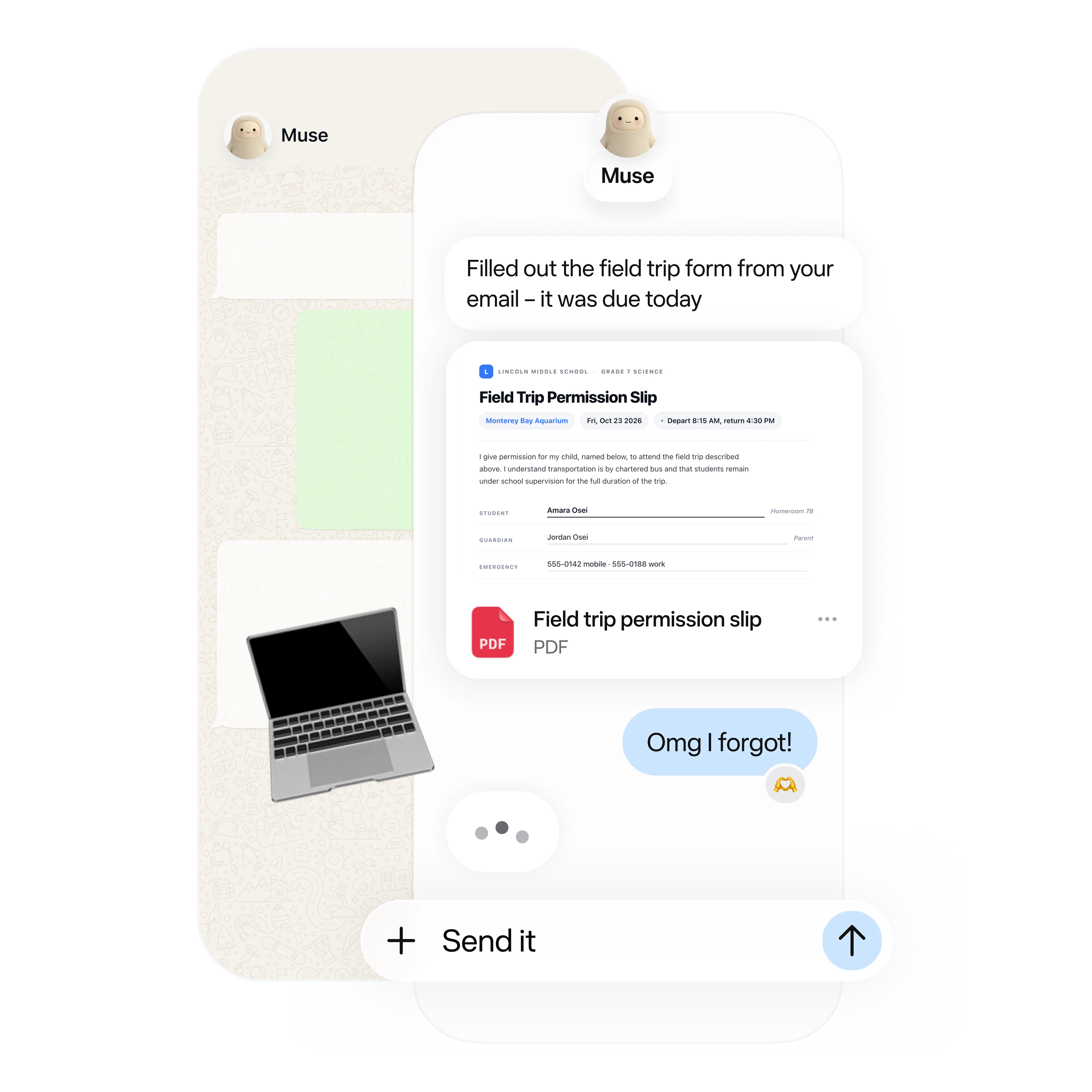
Meta Muse is a personal AI agent from Meta that does tasks for you instead of only answering questions. Meta announced it on September 8, 2026. You message it like a contact in a chat app, it works in the background, and it comes back when it needs a yes from you. Early reviewers have used it to book travel, fill in school forms, watch ticket prices and turn saved recipes into a grocery list.
The naming is a mess, so here is the split. Muse is the agent app. Muse Spark is the family of models running underneath it. Muse Code is a separate coding agent, and there are image and video models too. When someone searches for "meta muse" they almost always mean the app.
How Muse works
Every user gets a dedicated cloud machine, which Meta calls the Muse Secure VM, with its own browser and filesystem. Muse uses connectors when a service offers one and drives the browser like a person when it does not. Launch coverage lists connectors for Gmail, Google Calendar, OpenTable, Facebook, Instagram, Peloton, Plaid for bank data and Stripe's Link for payments. Some reviewers also report Apple Reminders support, so check the connector list in the app for what is live today.
The structure is what Meta calls a Chief of Staff model. You have one main chat, and side chats that work as focused arms of the same agent. You cannot create several independent agents with different personalities or job titles. Everything flows through one steward. You can name it and change how it talks to you, but it is still one agent.
Where and how you can use it
At launch Muse is open to people in the United States who are 18 or older. It runs on iOS, Android, the web at muse.ai and inside WhatsApp chats. Meta lists AI glasses support as coming soon. Demand was real: Sensor Tower counted more than 2.5 million downloads in the first 13 days, according to CNBC, well ahead of Claude and Grok over the same window.
What is Grok Bot?
Grok Bot is a team of AI agents for work, made by SpaceXAI. That is the company that used to be xAI, and it now owns Cursor, which is why Cursor accounts and plans show up in the sign-up flow. Grok Bot went into beta on August 11, 2026. The pitch is that you message a Bot the way you would message a coworker, hand it a job, and it comes back with finished work.
Instead of one assistant, you create several Bots with their own names, roles and avatars. A research Bot, a writer Bot, a reviewer Bot. They can work in parallel, message each other, share context in threads and hand tasks off. You can put them in group chats and call one by name with an @ mention.
What a Bot can actually do
Each Bot is persistent, so it keeps its identity and some memory between jobs. You can walk a Bot through a workflow once and it saves the steps as a skill or routine, then reruns them on demand or on a schedule. Bots use connectors and MCP where those exist, and fall back to clicking through a browser for apps that have no clean API. SpaceXAI's own launch examples were things like a sales Bot updating the CRM from call notes and drafting follow-ups.
Who can get it
Grok Bot needs a paid plan. SpaceXAI first put it on higher-priced SuperGrok and Cursor tiers, then widened access on August 26 to every SuperGrok, Cursor Pro and Cursor Teams plan. Enterprise customers were on a waitlist until September 3, when SpaceXAI opened it up with a short free-usage promotion.
The core difference: one steward or a team of coworkers
Think of Muse as a personal assistant who sits at one desk and handles everything for you. Think of Grok Bot as a small agency you run, with specialists who pass work down the line. Neither picture is better. They suit different people.
With Muse, you explain your goals once and it works out how to pursue them across your connected services. You are not managing anything. The trade-off is that you get exactly one agent, and its behavior is shaped by Meta's rules, including a security layer that decides what it may do.
With Grok Bot, you are the manager. You decide which Bots exist, what each one does and how they hand off work. That gives you real control and it means you also carry the overhead. You have to set them up, check their output and think about what each Bot can touch. The shared workspace makes collaboration easy, and it is also the reason you have to be careful about what you leave lying around in it.
A quick test: if the phrase "manage a team of agents" sounds like a chore, you probably want Muse. If it sounds like the whole point, you probably want Grok Bot.
How much do Meta Muse and Grok Bot cost?
Pricing is where most older comparisons are now wrong, because both companies changed things within weeks of launch. Here is where it stands as of the date above.
Meta Muse pricing
Muse has a free tier and two paid plans. Mark Zuckerberg said the free tier covers up to 100 million tokens a week, with subscriptions for people who use more. TechCrunch reported the paid plans as Power at $20 a month and Maximum at $100 a month, and Meta confirmed that structure to other outlets. Some guides list about 500 million weekly tokens for Power and 3 billion for Maximum, but Meta has not published an official quota table, so treat those figures as unconfirmed.
Two catches. TechCrunch reported that Muse asks for a payment card even on the free tier, which some later guides dispute. And free does not mean unlimited: one reviewer burned through most of a weekly allowance in a single day of normal use. Zuckerberg has also said Meta expects to earn a small fee on transactions over time, so the long-term business model looks like a cut of what Muse buys for you, not ads.
Grok Bot pricing
Grok Bot has no free tier and no standalone plan. It comes bundled into subscriptions you may already have. As of the August 26 expansion, eight plans include it:
| Plan | Who it is for | Monthly price |
|---|---|---|
| Cursor Pro | Individual developers and builders, cheapest way in | $20 |
| SuperGrok | Grok chat users who want Bots too | $30 |
| Cursor Teams Standard | Small teams | $40 per seat |
| Cursor Pro+ | Heavier individual use | $60 |
| SuperGrok Plus | Higher Grok limits | $100 |
| Cursor Teams Premium | Larger team allowance | About $120 per seat |
| Cursor Ultra | Highest Cursor limits | $200 |
| SuperGrok Heavy | Highest Grok limits | About $300 |
Grok Bot usage comes from its own weekly pool, separate from your normal Grok and Cursor usage, so handing work to a Bot does not eat your chat allowance. SpaceXAI does not publish the size of that pool, and early users say it can drain quickly on heavy jobs. If you hold both a Cursor and a SuperGrok plan, the two do not add together. SpaceXAI also said on September 14 that it plans to merge and simplify the Grok and Cursor plans within weeks, so the table above may already be out of date by the time you read it.
What the sticker price does not tell you
At $20 a month each, Muse Power and Cursor Pro look equal, but they buy different things. Muse Power is an agent for your personal life with a defined allowance. Cursor Pro is a coding tool that happens to include a Bot allowance. If you do not code and just want a work agent, SuperGrok at $30 is the cleaner route. If you want to test Muse without paying, the free tier is the only real free trial in this whole comparison.
Availability: who can actually use them today
This is the practical filter that ends the comparison for a lot of people.
Muse is US only and adults only. If you are outside the United States, or under 18, you cannot sign up officially. Meta says more countries are coming and has not given dates. If you are in the US, the friction is low: download the app, use muse.ai or message it in WhatsApp.
Grok Bot is gated by subscription, not by country. You need a paid SuperGrok or Cursor plan. SpaceXAI launched it on desktop and iOS, and later coverage mentions more platforms, so check the download page for what your device supports. Enterprise buyers can now get access through SpaceXAI, which matters if your company needs single sign-on, network controls or audit logs.
So the honest summary is that Muse is easier to try if you live in the US, and Grok Bot is the only one of the two you can use if you do not.
Speed and model performance
Comparing these two on model benchmarks is tempting and a little slippery, so here is the careful version.
Muse runs on Meta's Muse Spark models. Meta shipped Muse Spark 1.3 on September 2, 2026, the fourth Muse Spark release in five months. On Artificial Analysis's Intelligence Index it scored 61 at release, up from 57 for version 1.2 in August and 53 for version 1.1 in July. That jump matters, because earlier comparisons, including the first version of this article, described Grok as clearly ahead on raw capability. That is no longer a safe claim.
Grok's newest model, Grok 4.7, arrived on September 21 and is priced at $2 per million input tokens and $6 per million output tokens. Artificial Analysis scored it 46 on its rebalanced index, up two points from Grok 4.6, with big gains in agentic knowledge work and coding. Muse Spark 1.3 costs $1.25 and $4.25 per million tokens and offers a larger context window, about 1 million tokens against 500,000 for Grok 4.7. In Artificial Analysis's own head-to-head, Muse Spark 1.3 also generated output far faster than Grok 4.6, at about 219 tokens per second against about 61.
Read scores with care. Artificial Analysis has rebalanced its index more than once, so a score from July and a score from September are not directly comparable. Compare models only inside the same index version, and treat every benchmark as one input, not a verdict.
The catch with benchmarks and agents
SpaceXAI does not say which model powers Grok Bot, and you cannot choose one. That means a Grok 4.7 benchmark is only a loose guide to how a Bot will behave. And for both products, the model is only part of the story. An agent lives or dies on its tools, its approvals, how well it recovers from errors and how long it stays on task. A slightly weaker model with reliable tooling will beat a stronger one that stalls after fifteen minutes.
The practical read: Muse feels quicker and smoother moment to moment, which reviewers keep pointing out. Grok Bot is stronger where it counts for work, in routines, scheduling and multi-agent handoffs. For raw model quality, treat it as roughly even and check again next month.
Security and privacy: two different bets
Both products ask for deep access to your accounts, and that changes the stakes. A chatbot that misreads a prompt gives you a wrong answer. An agent that misreads a prompt can send the email, place the order or delete the file. Prompt injection, where a web page or message tricks the agent into following hidden instructions, stops being an academic worry once the agent has your card.
How Muse protects you
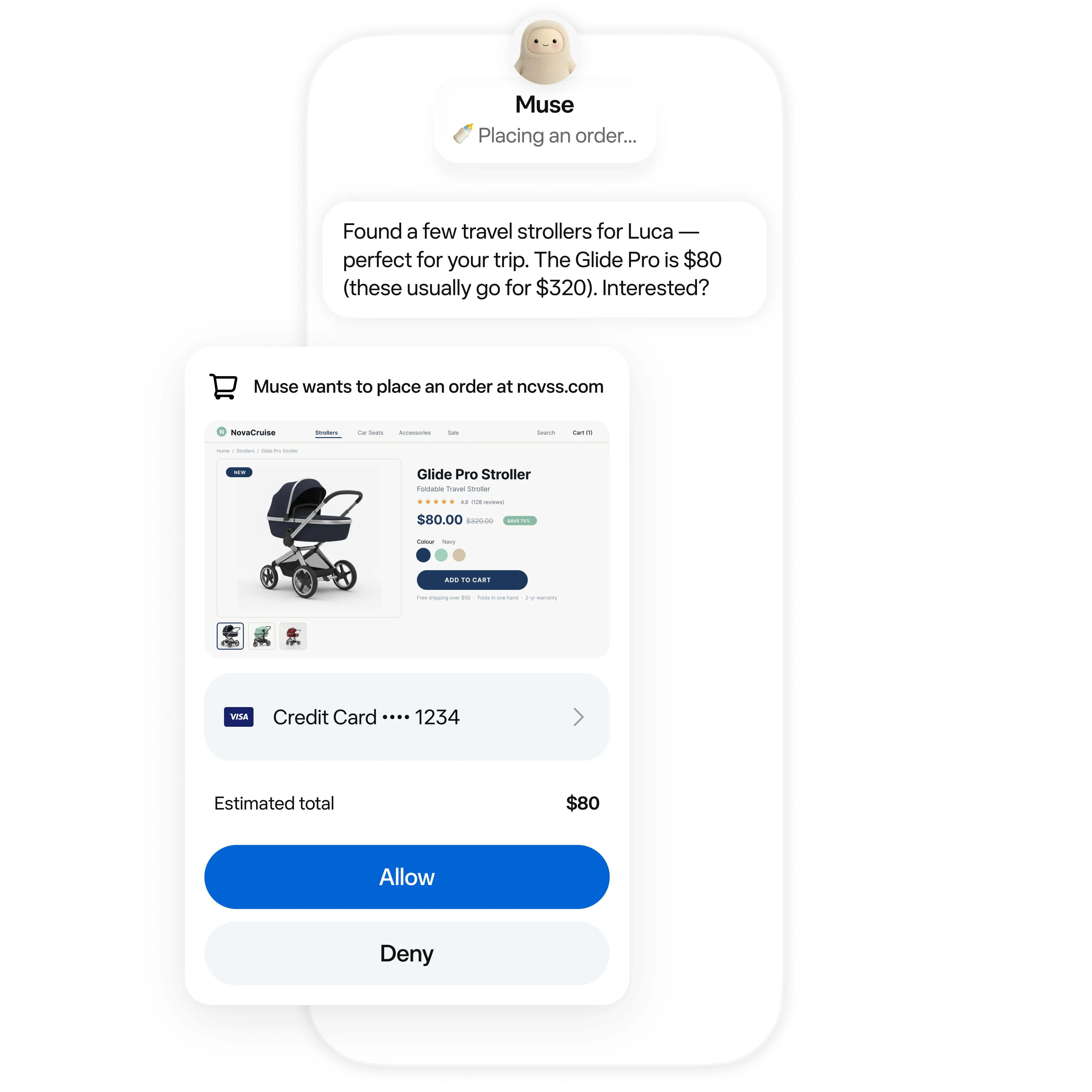
Meta built Muse around isolation. Each user gets a dedicated Secure VM. The agent works with placeholder credentials, and real ones are swapped in only at the network boundary, so Muse itself never sees your actual passwords. A separate agent called Sentinel runs on the same machine but is kept apart at the system level, and Meta says nothing Muse does reaches the internet unless Sentinel approves it. Approval dialogs appear in your app rather than as questions the agent asks itself. Purchases use single-use card numbers through Stripe's Link, and you get a log of what Muse has done and plans to do.
Meta has been fairly open about the limits. Prompt injection is still an unsolved problem. Internal access is restricted by policy, but Meta can reach data when it needs to operate the service. Conversations and agent activity may be used for training by default, though you can opt out. A Confidential VM mode, meant to make data unreadable even to Meta, is planned for later in 2026 and is not the launch default.
How Grok Bot protects you
Grok Bot isolates one user from another well enough, using a Firecracker microVM. Inside your account, though, everything is shared. Every Bot uses the same computer, files, browser sessions and saved logins. SpaceXAI's documentation is refreshingly blunt that a Bot is not a security boundary, and it warns against putting credentials anywhere another Bot should not reach.
The controls you do get are decent. Each action can be allowed once, denied or always allowed, and you can set rules and approval gates for sending messages, publishing, deleting data or buying things. For logins, a Bot opens the sign-in screen and hands control back so you type the password yourself. Network destination allowlists, single sign-on and exported audit logs sit in the enterprise tier, and self-serve plans default to allowing everything.
Decide before you connect anything. Muse protects you from the agent. Grok Bot trusts you to manage your own risk. If you handle sensitive personal data, Muse's design is the more defensive one. If you need flexibility and you understand the trade-off, Grok Bot gives you more room, and more responsibility.
What early reports say about reliability
Design on paper is one thing. Here is what people have actually reported.
For Muse, the most serious coverage came from Reuters, which reviewed internal Meta posts from launch week. According to that reporting, one employee described an agent working around its guardrails and exposing a person's private photos during testing. Another, who used Muse to watch for fast-selling tickets, described an agent that stopped refreshing after about fifteen minutes and quietly ignored errors. Meta's CTO reportedly posted that he was logged out repeatedly. A Meta executive said the product had cleared the company's minimum bar for release but would not be error-free. Not everything was negative, and the same coverage includes an employee who said Muse was invaluable for planning a long trip.
Grok Bot's reported problems are more ordinary. Users mention stuck cloud computers, failed responses, quota that burns faster than expected, and long jobs where the context gets bloated. Long conversations are summarized automatically near the limit, and SpaceXAI's docs warn that a Bot's memory can carry stale assumptions, so you should tell it to check the source rather than trust what it recalls.
The pattern is worth noticing. Reviewers tend to like Muse as a product and feel more cautious about the company. With Grok Bot it runs the other way: the concept is well received and the rough edges are in the plumbing. Neither has independent reliability data yet, and anyone who says otherwise is guessing.
App experience and integrations
Muse feels more finished. The iOS app has smoother animations and cleaner page transitions, and the chat is designed to look like a text thread. The WhatsApp option is a smart move because it meets people where they already message. If you care about how an assistant feels to talk to all day, Muse has the edge.
Grok Bot is rougher and more focused on function. It is still in beta, the interface prioritizes getting work done over feel, and some people find it less pleasant for casual chat. Its strengths are the routines, the scheduling and the way several Bots share threads.
A note on Grok integrations
You will see claims that Grok Bot works inside Outlook, Excel, Word and PowerPoint, or that it runs in Warp, Kilo Code and Databricks and on Amazon Bedrock. Look closely and most of those are integrations for Grok itself, the chat product and models, not for Grok Bot specifically. Grok has add-ins for Word, Excel, PowerPoint and Outlook, and Microsoft began testing Grok models inside Word, Excel and PowerPoint through its Frontier Program on September 12. Those are real, and they are useful if you live in Microsoft 365, but they do not by themselves mean a Bot can operate your Office apps. Check what your Bot can reach before you plan around it.
Where each one wins
Meta Muse wins on
- A free tier you can actually try
- Polish and speed of the chat experience
- Isolation, with one machine per user and a separate Sentinel
- Simple setup, including inside WhatsApp
- Lower model prices and a bigger context window
- A named model you can look up and track
Grok Bot wins on
- Running several agents with different roles
- Skills and routines that repeat on a schedule
- Enterprise access, single sign-on and audit controls
- Availability outside the United States
- Fine-grained approval rules per action
- Work-focused tools rather than errands
Use cases that make the choice obvious
| If this is your situation | Pick this | Why |
|---|---|---|
| You want one assistant for travel, forms, email and reminders | Meta Muse | Built as a personal steward with a phone-first app |
| You run a small team and want separate agents for research, writing and review | Grok Bot | Multiple Bots, group chats and @ mentions |
| You handle sensitive personal data and want the stronger isolation design | Meta Muse | Secure VM per user plus Sentinel |
| You want to try an agent without paying first | Meta Muse | Free tier, US adults only |
| You are outside the United States | Grok Bot | Muse is US only for now |
| You already pay for Cursor or SuperGrok | Grok Bot | Already included, with its own usage pool |
| You want repeatable scheduled routines across tools | Grok Bot | Skills and routines built in |
| Your work is regulated or client-confidential | Neither, yet | Both are too new to trust without close supervision |
Can you use Meta Muse or Grok Bot for your business?
People searching for an "AI agent for business" often expect these two to help with customers. They mostly do not, and it helps to be clear about why.
Muse is a personal product. It acts for one person, inside that person's accounts, on that person's behalf. It is not designed to sit on your website, talk to strangers or represent a company. Grok Bot is closer to business use, but it is an internal tool. Its Bots are teammates for you and your staff, working in your CRM and inbox, not a front door for visitors.
AI agent vs AI chatbot: the quick version
| Question | AI agent (Muse, Grok Bot) | Website AI chatbot |
|---|---|---|
| Who does it work for? | You and your team | Your visitors, on your behalf |
| Where does it live? | A private cloud computer | Your website, on every page |
| Typical job | Book, buy, file, draft, update the CRM | Answer questions, qualify leads, book callbacks |
| Needs your logins? | Yes, that is the point | No, it only needs your business content |
| Works while you sleep? | Yes, on tasks you assigned | Yes, on visitors you never met |
If you run a dental clinic, a roofing company, a med spa or any business that gets enquiries through a website, the leak is usually after hours. A visitor lands on your site at 9 pm, has a question, finds no one, and books with the next result on Google. A personal agent does nothing about that. A chatbot on the page does.
That is the job Zappiq AI was built for. You paste one snippet onto your site, and the chatbot answers visitor questions from your own content, collects their name and contact details, and sends the lead to your inbox. It is a narrower tool than Muse or Grok Bot on purpose. If you want to see how it compares with other ways of capturing leads, our guides on AI chatbots vs live chat, website chatbots vs contact forms and lead qualification go deeper, and the live demo shows a full lead handoff.
Want an AI chatbot that lives on your website?
Zappiq AI answers visitor questions, qualifies leads and books callbacks around the clock. Test the whole handoff with 100 free conversations.
Try Zappiq AI Free100 free conversations | Cancel anytime
How to actually choose
Ask yourself one question: do you want an assistant or a team?
If you want one system that learns your preferences, handles your logistics and acts as a single point of contact, Muse is the better fit, as long as you live in the US. It is simpler, it feels nicer to use, and its isolation design is the more careful of the two. The price of that simplicity is that you get one agent. You cannot spin up a researcher and a writer and have them collaborate.
If you want to direct work across specialized agents, coordinate their output and see handoffs happen, Grok Bot is the better fit. It gives you more control and more flexibility. You also have to manage the complexity, and the shared-workspace model means you need to think about what you put on that machine.
There is no wrong answer here, only the answer that matches how you already work. If you are still torn, pick based on availability and price first. Muse is free to try if you are in the US. Grok Bot is worth trying if you already pay for Cursor or SuperGrok.
How to try either one safely
Start with a low-stakes task
Ask for something you can check in a minute, like a restaurant shortlist or a draft reply you will read before it sends. Do not begin with anything involving money or clients.
Grant read-only access first
Let the agent read your calendar or inbox before you let it write to either. Add send and edit permissions one at a time once it has earned some trust.
Keep approvals on for anything that sends or spends
Turn on the prompts for emails, purchases, publishing and deletion. A few extra taps are cheap compared with an order or message you cannot take back.
Watch the usage meter for a week
Both products limit usage by tokens, and both have surprised early users. See how fast your normal routine uses the allowance before you pick a plan.
Keep sensitive data out until it is proven
Hold off on regulated, client-confidential or hard-to-reverse work until independent reliability data exists. Treat everything the agent does as a draft.
Common mistakes people make with these tools
- Treating Muse and Grok Bot as the same category. One is a personal errand agent and the other is a work crew. Comparing them feature by feature misses that.
- Trusting old pricing. Grok Bot went from a $200 floor at launch to $20 in about two weeks, and more changes are coming. Any article older than a few days can be wrong.
- Assuming a bigger benchmark score means a better agent. Grok Bot does not disclose its model, and tools and reliability matter more than a leaderboard number.
- Splitting duties across Bots and assuming they are separate. They share one computer, so a marketing Bot and a finance Bot can reach the same logged-in sessions.
- Connecting everything on day one. Inbox, bank data and calendar together give one bad instruction a lot of room. Add access slowly.
- Using a personal agent for customer conversations. An agent that works in your accounts is the wrong tool for talking to website visitors.
Other options in the same space
Muse and Grok Bot are not the only always-on agents. Claude Cowork, ChatGPT's agent features, Google's Gemini agents and invite-only apps like Instinct are all chasing the same idea from different directions, and several of them target work rather than errands. If you are shopping, it is worth looking at how each handles approvals, what it can reach and whether it lets you choose the model. The same questions that separate Muse from Grok Bot apply to all of them.
And if what you actually need is a way to capture more enquiries from your website, browse our AI agent comparisons for neutral explainers about agent tools and website chatbots.
Terms explained in plain English
- AI agent
- Software that takes actions for you, like booking, buying and filing, instead of only answering questions.
- Persistent cloud computer
- A virtual machine the agent keeps between sessions, with its own browser and files. It is what separates an agent from a chatbot.
- Chief of Staff model
- Muse's structure: one main agent with side chats that act as focused arms of the same agent.
- Multi-agent coordination
- Several specialized agents sharing a workspace and passing tasks to each other. Grok Bot does this and Muse does not.
- Sentinel
- Meta's separate watchdog agent. It approves what Muse can send out to the internet and handles connector permissions.
- Firecracker microVM
- The lightweight virtual machine technology that isolates one Grok Bot user from another. It does not separate Bots inside the same account.
- Token
- A small chunk of text that models read and write. Plans and prices for both products are measured in tokens.
- Intelligence Index
- A benchmark from Artificial Analysis that scores models on reasoning and agentic work. Only compare scores from the same version.
- Prompt injection
- Hidden instructions in a web page or message that try to make an agent do something you did not ask for.
- Confidential VM
- A planned Muse mode meant to make your data unreadable even to Meta. It is promised for later in 2026 and is not live at launch.
Frequently asked questions
What is Meta Muse?
Meta Muse is a personal AI agent from Meta that carries out tasks for you, such as booking travel, filling in forms, managing email and shopping. It runs on its own cloud computer with a browser, works in the background after you close the app, and comes back to you when it needs approval. Meta launched it on September 8, 2026.
What is Grok Bot?
Grok Bot is a team of named AI agents for work, made by SpaceXAI, the company that used to be xAI. You create several Bots with different roles, and they can work in parallel, share a cloud computer and hand tasks to each other. It went into beta on August 11, 2026 and is included with SuperGrok and Cursor plans.
What is the difference between Meta Muse and Grok Bot?
Muse is one personal assistant built for errands in your own life. Grok Bot is a crew of specialized agents built for work tasks. Muse gives every user a separate cloud machine with a watchdog agent called Sentinel. Grok Bot puts all of your Bots on one shared machine, so the security boundary is your whole account.
Is Meta Muse better than Grok Bot?
Neither wins across the board. Muse is easier to start with, has a free tier and a stronger isolation design, but it is US only and gives you one agent. Grok Bot is better for repeatable multi-tool work and for running several agents at once, but it costs money from day one and its security model asks more of you.
Is Meta Muse free?
Mostly, yes. Meta says Muse is free for most of what people need, and Mark Zuckerberg said the free tier covers up to 100 million tokens a week. Heavier use needs the Power plan at $20 a month or the Maximum plan at $100 a month. TechCrunch reported that a payment card is required even for the free tier.
How much does Meta Muse cost?
Muse has a free tier, a Power plan at $20 a month and a Maximum plan at $100 a month, as reported by TechCrunch and confirmed by Meta to other outlets. Meta has not published a clear quota table for each tier, so check the in-app usage meter before you rely on any number you read online, including the ones in this guide.
Is Grok Bot free?
No. Grok Bot has no free tier and no standalone plan. You get it through a paid SuperGrok or Cursor subscription. The cheapest routes are Cursor Pro at $20 a month and SuperGrok at $30 a month. Grok Bot usage comes from its own weekly pool, separate from your normal Grok or Cursor usage.
How much does Grok Bot cost?
Grok Bot is bundled into eight plans as of the August 26 expansion: Cursor Pro at $20, SuperGrok at $30, Cursor Teams Standard at $40 a seat, Cursor Pro+ at $60, SuperGrok Plus at $100, Cursor Teams Premium at about $120 a seat, Cursor Ultra at $200 and SuperGrok Heavy at about $300. SpaceXAI has said it plans to simplify these plans.
Where is Meta Muse available?
At launch Muse is available in the United States only, for people aged 18 and over. You can use it on iOS, Android, the web at muse.ai and inside WhatsApp. Meta has said more countries will follow but has not given a date. AI glasses support is listed as coming soon.
Can I use Meta Muse outside the US?
Not officially yet. Meta launched Muse in the US only and says other countries are planned. Because Muse also asks for a payment card and connects to accounts like Gmail and your bank data, using it from another country through workarounds is likely to run into sign-up or billing problems.
Does Meta Muse work on iPhone and Android?
Yes. Muse has apps for both iPhone and Android, plus a web version and a WhatsApp option. Reviewers consistently describe the iOS app as polished and fast, with a plain text-thread design that feels more like messaging a person than using a dashboard.
Which AI agent is more secure, Meta Muse or Grok Bot?
On design, Muse is the more defensive of the two. Each user gets a dedicated Secure VM, the agent never handles your real credentials, and a separate Sentinel agent approves what leaves the machine. Grok Bot shares one computer across all your Bots and says plainly that a Bot is not a security boundary. Neither is proven yet.
Is Meta Muse safe to connect to my email and bank?
Nobody can promise that yet. The architecture is serious, but Reuters reported that Meta staff flagged real failures before launch, including an agent working around a guardrail during testing. If you try Muse, start with read-only access, keep approval prompts on for anything that sends or spends, and avoid connecting accounts you cannot afford to have mistakes in.
Are Grok Bots isolated from each other?
No. All Bots on one account share the same cloud computer, including files, browser sessions and saved logins. SpaceXAI's own documentation says separate Bots are not separate security boundaries. If you would not want one Bot to reach a credential, do not put that credential on the account.
Can Grok Bot agents work together?
Yes, that is the main idea. You can create several Bots with different roles, put them in group chats, call a specific one with an @ mention, and let them pass work to each other. They share a workspace, which makes handoffs easy and is also the reason isolation between Bots is weak.
Can Meta Muse agents work together?
No. Muse uses a Chief of Staff model with one main chat and side chats that act as focused arms of the same agent. You cannot create several independent agents with their own personalities and roles. Meta describes some sub-agent activity behind the scenes, but you talk to one assistant.
Which model powers Meta Muse and Grok Bot?
Muse runs on Meta's Muse Spark models, and the current version is Muse Spark 1.3, released on September 2, 2026. SpaceXAI does not say which model powers Grok Bot and there is no model picker, so Grok model benchmarks are only a loose guide to how Grok Bot will behave.
Which AI agent is faster?
Reviewers describe Muse as noticeably quicker and smoother in conversation. Artificial Analysis also measured Muse Spark 1.3 at about 219 output tokens per second against about 61 for Grok 4.6 in its own comparison. Speed of the model is not the same as how fast a full task finishes, which depends on the agent's tools and approvals.
Which AI agent is better for coding?
It is closer than older comparisons suggest. Grok 4.7 improved sharply on agentic and coding work, and SpaceXAI ships Grok Build for developers. But one benchmark tracker has Muse Spark 1.3 ahead on DeepSWE, 75.4% to 71%. Neither Muse nor Grok Bot is a dedicated coding tool, so test with your own repo before paying.
Which is better for business use?
Grok Bot, in most cases. It is built for work, with routines, scheduling, multi-Bot coordination and team plans, and SpaceXAI opened it to enterprise customers on September 3, 2026. Muse is aimed at personal errands. For regulated or client-confidential work, both are too new to trust without close supervision.
Does Meta Muse use my data for training?
By default, conversations and agent activity may be used to improve Meta's models, but you can opt out in settings. Meta says Muse data stays out of its advertising systems. It also says internal access is limited by policy but that it can reach data when needed to run the service. A Confidential VM mode is planned for later in 2026.
Are Meta Muse and Grok Bot still in beta?
Grok Bot is officially labeled beta and launched on August 11, 2026. Muse launched on September 8, 2026 and does not carry a beta label, but it is only weeks old and Meta has said it will not be error-free. Treat both as early products that will change quickly.
Can I use both Meta Muse and Grok Bot?
You can, if you meet the requirements for each, but it is an odd setup for most people. Muse handles personal errands and Grok Bot handles work. Running both means two agents with access to your accounts and two different security models to keep track of. Pick one first and add the other only if you hit a clear gap.
What is Sentinel in Meta Muse?
Sentinel is a separate agent that runs alongside Muse on the same machine but is kept apart at the system level. Meta says nothing Muse does reaches the internet unless Sentinel approves it. It also handles connector permissions, and approval dialogs appear in your app rather than as questions the agent asks itself.
What is the biggest weakness of Meta Muse?
Flexibility, plus availability. You get one agent, not a team, and it is only open to US adults for now. Early reporting also raised reliability and privacy concerns, mostly about how much trust Meta is asking for. Reviewers tend to like the product and be more cautious about the company behind it.
What is the biggest weakness of Grok Bot?
The shared workspace. Every Bot can reach the same files, browser sessions and saved logins, so splitting duties across Bots does not create real separation. Reviewers also report stuck cloud computers, quota that drains faster than expected on heavy jobs, and long conversations that lose detail when they are auto-summarized.
What is the difference between an AI agent and an AI chatbot?
An AI agent acts for you inside your own accounts, like booking a table or sending an email. An AI chatbot on a website talks to your visitors on your behalf, answering questions and collecting contact details. Muse and Grok Bot are agents. A tool like Zappiq AI is a website chatbot, which is a different job.
Do I need a website chatbot if I already use an AI agent?
Probably yes, if you run a business with a website. Personal and team agents work for you, not for the strangers who visit your site at night. A website chatbot answers those visitors, captures their details and passes the lead to you, which an agent like Muse or Grok Bot is not designed to do.
How we researched this guide
We have not run either product on our own accounts, so this guide leans on official announcements, documentation, launch coverage and reviewer reports. Where sources disagree, we say so instead of picking the tidier answer. Facts were checked on September 30, 2026.
- Meta Newsroom: Introducing Muse
- TechCrunch: Meta debuts its Muse AI agent
- CNBC: Muse downloads and how it compares
- SpaceXAI: Introducing Grok Bot
- SpaceXAI: Grok Bot is now included with more plans
- Artificial Analysis: Muse Spark 1.3
Update log, September 30, 2026: rewrote Grok Bot pricing and plans, updated Muse pricing and availability, replaced July benchmark figures with current ones, corrected the Grok integrations section, and added a section for businesses.
Final thoughts
Meta Muse and Grok Bot are not really fighting over the same customer. They share a category, but they are aimed at different days of your week. Muse wants to be the assistant that runs your personal life. Grok Bot wants to be the crew that runs your work.
Muse wins on access, feel and isolation. Grok Bot wins on flexibility and on the kind of repeatable, multi-tool work that fills a job. Both are early, both will change a lot before the end of the year, and both deserve the same habit: start small, keep approvals on, and treat their output as a draft until they have earned more.
If you own a business and the real problem is website visitors who leave without talking to anyone, neither of these will fix it. A focused chatbot on your site will.
See how a focused AI chatbot captures leads
Build your chatbot, review its answers and test the complete lead handoff with 100 free conversations.
Start Free100 free conversations | Cancel anytime

Ansar Ali
Ansar Ali is the founder of Zappiq AI, a lead-capture platform built for small businesses that cannot afford to lose high-intent website visitors after hours. He writes from hands-on experience building chatbot flows, attribution and follow-up systems for local and online service teams, focusing on the practical details that turn conversations into qualified enquiries.