
Quick Summary
- Retell AI pricing is modular: voice infra at $0.055 per minute, TTS from $0.015, LLM from $0.003 to $0.160, and telephony at $0.015. A basic setup lands around $0.07 to $0.09 per minute [citation:11].
- Retell includes HIPAA, SOC 2 Type 1 and 2, and GDPR on standard plans with a self-serve BAA. Vapi charges around $1,000 per month for HIPAA [citation:20].
- Retell does not offer self-hosting. If on-premises deployment is a requirement, Dograh is the open source alternative that runs with one Docker command [citation:1].
- Vapi is the developer favorite for a true bring-your-own-LLM setup at $0.05 per minute for orchestration. Synthflow and Bland are stronger for no-code visual building [citation:3][citation:19].
- Zappiq AI is not a voice AI replacement. It handles the website lead capture that voice agents do not cover, with flat conversation pricing.
What Retell AI Costs in 2026, Component by Component
Retell AI bills every component separately. Voice infrastructure is $0.055 per minute, standard text-to-speech starts at $0.015 per minute, LLM costs range from $0.003 to $0.160 per minute depending on the model, and US telephony adds $0.015 per minute. A basic setup with a mid-range model lands around $0.07 to $0.09 per minute, while a complex configuration with a premium LLM and ElevenLabs voices reaches $0.31 per minute [citation:11][citation:16].
Retell has built a strong position in the voice AI market by being the managed platform that ships compliance without an upcharge. HIPAA, SOC 2 Type 1 and 2, and GDPR are included on standard plans with a self-serve BAA. That is a real differentiator against Vapi, which charges around $1,000 per month for HIPAA [citation:20].
The pricing model is modular, which cuts both ways. You control exactly what each call costs by choosing the LLM and voice model. But you also have to model the bill across four or five line items before you know what a month will cost. The $0.07 per minute floor is the voice infrastructure plus standard TTS, not what most production setups actually pay.
| Component | Price per minute | Notes |
|---|---|---|
| Voice infrastructure | $0.055 | Required for every agent |
| Text-to-speech (standard) | $0.015 | Retell, Minimax, Cartesia, OpenAI voices |
| Text-to-speech (ElevenLabs) | $0.040 | Premium voices |
| LLM (GPT 4.1) | $0.045 | Recommended mid-range option |
| LLM (GPT 5 nano) | $0.003 | Cheapest option |
| LLM (GPT 5.4 Fast) | $0.160 | Premium tier |
| Telephony (US) | $0.015 | SIP trunking is free |
| Phone numbers | $2.00/month | Or bring your own at no charge |
| Knowledge base | $0.005/min + $8/mo | First 10 free |
Two details sit outside that table. The first is concurrency. Retell includes 20 concurrent calls free, then charges $8 per concurrency per month. For a high-volume operation, that adds up. The second is the free tier: $10 in credits, 10 free knowledge bases, and 20 concurrent calls to start [citation:16].
Check the source before you budget. Retell publishes its full rate card on its pricing page, and rates change.
Why People Look for a Retell AI Alternative
Retell reviews well for latency consistency, compliance, and the breadth of its outbound tooling. The complaints that come up are mostly about control, cost predictability, and what happens when you need something Retell does not offer.
It is closed source with no self-hosting
Retell is proprietary SaaS. There is no self-hosted option, no source code access, and no on-premises deployment. For teams in regulated industries or with data residency requirements, that is a hard stop. Dograh exists specifically to fill that gap: it is open source under BSD 2-Clause and runs with one Docker command [citation:1].
Custom LLM requires a relay
Retell does support a custom LLM, but the mechanism is awkward. You have to host a WebSocket server that speaks Retell's protocol and calls your model behind it. Retell's own documentation recommends against it unless you have a specific reason. Vapi, by contrast, lets you paste any OpenAI-compatible base URL and swap models without a relay [citation:3].
Cost is predictable only after you model it
Retell publishes every component price, which is better than hidden markups. But the total bill depends on which LLM and voice you pick, how many calls you take, and how many concurrent calls you run. The $0.07 per minute headline is the floor, not the average. Teams that pick a premium model and ElevenLabs voices can land at four times that number [citation:16].
Less low-level control than assembling your own stack
Retell manages the full pipeline internally, which is why latency is consistent without tuning. The trade-off is that you cannot swap individual components the way you can on Vapi or a self-hosted stack. If you want to use a specific STT provider or tune the turn-taking logic, Retell does not expose that layer [citation:3].
What 100,000 Minutes a Month Really Costs
For 100,000 minutes a month, Retell lands around $7,000 with a standard setup. Vapi with a bring-your-own stack ranges from $11,500 to $14,000 once you add STT, LLM, and TTS at provider rates. OpenAI Realtime API alone is $15,000 to $25,000. Self-hosted stacks can reach $6,000 to $7,500 plus on-call engineering cost [citation:9].
One scenario, every option: 100,000 minutes per month
Two things shape that table. The first is the crossover point. Under 100,000 minutes a month, Retell's flat rate usually wins on total cost of ownership because the engineering time saved on optimization and compliance paperwork dominates the per-minute delta. Above 1 million minutes a month, bring-your-own economics flip and Vapi or self-hosted starts to dominate [citation:9].
The second is what sits outside the per-minute rate. HIPAA is included on Retell and Bland but costs around $1,000 per month on Vapi. Concurrency fees add up at scale. Knowledge base retrieval and PII removal carry their own per-minute charges [citation:20].
Zappiq AI is not in this table on purpose. It handles website lead capture, not voice calls, so a per-minute comparison would be misleading. It is covered below as its own category.
Quick Comparison: 7 Retell AI Alternatives
| Tool | Starting price | Self-hosted? | HIPAA included? | Best for |
|---|---|---|---|---|
| Zappiq AI | $9/mo annual equivalent (Starter), 350 conversations | No (SaaS) | N/A (chat) | Website lead capture |
| Dograh | Free (self-host) | Yes, Docker | Depends on setup | Open source, on-prem |
| Vapi | $0.05/min orchestration | No | $1,000/mo add-on | Build-your-own stack |
| Bland AI | $0.09/min | No | Yes, Build+ | High-volume outbound |
| Synthflow | From $30,000/yr | No | Enterprise | No-code visual builder |
| ElevenLabs Conversational | Usage-based | No | Enterprise + add-on | Voice quality |
| LiveKit Agents | Free (self-host) | Yes | Depends on setup | Engineering teams |
| Retell AI (for reference) | $0.07 to $0.31/min | No | Yes, self-serve BAA | Managed phone ops |
1. Zappiq AI: Best for Website Lead Capture Alongside a Voice Stack
Zappiq AI
zappiqai.com | Website-trained AI lead capture chatbot with ad tracking, email delivery, no branding, and no per-seat fees
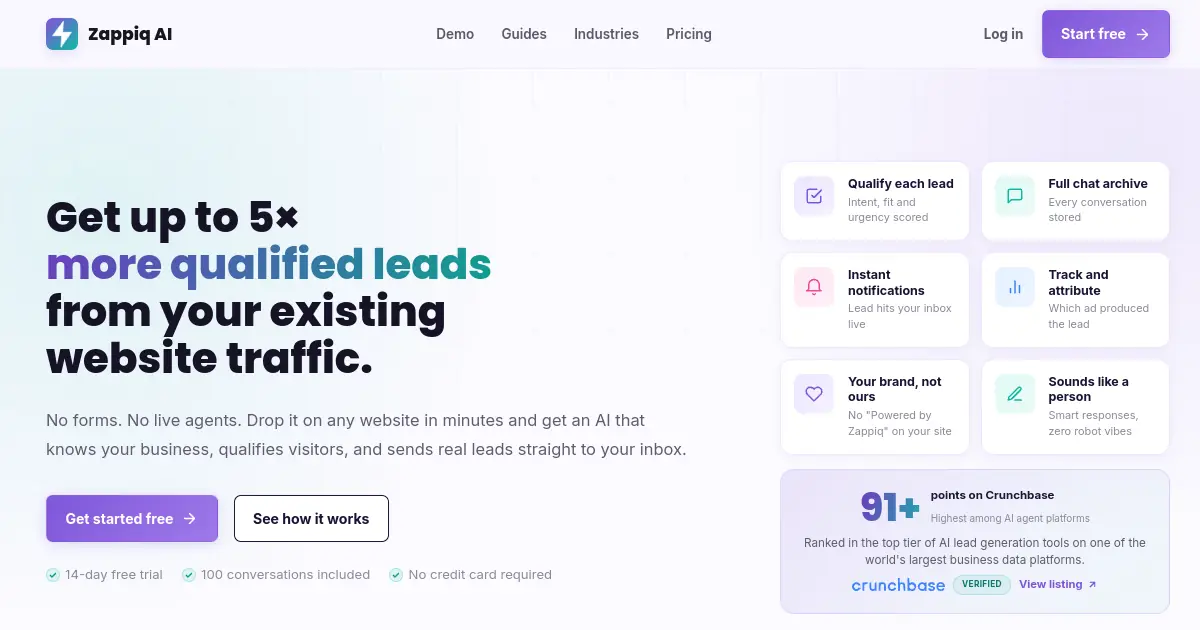
Start with the honest part: Zappiq does not make or answer phone calls. It is not a Retell replacement. If you are building voice agents, this is not your platform, and you can skip to the voice options below. But voice AI handles one channel. Your website handles another. Most businesses that deploy a voice agent still lose visitors who land on a page, have a question, and leave without calling.
Setup is a URL. You paste in your website address at signup, Zappiq reads your pages, and it learns your services, pricing, team and FAQs on its own. There is no flow builder and nothing to upload. When you change a page, the bot keeps up.
Qualification happens inside the conversation rather than in a form afterwards. When a visitor shows real intent, Zappiq collects their details as part of the chat and emails you right away with the name, contact info, what they asked about, and the full thread. Calling someone back with that context beats chasing a cold voicemail.
Pricing is flat and based on conversations, not seats or minutes. Start with a 14-day trial that includes 100 conversations. Starter is $9 a month equivalent when billed annually for 350 conversations; Growth is $39 monthly or $27/month equivalent billed annually for 1,500; Pro is $99 monthly or $69/month equivalent billed annually for 5,000. A website chat and a voice call are different things, so do not read that as a like-for-like price against Retell's per-minute rates. It does show how differently the two models scale.
If you spend money on ads, there is one more thing worth knowing. Each captured lead is tied back to the campaign, keyword or referral source that brought the visit, so you can see which clicks turned into real enquiries.
One script tag, any website: Zappiq installs with a single asynchronous script that works on WordPress, Shopify, Webflow, Wix, Squarespace, and any site that accepts custom HTML. No plugin to maintain.
Pros
- Flat conversation-based pricing with no per-seat fees
- Trains itself from your website URL
- Works around the clock without anyone logged in
- Qualifies visitors inside the conversation
- Ad and referral attribution included
- Instant email alerts with the full conversation
- No branding on any plan
- 14-day trial with 100 conversations
Cons
- Does not make or answer phone calls
- No voice AI capabilities
- No live human agents behind the AI
- Newer product with a smaller community
Pricing
Best for: Businesses running a voice AI stack that also need website lead capture with attribution, without adding another per-minute voice tool. See the plans on the Zappiq AI pricing page.
2. Dograh: Best Open Source, Self-Hosted Alternative to Retell
Dograh
github.com/dograh-hq/dograh | Open source voice AI platform, self-hosted with one Docker command, BYOK across LLM, STT and TTS
Dograh is the direct open source alternative to Retell and Vapi. It is BSD 2-Clause licensed, self-hostable with one Docker command, and built by YC alumni and exit founders. The pitch is simple: no vendor lock-in, full source access, and data residency on your own infrastructure [citation:1].
Setup takes about two minutes. You run a Docker command, open localhost:3010, pick inbound or outbound, name your bot, and describe the use case in a few words. Dograh ships with auto-generated API keys and its own LLM, TTS and STT stack, so you can test a working bot before connecting any external providers. Bring-your-own keys for LLM, TTS, STT and telephony work whenever you are ready [citation:1].
The feature set covers the basics: telephony integration with Twilio, Vonage, and others, call transfer to human agents, a visual workflow builder, and a QA node for testing before launch. It is Python-based and modular, so you can swap components as needed.
The trade-off is that you own the infrastructure. Dograh does not run your calls for you. If your team does not have someone who can maintain a Docker deployment and handle on-call, the managed platforms are a better fit. But for teams with engineering resources and a hard requirement for self-hosting or data residency, Dograh is the only option in this list that fully delivers it [citation:1].
Pros
- 100% open source under BSD 2-Clause
- Self-hostable with one Docker command
- Full source-level customization
- BYOK across LLM, TTS, STT and telephony
- Data residency on your own infrastructure
- No vendor lock-in
- Free to self-host
Cons
- You maintain the infrastructure
- No managed SLA or support contract
- Smaller community than managed platforms
- Requires engineering time to deploy and operate
Pricing
Best for: Engineering teams that need self-hosting, on-premises deployment, or full source access, and can maintain the infrastructure themselves.
3. Vapi: Best for Developers Who Want Full Provider Control
Vapi
vapi.ai | Developer-first orchestration API at $0.05 per minute, with true bring-your-own-LLM and the widest provider choice
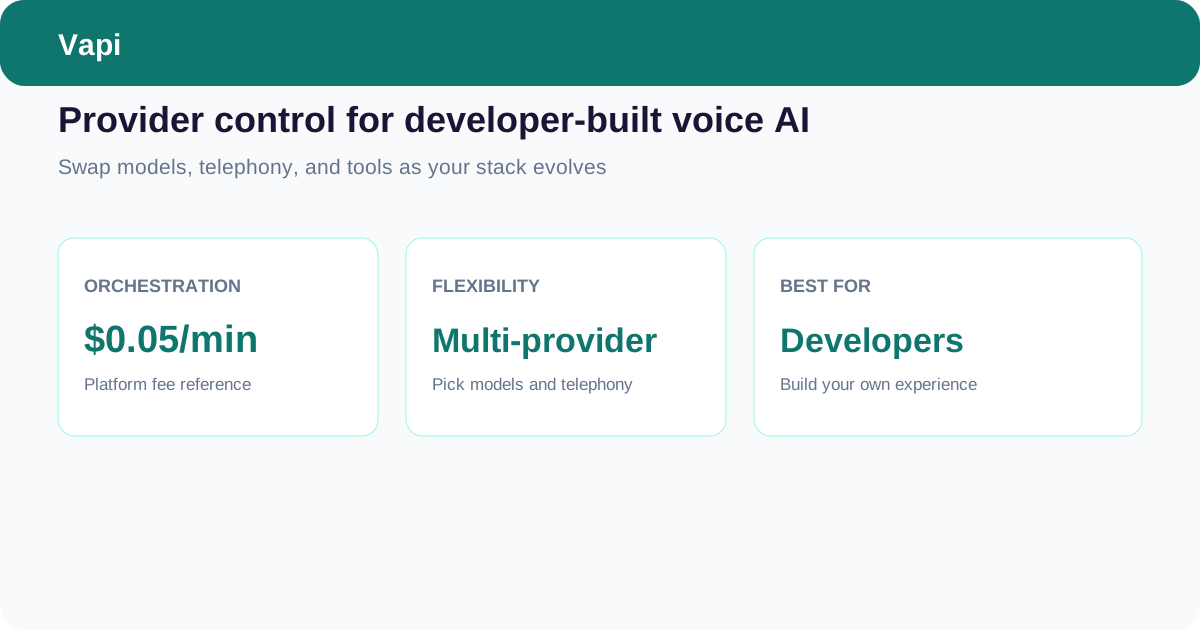
Vapi is the platform most often compared to Retell, and for good reason. It is the developer-first option: you assemble speech-to-text, LLM, and text-to-speech from any provider, and Vapi runs the real-time loop and telephony. The orchestration fee is $0.05 per minute, the cheapest in the category, with provider costs passed through at cost [citation:3].
The key differentiator is the custom LLM setup. Vapi lets you paste any OpenAI-compatible base URL and swap models without a relay. OpenRouter, Together, or your own server all work as long as the endpoint supports a streaming chat completions route. Retell requires you to host a WebSocket relay for the same capability, which adds a network hop and more work [citation:3].
Vapi also has the widest speech provider list: Deepgram, AssemblyAI, and Cartesia for STT; ElevenLabs, Cartesia, PlayHT, Rime, and more for TTS. It includes up to 10 free US phone numbers, Twilio import for international, and SIP trunking. The platform reports over a billion calls handled and raised a $50M Series B in May 2026 [citation:3].
The catch is the bill. Because everything is pass-through, the advertised $0.05 per minute is the smallest line item. At 100,000 minutes a month with a full stack, Vapi lands at $11,500 to $14,000, against Retell's roughly $7,000 for a standard managed setup. And HIPAA costs around $1,000 per month as an add-on, where Retell includes it [citation:20].
Pros
- Cheapest orchestration fee at $0.05/min
- True bring-your-own-LLM with a base URL swap
- Widest speech and voice provider list
- 10 free US phone numbers
- SIP trunking and Twilio import
- Over a billion calls handled
Cons
- You assemble and tune the stack yourself
- HIPAA costs around $1,000/mo extra
- Fully-loaded cost is hard to forecast upfront
- No self-hosting option
Pricing
Best for: Developers who want maximum control, the cheapest orchestration fee, and a true bring-your-own-model setup, and who are comfortable assembling the stack.
4. Bland AI: Best for High-Volume Outbound Phone Agents
Bland AI
bland.ai | AI phone agents built for outbound at scale, with tiered concurrency and a no-code agent builder
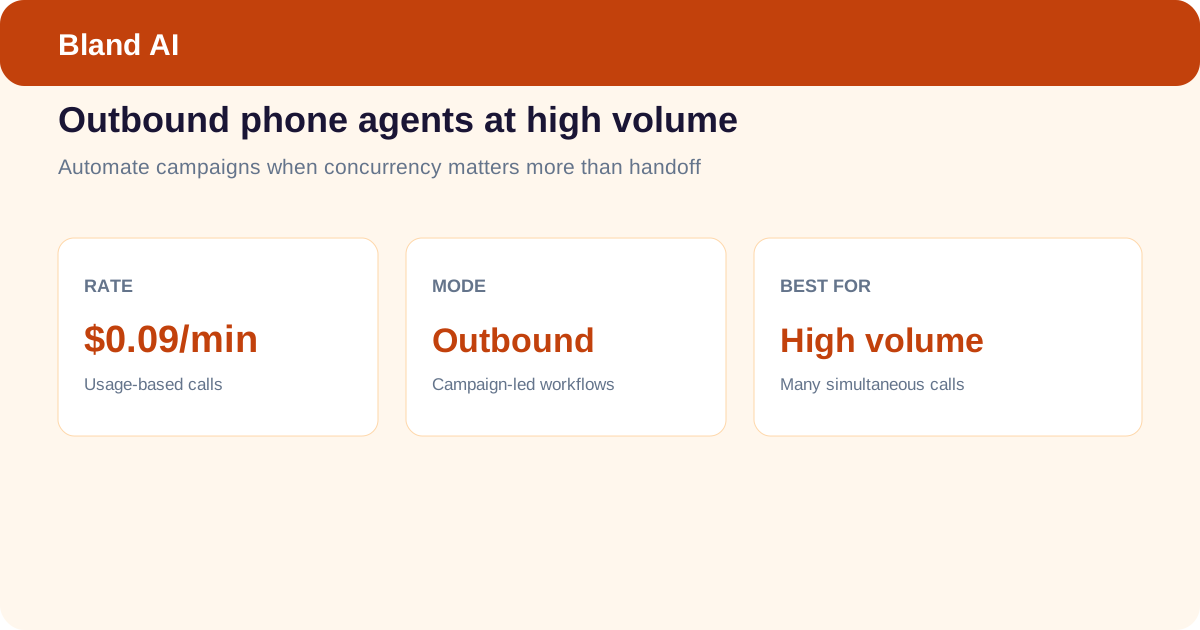
Bland AI is built for one job: making outbound phone calls at volume. Where Retell is a general-purpose voice platform, Bland is optimized for dialer concurrency and campaign management. The pricing is tiered by concurrency: Start is 10 concurrent calls and 100 calls per day, Build is 50 concurrent and 2,000 per day, Scale is 100 concurrent and 5,000 per day, and Enterprise is unlimited [citation:20].
The Build and Scale tiers include HIPAA with a signed BAA, which puts Bland in the same compliance position as Retell and ahead of Vapi. The no-code agent builder, called Norm, is designed for operations teams rather than developers, which matters if the people running your outbound campaigns are not engineers [citation:20].
Bland also offers a self-hosted model option at the enterprise tier, which is unusual among managed platforms and worth noting for regulated industries. The latency claim is sub-200ms on the product page, though the advertised figure is around 400ms in independent comparison tables [citation:3].
The trade-off is scope. Bland is not the platform for building a general-purpose voice agent that handles inbound support, appointment booking, and complex multi-turn workflows. It is a dialer. If your workload is outbound sales or structured outbound calls, it is a strong fit. If you need a flexible voice agent for any use case, Retell or Vapi are broader [citation:8].
Pros
- Built specifically for high-volume outbound
- Tiered concurrency from 10 to unlimited
- No-code Norm agent builder
- HIPAA included on Build and above
- Self-hosted model option at enterprise
Cons
- Less flexible for inbound or general-purpose agents
- No self-hosting below enterprise
- Latency claims vary between sources
Pricing
Best for: Sales operations teams running high-volume outbound campaigns that need dialer concurrency and a no-code builder.
5. Synthflow: Best No-Code Visual Builder
Synthflow
synthflow.ai | No-code voice AI platform with a visual flow designer, 30+ languages, and white-label options
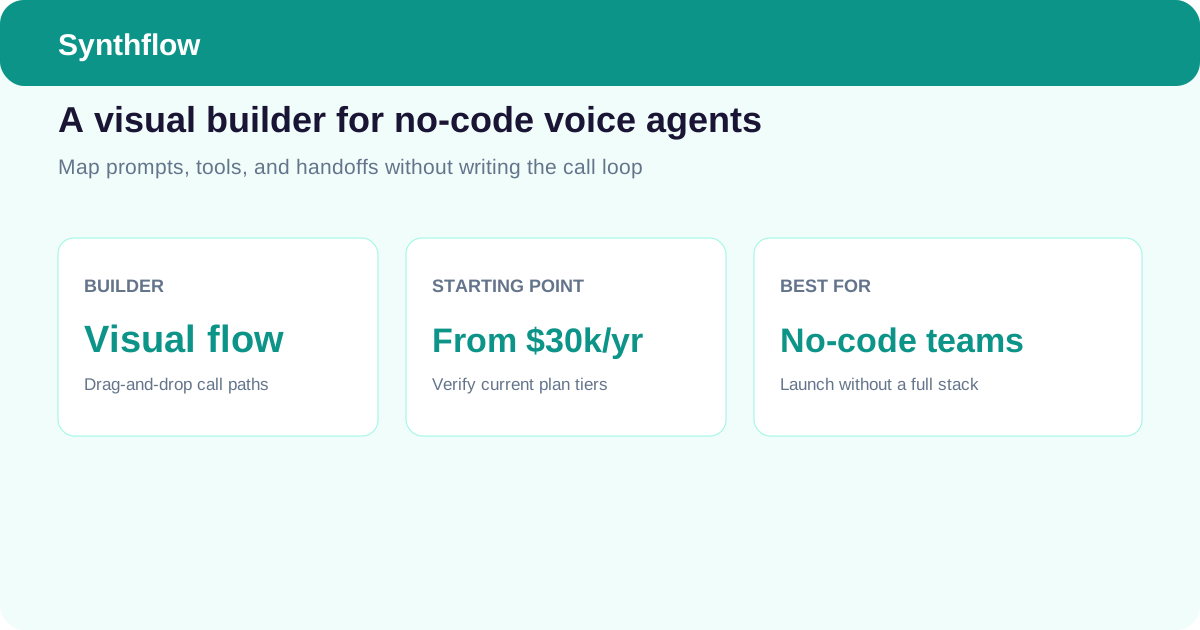
Synthflow is the strongest no-code alternative to Retell. Where Retell is API-first and expects engineering involvement, Synthflow leads with a Visual Flow Designer that lets operations teams, agencies, and CX teams build voice agents without writing code. It supports 30+ languages and multilingual voice cloning, which matters for multi-market deployments [citation:19].
The platform is built for enterprises and agencies. A $230M multinational BPO runs over 600,000 calls a month across 40+ agents on Synthflow. White-label options and ISO 27001 certification make it a fit for agencies that want to resell voice AI under their own brand. The build process follows a named operating model called BELL (Build, Evaluate, Launch, Learn), with an Evaluate stage that runs simulated calls against KPIs before go-live [citation:19].
Pricing is scoped enterprise contracts starting at $30,000 a year, not pay-as-you-go. That is a different shape from Retell's modular pricing. You get one bundled commitment covering the platform, telephony, integrations, compliance, and launch support. For enterprises that want predictable costs and a managed launch, that is a feature. For startups and small teams, the entry point is steep [citation:19].
On latency, Synthflow reported 420ms voice-to-voice in Retell's own 2025 benchmark, against Retell's 780ms. The gap is real, though Synthflow's sub-100ms figure is a separate metric for telephony processing rather than the full round trip [citation:19].
Pros
- Visual Flow Designer for no-code building
- 30+ languages and multilingual voice cloning
- White-label options for agencies
- ISO 27001 certified
- BELL framework with pre-launch evaluation
- Proven at BPO scale (600K+ calls/month)
Cons
- Enterprise pricing from $30,000/year
- No pay-as-you-go option
- Not aimed at individual developers or small teams
Pricing
Best for: Enterprises and agencies that want a no-code visual builder, multilingual coverage, and white-label capability, and prefer a scoped contract over pay-as-you-go.
6. ElevenLabs Conversational: Best When Voice Quality Is the Brand
ElevenLabs Conversational
elevenlabs.io | Voice-quality-first agent platform with industry-leading TTS and voice cloning fidelity
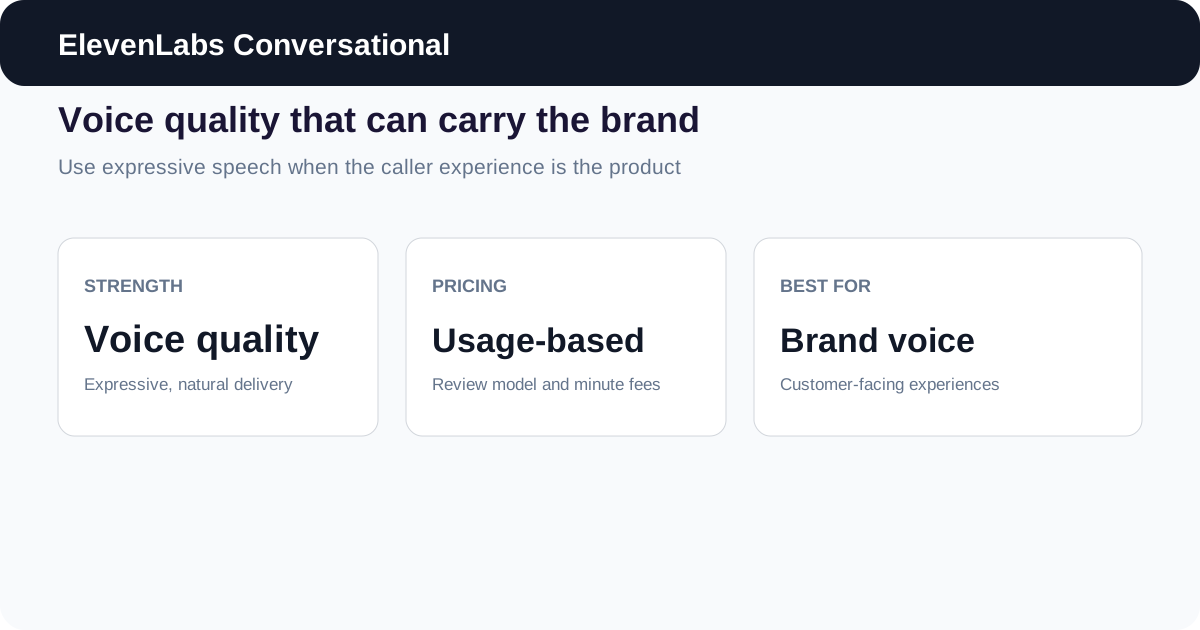
ElevenLabs is the platform to pick when the voice is the product. Its TTS quality and voice cloning fidelity are the best in the category, which matters for premium consumer products, character voice agents, and brands where the sound of the interaction is part of the value proposition. ElevenLabs Conversational wraps that voice quality in an agent platform [citation:9][citation:20].
The trade-off is latency and cost. ElevenLabs v3 is gorgeous but not real-time-optimized. Teams targeting low-latency turn-taking should pair the platform with Flash v2.5 rather than v3. And HIPAA requires an Enterprise contract plus Zero Retention Mode, reportedly around $1,000 per month on top [citation:20].
For most production voice agents where latency is binding, Cartesia Sonic Turbo with 40ms TTFA is the faster TTS choice. ElevenLabs is the right call when voice quality is the priority and the latency budget can accommodate it [citation:9].
Pros
- Best-in-class TTS quality and voice cloning
- Conversational agent platform included
- Strong choice when voice is the brand
Cons
- v3 is not real-time optimized
- HIPAA requires Enterprise plus add-on cost
- Not the fastest option for latency-sensitive use cases
Pricing
Best for: Voice products where the voice is the brand, character voice agents, and premium consumer products where quality matters more than the lowest latency.
7. LiveKit Agents: Best for Engineering Teams Building Their Own Stack
LiveKit Agents
livekit.io | Open source framework for building real-time voice agents with full control over every component
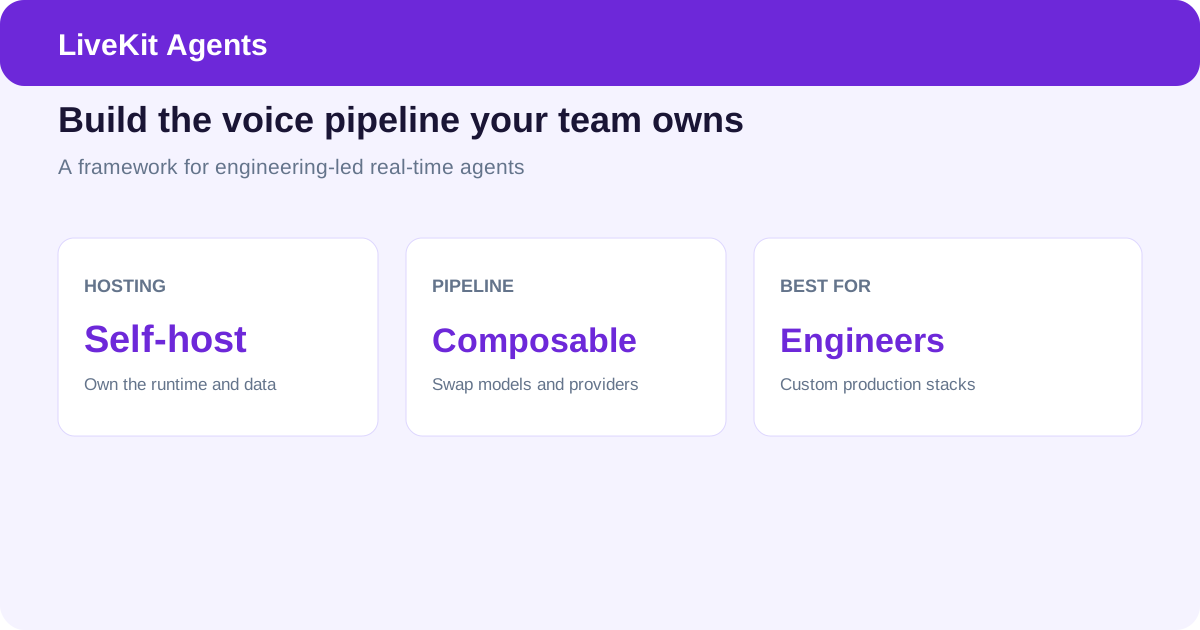
LiveKit Agents is a framework, not a managed platform. It gives engineering teams the building blocks to compose their own voice agent stack: transport, STT, LLM, and TTS, all under their control. End-to-end latency runs around 750 to 900ms in community reports, which is competitive with managed platforms but not the absolute fastest [citation:20].
The appeal is control and cost. You pick every component, you own the orchestration, and you are not paying a platform fee on top of provider costs. At very high volume, that economics can beat any managed platform. The cost is engineering time: building from scratch takes three to six months to reach the quality that Vapi or Retell deliver out of the box [citation:9].
LiveKit is the right choice if you have a team that wants to own every layer and you are planning for scale where the per-minute platform fee becomes significant. It is the wrong choice if you want to ship a working phone agent next week.
Pros
- Full control over every component
- No platform fee on top of provider costs
- Open source and self-hostable
- Competitive latency (750-900ms)
Cons
- Requires significant engineering time
- No managed support or SLA
- Three to six months to reach platform quality
Pricing
Best for: Engineering teams with the time and expertise to build and maintain their own voice agent stack, planning for scale where owning every layer pays off.
How to Pick the Right Retell AI Alternative
Start with this question: do you want a managed platform, or do you want to own the stack?
That one question sorts this list better than any feature table. Managed platforms get you to production faster. Self-hosted and framework options give you control and better unit economics at scale, at the cost of engineering time.
- You need self-hosting, on-prem, or open source: Dograh, because it runs with one Docker command and has no vendor lock-in.
- You want the cheapest orchestration and true bring-your-own-LLM: Vapi.
- You are running high-volume outbound: Bland AI.
- You want no-code visual building: Synthflow.
- Voice quality is the brand: ElevenLabs Conversational.
- You have engineering time and want to own every layer: LiveKit Agents.
- You also need website lead capture: Zappiq AI, alongside whichever voice platform you pick.
One more thought on compliance. HIPAA is included on Retell and Bland but costs around $1,000 per month on Vapi. If you are in a regulated industry, that single line item can be decisive before you get to per-minute costs [citation:20].
Before You Switch from Retell
A clean migration takes planning, mostly around your prompts, your integrations, and your data.
- Export your prompts and agent configurations. Retell does not export to a standard format. Copy your prompts, knowledge bases, and flow logic before you leave.
- Check your phone numbers. If you bought numbers through Retell at $2 per month, find out whether you can port them or need to provision new ones. SIP trunking is free on Retell, so custom telephony setups may be easier to move.
- Map your integrations. Calendar, CRM, and telephony connections are platform-specific. List what you have connected and check whether your new platform supports native connectors or requires custom work.
- Model the new bill with your real usage. Retell's modular pricing means the total depends on which LLM and voice you pick. Run your last month's call minutes through the new platform's rate card before you commit.
- Check compliance coverage. If you handle PHI, confirm the new platform includes a BAA without an upcharge. Retell includes it; Vapi charges for it.
- Run both for a week. Test the new service with real callers before you move live traffic. Voice AI failures are more visible than chat failures.
Is your website losing leads while you build out a voice stack?
Try Zappiq AI with a 14-day trial and 100 conversations and see what a website-trained chatbot captures from your own traffic.
Start free14-day trial · 100 conversations | Cancel anytime
Frequently Asked Questions
Retell AI pricing is modular. Voice infrastructure runs $0.055 per minute, standard TTS $0.015 per minute, LLM costs range from $0.003 to $0.160 per minute depending on the model, and telephony adds $0.015 per minute for US calls. A basic setup lands around $0.07 to $0.09 per minute, with more complex configurations reaching $0.31 per minute.
Retell offers $10 in free credits to start, along with 20 concurrent calls and 10 free knowledge bases. There is no ongoing free tier, but the credits give you enough to test a production workflow before committing.
It depends on what you need. If you want open source and self-hosting, Dograh is the direct alternative. If you need the widest provider choice and a true bring-your-own-LLM setup, Vapi is the developer favorite. If you want no-code visual building, Synthflow or Bland are strong options. If your leads start on the website, Zappiq AI captures those visitors without a voice stack.
Dograh is free if you self-host it. On managed platforms, Vapi charges $0.05 per minute for orchestration plus provider costs at passthrough. Retell itself starts around $0.07 per minute all-in. For very high volume, self-hosted stacks can beat all managed options.
Yes. Dograh is an open source voice AI platform built specifically as a self-hosted alternative to Vapi and Retell. It runs with one Docker command, supports bring-your-own LLM, TTS, and STT, and has no vendor lock-in. The trade-off is that you maintain the infrastructure yourself.
Vapi is better for developers who want the cheapest orchestration fee, a true bring-your-own-LLM setup, and the widest provider choice. Retell is better for teams that want bundled pricing, consistent low latency without tuning, HIPAA compliance included, and production workflow tooling. Vapi starts at $0.05 per minute for orchestration; Retell starts around $0.07 per minute all-in.
No. Retell includes HIPAA, SOC 2 Type 1 and 2, and GDPR compliance on its standard plans with a self-serve BAA. Vapi charges around $1,000 per month for HIPAA as an add-on, which is one of the largest pricing differences between the two platforms.
No. Retell is a proprietary SaaS platform and does not offer self-hosting. If self-hosting or on-premises deployment is a requirement, look at Dograh, which is open source under BSD 2-Clause and runs with one Docker command.
Synthflow is the strongest no-code alternative. It offers a visual flow designer for building voice agents without writing code, supports 30+ languages, and includes white-label options. Bland AI also offers a no-code agent builder focused on outbound sales.
Bland AI is built specifically for high-volume outbound phone agents. It has a dialer-focused architecture, tiered concurrency limits, and a no-code builder suited to sales operations teams. Vapi is also strong for outbound if you have engineering resources.
Only for the website side. Zappiq AI is a website chatbot that qualifies visitors and emails you the lead. It does not make or answer phone calls, so it is not a voice AI replacement. It handles the website lead capture that voice agents do not cover.
Zappiq AI offers a 14-day trial with 100 conversations. Starter is $9/month equivalent billed annually for 350 conversations; Growth is $39 monthly or $27/month equivalent billed annually for 1,500; Pro is $99 monthly or $69/month equivalent billed annually for 5,000, with no per-seat fees.
The Bottom Line
Retell AI is a strong managed platform with compliance included, predictable latency, and modular pricing that lets you control costs. The gap is control: it is closed source, there is no self-hosting, and a custom LLM requires a relay. If none of those are blockers, Retell is a solid choice and there is no urgent reason to leave.
If you need self-hosting or open source, Dograh is the only option here that fully delivers it. If you want the cheapest orchestration and true bring-your-own-LLM, Vapi is the developer favorite. If you want no-code building, Synthflow is the strongest fit. If you are running high-volume outbound, Bland is purpose-built for it.
And if you are deploying voice AI but still losing website visitors who never call, Zappiq AI handles that channel. It offers a 14-day trial with 100 conversations, followed by Starter at $9/month equivalent billed annually for 350 conversations, Growth at $39 monthly or $27/month equivalent annually for 1,500, and Pro at $99 monthly or $69/month equivalent annually for 5,000. No plan includes Zappiq branding. Whatever you choose, model the real bill with your own usage before you commit.
References
- Dograh. "Open source voice AI platform. Self-hosted alternative to Vapi and Retell." github.com.
- Morph. "Best AI Voice Agent Platforms in 2026: Vapi vs Retell vs Bland vs Synthflow vs ElevenLabs." morphllm.com.
- Retell AI. "AI Phone Agent Pricing." retellai.com.
- Cekura. "Retell AI Pricing per Minute: What You Actually Pay in 2026." cekura.ai.
- Future AGI. "Best Voice AI Models in May 2026: STT, TTS, and Voice Agent Stack." futureagi.com.
- Future AGI. "5 Best AI Voice Agent Platforms for Outbound Sales in 2026." futureagi.com.
- Synthflow. "Synthflow vs. Retell: Enterprise Platform vs Developer Infrastructure." synthflow.ai.
- Cekura. "Retell vs. Vapi: Features, Pricing & Who Wins in 2026." cekura.ai.
- Retell AI. "Conductor pricing and usage limits." docs.retellai.com.
- Deepgram. "Voice Agent Platform Tax: True Costs Explained (2026)." deepgram.com.
- Future AGI. "Voice AI Integration Guide 2026: Vapi, Retell, LiveKit, Pipecat." futureagi.com.
- Future AGI. "Best Voice AI Models in April 2026." futureagi.com.

Ansar Ali
Ansar Ali is the founder of Zappiq AI, a lead-capture platform built for small businesses that cannot afford to lose high-intent website visitors. He writes about chatbot tools, pricing models, and lead generation tactics from the perspective of a small business operator, with a focus on what things actually cost versus what the marketing page says they cost.