
Quick Summary
Short answer: The best Ruby Receptionist alternative depends on what you are paying Ruby for. For live human answering at a lower price, look at AnswerConnect, Abby Connect, or Posh. For per-call billing with an AI option, look at Smith.ai. For AI-only phone answering at a fraction of the cost, look at Goodcall or Dialzara. For the website chat side of Ruby, Zappiq AI is the pick, but it does not answer phone calls.
- Zappiq AI is the best swap for Chat Ruby and website lead capture. Flat pricing from $27/month, no phone answering.
- Smith.ai bills per call instead of per minute, and it has a free tier for 25 AI-answered calls a month.
- Abby Connect runs human and AI answering on one plan, from $165/month, with a free trial.
- AnswerConnect has the lowest published price per human minute, roughly $1.32 to $1.75.
- Moneypenny and Posh are the other established live-answering options.
- Goodcall, Dialzara, and Rosie are AI-only phone answering, priced from about $29 to $249 a month.
Why Businesses Leave Ruby
Let's be fair to Ruby first. It has been around since 2003, the receptionists are well trained, and customers who like it tend to really like it. Nobody serious calls it a bad service. When people start searching for Ruby Receptionist alternatives, it's nearly always about the bill.
The first problem is the meter. Ruby bills by the minute, and the bundles are small. The $250 plan includes 50 minutes, which works out to somewhere between 17 and 25 calls if your average call runs two to three minutes. Go over and you pay overage, which Ruby's help center lists at $5.40 a minute on the 50-minute plan, $4.50 on the 100-minute plan, and $4.40 on the 200-minute plan. Even at 1,500 minutes the overage is still $3.50 a minute.
The second is what counts as a minute. Ruby rounds up, and independent reviewers report that work around the call, like sending the message or looking something up, can eat into the same allotment. Ruby's billing pages are the place to confirm the current rules. But honestly, ask that question of any provider before you sign, Ruby included.
Third, Ruby is people-only when it comes to answering calls. It uses AI for transcripts, sentiment analysis, and assisted call flows, but there is no AI receptionist picking up the phone. If you want a human on every call, that's a feature. If half your calls are "what are your hours" and "do you cover my zip code," it's an expensive way to answer them.
And then there's chat. Chat Ruby, the managed live chat for your site, is billed per chat: $520 a month for 50 chats, $945 for 100. That's over $9 every time a visitor talks to someone. If the chat line on your invoice is the one that stings, it's also the easiest piece to replace.
What Ruby Actually Costs: A Realistic Example
Check your own average call length. The three-minute figure is an assumption, and it matters a lot. At 90 seconds per call, the same 100 calls use about 150 minutes, and the Ruby bill drops to roughly $620. Pull a month of call logs before you compare anything.
Quick Comparison: Ruby vs. 10 Alternatives
Prices below come from provider pages and recent roundups checked in early October 2026. Plans change often, so use this table to narrow the field, then confirm on each provider's site.
| Tool | Starting Price | Billing Model | Who Answers | Best For |
|---|---|---|---|---|
| Ruby (baseline) | $250/mo (50 min) | Per minute, plus overage | Humans | Low volume, human on every call |
| Zappiq AI | 100 free / $27/mo (1,500) / $69/mo (5,000) | Flat by conversation volume | AI, website chat only | Chat Ruby replacement, lead capture |
| Smith.ai | Free (25 AI calls) / about $300/mo for humans (30 calls) | Per call | AI, hybrid, or humans | Professional services, mixed call types |
| Abby Connect | $165/mo (50 Abby Minutes) | Per Abby Minute, AI counts half | Humans, AI, or both | Dedicated team plus AI option |
| AnswerConnect | $350/mo (200 min) | Per minute, rounded up | Humans | Lowest published human rate |
| Moneypenny | $165/mo (50 min) / AI from $69/mo (25 calls) | Per minute (people), per call (AI) | Humans or AI | Polished brand image |
| Posh | From $65/mo | Per minute | Humans | Budget live answering, bilingual |
| Nexa | Quote only | Per minute | Humans | Established multi-industry service |
| Goodcall | $79/mo per agent (100 unique callers) | Per unique caller | AI | Repeat callers, flat AI answering |
| Dialzara | $29/mo (60 min) | Per minute bundle | AI | Cheapest way to test AI answering |
| Rosie | From about $49/mo | Per minute bundle | AI | Small service businesses |
1. Zappiq AI: Best Replacement for Chat Ruby and Website Lead Capture
Zappiq AI
zappiqai.com | AI lead generation chatbot built for small and medium business websites
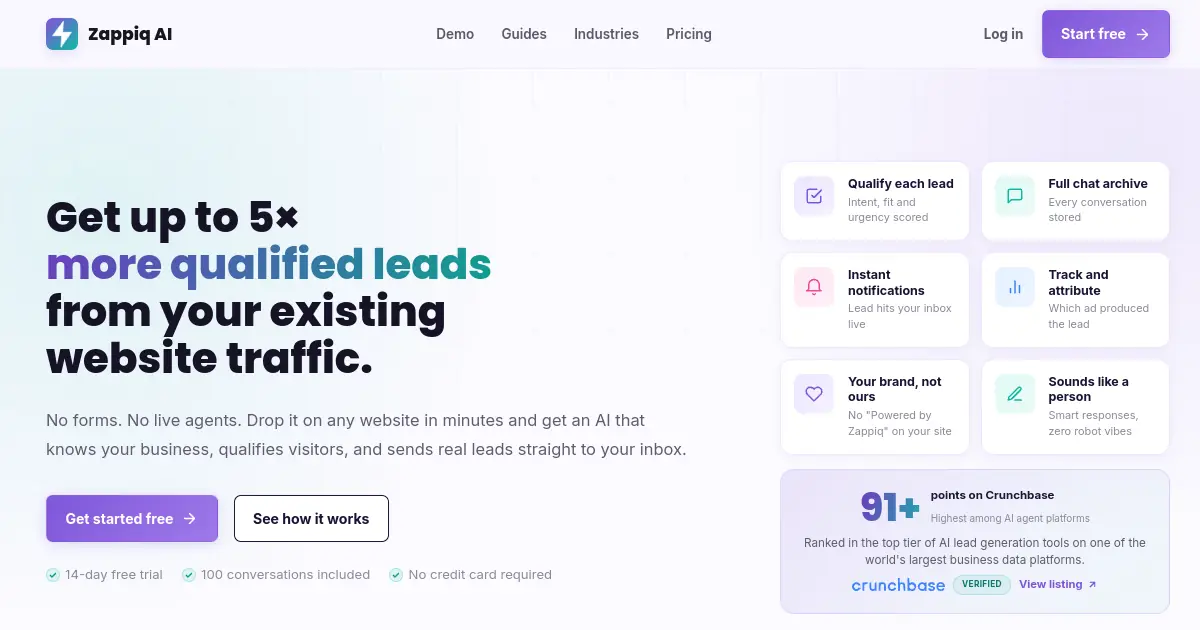
One thing up front: Zappiq AI does not answer phone calls. If phones are the reason you pay Ruby, skip to the next card and come back if your website matters too. Ruby sells two things, call answering and managed live chat, and Zappiq goes after the second one.
Chat Ruby puts a person on your site, and you pay for every chat that person handles. Zappiq works differently. It reads your website when you sign up, learns your services and the questions people keep asking, and starts talking to visitors right away. Nobody builds flows. The chatbot finds out what the visitor needs, how soon they need it, and whether they're a fit, and only then asks for contact details. When someone qualifies, you get an email with their info and the full conversation.
Pricing is flat: 100 conversations free, $27 a month for 1,500, $69 for 5,000. A Zappiq conversation and a Ruby chat aren't the same unit, since Ruby counts chats a human actually handled, so this isn't a perfect like-for-like swap. Still, for a site that mostly needs questions answered and leads caught at 2 a.m., the cost gap is hard to ignore.
Ad tracking is another piece worth having. Zappiq connects each lead to the campaign, keyword, or channel that brought the visitor in, which matters if you're paying for Google or Meta traffic. No branding appears on any plan, and the script loads asynchronously, so your page speed and Core Web Vitals stay put. It installs as one script tag on WordPress, Shopify, Webflow, Wix, Squarespace, or plain HTML.
A setup that makes sense for a lot of small businesses: a phone service from this list for calls, Zappiq on the website.
White-label ready: Zappiq supports white-label deployment, so agencies can run it on client sites without a third-party brand showing.
Pros
- Trains itself on your website from day one
- Lead qualification built in, no flow-building
- Instant email alerts with the full conversation
- Ad tracking connects leads to campaigns
- No branding on any plan
- Flat pricing, no separate AI add-on
- Webhooks for Zapier, Make, and n8n
Cons
- Does not answer phone calls
- Newer platform, smaller user community
- Push notifications still in development
- Not built for WhatsApp or email support
- Fewer native integrations than Intercom
What you get that a per-chat service does not give you
Predictable cost: One flat monthly price, so a busy week doesn't turn into a bigger invoice.
Automatic website training: The chatbot learns from pages you already maintain instead of waiting on scripts or flows.
Natural qualification: It asks about intent, urgency, and fit before it asks for an email address, so the inbox gets better leads.
Email lead delivery: Contact details, source data, and the whole conversation arrive together while the lead is still warm.
Pricing
Best for: Service businesses with a website that gets after-hours visitors, and anyone paying per chat for Chat Ruby. Especially dental, legal, real estate, home services, solar, and agencies.
2. Smith.ai: Best for Per-Call Pricing With an AI-First Option
Smith.ai
smith.ai | Per-call billing with AI-first, hybrid, and human-first receptionist plans
Smith.ai is the service Ruby customers compare against most, and the big difference is how it bills. Ruby charges for time. Smith.ai charges for calls. That sounds minor until you run your own numbers.
Here's rough math. Ruby's in-bundle rate is $3.45 to $5.00 a minute depending on the plan, so a three-minute call lands somewhere around $10 to $15. Smith.ai's human-first receptionists run roughly $7 to $10 a call, and the price doesn't creep up when a caller rambles. If your calls average under two minutes, Ruby's meter can come out ahead. Longer than that, per-call pricing usually wins.
The AI side is the other draw. Smith.ai's AI-first plans start free for 25 calls, with paid tiers from around $150 a month, and there's a hybrid option where the AI answers and a person steps in when it matters. You choose the mix per plan, which is a bit clunkier than one blended plan, but it gives you a real ladder to climb as call volume grows.
Watch the add-ons. Booking an appointment is $1.50 a call, a dedicated Spanish line is $1.00, text and email follow-up is $0.50, and recording on human plans is $0.25. Use them often and a $7 call becomes a $10 call. Month-to-month terms and a 30-day money-back guarantee on the human-first plans soften that a little.
Pros
- Call length doesn't change what you pay
- Free AI tier for 25 calls a month
- Month-to-month, with a 30-day guarantee on human plans
- CRM sync with HubSpot, Salesforce, Clio, and Zapier
Cons
- Add-ons stack up per call
- Overage on human plans runs $8.50 to $11.50 a call
- AI and human receptionists are separate plans
- Per-call cost climbs fast past about 150 calls a month
Pricing
Best for: Law firms, medical practices, and professional services handling roughly 30 to 120 calls a month, where how a call is handled affects revenue.
3. Abby Connect: Best for a Dedicated Team Plus an AI Option
Abby Connect
abby.com | Human and AI receptionists on one month-to-month plan
Abby's pitch is one subscription you can use three ways: people only, AI only, or a mix you can change whenever you like. Usage is counted in "Abby Minutes." A minute with a human receptionist uses one. A minute with the AI uses half, so AI-handled calls stretch the same plan twice as far.
The published plans are $165 a month for 50 Abby Minutes, $329 for 100, $599 for 200, and $1,380 for 500. Line those up against Ruby at matching minute counts and Abby comes in about 17% to 34% lower. Every plan is month-to-month, there's no setup fee, nights and weekends carry no upcharge, and English and Spanish answering is included. Abby also lists a free trial on every plan (14 days or 500 Abby Minutes), and according to Abby's own comparison, Ruby's pricing page doesn't list one.
A caveat worth saying plainly: most of these numbers come from Abby's own comparison pages, so treat them as the vendor's claims until you've seen a quote. The one real adjustment is learning a new unit. "Abby Minutes" isn't hard, but it does mean your cost depends on how you split calls between people and AI.
Pros
- Human and AI answering on a single plan
- Free trial on every plan
- Lower than Ruby at every matching tier
- Bilingual and 24/7 included
Cons
- Billing in Abby Minutes takes a moment to model
- Plans above 500 minutes are quote-only
- Published figures are mostly vendor-sourced
Pricing
Best for: Small businesses and practices that want a consistent receptionist team for some calls and an AI for the routine and after-hours ones, without buying two products.
Paying per chat for Chat Ruby?
Zappiq AI reads your website, trains itself, and qualifies visitors without flows to build or a per-chat meter running. Live in under 5 minutes.
Start Free TrialNo credit card required | Works on any website
4. AnswerConnect: Best for the Lowest Published Price Per Human Minute
AnswerConnect
answerconnect.com | 24/7 live answering with low per-minute rates and no AI by policy
If your single goal is to keep a human answering the phone for less money, AnswerConnect is the cleanest answer in this list. It publishes three plans: 200 minutes for $350, 300 minutes for $395, and 400 minutes for $575. That's about $1.32 to $1.75 per minute, well under Ruby's $3.45 to $5.00. Extra minutes cost $1.85 to $2.50.
At the 300-minute mark you're looking at $395 against the $1,160 in our Ruby example. That gap is real, but don't take it at face value. AnswerConnect counts after-call work, rounds every interaction up to the next full minute, and your billed minutes will run higher than the time callers spend talking. The first 30 interactions under 30 seconds each cycle are free, which helps with wrong numbers and hang-ups.
Two plans carry a $49.99 setup fee, and the company says plainly that it doesn't use AI to answer calls. That's a plus if you want people only and a dealbreaker if you want an AI for overflow.
Pros
- Lowest published human per-minute rate in this guide
- 24/7 answering included on every plan
- Integrations with Salesforce, Zoho, Slack, and Zapier
Cons
- No AI answering at all
- Setup fee on two of three plans
- Rounding and after-call time inflate billed minutes
- No free trial listed
Pricing
Best for: Businesses that want people on every call, have steady volume, and care most about cost per minute.
5. Moneypenny: Best for a Polished Brand Image, With People or AI
Moneypenny
moneypenny.com/us | UK-founded virtual receptionist service with a US team, live and AI plans
Moneypenny sells two products now. The people-answered plans start at $165 a month for 50 minutes, and the AI plans are metered by call: $69 for 25 calls, $99 for 50, $199 for 100, and $435 for 250, with extra calls running $2.49 down to $1.89 depending on the plan. The AI option includes a hand-off to a real person, which suits a firm that wants the cheap-and-fast option for routine calls without losing the human backup.
One warning. If you search for Moneypenny reviews, you'll find older write-ups describing a different setup: $145 base plans, a paid add-on for 24/7 coverage, and setup fees. Plans have been reshuffled since, but it's a good reminder to get current terms in writing, especially whether round-the-clock coverage is included on the plan you pick.
Pros
- Live and AI options from one provider
- AI plans with built-in human transfer
- Strong fit for firms that care about how calls sound
Cons
- Entry people plan covers only 50 minutes
- AI plans are capped by call count
- Pricing history is confusing, so confirm 24/7 terms
Pricing
Best for: Professional firms with small, steady call volume that want a polished voice, and the option to start with AI and add people later.
6. Posh: Best Budget Live Answering With Bilingual Coverage
Posh
posh.com | Live virtual receptionists on per-minute plans
Posh says its plans begin at $65 a month, and it lists plans from 50 up to 1,000 receptionist minutes, plus a pay-as-you-go option with no minutes pre-loaded. Third-party roundups put effective rates at about $2.20 to $3.20 a minute, which is under Ruby across the board. Bilingual English and Spanish and 24-hour answering come standard, and there's a free trial of seven days or 250 receptionist minutes, whichever hits first.
The same per-minute caveat applies. Posh counts time on the phone with callers and also time spent completing an activity for your account, so a receptionist who sends an email on your behalf is running your meter. That's not a flaw, just something to model against your real call patterns before you commit.
Pros
- Low entry price and a pay-as-you-go option
- Bilingual and 24-hour answering included
- Free trial before you pay
Cons
- Still a per-minute meter, like Ruby
- Activity time counts toward minutes
- Entry plans cover very few minutes
Pricing
Best for: Solo operators and small teams who want a live person answering for less than Ruby charges, with Spanish coverage included.
7. Nexa: Best Long-Running Option if You're Fine Requesting a Quote
Nexa
Formerly Answer 1 | Phoenix-based live answering and virtual receptionist service
Nexa (formerly Answer 1) has been in the answering business for decades. It offers 24/7 call answering, appointment scheduling, lead qualification, and some customer service work, with specialized handling for industries like legal, medical, home services, and retail. Billing is by the minute.
The sticking point is pricing, because Nexa doesn't publish it. You'll need a sales call to see numbers, and extra services such as customer-service correspondence can be billed on top of base minutes. For a business that likes to compare plans side by side before talking to anyone, that's friction. For a business that wants a long-established vendor and doesn't mind negotiating, it may not matter.
Pros
- Decades of experience in live answering
- Industry-specific call handling
- Goes beyond messages into customer service work
Cons
- No public pricing
- Extra charges for some services
- Harder to compare against published rates
Pricing
Best for: Established businesses that want a long-running provider and are comfortable getting a custom quote first.
8. Goodcall: Best AI Receptionist for Businesses With Repeat Callers
Goodcall
goodcall.com | AI phone agent billed by unique callers, not minutes
Goodcall flips the pricing question. Minutes are unlimited. What you pay for is the number of unique callers per month, where "unique" means a distinct phone number. Starter is $79 a month per agent for 100 unique callers, Growth is $129 for 250, and Scale is $249 for 500. Each extra caller past your cap costs $0.50. Annual billing drops the monthly figures to $66, $108, and $208.
That structure favors businesses where the same people call again and again, like a clinic or a service company with regular customers. A caller who rings five times in a month still counts once. The reverse is true for a business that gets mostly one-off callers: your costs track your caller count, and a viral month could add up.
Two practical limits. Pricing is per agent, and each location or phone number usually needs its own. And the Starter plan allows just one logic flow, so anything more complicated pushes you to Growth quickly. Since this is AI only, how well it handles tricky or sensitive calls depends on how carefully you set up your transfers.
Pros
- Unlimited minutes, no per-minute meter
- Repeat callers count once
- Published, self-serve pricing
Cons
- Priced per agent, so more locations cost more
- $0.50 for each caller over the cap
- Starter limited to one logic flow
- No live human unless you route calls to your team
Pricing
Best for: Single-location service businesses and clinics with a loyal customer base and mostly routine calls.
9. Dialzara: Cheapest Way to Test an AI Receptionist
Dialzara
dialzara.com | AI receptionist with minute-based plans from $29 a month
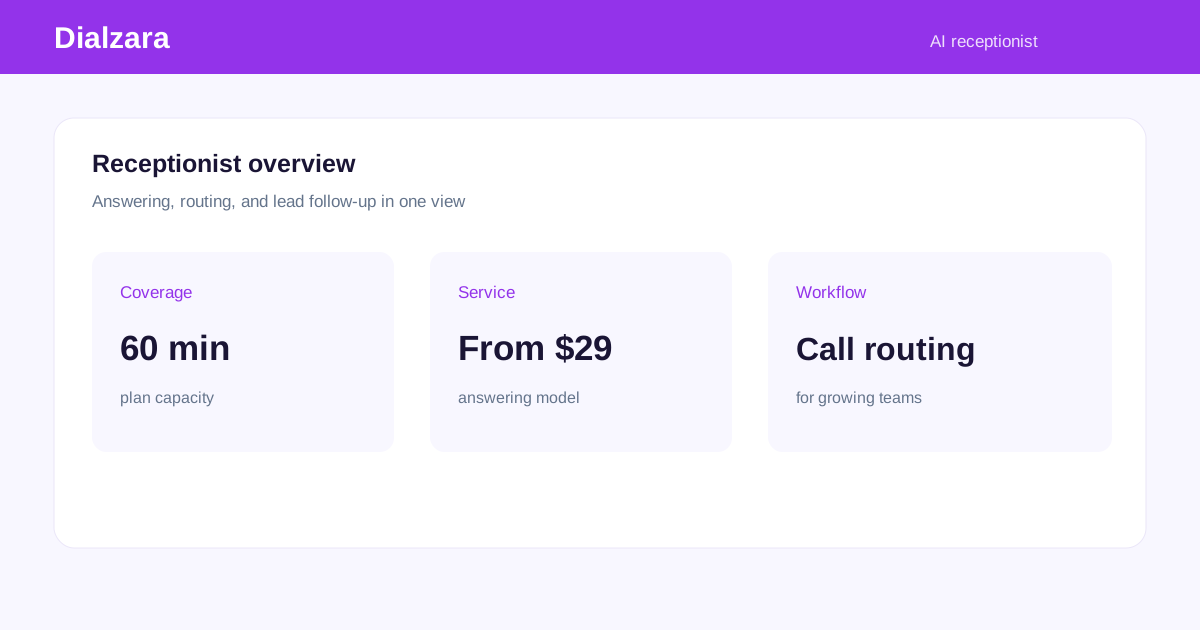
Dialzara has the lowest entry price in this guide: $29 a month for 60 minutes, with four inbound plans (Business Lite, Pro, Plus, and Elite) scaled by included talk time. It has a free trial. The company says every plan includes English and Spanish, appointment booking, call transfers, two-way SMS, and Zapier integration, though those are vendor claims worth confirming in a trial.
The trade-off is the usual one for minute-metered AI. A busy month can use up a small bundle, and the cheapest plan is built to let you try the idea, not to carry a growing business. It's a reasonable first step if you're not sure an AI receptionist is right for you and would like to test it on real calls before committing real money.
Pros
- Lowest entry price here at $29/month
- Free trial
- Booking, transfers, and SMS on the feature list
Cons
- Small minute bundles on entry plans
- Feature claims are mostly vendor-sourced
- No human answering
Pricing
Best for: Small businesses that want to try AI call answering cheaply before deciding whether to replace a live service.
10. Rosie: Simple AI Answering for Small Service Businesses
Rosie
heyrosie.com | AI answering service for small businesses, from about $49 a month
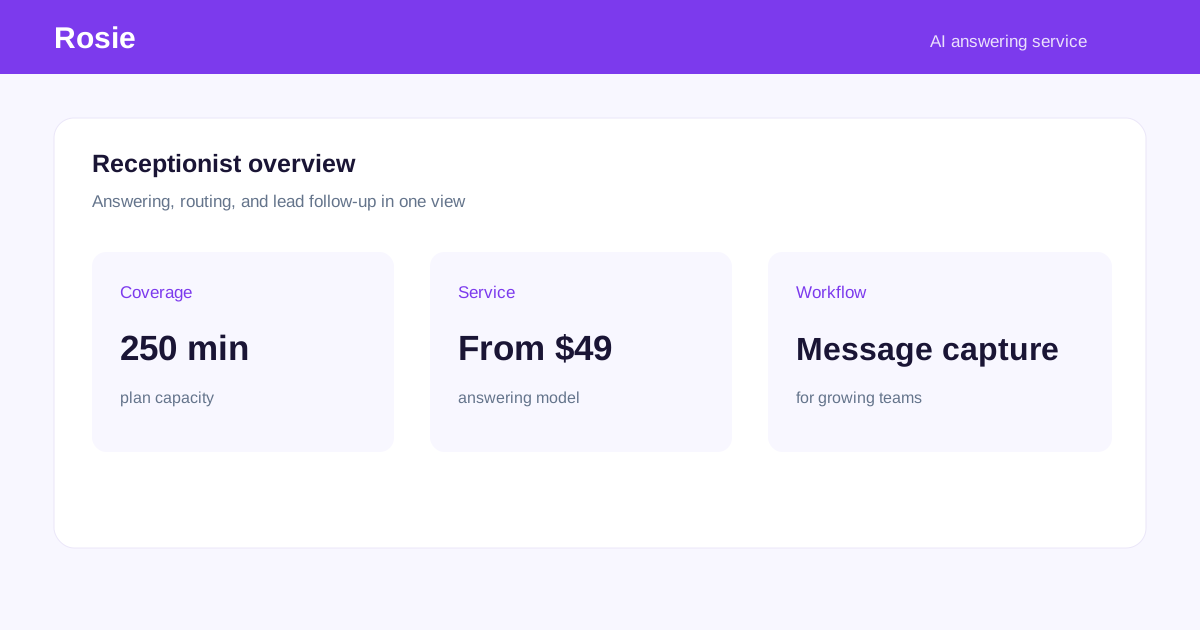
Rosie is an AI answering service aimed at small service businesses. It learns from your website, captures leads, books appointments, and answers around the clock. Third-party roundups list plans from about $49 a month with minute limits, and describe support as English and Spanish only. Pricing figures here come from those roundups, so confirm on Rosie's site.
It's a fair pick if your calls are predictable and your callers mostly speak English or Spanish. If you serve a multilingual area, or you want a person ready to take over mid-call, one of the hybrid options above is a safer bet.
Pros
- Low entry price
- Learns from your website
- Lead capture and booking included
Cons
- English and Spanish only, per third-party roundups
- Minute limits on tiers
- Pricing details vary by source, so verify
Pricing
Best for: Small home-service and local businesses with predictable calls and a simple budget.
What 100 Calls a Month Actually Costs
Headline prices don't mean much until you apply them to your own volume. This table uses one example: 100 inbound calls a month averaging three minutes, or roughly 300 minutes. These are estimates built from the published plans above, not quotes.
| Provider | How It's Calculated | Estimated Monthly Cost |
|---|---|---|
| Ruby | Call Ruby 200 ($720) plus 100 extra minutes at $4.40 | $1,160 |
| Smith.ai (human-first) | 90-call plan ($810) plus 10 extra calls at $8.50 to $11.50 | About $895 to $925 |
| AnswerConnect | 300-minute plan, before rounding and after-call time | $395 or more |
| Moneypenny AI | 100-call AI plan | $199 |
| Goodcall | Starter or Growth, depending on unique callers | $79 to $129 |
Abby Connect, Posh, and Nexa bill by the minute with plan-specific overage, so run those numbers with an actual quote in hand rather than guessing. And remember that none of this includes website chat. If you're also paying for Chat Ruby, add that line to your current total before you compare.
How to Choose the Right Ruby Alternative
Start with what you want to change. Most people fall into one of a few groups.
If the bill is the problem but you still want a human on every call, compare AnswerConnect, Posh, and Abby Connect. They all use a per-minute meter, so the rounding and after-call rules matter as much as the headline price.
If your calls are short and repetitive, like hours, pricing, and directions, an AI receptionist will probably handle most of them for far less. Goodcall, Dialzara, Rosie, and Smith.ai's AI tier are the ones to test. Run them on real calls for a week before you cancel anything.
If call quality directly drives revenue, as it does for law firms, medical practices, and high-ticket services, keep humans on the calls that matter. Smith.ai, Abby Connect, and Moneypenny each let you pair people with AI, which gives you a cheaper first line without losing the personal touch where it counts.
And if chat is the part of your Ruby bill you most want to cut, that's where Zappiq AI fits. Pair it with whichever phone option above suits you.
Before you switch: Model your busiest month, not your average one. Ask each provider in writing how minutes are rounded and whether after-call work counts. If you advertise a number that Ruby hosts, ask about porting it before you cancel. And if you handle patient information, ask whether the provider will sign a business associate agreement.
What is the best Ruby Receptionist alternative?
For live answering at a lower price, AnswerConnect and Abby Connect are the strongest candidates, with Posh as the budget pick. For per-call billing and an AI option, Smith.ai. For AI-only phone answering, Goodcall or Dialzara. For website chat, Zappiq AI. The best choice is whichever matches the job you hired Ruby to do.
Is Ruby Receptionist worth the money?
It can be. Reviewers consistently praise the receptionists, 24/7 coverage is included on every plan, and the feature set doesn't change from one tier to the next. For a low-volume business that wants a person on every call, that may justify the price. Once call volume grows, or most of your calls are simple enough for AI to handle, the per-minute cost becomes hard to defend.
Ruby vs Smith.ai: which is cheaper?
It depends on call length. Ruby charges per minute and Smith.ai charges per call, so short calls favor Ruby and longer calls favor Smith.ai. The break-even sits around two minutes per call. Smith.ai also adds per-call fees for things like booking and recording, so include the add-ons you'll actually use.
Can an AI receptionist fully replace Ruby?
For many small businesses, it can replace most of it. Routine questions, appointment booking, and lead capture are things AI does well and cheaply. Emotional, urgent, or high-stakes calls are where people still earn their rate, which is why the hybrid plans from Smith.ai, Abby Connect, and Moneypenny exist.
Frequently Asked Questions
Ruby's published receptionist plans are $250 a month for 50 minutes, $395 for 100, $720 for 200, $1,210 for 350, and $1,725 for 500, with larger tiers such as 1,500 minutes at $4,945. Overage runs from $5.40 a minute on the smallest plan down to $3.50 on the largest. Chat Ruby is separate: $520 a month for 50 chats and $945 for 100.
As of October 2026, Ruby describes its AI as enhancements such as transcripts, sentiment analysis, and assisted call flows. Calls are still answered by human receptionists rather than an AI receptionist. This area is moving quickly, so check Ruby's site for current details.
For live human answering, AnswerConnect has the lowest published per-minute rate at roughly $1.32 to $1.75, and Posh starts at $65 a month. For AI answering, Dialzara starts at $29 a month and Goodcall at $79. Smith.ai also has a free plan covering 25 AI-answered calls.
Yes. Zappiq AI replaces the website chat side of Ruby with an AI chatbot trained on your site, with plans from $27 a month for 1,500 conversations and a free tier of 100 conversations. It does not answer phone calls, so most businesses pair it with a separate phone answering service.
Set up the new service first and forward a test line to it. Run both in parallel for a week or two, compare how each handles real calls, then move your main number over. If Ruby hosts a number you advertise, ask about porting it before you cancel so you don't lose it.
Per-minute billing favors short calls and per-call billing favors longer ones, with a break-even around two minutes. Per-call pricing is easier to budget because a long conversation doesn't change the price. Whichever you choose, check how time is rounded and whether after-call work counts.
The Bottom Line
Ruby does one thing well: it puts a trained person on your phone, around the clock, under your company name. If that's worth the price to you, it's worth staying. The reason to leave is rarely quality. It's that a per-minute meter with small bundles gets expensive the moment your call volume stops being tiny.
The alternatives fall into three groups. Live services like AnswerConnect, Abby Connect, Posh, and Nexa keep the human touch at a lower price. Per-call and hybrid options like Smith.ai and Moneypenny give you AI first and people when it counts. AI-only tools like Goodcall, Dialzara, and Rosie cut cost the most but ask you to trust software with your callers.
If the thing you want to cut is the website chat on your Ruby invoice, Zappiq AI is built for that. It trains on your site automatically, qualifies visitors without any setup, emails you the moment a lead qualifies, and doesn't charge per chat. The free trial is at zappiqai.com.
Replace the chat half of your Ruby bill
Zappiq AI is live in under 5 minutes. It trains itself, qualifies visitors automatically, and captures leads without flows to build or a per-chat meter.
Start Free TrialNo credit card | No branding | No per-chat fees
References
- Ruby Help Center. "Am I on the right billing plan?" rubyhelpcenter.helpjuice.com.
- CloudTalk. "Ruby Receptionist Pricing 2026: Plans, Costs & Is It Worth It?" cloudtalk.io.
- Abby Connect. "The Best Virtual Receptionist Services in 2026: Abby, Ruby, Smith.ai and AnswerConnect Compared." abby.com. Vendor-published comparison.
- Macha. "Smith.ai Pricing (2026): Plans, Real Costs and What You'll Actually Pay." getmacha.com.
- Macha. "Goodcall: The Complete Guide (2026)." getmacha.com.
- NextPhone. "Best AI Receptionist for Small Business: 5 Compared (2026)." getnextphone.com. Vendor-published roundup.
- Upfirst. "Answering Service Pricing & Cost: 11 Compared (2026)." upfirst.ai. Vendor-published roundup.
- Posh. "Virtual Receptionist Pricing Plans." posh.com.
- CloudTalk. "Dialzara Pricing 2026." cloudtalk.io.
- Fit Small Business. "Ruby Review: Pricing, Features & Alternatives." fitsmallbusiness.com.

Ansar Ali
Ansar Ali is the founder of Zappiq AI, a lead-capture platform built for small businesses that cannot afford to lose high-intent website visitors. He writes from hands-on experience building chatbot flows, attribution systems, and qualification workflows for service businesses, focusing on the practical details that turn website conversations into qualified enquiries.