
Quick Summary
- Moneypenny bills usage in 30 second increments, where most competitors round up to the full minute. That stretches your minute package further and reduces overage risk.
- Moneypenny is a premium live answering service. Pricing varies by plan and region, so check the current Plans and Pricing page. Overage uses the same 30 second increments.
- In a 200-call month of 2.5 minutes each, Ruby's 500-minute plan is $1,725. PATLive's 500-minute plan plus overage is about $938. Goodcall is $129 for 250 unique callers. Rosie is $149 for 1,000 minutes.
- If you want cheaper live answering, Ruby and PATLive are the closest human-answered alternatives. If you want AI answering instead of people, Rosie, Goodcall and Smith.ai are cheaper. If your leads start on the website, Zappiq AI handles that without a phone plan.
- Before you switch, check the rounding rules. A provider that bills in 60 second increments can cost more than one with a higher headline rate but 30 second rounding.
What Moneypenny Costs in 2026, Plan by Plan
Moneypenny sells answering plans in minute bundles and bills usage in 30 second increments. That is the key difference from most competitors, which round up to the full minute. A 1 minute 5 second call is billed as 1 minute 30 seconds on Moneypenny and 2 minutes on a full-minute provider [citation:2].
Moneypenny has been in the answering service business for decades and operates in both the UK and US markets. It offers live receptionists, live chat, and outsourced switchboard services. Its reviewer base skews toward professional services, legal, and healthcare. The 30 second rounding is a deliberate choice: Moneypenny argues it makes your monthly package stretch further and reduces the likelihood of overages [citation:2].
The pricing model is per-minute with bundled allowances. Moneypenny does not publish a simple public rate card on its main site; pricing varies by plan and region. Overage is billed at your plan rate using the same 30 second increments. Moneypenny also offers customizable usage warnings, so you can get an alert at 50 percent, 80 percent, or 90 percent of your plan [citation:2].
| Provider | Billing increment | 1 min 5 sec call billed as | 2 min 10 sec call billed as |
|---|---|---|---|
| Moneypenny | 30 seconds | 1 min 30 sec | 2 min 30 sec |
| Most competitors | Full minute | 2 min | 3 min |
| Ruby | 60 seconds | 2 min | 3 min |
| PATLive | First min full, then 6 sec | 1 min 6 sec | 2 min 12 sec |
Two details sit outside that table. The first is bilingual support. Moneypenny offers it, but availability and pricing depend on your plan and region. The second is that Moneypenny sells live chat alongside its phone services, priced separately from the call plans [citation:2].
Check the source before you budget. Moneypenny publishes its pricing on its own site, and plans change.
Why People Look for a Moneypenny Alternative
Moneypenny reviews well for onboarding, flexibility, and the quality of its receptionists. The complaints that come up are mostly about the price and what happens when your call volume does not match the plan you bought.
It is a premium service
Moneypenny positions itself at the higher end of the live answering market. The 30 second rounding is a genuine advantage, but it does not change the fact that the per-minute rate is higher than most competitors. If budget is the priority, AI-only tools or cheaper human services cover much of the same ground for less.
Pricing is not fully public
Moneypenny does not publish a simple public rate card on its main site. Pricing varies by plan and region, so you have to contact sales to get a quote. That is a different shape from PATLive, which prints every tier alongside its overage rate. If price transparency is a priority, Moneypenny makes it harder to compare.
Minutes do not roll over
Like most answering services, Moneypenny plans are monthly. Unused minutes do not roll over. If you have a quiet month, you still pay for the full plan. If you have a busy month, you pay overage. The plan that fits your average month may not fit any individual month.
No AI tier to keep costs down
Moneypenny is human-first. Every call uses a receptionist's time, which is why the per-minute rate is what it is. If most of your calls are routine and could be handled by AI, you are paying human rates for work that does not need a human. That is where AI answering services make more sense.
Call volume is capped by operator availability
Live answering services depend on having enough receptionists on shift. During peak periods, callers may experience delays. That is a real limit for businesses with spiky call patterns [citation:4].
What 200 Calls a Month Really Costs
For 200 calls a month averaging 2.5 minutes each, pure AI answering services cost roughly $59 to $164, while live receptionists cost $759 to $1,725. Those figures come from published prices as of late September 2026, so treat them as a guide and recheck before you buy.
One scenario, every option: 200 calls, 2.5 minutes each
Two things shape that table. The first is the billing unit. Moneypenny, Ruby, PATLive, Rosie and Retell bill per minute, so longer calls cost more. Goodcall bills per unique caller and Smith.ai bills per call, so call length does not move the price. At four-minute calls the order shifts. The second is what sits behind the AI. Moneypenny, Ruby and PATLive answer every call with a person. Rosie, Goodcall and Retell are AI-only. Smith.ai is a hybrid with human backup.
Zappiq AI is not in this table on purpose. It answers website visitors, not callers, so a per-call comparison would be misleading. It is covered below as its own category.
Quick Comparison: 7 Moneypenny Alternatives
| Tool | Starting price | Who answers | Billed by | Free option | Best for |
|---|---|---|---|---|---|
| Zappiq AI | $9/mo annual equivalent (Starter), 350 conversations | AI on your website | Conversations | 14-day trial with 100 conversations | Website lead capture |
| Ruby | $250/mo | Live receptionists | Minutes | See pricing page | Polished human answering |
| PATLive | $49/mo plus $2.99/min | Live receptionists | Minutes | 14-day trial | Cheapest live answering |
| Rosie | $49/mo | AI on the phone | Minutes | 7-day trial | Solo owners on a budget |
| Goodcall | $79/mo | AI on the phone | Unique callers | See pricing page | Repeat callers |
| Smith.ai | Free, then $150 | AI, people or both | Calls | 25 free AI calls | Law firms, intake-heavy calls |
| LEX Reception | Custom quote | Live legal intake specialists | Minutes | See pricing page | Law firms |
| Moneypenny (for reference) | Custom quote | Live receptionists | Minutes (30 sec) | See pricing page | Premium live answering |
1. Zappiq AI: Best Moneypenny Alternative for Website Lead Capture
Zappiq AI
zappiqai.com | Website-trained AI lead capture chatbot with ad tracking, email delivery, no branding, and no per-seat fees
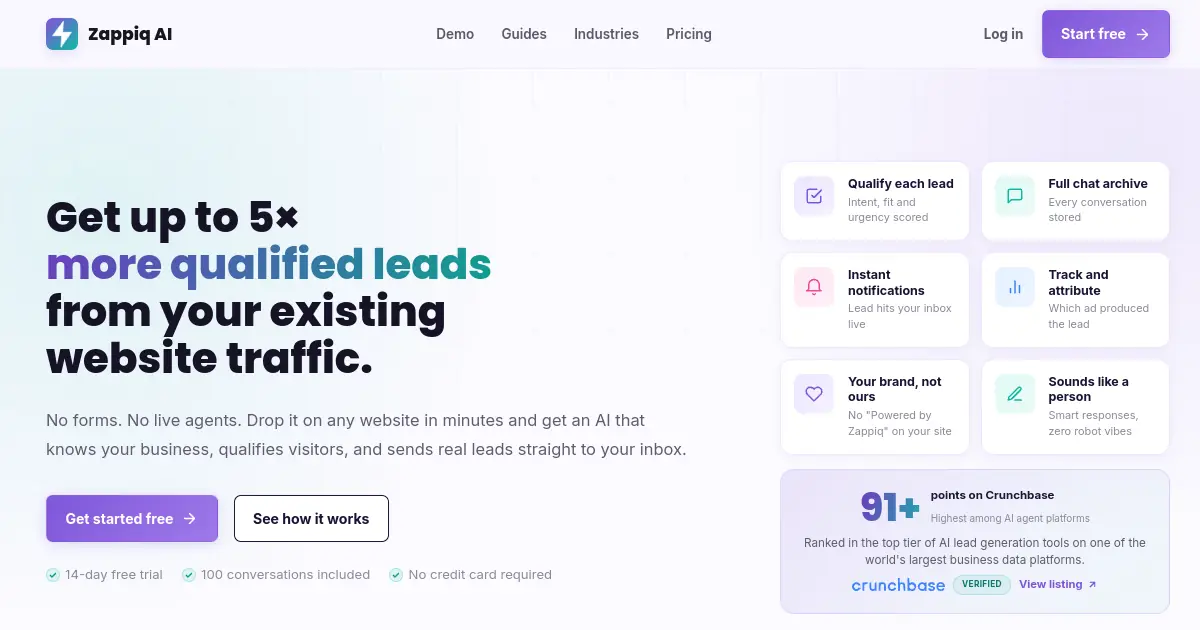
Start with the honest part: Zappiq does not answer phone calls. If your business lives on the phone, this is not your Moneypenny replacement, and you can skip to the phone options below. But Moneypenny also sells live chat, and plenty of small businesses pay for a phone service when most of their enquiries actually begin on a site after an ad click. For that second group, Zappiq does the job for a lot less money.
Setup is a URL. You paste in your website address at signup, Zappiq reads your pages, and it learns your services, pricing, team and FAQs on its own. There is no flow builder and nothing to upload. When you change a page, the bot keeps up.
Qualification happens inside the conversation rather than in a form afterwards. When a visitor shows real intent, Zappiq collects their details as part of the chat and emails you right away with the name, contact info, what they asked about, and the full thread. Calling someone back with that context beats chasing a cold voicemail.
Pricing is flat and based on conversations, not seats or minutes. Start with a 14-day trial that includes 100 conversations. Starter is $9 a month equivalent when billed annually for 350 conversations; Growth is $39 monthly or $27/month equivalent billed annually for 1,500; Pro is $99 monthly or $69/month equivalent billed annually for 5,000. A website chat and a phone call are different things, so do not read that as a like-for-like price against Moneypenny's per-minute rates. It does show how differently the two models scale.
If you spend money on ads, there is one more thing worth knowing. Each captured lead is tied back to the campaign, keyword or referral source that brought the visit, so you can see which clicks turned into real enquiries.
One script tag, any website: Zappiq installs with a single asynchronous script that works on WordPress, Shopify, Webflow, Wix, Squarespace, and any site that accepts custom HTML. No plugin to maintain.
Pros
- Flat conversation-based pricing with no per-seat fees
- Trains itself from your website URL
- Works around the clock without anyone logged in
- Qualifies visitors inside the conversation
- Ad and referral attribution included
- Instant email alerts with the full conversation
- No branding on any plan
- 14-day trial with 100 conversations
Cons
- Does not answer phone calls
- No live human agents behind the AI
- No co-browsing or screen sharing
- Newer product with a smaller community
Pricing
Best for: Small and medium businesses whose enquiries start on the website and who want AI lead capture with attribution and email delivery, not a phone service. See the plans on the Zappiq AI pricing page.
2. Ruby: Best Live Receptionist Alternative to Moneypenny
Ruby
ruby.com | Trained live receptionists billed by the minute, with no per-call add-on list
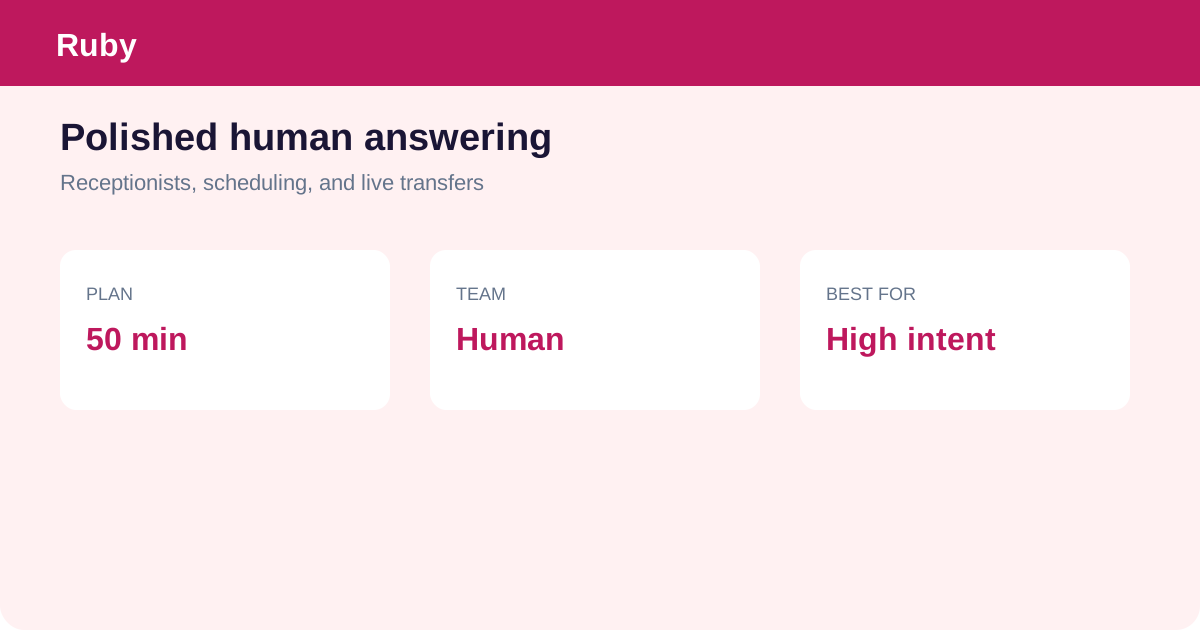
Ruby is the closest like-for-like swap for Moneypenny's human-first service. Plans are $250 a month for 50 receptionist minutes, $395 for 100, $720 for 200, and $1,725 for 500. Ruby says there are no extra fees for activation, onboarding or setup, and you do not pay per call for features like appointment booking [citation:1].
In our 200-call example, Ruby's 500-minute plan costs $1,725. That is the premium end of the live answering market. But Ruby includes more without per-call add-ons, and its receptionist minutes include hold time and exclude the talk time once a call is transferred to you or your voicemail. That matters if your team takes a lot of warm transfers.
Ruby bills receptionist minutes in 60-second increments, rounding up, and unused minutes do not roll over [citation:15]. That is less precise than Moneypenny's 30 second rounding. A 1 minute 5 second call costs 2 minutes on Ruby and 1 minute 30 seconds on Moneypenny. Over hundreds of calls, that difference adds up. Ruby does not publish an overage rate on its main pricing page, so ask before you pick a plan close to your usage.
Pros
- Trained people answering every call
- No per-call add-on charges
- No setup or onboarding fees
- Minutes include hold time but exclude transferred talk time
Cons
- Per-minute billing penalises long calls
- Overage rate is not published
- 60 second rounding is less precise than Moneypenny
Pricing
Best for: Businesses that want a person on every call, expect short calls, and prefer one price without per-call add-ons.
3. PATLive: The Cheapest Live Answering on Published Terms
PATLive
patlive.com | Month-to-month live answering with published overage rates and a 14-day free trial
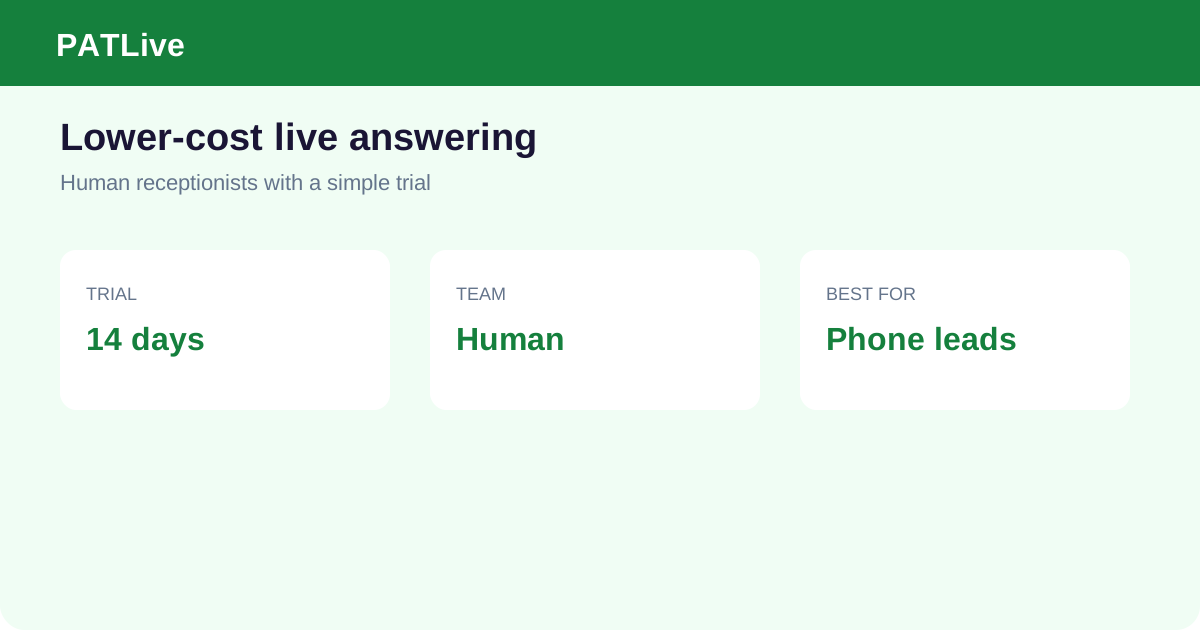
PATLive prints every tier alongside its overage rate, which is refreshing. Pay as you go is $49 a month plus $2.99 a minute. The 50-minute plan is $99, 200 minutes is $349 with $1.99 a minute after, and 500 minutes is $759 with $1.79 after. Plans run month to month, and there is a 14-day free trial [citation:1].
If a prepaid contract is what pushed you away from another vendor, this is the opposite approach: no long commitment, and the cost of going over is on the page. At 500 minutes it costs well under half of Ruby.
The limits are plain. PATLive bills the first minute of every call in full, then in 6-second increments after that. That is a different rounding model from Moneypenny's 30 second increments. A 1 minute 5 second call costs 1 minute 6 seconds on PATLive and 1 minute 30 seconds on Moneypenny. For very short calls, PATLive can actually be cheaper on rounding. For calls just over a minute, Moneypenny's 30 second rounding wins. It also has no AI tier, so every call uses a human's time.
Pros
- Month to month with a free trial
- Overage rates are published
- Lowest live-answering price in this comparison
- 6-second increments after the first minute
Cons
- First minute billed in full
- No AI front line
- Less specialised for legal intake than Smith.ai
Pricing
Best for: Businesses that want live answering on the lowest published terms and can live without an AI front line.
4. Rosie: Best AI Phone Alternative for Solo Owners
Rosie
heyrosie.com | AI phone answering sold in minute bundles from $49 a month, cancel anytime
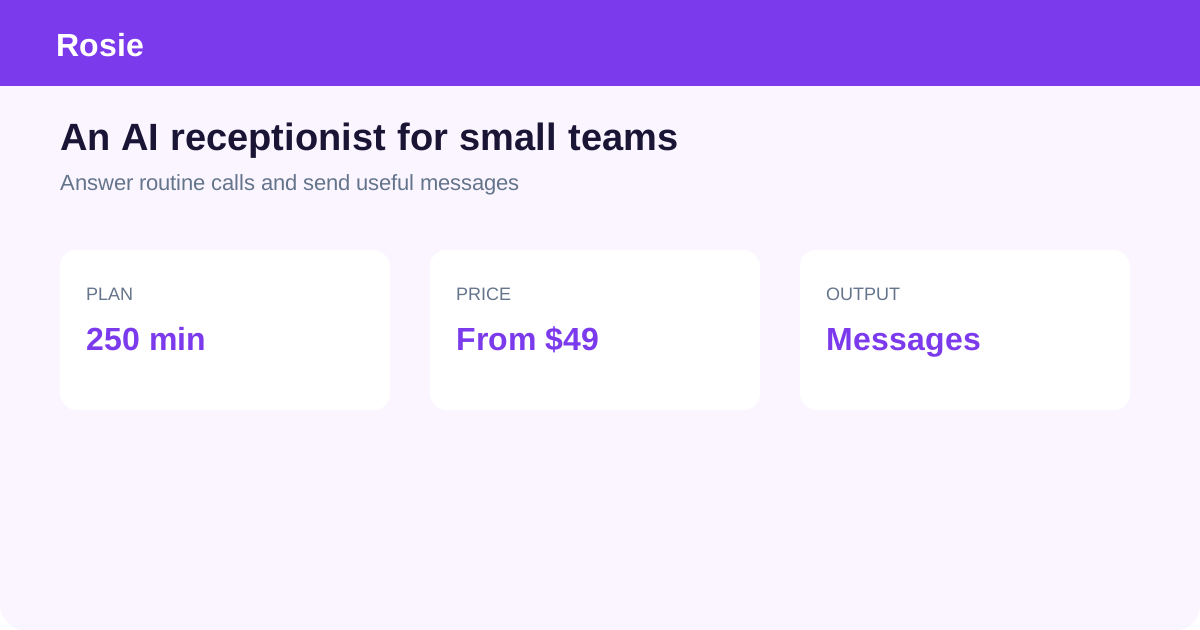
Rosie sells AI answering in minute bundles. Professional is $49 a month for 250 minutes, Scale is $149 for 1,000, and Growth is $299 for 2,000. There is a 7-day free trial, you can cancel anytime, and annual billing gets you two months free [citation:1].
For a solo operator who mostly needs calls picked up and messages taken, $49 covers the same ground as Moneypenny's entry plan at a much lower ceiling. Know the limit though: appointment booking and live call transfers start on the Scale plan, so the cheapest tier is closer to a smart message taker than a full receptionist. And Rosie bills by the minute, so longer calls use up the bundle faster.
Rosie does not publish a per-minute overage rate. Its terms describe an automatic upgrade when you exceed your minutes, and you stay upgraded until you downgrade. That is a different shape from Moneypenny's per-minute overage, and worth understanding before you commit.
Pros
- $49 entry price for a managed AI line
- Month to month with a free trial
- Annual billing gives two months free
- Plenty of minutes at the Scale tier
Cons
- Booking and transfers only from Scale
- Per-minute billing penalises long calls
- Overage terms are not published
Pricing
Best for: Solo owners and small shops that need an AI to answer, take messages and route calls on simple month-to-month terms.
5. Goodcall: Best for Businesses With Repeat Callers
Goodcall
goodcall.com | AI phone agent with unlimited minutes, priced by unique callers instead of calls
Goodcall is the cleanest fix for the complaint that per-minute bills creep up. It prices an AI agent per month, includes unlimited minutes, and caps unique customers instead of calls. Starter is $79 for 100 unique customers, Growth is $129 for 250, and Scale is $249 for 500, with $0.50 for each extra customer [citation:6].
Here is why that structure matters. A regular who phones you five times in a month is five calls on Moneypenny and one caller on Goodcall. A long, rambling call costs the same as a quick one. If your phone line is mostly existing customers and neighbours, the bill follows the number of people you serve, which is easier to forecast.
The trade-off is the bench. Goodcall has no network of human receptionists behind the AI, so when a caller needs a person, that person is you or your staff. Pricing is also per AI agent, so a business with several locations should check how many agents it would need.
Pros
- Unlimited minutes on every plan
- Repeat callers do not add to the bill
- Annual billing lowers each tier
- Easy to predict monthly cost
Cons
- No human receptionists behind the AI
- Capped by unique callers
- Priced per agent, so multi-location setups add up
Pricing
Best for: Local businesses with lots of repeat callers and staff who can take the calls the AI cannot.
6. Smith.ai: Best for Blended AI and Human Answering
Smith.ai
smith.ai | AI answering with live North American receptionists as a fallback, billed per call
Smith.ai is the option for businesses where a mishandled call is expensive. It pairs AI-first answering with live North America-based receptionists who can step in when a call needs a person. That is why its reviewer base skews heavily toward law practices [citation:1].
The pricing model is per call, not per minute. The AI Receptionist plans run from free (25 calls) to $150 for 75 calls, $270 for 150, $500 for 300 and $800 for 500. Calls over your bundle cost more, and sending an AI call to a live agent adds $3. The human-first Virtual Receptionist plans start at $300 for 30 calls and go up to $2,100 for 300 .
For our 200-call example, Smith.ai's AI-first plan costs about $385 before escalations. That is well below Moneypenny's likely range for live answering. What you get for the difference is human backup on AI calls and billing that does not change when calls run long.
Pros
- Live human backup for calls the AI cannot handle
- Per-call billing does not penalise long calls
- Legal intake training and integrations
- Free tier with 25 AI calls
Cons
- Add-ons push the real bill above the headline
- Human escalation costs $3 extra
- Prepaid plans have less flexible terms
Pricing
Best for: Law firms, medical practices and professional services where a call needs a person sometimes and the bill should not depend on how long people talk.
7. LEX Reception: Best Legal-Specific Live Answering
LEX Reception
lexreception.com | 24/7 live answering and client intake built specifically for law firms, with legal software integrations
LEX Reception is a live answering service built specifically for the legal sector. Where Moneypenny is general-purpose, LEX leads with legal intake: handling calls, qualifying potential clients, scheduling appointments, and integrating with legal software to streamline law firm operations [citation:1][citation:13].
The pitch is that a receptionist who understands the difference between a personal injury inquiry and a contract dispute does a better job than a generalist. LEX receptionists can collect case details, run conflict checks, and route based on firm instructions. For law firms where a mishandled intake call is expensive, that matters.
LEX Reception does not publish its pricing on the main site, so you will need a quote. That is a different shape from PATLive's published rate card. If price transparency is a priority, PATLive has the edge. If legal-specific intake is the priority, LEX is worth a call.
Pros
- Built specifically for law firms
- Legal intake and client qualification
- Integrates with legal software
- 24/7 coverage
Cons
- Pricing requires a quote
- Less general-purpose than Moneypenny
- Smaller reviewer base
Pricing
Best for: Law firms that want live receptionists with legal-specific training and intake workflows, and prefer a specialist over a general answering service.
How to Pick the Right Moneypenny Alternative
Start with this question: do your calls need a person, or would an AI handle them just as well?
That one question sorts this list better than any feature table. Human answering services cost more per minute. AI answering services cost less and never sleep. The right answer depends on what your callers actually need.
- You want cheaper live answering: PATLive, with published rates and month-to-month terms.
- You want a premium human service with more inclusive features: Ruby.
- You want AI answering instead of people: Rosie, Goodcall or Smith.ai.
- Your calls run long and you want a person: Ruby or PATLive. Per-minute billing hurts less when you know the average and can pick the right tier.
- You run a law firm: LEX Reception for legal-specific intake.
- Enquiries start on the website, often from ads: Zappiq AI, with a phone service alongside if you still need one.
One more thought on rounding. Moneypenny bills in 30 second increments, which is more precise than most competitors. But rounding is only one factor. Whichever tool you choose, run your last three months of call data through its pricing and rounding rules before you sign.
Before You Cancel Moneypenny
A clean switch takes a little planning, mostly around your phone number and your call instructions.
- Find out who owns your number. If callers dial your own number and you forward it to Moneypenny, switching is a forwarding change. If Moneypenny assigned the number, ask about porting it before you cancel.
- Check your contract terms. Moneypenny plans have terms that vary by contract. Check your specific agreement for notice periods and early termination terms before you cancel.
- Export your records. Download call recordings, transcripts and lead logs before the account closes.
- Copy your call instructions. Intake questions, routing rules and transfer destinations are set up per vendor. Keep yours and rebuild them, fixing any question callers disliked.
- Reconnect your calendar and CRM. Those links do not carry over.
- Run both for a week. Test the new service with real questions before you move live traffic.
Is your website losing leads while you pay for a phone line?
Try Zappiq AI with a 14-day trial and 100 conversations and see what a website-trained chatbot captures from your own traffic.
Start free14-day trial · 100 conversations | Cancel anytime
Frequently Asked Questions
Moneypenny sells answering plans in minute bundles and bills usage in 30 second increments, which is more precise than the full minute rounding most competitors use. Pricing varies by plan and region, so check the current Plans and Pricing page. Overage is billed at your plan rate using the same 30 second increments.
Moneypenny does not publish a free tier. It offers a trial or demo so you can test the service with real calls. Contact sales or check the website for current trial terms.
It depends on what you need. If you want a cheaper live answering service, Ruby and PATLive are strong options. If you want AI answering instead of people, Rosie starts at $49, Goodcall at $79, and Smith.ai has a free AI tier for 25 calls. If your leads start on the website, Zappiq AI captures those visitors without a phone plan.
In a 200-call month of 2.5 minutes per call, Retell comes to roughly $59 if you build it yourself. Goodcall is $129 for 250 unique callers. Rosie's 1,000-minute plan is $149. Moneypenny's own per-minute rates vary by plan, so run your own call minutes through its pricing before comparing.
Yes. Moneypenny bills usage in 30 second increments, where most competitors round up to the full minute. A 1 minute 5 second call is billed as 1 minute 30 seconds, not 2 minutes. Over hundreds of calls, that difference stretches your minute package further and reduces overage risk.
It depends on call length and rounding. Ruby bills in 60 second increments, rounding up, so short calls cost more on Ruby than on Moneypenny. Moneypenny's 30 second rounding means a 1 minute 5 second call costs 1 minute 30 seconds on Moneypenny and 2 minutes on Ruby. Run your own call data through both pricing models before you decide.
Moneypenny offers bilingual support, but availability and pricing depend on your plan and region. Ask about Spanish coverage in your time zone before you rely on it. Some competitors charge a separate bilingual add on.
Moneypenny plans have terms that vary by contract. Check your specific agreement for notice periods and early termination terms before you cancel. Some plans are month to month, others carry longer commitments.
Yes. Moneypenny sells live chat alongside its phone answering services, priced separately from the call plans. Ask for the current chat rate before you compare it with an AI chatbot.
It can be, especially if you want live UK based or US based receptionists and your calls are short. The 30 second rounding is a real advantage over full minute competitors. But Moneypenny is a premium service, so if budget is the priority, AI only tools or cheaper human services cover much of the same ground.
Smith.ai is the closest fit, since its intake training and legal integrations are built for law practices. Ruby and LEX Reception are the human answered alternatives. If your intake begins on the website, Zappiq AI can capture those leads without a phone service.
Only for the website side. Zappiq AI is a website chatbot that qualifies visitors and emails you the lead. It does not answer phone calls, so keep a phone service if calls are your main source of new business.
Zappiq AI offers a 14-day trial with 100 conversations. Starter is $9/month equivalent billed annually for 350 conversations; Growth is $39 monthly or $27/month equivalent billed annually for 1,500; Pro is $99 monthly or $69/month equivalent billed annually for 5,000, with no per-seat fees.
The Bottom Line
Moneypenny is a well-reviewed live answering service with a genuine billing advantage: 30 second rounding, where most competitors round up to the full minute. That stretches your minute package further and reduces overage risk. The trade-offs are price and transparency. Moneypenny is a premium service, and its pricing is not fully public, so you have to contact sales to compare.
Pick by channel first and price second. Phone-first businesses that need people should compare PATLive, Ruby and LEX Reception against their own call minutes and rounding patterns. Businesses that would be fine with AI should compare Rosie, Goodcall and Smith.ai. Website-first businesses are better served by a lead capture chatbot than by a phone service stretched across both jobs.
Zappiq AI is built for the website side. It offers a 14-day trial with 100 conversations, followed by Starter at $9/month equivalent billed annually for 350 conversations, Growth at $39 monthly or $27/month equivalent annually for 1,500, and Pro at $99 monthly or $69/month equivalent annually for 5,000. No plan includes Zappiq branding. Whatever you choose, test it with real customer questions and recheck the vendor's current pricing page before you commit.
References
- CB Insights. "Moneypenny's alternatives and competitors." cbinsights.com.
- Moneypenny. "Moneypenny pricing overages explained: how answering service billing really works." us.moneypenny.com.
- Cekura. "9 Best-Rated AI Virtual Receptionist Voice Tools in 2026 (Tested)." cekura.ai.
- Bluehost. "How much does a virtual receptionist cost for small businesses in 2026?" bluehost.com.
- Gartner. "RingCentral AI Receptionist Alternatives." gartner.com.
- Retell AI. "What Is a Virtual Receptionist? Costs, Human vs AI, 2026." retellai.com.
- TrustRadius. "Best Moneypenny Alternatives & Competitors in 2026." trustradius.com.
- InsertChat. "AI Receptionist Cost: Pricing Models Explained." insertchat.com.

Ansar Ali
Ansar Ali is the founder of Zappiq AI, a lead-capture platform built for small businesses that cannot afford to lose high-intent website visitors. He writes about chatbot tools, pricing models, and lead generation tactics from the perspective of a small business operator, with a focus on what things actually cost versus what the marketing page says they cost.