
Quick Summary
Short answer: Cognigy is now part of NICE Cognigy and remains available through the NICE ecosystem and as a standalone offering. The best alternative depends on your use case: Zappiq AI is the practical choice for website lead capture, Voiceflow for teams that want to build and control their own agents, Forethought or Ada for support automation, and Omilia for voice-first IVR modernization.
- Zappiq AI: best for website visitor qualification and lead capture without a sales-led implementation project.
- Voiceflow: best for teams that want control over agent logic, knowledge, model choice, and deployment channels.
- Kore.ai: the closest broad enterprise comparison for organizations automating CX and EX across departments.
- Yellow.ai: a fit for enterprises looking for agentic automation across customer and employee journeys.
- Ada: focused on high-volume, multilingual customer service automation and deflection.
- Forethought: focused on support resolution, ticket triage, agent assistance, and helpdesk workflows.
- Omilia: worth evaluating when voice and IVR modernization are the primary requirements.
What Happened to Cognigy and Why Mid-Market Teams Are Looking Elsewhere
Cognigy earned its reputation. The platform was built for high-volume contact center automation, with multilingual support across 100+ languages, HIPAA compliance, on-premise deployment options, and a visual flow builder that let conversation designers work without writing code. For large enterprises with dedicated technical teams, it did the job well. Lufthansa, Toyota, and DHL are named customers handling millions of conversations on the platform.
Then NICE completed its acquisition of Cognigy on September 8, 2025. NICE says Cognigy is available both through the CXone ecosystem and as a standalone offering, so the product did not simply disappear; the buying decision is now tied more closely to NICE's broader CX strategy. For teams already running NICE CXone, that integration can mean fewer vendors and more unified data.
For teams outside the NICE ecosystem, the key question is fit rather than availability. You are evaluating Cognigy's enterprise-grade capabilities alongside a larger vendor relationship, implementation model, and product stack. That may be exactly what a large contact center wants; it can be more operational overhead than a marketing, support, or mid-market team needs.
The pricing reality: Cognigy does not publish public pricing. Expect a sales-led evaluation, solution design, and an implementation conversation rather than a self-serve checkout. Budget for the people, integrations, testing, and governance around the platform—not only the software license.
There is also the implementation reality. Enterprise conversational AI deployments can take weeks or months once integrations, security review, conversation design, analytics, and testing are included. For a team without a dedicated conversational AI owner, that is a significant commitment before the first production conversation happens.
The pattern is familiar across the conversational AI market: a platform can be technically capable and still be a poor operational fit. The most useful Cognigy comparison is therefore not “which product has the longest feature list?” but “which platform solves our specific workflow with the least avoidable complexity?”
What Cognigy Does Well—and Where It May Be Overkill
Cognigy is a strong fit when conversational AI sits inside a larger contact-center program. Its value is highest when you need complex routing, multiple channels, enterprise governance, integrations with existing CCaaS systems, multilingual service, and a team that can continuously design, test, and maintain the experience.
It becomes harder to justify when the requirement is narrower: answer questions on a marketing site, qualify a visitor, reduce repetitive helpdesk tickets, or modernize one voice journey. In those cases, a focused tool can reach production faster and give the team a clearer success metric. A smaller product is not automatically more capable; it is often simply better aligned with the job.
Use case first: Write down the one workflow that must improve after the switch. “Automate customer experience” is too broad to evaluate. “Qualify paid-traffic visitors and send sales-ready leads to email within one minute” is specific enough to test.
Where Cognigy Users Are Actually Looking in 2026
Cognigy users are not all looking for the same replacement. Teams that used Cognigy primarily for contact center voice automation are evaluating different options than teams that used it for website chat. The important distinction is between replacing the enterprise contact center function and replacing the website lead capture or support function that Cognigy was doing alongside it.
For teams that need to modernize an existing Genesys or Avaya contact center, Cognigy remains worth evaluating because of its enterprise integration depth. For teams on a modern SaaS stack, the calculation is different. The alternatives below are organized by the job they actually do, not by feature parity with Cognigy's full enterprise platform.
- Website lead capture and qualification: Zappiq AI for automatic training, visitor qualification, and lead delivery.
- Independent conversational AI platform: Voiceflow for teams that want to own their agent logic, content, and model choices.
- Broad enterprise automation: Kore.ai or Yellow.ai for organizations orchestrating CX and EX across departments.
- Customer service deflection: Ada or Forethought for support-focused automation connected to helpdesk workflows.
- Voice-first IVR modernization: Omilia for teams where phone automation is the primary channel.
What Cognigy Actually Costs vs the Alternatives
The tools below replace different pieces of what Cognigy does. No single product does everything Cognigy does for every team, because Cognigy itself was being stretched across jobs that range from enterprise contact center automation to basic website chat. The honest answer is matching your actual use case to the tool built for it.
Quick Comparison: 7 Cognigy Alternatives
| Tool | Starting Price | Best For | Setup Time | Free Option |
|---|---|---|---|---|
| Zappiq AI | Starter from $9/mo equivalent billed annually for 350 conversations | Website lead capture and qualification | Under 10 min | 100 conversations |
| Voiceflow | Free, paid from ~$60/mo | Independent conversational AI platform | Hours to days | Yes, individual tier |
| Kore.ai | Quote only | Enterprise CX and EX orchestration | Weeks to months | No |
| Yellow.ai | Quote only | Agentic AI with faster deployment | Weeks | No |
| Ada | Quote only | Customer service deflection | Weeks | No |
| Forethought | Quote only | AI support ticket resolution | Weeks | No |
| Omilia | Quote only | Voice-first IVR modernization | Weeks to months | No |
Before picking a replacement: Decide which job Cognigy was doing for your team. If it was capturing and qualifying website visitors, the tools at the top of this list were purpose-built for that. If it was contact center voice automation, you are looking at a different category with different requirements.
1. Zappiq AI: Best for Website Lead Capture Without Enterprise Overhead
Zappiq AI
zappiqai.com | AI lead generation chatbot for small and medium business websites, no implementation partner required
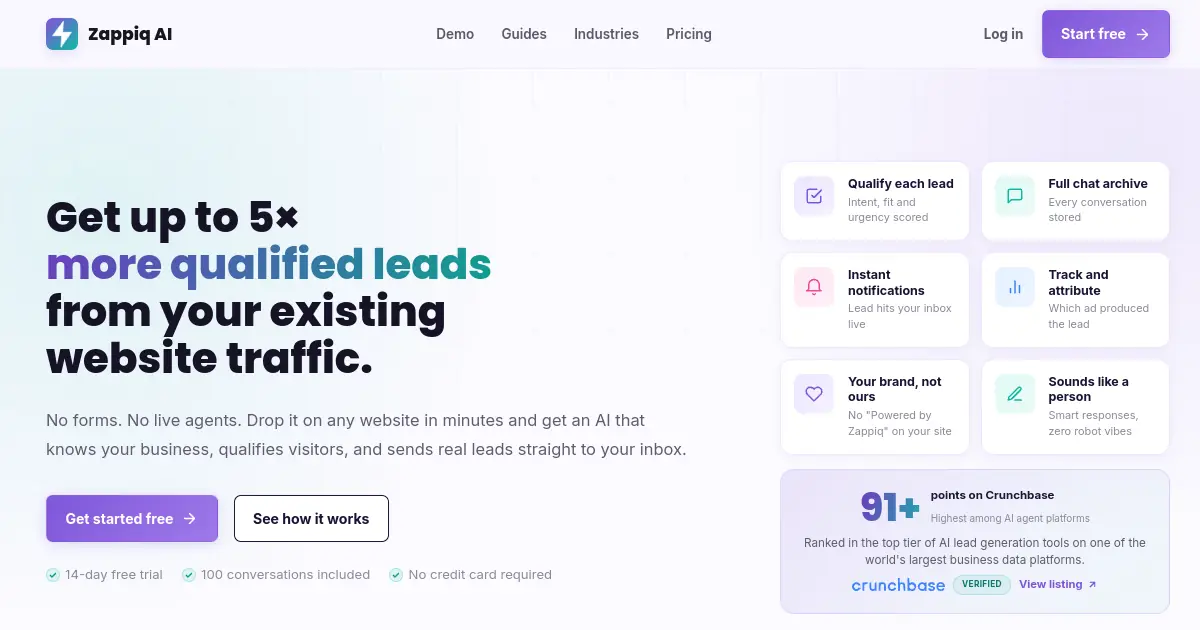
The comparison between Cognigy and Zappiq AI is almost entirely about scope. Cognigy is built to orchestrate conversations across an enterprise contact center with dozens of integrations, multiple departments, and compliance requirements that range from HIPAA to on-premise deployment. Zappiq AI is built to do one thing well: turn website visitors into qualified leads and deliver them to your team while the conversation is still relevant.
For a mid-market team, that narrower scope is the point. You install a script, Zappiq reads your website, and there is a working chatbot answering visitor questions within minutes. There is no flow builder to navigate before the first conversation, no knowledge base to manually configure, no integration endpoints to document. The AI trains itself on your content and starts from there. If something needs adjustment, you adjust it. The base state is already functional.
Cognigy's qualification model requires someone to design the conversation flow before the platform can do anything useful. That is not a criticism. Enterprise contact centers have complex qualification logic that requires deliberate design. But mid-market teams usually do not have that complexity. They need a chatbot that asks about intent, timeline, and fit before collecting contact details, and then sends the lead to the right person. Zappiq handles that as part of the core product rather than a configuration project.
The moment a visitor qualifies, Zappiq emails you the full lead: contact details, intent summary, and the complete conversation transcript. That combination of speed and context matters because website visitors who are ready to buy do not stay ready for long. A lead that sits in a shared inbox for three hours is a different lead than one that arrives with context while the conversation is still fresh.
Pricing is structured around conversation volume rather than outcome count, seat count, or enterprise tier. The same traffic spike that would trigger a conversation about contract expansion at an enterprise vendor does not change your Zappiq bill. For a mid-market team running paid traffic, that predictability matters more than it might seem until the first month you run a campaign and watch volume spike.
Integration options: Zappiq connects to Zapier, Make, and n8n, which means a qualified lead can be pushed into your CRM, a Slack channel, or any other tool your team already uses without touching a line of code. Ad attribution is tracked per lead, so you know which campaign or keyword brought a visitor before they became a contact.
Cognigy vs Zappiq AI
| Decision point | Cognigy (NICE) | Zappiq AI |
|---|---|---|
| Primary fit | Enterprise contact center automation | Mid-market website lead capture |
| Setup | Sales-led implementation; timeline varies by scope | Under 10 minutes, self-serve |
| Lead handoff | Complex routing and escalation workflows | Email delivery with contact details, source data, summary, and transcript |
| Pricing approach | Quote only; plan for implementation and governance | 14-day trial with 100 conversations; Starter $9/mo annual equivalent (350), Growth $39/mo monthly or $27/mo annual equivalent (1,500), Pro $99/mo monthly or $69/mo annual equivalent (5,000) |
Pros
- No developer or implementation partner needed to go live
- Trains automatically on your website from day one
- Flat pricing, no enterprise contract or usage meter
- Lead qualification built in, not a separate configuration layer
- Instant email alerts with full conversation transcript
- Ad source and campaign attribution per lead
- No branding added to the widget on any plan
- Webhook routing to Zapier, Make, and n8n
Cons
- Not a full contact center platform or helpdesk system
- No voice channel or IVR support
- No multi-department orchestration for IT, HR, and operations
- Younger platform compared to enterprise vendors
Pricing
Best for: Mid-market teams that need website visitor qualification and lead capture without an enterprise contract, implementation partner, or months-long deployment. Service businesses, agencies, clinics, legal, real estate, home services, and anyone running paid traffic who wants to know exactly what a lead cost them.
voiceflow">2. Voiceflow: Best for Owning Your Conversational AI Platform
Voiceflow
voiceflow.com | Visual conversational AI platform with bring-your-own model, voice support, and independent product direction
Read the Voiceflow alternatives guide →
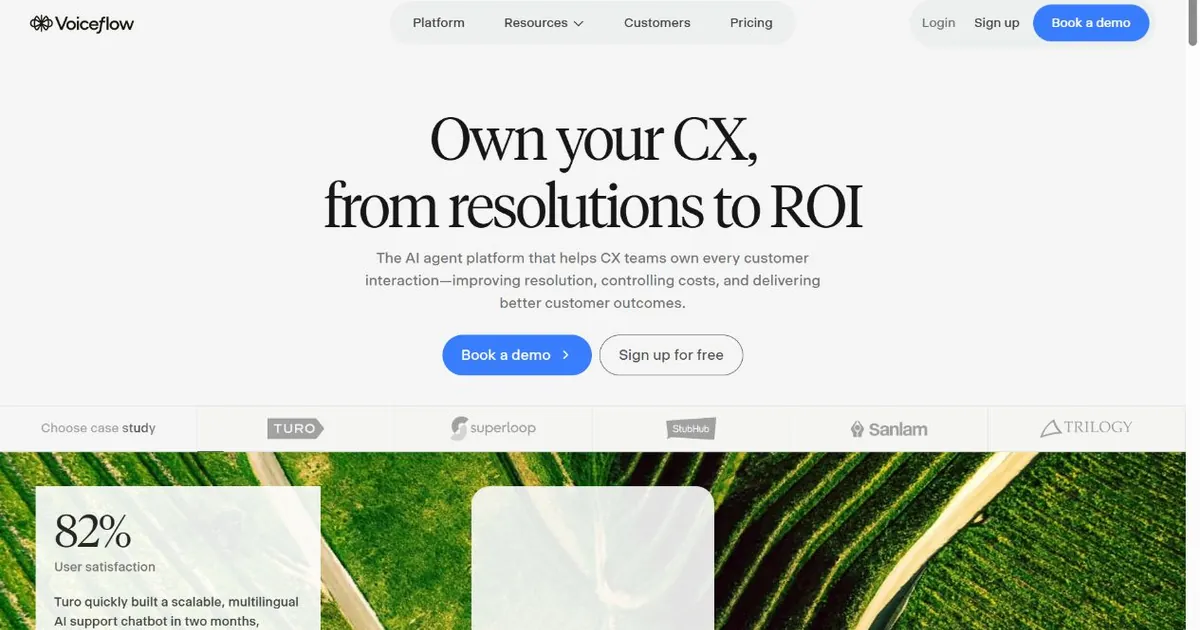
Voiceflow's pitch against Cognigy is control. Teams use it to build, test, launch, and manage agents from a central platform, with knowledge bases, workflows, custom code, and the option to use different model providers. That matters when the team wants to own the agent experience instead of adopting a prepackaged contact-center stack.
The technical difference is in model strategy. Voiceflow supports multiple AI vendors and lets teams combine agentic instructions with deterministic workflows, custom code, and business content. Cognigy is the better fit when you want a packaged enterprise CX platform; Voiceflow is the better fit when your team wants to design the operating model itself.
Voice deployment is another differentiator. Voiceflow shipped with native voice agent support across IVR, phone, and voice apps, so you build the voice agent once and deploy across channels. Cognigy also supports voice, but Voiceflow's positioning is built around owning that capability rather than depending on a separate voice gateway component.
The tradeoff is implementation effort. Voiceflow gives you more control, which means more decisions to make. It is a platform you build on rather than a product you install. For a mid-market team with someone who can own the conversational AI workflow, that tradeoff is worth it. For a team that wants a working chatbot with minimal setup, Zappiq or a simpler tool is a better fit.
Cognigy vs Voiceflow
| Decision point | Cognigy (NICE) | Voiceflow |
|---|---|---|
| Vendor status | Acquired by NICE, part of CXone | Independent, venture-funded |
| Model strategy | NICE purpose-built CX AI models | Bring-your-own model or open-weight |
| Voice support | Via Voice Gateway integration | Native across IVR, phone, and voice apps |
| Control | Vendor-managed inside CXone | Full control over flows, prompts, and model choice |
Pros
- Independent platform with clear product direction
- Bring-your-own model including self-hosted options
- Native voice support across IVR, phone, and voice apps
- Visual agent builder with full control over flows
- Same enterprise readiness including SOC 2 Type 2 and PII masking
Cons
- Requires more implementation effort than a self-serve tool
- Not a contact center platform with agent routing and telephony
- No CRM integration out of the box without additional configuration
Pricing
Best for: Teams that want to own their conversational AI platform independently and have the technical resources to build and maintain it. Strong for voice-first deployments and teams that need model flexibility.
Need website leads without an enterprise contract?
Zappiq AI trains on your site in minutes, qualifies every visitor automatically, and sends you the lead before the conversation goes cold. No demo required. No annual minimum.
Start Free TrialNo credit card | No developer needed | No branding on any plan
3. Kore.ai: Best for Broad Enterprise Automation
Kore.ai
kore.ai | Conversational AI platform positioned as enterprise-wide orchestration across CX and EX
Read the Kore.ai alternatives guide →
Kore.ai is the closest functional match to Cognigy for organizations that need broad enterprise automation across multiple departments. Its positioning spans customer experience and employee experience, so the platform can support customer service, IT, HR, and operations use cases from the same governance model. For buyers evaluating Cognigy as part of a larger enterprise strategy, Kore.ai is a natural comparison.
The difference is in positioning. Kore.ai emphasizes enterprise-wide orchestration across CX and EX, while Cognigy is especially compelling when contact-center automation, channel depth, and complex service operations are the center of the project. Both approaches have merit: choose based on whether cross-department breadth or contact-center depth is the harder requirement.
The tradeoff with Kore.ai is the same as with Cognigy: enterprise pricing, enterprise implementation timelines, and enterprise resource requirements. It is not a platform you evaluate with a credit card trial. If your team is mid-market without a dedicated automation team, Kore.ai is likely more platform than you need.
Cognigy vs Kore.ai
| Decision point | Cognigy (NICE) | Kore.ai |
|---|---|---|
| Positioning | High-volume contact center specialist | Enterprise-wide CX and EX orchestration |
| Best for | Contact center automation | Cross-department automation |
| Operating model | Enterprise CX program with implementation and governance | Enterprise CX and EX program with implementation and governance |
| Pricing | Quote only | Quote only, enterprise |
Pros
- Broad automation across CX and EX
- Analyst-recognized leader in conversational AI
- Strong enterprise support and partner ecosystem
- Fits organizations with multi-department automation needs
Cons
- Enterprise pricing and implementation requirements
- More platform than most mid-market teams need
- Requires dedicated technical resources
Pricing
Best for: Large enterprises that need coordinated automation across customer service, IT, HR, and operations on a single platform with dedicated technical resources to implement and maintain it.
4. Yellow.ai: Best for Agentic AI with Faster Deployment
Yellow.ai
yellow.ai | Agentic AI platform positioned for enterprises that want automation capabilities with faster time to value
Read the Yellow.ai alternatives guide →
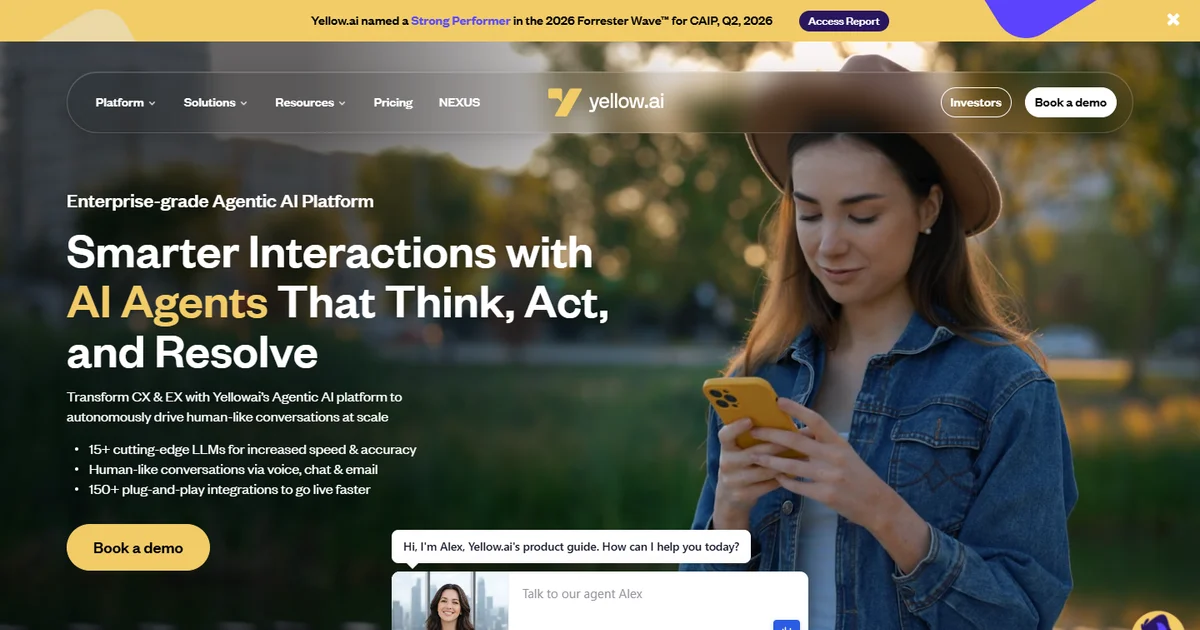
Yellow.ai appears in the same enterprise conversational AI conversations as Cognigy and Kore.ai, but positions itself around agentic AI and faster deployment. The platform is built for organizations that want automation capabilities without the traditional enterprise timeline, though "faster" in enterprise terms still means weeks rather than the ten minutes a self-serve tool takes.
Yellow.ai is positioned for enterprises that want to move quickly on AI automation while keeping enterprise integrations, analytics, and governance in the buying conversation. Its breadth makes it more comparable to Cognigy than a simple website chatbot, but the same breadth also means more solution design and operational ownership than a focused mid-market tool.
For mid-market teams, Yellow.ai is most sensible when there is a clear multi-channel or multi-department roadmap behind the purchase. If the immediate goal is only website lead capture, a focused alternative will usually be faster to launch and easier to measure.
ada">5. Ada: Best for Customer Service Deflection
Ada
ada.cx | Customer service automation platform focused on volume deflection, multilingual support, and CSAT improvement
Read the Ada alternatives guide →
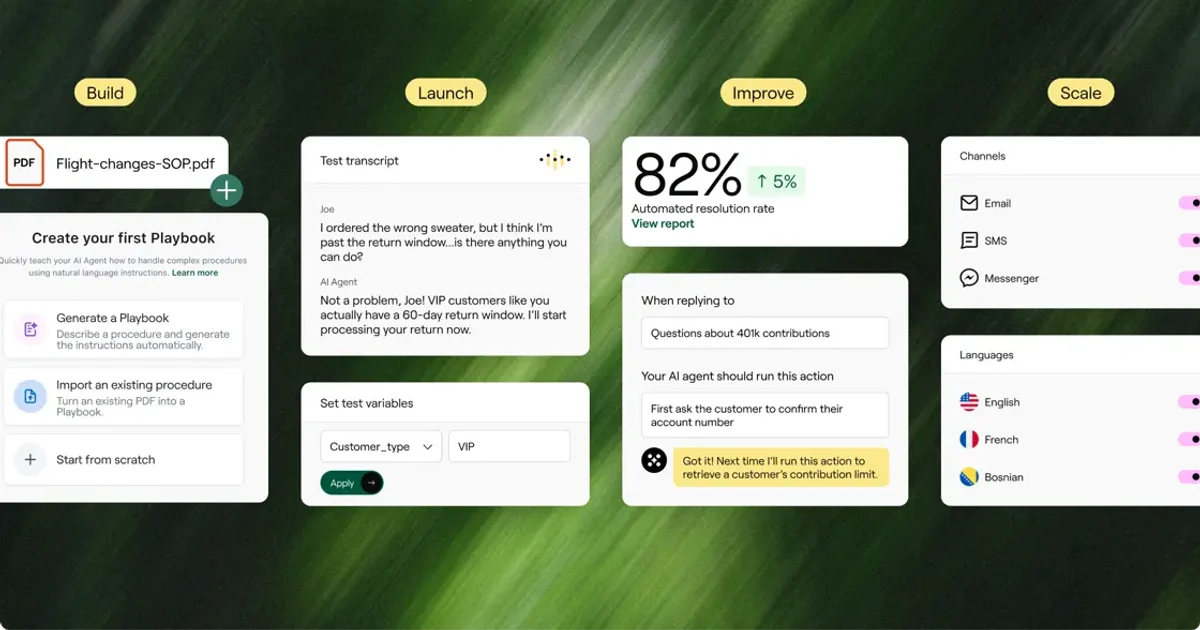
Ada is positioned differently from Cognigy and Kore.ai. It is a customer service specialist rather than a broad enterprise automation platform. The focus is on resolving repetitive service requests, preserving context across channels, and giving enterprise teams tools to measure and improve the AI agent over time.
For teams that used Cognigy primarily for customer support automation, Ada covers that narrower scope well. Its value is strongest when the business has high interaction volume, a well-maintained knowledge base, and clear service policies that the agent can follow. It is not built for complex revenue cycles or cross-department orchestration, but it does not try to be.
The tradeoff is a sales-led buying process and an enterprise operating model. For a support organization that needs multilingual, omnichannel automation, that can be a reasonable trade. For website lead generation, Ada is the wrong category because its center of gravity is service resolution rather than demand capture.
Cognigy vs Ada
| Decision point | Cognigy | Ada |
|---|---|---|
| Primary fit | Enterprise conversational AI and contact-center automation | Customer service automation and deflection |
| Best signal | Complex routing, integrations, and multi-channel orchestration | High-volume service questions across channels and languages |
| Team required | Conversation design, integration, and CX operations resources | Support operations and knowledge-management ownership |
| Pricing | Quote only | Quote only |
Pros
- Built around customer service outcomes
- Omnichannel and multilingual deployment
- Enterprise security and governance focus
- Continuous measurement and optimization
Cons
- Not a general-purpose website lead-generation tool
- Sales-led implementation and quote-based pricing
- Requires clean support content and clear policies
Pricing
Best for: Larger support organizations that need measurable deflection, multilingual service, and an AI agent that can operate inside established customer-care processes.
forethought">6. Forethought: Best for AI Support Ticket Resolution
Forethought
forethought.ai | AI agents for support resolution, ticket triage, knowledge gaps, and agent assistance
Read the Forethought alternatives guide →
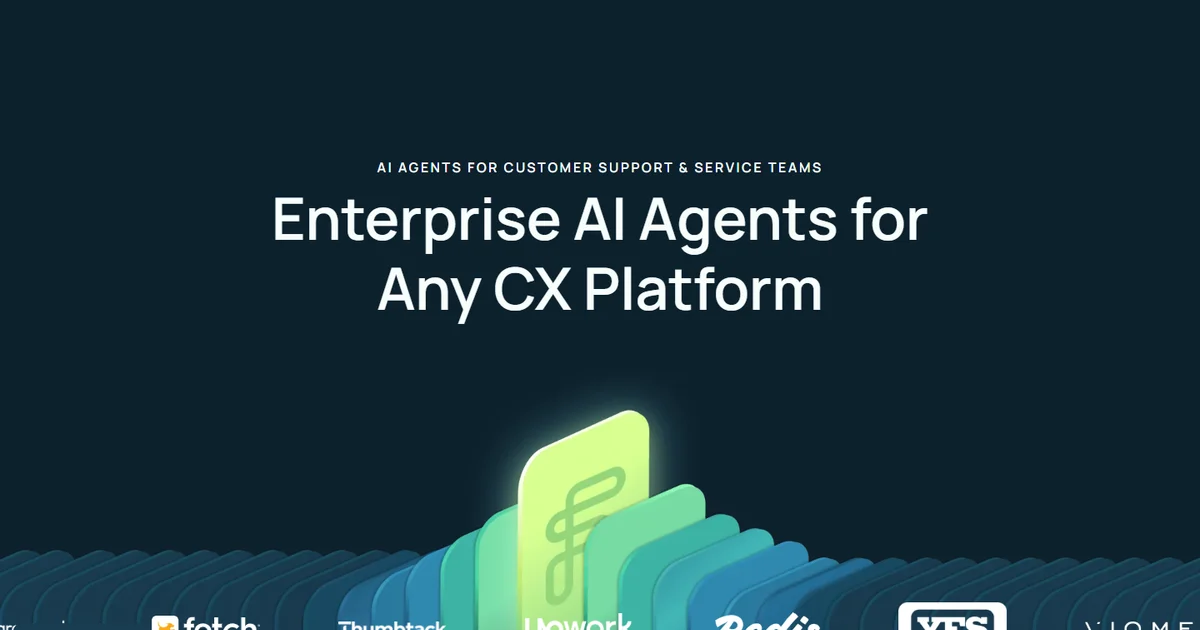
Forethought focuses specifically on customer support. Its product family covers AI-assisted insights, ticket classification, omnichannel resolution, and agent assistance, so it can sit across the support journey rather than only answering a chat widget.
Like Ada, Forethought is a specialist rather than a broad conversational AI platform. It is not designed for website lead capture or multi-department automation. For teams that used Cognigy for ticket deflection, triage, or agent productivity, it can be a closer operational fit than rebuilding the entire contact-center layer.
The key buying question is whether your support data is ready. Forethought can learn from historical tickets and help-center content, but the quality of the outcome still depends on clear policies, reliable knowledge, and a well-defined escalation path. It is a support-operations investment, not a plug-and-play marketing chatbot.
Cognigy vs Forethought
| Decision point | Cognigy | Forethought |
|---|---|---|
| Primary fit | Broad conversational AI and contact-center automation | Support resolution, triage, and agent assist |
| Starting point | Conversation orchestration across channels | Historical tickets, help-center content, and helpdesk workflows |
| Best for | Organizations building a wider CX automation program | Support teams reducing ticket volume and response time |
| Pricing | Quote only | Quote only |
Pros
- Support-specific AI agents for different jobs
- Ticket classification and routing automation
- Agent-assist workflows inside the helpdesk
- Omnichannel support options
Cons
- Not intended for website lead qualification
- Requires historical support data and content quality
- Sales-led evaluation and implementation
Pricing
Best for: Support leaders who want to reduce ticket volume, improve routing, and give human agents contextual help without replacing their helpdesk.
omilia">7. Omilia: Best for Voice-First IVR Modernization
Omilia
omilia.com | Conversational AI platform focused on voice, chat, and IVR modernization
Read the Omilia alternatives guide →
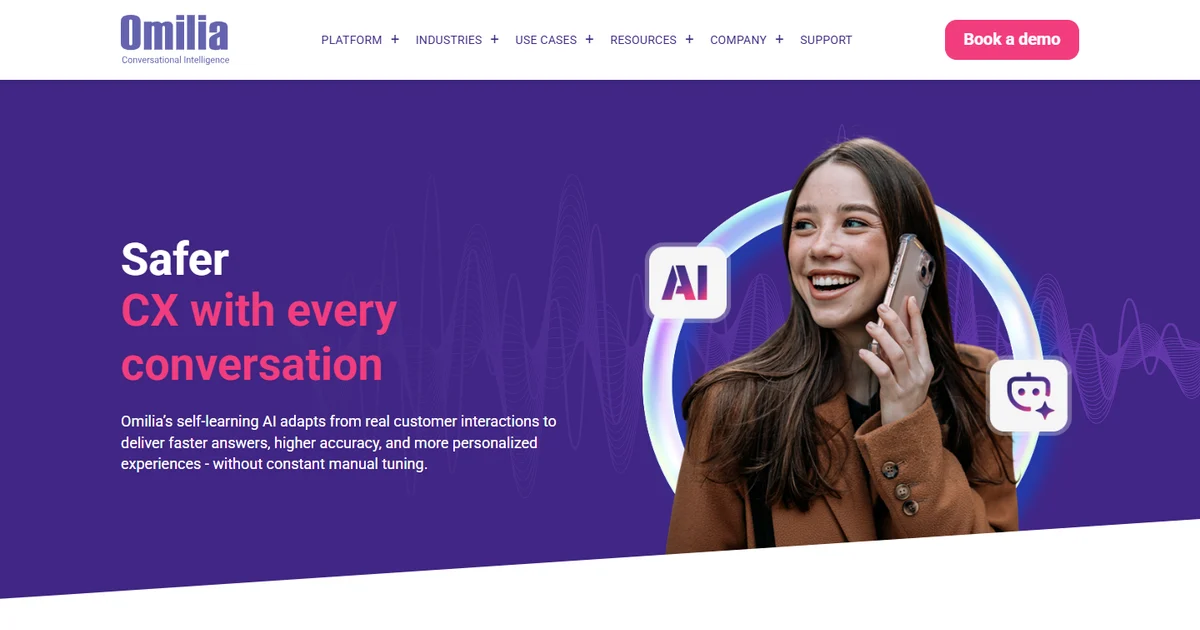
Omilia is a voice-first specialist. The platform is built for organizations that need to modernize IVR systems, handle phone-based customer service, and create more natural voice journeys. It also offers chat agents, but voice is the clearest reason to put it on a Cognigy shortlist.
For teams that used Cognigy primarily for voice automation and IVR modernization, Omilia is a direct alternative to investigate. The focus is on phone conversations, which means the evaluation should center on recognition accuracy, containment, handoff quality, latency, analytics, and how quickly the team can update the call flows.
Omilia is not the obvious choice for a simple website chatbot or a small lead-generation program. The implementation timeline and pricing follow the enterprise pattern: solution design, telephony integration, testing, and a quote-led commercial process.
Cognigy vs Omilia
| Decision point | Cognigy | Omilia |
|---|---|---|
| Primary fit | Multi-channel enterprise conversational AI | Voice-first customer service and IVR modernization |
| Core evaluation | Orchestration, integrations, governance, and channel coverage | Voice quality, containment, latency, and telephony handoff |
| Best for | Contact centers with multiple automation surfaces | Organizations where phone remains the highest-value channel |
| Pricing | Quote only | Quote only |
Pros
- Voice-first conversational experience
- Strong fit for IVR modernization projects
- Useful when phone containment is a measurable goal
- Chat capabilities available for broader service journeys
Cons
- Overkill for basic website lead capture
- Telephony and call-flow integration add project work
- Quote-based enterprise buying process
Pricing
Best for: Contact centers modernizing phone support, especially when the success metric is better self-service, containment, and handoff quality rather than web conversion.
How to Evaluate a Cognigy Alternative
Start with the job, not the feature list: The right replacement depends on which specific thing Cognigy was doing for your team. Answering that question first saves time on comparisons that were never relevant.
Cognigy was used differently by different teams, which is part of why this list does not have one obvious answer. Enterprise contact centers used Cognigy for voice automation and complex routing. Support teams used it for ticket deflection. Marketing teams used it for website chat and lead qualification. None of those jobs requires the same replacement.
If your team needs to modernize an existing Genesys or Avaya contact center, Cognigy remains worth evaluating because of its enterprise integration depth. The alternatives on this list that focus on voice, like Omilia, are worth evaluating if that is the primary requirement.
If your use case is website lead capture and qualification without the enterprise complexity, a focused tool like Zappiq AI covers that job directly. The key difference from Cognigy is that Zappiq starts with a working chatbot from day one without requiring an implementation project before anything happens. For a mid-market team looking for a practical alternative, that simplicity matters a great deal.
For teams already running NICE CXone, the consolidation works in your favor. The tighter integration with Agent Copilot and Knowledge AI is a genuine benefit if you are already in that ecosystem. For teams not on CXone, the question is whether the NICE stack is where you want to be. If the answer is no, the alternatives above are the starting point.
Five buying criteria that matter more than feature count
- Channel fit: confirm whether you need web chat, email, messaging, voice, or a shared experience across all of them.
- Knowledge ownership: check how content is imported, reviewed, cited, updated, and retired when your policies change.
- Handoff quality: test escalation to people, including context, transcript, routing rules, and the system of record.
- Measurement: define the outcome before the demo—qualified leads, containment, resolution rate, response time, or agent productivity.
- Exit path: ask how you export conversations, flows, knowledge, analytics, and customer data if the platform is no longer the right fit.
Migration Checklist: Moving Away from Cognigy
A conversational AI migration is not complete when the new platform is live. The risky parts are the conversation flows, routing logic, and integrations that your team built around Cognigy. Use this checklist before turning the old workflow off.
- Document your conversation flows. Save the qualification logic, fallback messages, escalation rules, and any audience-specific variations before rebuilding them elsewhere.
- Record routing and integration details. Note ownership rules, CRM fields, webhooks, notifications, and any custom integrations that connect to the platform.
- Export conversation data. Keep transcripts, contact details, and outcomes in a format your team can search after the migration.
- Choose the replacement by job. Use a lead-generation tool for website qualification, a support platform for ticket deflection, or a voice specialist for IVR modernization.
- Run the new tool in parallel for at least two weeks. Compare answers, qualification quality, lead delivery, routing, and handoffs before removing Cognigy.
- Cut over and monitor the first month. Review unanswered questions, duplicate leads, attribution, response time, and every integration that receives a qualified conversation.
Keep the old workflow available during testing. Parallel testing gives your team a way to compare real conversations and catch missing routing or qualification logic before it affects paid traffic.
Frequently Asked Questions
NICE completed its acquisition of Cognigy in September 2025. NICE and Cognigy describe the product as available through the NICE CXone ecosystem and as a standalone offering, so buyers should evaluate both the platform and the broader vendor relationship.
The best alternative depends on the job. Zappiq AI fits website lead capture, Voiceflow fits teams that want to build and control agents, Ada or Forethought fit support automation, and Omilia fits voice-first IVR modernization. Kore.ai and Yellow.ai fit broader enterprise automation.
Cognigy does not publish public pricing. It is a quote-led enterprise purchase, so the total cost depends on channels, integrations, usage, security requirements, implementation, and ongoing conversation-operations work.
Zappiq AI offers a 14-day trial with 100 conversations. Voiceflow has a free tier for individual builders. Most enterprise-focused alternatives do not offer free trials because they require sales engagement and implementation planning.
Cognigy is especially strong for enterprise contact-center and conversational-service automation, while Kore.ai positions itself around broader CX and EX orchestration across departments. The better choice depends on whether contact-center depth or cross-functional breadth is the priority.
Yes. Cognigy supports voice automation and contact-center use cases. If voice is the primary channel, compare it with a voice-first specialist such as Omilia and test recognition, latency, containment, escalation, analytics, and telephony integration with real calls.
The Bottom Line
Cognigy built a strong conversational AI platform and earned its enterprise reputation through real deployments at scale. NICE now offers that capability through the broader NICE ecosystem and as a standalone offering. The practical question is whether your team needs that enterprise depth, governance, and implementation model for the job in front of you.
The right replacement depends on which job Cognigy was doing for your team. NICE Cognigy is a logical path for teams already aligned with NICE. Kore.ai and Yellow.ai fit broader enterprise automation, Voiceflow provides platform control, Ada and Forethought focus on support, and Omilia specializes in voice.
For mid-market teams that primarily need website visitors qualified and delivered to a sales team, Zappiq AI covers that job with a focused self-serve workflow. The chatbot reads your site and starts working quickly, so the team can measure lead quality before committing to a wider automation program.
The free trial for Zappiq AI is at zappiqai.com. No credit card needed, no annual contract, no implementation project before your first visitor conversation.
Try the Cognigy alternative built for lead generation
Zappiq AI is live in under ten minutes, trains on your website, qualifies visitors automatically, and sends the lead while it is still fresh.
Start Free TrialNo credit card | No developer needed | No branding on any plan
References
- NICE Cognigy. "NiCE Closes Acquisition of Cognigy." cognigy.com.
- Voiceflow. "Platform overview." voiceflow.com.
- Ada. "The agentic customer experience platform." ada.cx.
- Forethought. "The Customer Service AI Platform for Modern Support Teams." forethought.ai.
- Omilia. "Self-Learning Agentic CX Platform." omilia.com.

Ansar Ali
Ansar Ali founded Zappiq AI after watching too many small business owners get quoted enterprise pricing for a job that really came down to answering questions on a website and identifying who was serious. He spends most of his time on lead qualification logic, attribution tracking, and making sure a chatbot install never slows a page down.